sexta-feira, 21 de setembro de 2012

From Pythagoras to Einstein


K. O. Friedrichs

Mathematical Association of America | 1975 | 97 páginas | RAR - PDF | 2,89 Mb

uploading.com (password : matav)
20120921pe
link


The main thread running through this somewhat unorthodox approach to the special theory of relativity is the Pythagorean theorem. It appears in its most elementary geometric form in the very beginning of this monograph. Then it reappears in algebraic garb, it is further modified and finally reinterpreted to play the role of one of the main characters in the special theory of relativity.
The first four chapters are easily accessible to high school sophomores or juniors. The remaining part of the book may be a little difficult for students who never studied physics, although the author actually employs only the notion of impact and presupposes no background in physics. With the aid of the vector geometry introduced earlier, he leads the reader from the impact conservation laws to the famous formula e = mc2


Contents
Preface
Introduction
Signed Numbers 13
Vectors 17
Components and Coordinates. Spaces of Higher Dimension 31
Momentum and Energy. Elastic Impact 41
Space and Time Measurement in the Special Momentum and Energy in the Special Theory of The Pythagorean Theorem 5
Inelastic Impact 55
Theory of Relativity 63
Relativity. Impact 79

A Career in Statistics: Beyond the Numbers


Gerald J. Hahn, Necip Doganaksoy

 Wiley | 2011| 360 páginas | RAR - PDF | 17,44 Mb

link

A valuable guide to a successful career as a statistician
A Career in Statistics: Beyond the Numbers prepares readers for careers in statistics by emphasizing essential concepts and practices beyond the technical tools provided in standard courses and texts. This insider's guide from internationally recognized applied statisticians helps readers decide whether a career in statistics is right for them, provides hands-on guidance on how to prepare for such a career, and shows how to succeed on the job.
The book provides non-technical guidance for a successful career. The authors' extensive industrial experience is supplemented by insights from contributing authors from government and academia, Carol Joyce Blumberg, Leonard M. Gaines, Lynne B. Hare, William Q. Meeker, and Josef Schmee. Following an introductory chapter that provides an overview of the field, the authors discuss the various dimensions of a career in applied statistics in three succinct parts:
  • The Work of a Statistician describes the day-to-day activities of applied statisticians in business and industry, official government, and various other application areas, highlighting the work environment and major on-the-job challenges
  • Preparing for a Successful Career in Statistics describes the personal traits that characterize successful statisticians, the education that they need to acquire, and approaches for securing the right job
  • Building a Successful Career as a Statistician offers practical guidance for addressing key challenges that statisticians face on the job, such as project initiation and execution, effective communication, publicizing successes, ethical considerations, and gathering good data; alternative career paths are also described
The book concludes with an in-depth examination of careers for statisticians in academia as well as tips to help them stay on top of their field throughout their careers. Each chapter includes thought-provoking discussion questions and a Major Takeaways section that outlines key concepts. Real-world examples illustrate key points, and an FTP site provides additional information on selected topics.
A Career in Statistics is an invaluable guide for individuals who are considering or have decided on a career in statistics as well as for statisticians already on the job who want to accelerate their path to success. It also serves as a suitable book for courses on statistical consulting, statistical practice, and statistics in the workplace at the undergraduate and graduate levels.

Contents
PREFACE.
ACKNOWLEDGMENTS.
CHAPTER 1 PROLOGUE: A CAREER IN STATISTICS.
1.1 About This Chapter.
1.2 What is Statistics?
1.3 Who is a Statistician?
1.4 Who Employs Statisticians?
1.5 The Statistical Thought Process and What Makes it Special.
1.6 Many Skills Required.
1.7 Beyond the Workplace.
1.8 Some Downsides of a Career in Statistics.
1.9 The Excitement of a Career in Statistics.
1.10 Embarking on a Career in Statistics.
1.11 Accreditation.
1.12 Professional Societies.
1.13 A Preview.
1.14 Further Reading.
1.15 Major Takeaways.
Discussion Questions.
PART I THE WORK OF A STATISTICIAN
CHAPTER 2 WHAT STATISTICIANS DO IN BUSINESS AND INDUSTRY.
2.1 About This Chapter.
2.2 Manufactured Product Applications.
2.3 Service Business Applications.
2.4 Process Improvement.
2.5 Further Applications.
2.6 Major Takeaways.
Discussion Questions.
CHAPTER 3 WHAT STATISTICIANS ENGAGED IN OFFICIAL GOVERNMENT STATISTICS DO.
3.1 About This Chapter.
3.2 The Scope of Official Statistics.
3.3 Examples of the Work.
3.4 Challenges of the Work.
3.5 Research Opportunities.
3.6 Some Major Employers in the U.S. Federal Government.
3.7 Required Credentials.
3.8 Integration of U.S. Government Statistical Activities.
3.9 Local Official Government Statistics Activities.
3.10 Government Statisticians Outside The United States.
3.11 Compensation and Other Considerations.
3.12 Sources of Further Information.
3.13 Major Takeaways.
Discussion Questions.
CHAPTER 4 WHAT STATISTICIANS DO: SOME OTHER APPLICATION AREAS.
4.1 About This Chapter.
4.2 Regulatory Activities.
4.3 Health.
4.4 National Defense.
4.5 Other Scientific Research.
4.6 Social and Behavioral Sciences.
4.7 Teaching (in Nonacademic Settings).
4.8 Some Further Institutes for Research in the United States.
4.9 Major Takeaways.
Discussion Questions.
CHAPTER 5 THE WORK ENVIRONMENT AND ON-THE-JOB CHALLENGES.
5.1 About This Chapter.
5.2 Receptiveness to Statistics and Statisticians.
5.3 Where do Statisticians Fit into the Organization?
5.4 Two Modes of Operation.
5.5 Grading Systems.
5.6 Globalization.
5.7 Hail to Our Managers!
5.8 Some Challenges.
5.9 Women in Statistics.
5.10 Major Takeaways.
Discussion Questions.
PART II PREPARING FOR A SUCCESSFUL CAREER IN STATISTICS.
CHAPTER 6 CHARACTERISTICS OF SUCCESSFUL STATISTICIANS.
6.1 About This Chapter.
6.2 Analytical and Technical Skills.
6.3 Communication and Interpersonal Skills.
6.4 Ability to Size Up Problems and See the "Big Picture".
6.5 Flexibility.
6.6 A Proactive Mindset.
6.7 Persistence.
6.8 A Realistic Attitude.
6.9 Enthusiasm and Appropriate Self-Confidence.
6.10 Ability to Prioritize, Manage Time, and Cope with Stress.
6.11 Team Skills.
6.12 Leadership Skills.
6.13 Ability to Properly Apply and Adapt Knowledge.
6.14 Passion for Lifelong Learning.
6.15 Further Reading.
6.16 As Others See It.
6.17 Major Takeaways.
Discussion Questions.
CHAPTER 7 EDUCATION FOR SUCCESS.
7.1 About This Chapter.
7.2 The Statistics Advanced Placement Course and Other High School Programs.
7.3 Degrees in Statistics: The Numbers.
7.4 How Far To Go: Bachelor's, Master's, or Ph.D. Degree?
7.5 Selecting the Right School and Program.
7.6 Statistical Education: Setting the Foundations.
7.7 Coursework in Statistics.
7.8 Statistical Computing and Software.
7.9 Some Other Recommendations.
7.10 Internships and University Consulting.
7.11 Entering Statistics from Other Fields.
7.12 Further Resources.
7.13 Concluding Comment: The Limits of Formal Statistical Education.
7.14 As Others See It.
7.15 Major Takeaways.
Discussion Questions.
CHAPTER 8 GETTING THE RIGHT JOB.
8.1 About This Chapter.
8.2 Defining Career Goals.
8.3 Identifying Opportunities.
8.4 Resume Writing.
8.5 The Job Interview.
8.6 Follow-Up.
8.7 Providing References.
8.8 Some Further Hints.
8.9 Assessing Job Offers.
8.10 Major Takeaways.
Discussion Questions.
PART III BUILDING A SUCCESSFUL CAREER AS A STATISTICIAN.
CHAPTER 9 ON-THE-JOB STRATEGIES: PROJECT INITIATION AND EXECUTION.
9.1 About This Chapter.
9.2 Project Initiation.
9.3 Project Execution.
9.4 As Others See It.
9.5 Major Takeaways.
Discussion Questions.
CHAPTER 10 ON-THE-JOB STRATEGIES: COMMUNICATION, PUBLICIZING, AND ETHICS.
10.1 About This Chapter.
10.2 Communication, Communication, Communication.
10.3 Publicizing Statistics (And Statisticians).
10.4 Ethical Considerations.
10.5 Major Takeaways.
Discussion Questions.
CHAPTER 11 GETTING GOOD DATA: A KEY CHALLENGE.
11.1 About This Chapter.
11.2 Designed Experiments.
11.3 Census and Random Sampling Studies of Human and Other Populations.
11.4 Systems Development Studies.
11.5 Observational Studies.
11.6 Hints for Getting the Right Data.
11.7 A Process for Data Gathering.
11.8 Major Takeaways.
Discussion Questions.
CHAPTER 12 CAREER PATHS.
12.1 About This Chapter.
12.2 Some Roles for Applied Statisticians.
12.3 Other Major Roles to which Applied Statisticians Might Aspire.
12.4 Some Career Paths.
12.5 More on Statistical Leadership.
12.6 Contributions Beyond the Workplace.
12.7 Some More Career Examples.
12.8 Putting It All Together.
12.9 Major Takeaways.
Discussion Questions.
PART IV FURTHER PERSPECTIVES: CAREERS IN ACADEMIA AND PROFESSIONAL DEVELOPMENT.
CHAPTER 13 CAREERS IN ACADEMIA.
13.1 About This Chapter.
13.2 What Statisticians in Academia do: An Overview.
13.3 Types of Positions.
13.4 Location within the Institution.
13.5 More on Tenure.
13.6 Life Beyond Tenure.
13.7 Teaching Challenges.
13.8 Research Challenges.
13.9 Consulting Challenges.
13.10 Administrative Service Challenges.
13.11 Professional Service Challenges.
13.12 More on the Academic Environment.
13.13 Training to Become an Academic Statistician.
13.14 Career Paths.
13.15 Downsides of a Career as an Academic Statistician.
13.16 Bright Sides of a Career as an Academic Statistician.
13.17 A Career as a Statistician in Academia: A Summary Comparison.
13.18 Major Takeaways.
Discussion Questions.
CHAPTER 14 MAINTAINING THE MOMENTUM.
14.1 About This Chapter.
14.2 Some Internet Resources.
14.3 Formal Education.
14.4 Technical and Professional Journals.
14.5 Technical Conferences.
14.6 Future Opportunity Areas.
14.7 Major Takeaways.
Discussion Questions.
REFERENCES.
INDEX.

Using Stories to Teach Maths Ages 4-7


Steve Way

Andrews UK | 2012 | 112 páginas | RAR - PDF | 6,1 Mb

link (password : matav)
uploading.com (password : matav)
20120921ustm

Make the teaching of Maths a more exciting and creative cross-curricular experience!
This new series provides original and fun stories, sketches and poems to use as the basis for teaching objectives from the Mathematics Programme of Study.
The stories are supported by differentiated lesson plans and original resources such as card games and suggestions for kinaesthetic activities.
Ages 4-7 stories include:
* The Numbers learn their Order
* One to Twenty Poem
* How Sir Cylinder saved Prince Pyramid
* The numbers have a Quarrel
* Ten's Problem
* Joins and Splits
* Bernice the Octopus buys a Watch
* All Shapes and Sizes
* My Problem with Pirates
The stories have been road-tested in schools and the children thoroughly enjoyed them!
* Differentiated
* Cross-curricular

Contents
Introduction 6
How the numbers got their shape 9
The numbers learn their order 14
One to Twenty 19
How Sir Cylinder saved Prince Pyramid
from the Cruel Cuboid Creature for Princess Prism 23
The Numbers have a quarrel 27
Ten’s problem 32
Joins and splits 37
Bernice the Octopus buys a watch 45
All shapes and sizes 52
Primitive place value 59
Chariot champions 67
The king-sized take away pizza for the Queen 76
I’m counting on you counting back to subtract! 80
My problem with pirates 81
Exciting times at the “Painthorpe Times” 89
Hugh the ostrich detective and the town clown 92
Sailors setting standards 100
Sailors setting standards II 109

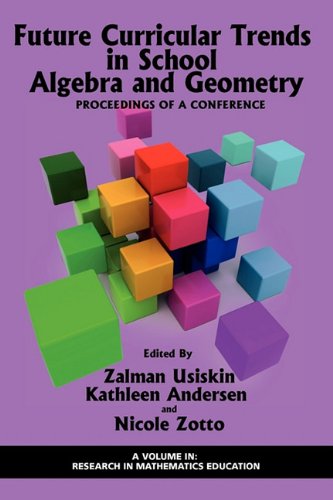
Future Curricular Trends in School Algebra And Geometry - Proceedings of a Conference


Zalman Usiskin, Kathleen Andersen, Nicole Zotto 


Information Age Publishing | 2010 | 345 páginas | RAR - PDF | 3 Mb

link 
password: matav


This volume contains papers from the Second International Curriculum Conference sponsored by the Center for the Study of Mathematics Curriculum (CSMC). The intended audience includes policy makers, curriculum developers, researchers, teachers, teacher trainers, and anyone else interested in school mathematics curricula.

Contents
Preface.
Introduction.
PART I - EARLY ALGEBRA
Early Algebraic Thinking: The Case of Equivalence in an Early Algebraic Context, Elizabeth Warren.
A Brief Essay on the Need to Consider the “Superficial” Aspects of Learning Algebra, Romulo Lins. Early Algebra, Maria Blanton.
A Davydov Approach to Early Mathematics, Barbara J. Dougherty.
PART II -  ALGEBRA USING COMPUTER ALGEBRA SYSTEMS (CAS)
Technology and the Yin and Yang of Teaching and Learning Mathematics, Bernhard Kutzler.
CAS and the Future of the Algebra Curriculum, Kaye Stacey.
Algebra in the Age of CAS: Implications for the High School Curriculum Examples from the CME Project, Al Cuoco.
A Perspective on the Future of Computer Algebra Systems in School Algebra, M. Kathleen Heid.
PART III - 3-D Geometry
Three-Dimensional Citizens Do not Deserve a Flatlanders’ Education: Curriculum and 3-D Geometry, Claudi Alsina.
Manipulating 3-D Objects in a Computer Environment,Jean-Marie Laborde.
Algebra and Geometry, from Two to Three Dimensions, Thomas F. Banchoff.
Thoughts on Elementary Students’ Reasoning about 2-D Arrays of Cubes and Polyhedra, Michael T. Battista.
PART IV - Linking Algebra and Geometry
Linking Geometry and Algebra in the School Mathematics Curriculum, Keith Jones.
Linking Geometry and Algebra through Dynamic and Interactive Geometry, Colette Laborde. Linking Algebra and Geometry: The Dynamic Geometry Perspective, Nicholas Jackw. Linking Algebra and Geometry in the Interactive Mathematics Program,Diane Resek.
PART V - PANEL OF PRACTITIONERS AND CURRICULUM DEVELOPERS
Making Future Trends Realities in U.S. Classrooms, Diane J. Briars.
Tools, Technologies, and Trajectories, Douglas H. Clements.
Future Trends in School Algebra and Geometry: Reflections on the Vision of Experts, James Fey. Thoughts from a Classroom Teacher, Jim Mamer.
Restoring and Balancing, William McCallum.
PART VI - REFLECTIONS BY CONFERENCE ATTENDEES
Insights into Dynamic Mathematical Learning Environments, Sarah J. Hicks, Melissa D. McNaught, and J. Matt Switzer.
Instrumental Genesis and Future Research in School Algebra and Geometry, Daniel J. Ross.
Closing Remarks, Zalman Usiskin.
APPENDICES
Conference Schedule
Biographies of Presenters.
Attendees

Mathematics Elsewhere: An Exploration of Ideas Across Cultures


Marcia Ascher

Princeton University Press | 2004 | 219 páginas |  PDF | 7,84 Mb

link

Mathematics Elsewhere is a fascinating and important contribution to a global view of mathematics. Presenting mathematical ideas of peoples from a variety of small-scale and traditional cultures, it humanizes our view of mathematics and expands our conception of what is mathematical.
Through engaging examples of how particular societies structure time, reach decisions about the future, make models and maps, systematize relationships, and create intriguing figures, Marcia Ascher demonstrates that traditional cultures have mathematical ideas that are far more substantial and sophisticated than is generally acknowledged. Malagasy divination rituals, for example, rely on complex algebraic algorithms. And some cultures use calendars far more abstract and elegant than our own. Ascher also shows that certain concepts assumed to be universal--that time is a single progression, for instance, or that equality is a static relationship--are not. The Basque notion of equivalence, for example, is a dynamic and temporal one not adequately captured by the familiar equal sign. Other ideas taken to be the exclusive province of professionally trained Western mathematicians are, in fact, shared by people in many societies.
The ideas discussed come from geographically varied cultures, including the Borana and Malagasy of Africa, the Tongans and Marshall Islanders of Oceania, the Tamil of South India, the Basques of Western Europe, and the Balinese and Kodi of Indonesia.
This book belongs on the shelves of mathematicians, math students, and math educators, and in the hands of anyone interested in traditional societies or how people think. Illustrating how mathematical ideas play a vital role in diverse human endeavors from navigation to social interaction to religion, it offers--through the vehicle of mathematics--unique cultural encounters to any reader.
Reviews:
"A useful reminder of how universal mathematical and logical structures are in any culture. Mathematicians will enjoy seeing the subject they love cropping up in apparently unexpected contexts. Non-mathematicians should be encouraged to realize that some of the processes that seem to appear naturally in everyday life do in fact have a mathematical content."--John O'Connor, Nature
"For a mathematician, Mathematics Elsewhere will expand the universe; for a non-mathematician, the expansion will just take a little more time. The book succeeds well in presenting and explaining very different ways of doing math both within particular cultural contexts and in terms of modern mathematics. . . . The author is clearly an excellent teacher and a wonderful explainer. Every time I felt a bit lost, the next sequence would present the same concept in different words or with another example. She is adept at moving from the general to the specific, from narrative to figurative."--Helaine Selin, Science
"This interesting book is a fundamental work in the area of ethnomathematics. . . . [T]he author opens numerous doors and directions in which one finds interesting, nontrivial mathematics. Persons interested in investigating the mathematics of non-Western cultures can use this book as a motivation to look beyond the obvious."--Thomas E. Golsdorf, Mathematical Reviews
"Ascher illustrates that non-Western cultures have developed sophisticated mathematical ideas often without having any formal concept of mathematics. This stimulating book deserves a wide audience, especially among those involved in teaching the subject."--Andrew Bowler, New Scientist

Table of Contents:
Preface ix
Introduction 1
CHAPTER 1: The Logic of Divination 5
CHAPTER 2: Marking Time 39
CHAPTER 3: Cycles of Time 59
CHAPTER 4: Models and Maps 89
CHAPTER 5: Systems of Relationships 127
CHAPTER 6: Figures on the Threshold 161
CHAPTER 7: Epilogue 191
Index 205

Number Training Your Brain (Teach Yourself)


Jonathan Hancock, Jon Chapman

 Teach Yourself | 2011 | 209 páginas | RAR - PDF | 2,5 Mb

link (password: matav)

Is this the right book for me? Train your brain to be quicker, sharper and more acute by challenging yourself with these puzzles and games. This book does much more than give you the skills to tackle maths with confidence - instead it shows you how, by learning to solve practical problems and perfecting your mental arithmetic, you can strengthen all your key thinking skills and astonish your friends and family. This is the ultimate mental workout - and the only one to show you how these fun and diverting number games will actually make you smarter, quicker and more acute than any of your peers. Number Training Your Brain includes: Part 1 - Thinking about numbers Chapter 1: Mathematical minds: the story so far Chapter 2: Adding skill, subtracting stress Chapter 3: Multiply your mind power: divide and conquer Chapter 4: Bits and pieces Part two - Thinking about everything Chapter 5: Shape up your thinking Chapter 6: Measurable improvements Chapter 7: Chances to shine Chapter 8: The formula for success Chapter 9: Think like a mathematician Chapter 10: Big maths, big challenges Learn effortlessly with a new easy-to-read page design and interactive features: Not got much time? One, five and ten-minute introductions to key principles to get you started. Author insights Lots of instant help with common problems and quick tips for success, based on the author's many years of experience. Test yourself Tests in the book and online to keep track of your progress. Extend your knowledge Extra online articles to give you a richer understanding of the subject. Five things to remember Quick refreshers to help you remember the key facts. Try this Innovative exercises illustrate what you've learnt and how to use it.


Contents
Meet the authors ix
In one minute x
Introduction to number training xi
Part one Thinking about numbers 1
1 Mathematical minds: the story so far 3
The numbers of nature 3
Tallying 5
Zero 7
Place value 8
Base two 10
Thinking about numbers 14
2 Adding skill, subtracting stress 20
Starting with ‘stuff’ 21
Laws to live by 21
Chisanbop 23
Thinking backwards 26
Magic squares 27
‘Look ahead, borrow’ 28
Keypad calculations 29
The 1089 trick 31
3 Multiply your mind power: divide and conquer 34
Leaps of faith 36
Arrays 36
Written rules 37
Sensible strategies 41
Doubling and halving 42
Ordered thinking 43
Times tables 44
Techniques and tricks 46
4 Bits and pieces 52
Balance your brain 54
Divisibility tricks 56
Nothing is a problem 60
Ratios 61
Percentages 62
Part two Thinking about everything 73
5 Shape up your thinking 75
Square numbers 76
Ancient Greece 77
Pythagorean triples 79
Triangular numbers 80
Cube nets 83
Rotation 85
Refl ection 85
Rubik’s Cube 86
6 Measurable improvements 91
Estimation 92
Units of measurement 93
Money maths 97
Pi 97
7 Chances to shine 102
The law of averages 105
Thinking about probability 106
Maths on drugs 109
Reverse odds 109
Combining probabilities 110
8 The formula for success 115
Algebra is useful… 118
Extracting information 120
Rules 121
Algebra applied 125
9 Think like a mathematician 130
Different sorts of proof 131
Prizefi ghters 135
10 Big maths, big challenges 138
Big and small numbers 138
Thinking to scale 140
To infi nity and beyond 141
Big possibilities 143
Test yourself now 147
Taking it further 151
Answers 152
Index 175

Crossroads in the History of Mathematics and Mathematics Education


The Montana Mathematics Enthusiast Monographs in Mathematics Education Monograph 12,


Bharath Sriraman, The University of Montana 

 Information Age Publishing | 2012 | 380 páginas | RAR - PDF | 20,7 Mb

link
password: matav

The interaction of the history of mathematics and mathematics education has long been construed as an esoteric area of inquiry. Much of the research done in this realm has been under the auspices of the history and pedagogy of mathematics group. However there is little systematization or consolidation of the existing literature aimed at undergraduate mathematics education, particularly in the teaching and learning of the history of mathematics and other undergraduate topics. In this monograph, the chapters cover topics such as the development of Calculus through the actuarial sciences and map making, logarithms, the people and practices behind real world mathematics, and fruitful ways in which the history of mathematics informs mathematics education. The book is meant to serve as a source of enrichment for undergraduate mathematics majors and for mathematics education courses aimed at teachers.


(links para as versões drafts)
Contents
Preface
Bharath Sriraman ix
Topics in History and Didactics of Calculus and Analysis
1. A note on the institutionalization of mathematical knowledge or “What was and is the Fundamental Theorem of Calculus, really”?
Eva Jablonka and Anna Klisinska (Sweden) 3
2. Transitioning students to calculus: Using history as a guide
Nicolas Haverhals & Matt Roscoe (USA) 41
3. The tension between intuitive infinitesimals and formal mathematical analysis
Mikhail Katz (Israel) & David Tall (UK) 71
4. The didactical nature of some lesser known historical examples in mathematics
Kajsa Bråting (Sweden) Nicholas Kallem & Bharath Sriraman (USA) 91
5. The Brachistochrone Problem: Mathematics for a Broad Audience via a Large Context Problem
Jeff Babb & James Currie (Canada) 115
6. Chopping Logs: A Look at the History and Uses of Logarithms
Rafael Villarreal-Calderon (USA) 131
7. The history of mathematics as a pedagogical tool: Teaching the integral of the secant via Mercator’s projection
Nicolas Haverhals & Matt Roscoe (USA) 139
Topics in the History and Didactics of Geometry and Number
8. Euclid’s Book on the Regular Solids: Its Place in the Elements and Its Educational Value
Michael N. Fried (Israel) 173
9. Book X of The Elements: Ordering Irrationals
Jade Roskam (USA) 197
10. The Origins of the Genus Concept in Binary Quadratic Forms
Mark Beintema & Azar Khosravani (USA) 215
11. Where are the Plans: A socio-critical and architectural survey of early Egyptian Mathematics
Gabriel Johnson, Bharath Sriraman, Rachel Saltzstein (USA) 229
History of Mathematics in Mathematics Education
12. Classifying the arguments and methodological schemes for integrating history in mathematics education
Constantinos Tzanakis & Yannis Thomaidis (Greece) 247
13. A first attempt to identify and classify empirical studies on history in mathematics education
Uffe Thomas Jankvist (Denmark) 295
14. Reflections on and benefits of uses of history in mathematics education exemplified by two types of student work in upper secondary school
Tinne Hoff Kjeldsen (Denmark) 333
15. Adversarial and friendly interactions: Progress in 17th century mathematics
Shirley B. Gray & Libby Knott (USA) 357