domingo, 15 de fevereiro de 2009

Sacred Mathematics: Japanese Temple Geometry


Fukagawa Hidetoshi, Tony Rothman

Princeton University Press | 2008 | 392 páginas | PDF | 10 MB

links diretos:
freeenergycommunity

lib.freescienceengineering.org
pt.scribd.com

Between the seventeenth and nineteenth centuries Japan was totally isolated from the West by imperial decree. During that time, a unique brand of homegrown mathematics flourished, one that was completely uninfluenced by developments in Western mathematics. People from all walks of life--samurai, farmers, and merchants--inscribed a wide variety of geometry problems on wooden tablets calledsangakuand hung them in Buddhist temples and Shinto shrines throughout Japan.Sacred Mathematicsis the first book published in the West to fully examine this tantalizing--and incredibly beautiful--mathematical tradition.Fukagawa Hidetoshi and Tony Rothman present for the first time in English excerpts from the travel diary of a nineteenth-century Japanese mathematician, Yamaguchi Kanzan, who journeyed on foot throughout Japan to collect temple geometry problems. The authors set this fascinating travel narrative--and almost everything else that is known about temple geometry--within the broader cultural and historical context of the period. They explain the sacred and devotional aspects ofsangaku, and reveal how Japanese folk mathematicians discovered many well-known theorems independently of mathematicians in the West--and in some cases much earlier. The book is generously illustrated with photographs of the tablets and stunning artwork of the period. Then there are the geometry problems themselves, nearly two hundred of them, fully illustrated and ranging from the utterly simple to the virtually impossible. Solutions for most are provided.A unique book in every respect,Sacred Mathematicsdemonstrates how mathematical thinking can vary by culture yet transcend cultural and geographic boundaries.
Contents
Foreword by Freeman Dyson ix
Preface by Fukagawa Hidetoshi xiii
Preface by Tony Rothman xv
Ac know ledg ments xix
What Do I Need to Know to Read This Book? xxi
Notation xxv
1 Japan and Temple Geometry 1
2 The Chinese Foundation of Japanese Mathematics 27
3 Japanese Mathematics and Mathematicians of the Edo Period 59
4 Easier Temple Geometry Problems 89
5 Harder Temple Geometry Problems 145
6 Still Harder Temple Geometry Problems 191
7 The Travel Diary of Mathematician Yamaguchi Kanzan 243
8 East and West 283
9 The Mysterious Enri 301
10 Introduction to Inversion 313
For Further Reading 337
Index 341

The Mathematics of Plato's Academy: A New Reconstruction


David Fowler
Oxford University Press | 1999 | 486 páginas | DJVU | 5,88 Mb

lib.freescienceengineering.org

pdf
scribd.com
Referência em: MathEduc

This is an updated edition of an original and controversial book. As well as revising parts of the text and substantially updating the bibliography, in a new Appendix the author takes a more polemical stance and enters into a discussion of the nature and range of different interpretations. The book is divided into three parts; Interpretation, Evidence, and Later developments. The first part presents several new interpretations of the idea of ratio in early Greek mathematics and illustrates them in detailed discussions of several texts. Part Two focuses on the sources themselves, and questions the depth of modern knowledge of Plato's Academy during his lifetime, the source of our text of Euclid's Elements, and modern understanding of early Greek mathematics. The final part contrasts some of the evidence from early and late antiquity and then gives a historical account, since the seventeeth century, of the theory of continued fractions, our version today of the mathematics underlying the reconstruction. From reviews of the first edition: '...a real treat.' Greece and Rome '...cites an impressive array of evidence...The result should be widely read by classicists and mathematicians as well as historians of mathematics.' ISIS '...he enters into classical scholarship here with a really 'new reconstruction' of early Greek mathematics.' Nature '...this fascinating book...will arouse the interest and command the admiration of any historically minded lover of mathematics with a taste for the unorthodox.' Institute of Mathematics and its Applications 'This book, speculative in the best sense, engages the ancient material on its own terms in setting forth what the Greeks might have thought and done...While the book represents an important departure in historical research in its reaching beyond the spare formalism of surviving materials to an understanding of motivation and perception, its careful documentations and technical descriptions make it valuable in a more traditional way.' Zentralblatt für Mathematik

Readership: Historians of Greek mathematics, at any level. Historians of mathematics or science in general. Classicists and philosophers.

Contents
Part One: Interpretations
1: The proposal
2: Anthyphairetic ratio theory
3: Elements II: The dimension of squares
4: Plato's mathematics curriculum in Republic VII
5: Elements IV, X, and XII: The circumdiameter and side
Part Two: Evidence
6: The nature of our evidence
7: Numbers and fractions
Part Three: Later Developments
8: The received interpretation
9: Continued fractions
10: New material added to the second edition:
11: Appendix (A new introduction; Ratio as on evidence class; The method of gnomons and Theatetas 147-158; Elements;...but why is there no evidence for these ratio theories?)
12: Epilogue: a brief intellectual autobiography

Encyclopedia of Mathematics


Volumes 1, 2, 3, e 4
B. M. Brandenberger, Jr.

Macmillan |I Vol.1 Ab-Cy | 2002 | 214 páginas (link - djvu)
Macmillan | Vol.2 Da-Lo | 2002 | 218 páginas (link - djvu)
Macmillan | I Vol.3 Ma-Ro | 2002 | 230 páginas (link - djvu)
Macmillan | IVol.4 Sc-Ze | 2002 | 210 páginas (link - djvu)

893 páginas | PDF - 35 Mb

link
password: matav

Mathematics has been defined as the "universal language of numbers," a language whose basic principles remain the same for all users. Many routine activities, from balancing a checkbook to measuring ingredients for a recipe, require a certain familiarity with mathematical concepts and applications. In Macmillan's Mathematics encyclopedia, users will learn more about the function of mathematics in everyday life, as well as its role as a tool for measurement, data analysis, and technological development. Interdisciplinary in scope, the encyclopedia provides students with a clear and comprehensive introduction to this vast topic through nearly three hundred entries commissioned especially for the set

A Remarkable Collection of Babylonian Mathematical Texts

Manuscripts in the Schøyen Collection: Cuneiform Texts I(Sources and Studies in the History of Mathematics and Physical Sciences)
Jöran Friberg

Springer | 2007 | 536 páginas | DJVU | 11 Mb

lib.freescienceengineering.org

PDF | 43 Mb

lib.freescienceengineering.org

This new text from Jöran Friberg, the leading expert on Babylonian mathematics, presents 130 previously unpublished mathematical clay tablets from the Norwegian Schøyen collection, and provides a synthesis of the author's most important work. Through a close study of these tablets, Friberg has made numerous amazing discoveries, including the first known examples of pre-Classical labyrinths and mazes, a new understanding of the famous table text Plimpton 322, and new evidence of Babylonian familiarity with sophisticated mathematical ideas and objects, such as the three-dimensional Pythagorean equation and the icosahedron. In order to make the text accessible to the largest possible audience, the author has included an introductory chapter entitled, "How to get a better understanding of mathematical cuneiform texts." Throughout the text he avoids anachronisms and makes every effort to teach the reader to do the same. The approach in this book is inherently pedagogical, as Friberg illustrates all the steps of the process of interpretation and clearly explains the mathematical ideas, including terminology, metrological systems, and methods of calculation. Drawings and color photos of a large selection of tablets are also included. Particularly beautiful hand copies of the most complicated texts were made by Farouk Al-Rawi, professor of Ancient Languages and Archaeology at Baghdad University. While the book is reader-friendly, it remains as detailed and exhaustive as possible. It is the most comprehensive treatment of a set of Babylonian mathematical texts ever published and will open up this subject to a new generation of students, mathematicians, and historians of science. Jöran Friberg is Professor Emeritus of Mathematics at Chalmers University of Technology, Sweden. He has recently published the book Unexpected Links Between Egyptian and Babylonian Mathematics (World Scientific 2005), and its sequel Amazing Traces of a Babylonian Origin in Greek Mathematics (World Scientific 2007).


Contents
0. How to Get a Better Understanding of Mathematical Cuneiform Texts
0.1. On Avoiding Anachronisms in Translations of Mathematical Terms
0.2. Conform Transliterations, Translations, and Interpretations
0.3. Babylonian Sexagesimal Numbers
0.4. Counting with Sexagesimal Numbers in Relative Place Value Notation
1. Old Babylonian Arithmetical Hand Tablets
1.1. Old Babylonian Multiplication Exercises
1.2. Old Babylonian Squaring Exercises
1.3. An Old Babylonian Division Exercise
1.4. Old Babylonian Operations with Many-Place Regular Sexagesimal Numbers
1.5. Old Babylonian Squares and Squares of Squares of Many-Place Sexagesimal Numbers
2. Old Babylonian Arithmetical Table Texts
2.1. Old Babylonian Tables of Squares
2.2. Old Babylonian Tables of Square Sides
2.3. Old Babylonian Tables of Cube Sides
2.4. Old Babylonian Tables of Quasi-Cube Sides
2.5. The Old Babylonian Standard Table of Reciprocals
2.6. Old Babylonian Multiplication Tables
2.7. Old and Late Babylonian Sexagesimal Representations of Decimal Numbers
3. Old Babylonian Metrological Table Texts
3.1. Old Babylonian Capacity Measures. System C
3.2. Old Babylonian Weight Measures. System M
3.3. Old Babylonian Area Measures. System A
3.4. Old Babylonian Length Measures. Systems Ln and Lc
3.5. Old Babylonian Combined Metrological Tables
4. Mesopotamian Weight Stones
4.1. MS 4576. A Kassite Reused Talent Weight with an Inscription in Sumerian
4.2. MS 2481. A Barrel-Shaped 1 Mina Weight with an Inscription in 3 Lines
4.3. MS 2837. An Ellipsoid-Shaped 3 Shekels Weight with a Brief Inscription
4.4. MS 2836. A Small Duck Weight in Agate with the Inscription ‘1/3 Shekel’
4.5. MS 5088. 55 Assorted Weight Stones Found Together in a Damaged Bronze Pot
4.6. YBC 4652. Weight Stones in an Old Babylonian Mathematical Theme Text
4.7. YBC 4669 § 1. Measuring Vessels in an Old Babylonian Mathematical Theme Text
5. Neo-Sumerian Field Plans (Ur III)
5.1. MS 1984. A Field Plan Text from Umma with a Summary on the Reverse
5.2. MS 1850. A Field Plan Text without a Summary on the Reverse
5.3. Four Ur III Field Plan Texts, Published in 1915, 1898, 1922, and 1962
6. An Old Sumerian Metro-Mathematical Table Text (Early Dynastic IIIa)
6.1. Three Previously Published Metro-Mathematical School Texts from Shuruppak
6.2. MS 3047. An Old Sumerian Metro-Mathematical Table Text
7. Old Babylonian Hand Tablets with Practical Mathematics
7.1. MS 2317. Division of a Funny Number by a Non-Regular Factor
7.2. Combined Market Rate Exercises
7.3. Old Babylonian Brick Types and Brick Constants
7.4. Inheritance Problems with the Shares Forming a Geometric Progression
8. Old Babylonian Hand Tablets with Geometric Exercises
8.1. Triangles and Trapezoids
8.2. Figures Within Figures
8.3. Labyrinths, Mazes, and Decorative Patterns
9. The Beginning and the End of the Sumerian King List
9.1. The Sumerian King List
9.2. MS 1686. A New Version of the Ur-Isin King List
9.3. MS 2855. A New Version of the Antediluvian Part of the Sumerian King List
9.4. The Numbers in the Antediluvian King List
9.5. Mesopotamian Year Names
10. Three Old Babylonian Mathematical Problem Texts from Uruk
10.1. MS 3971. A Double-Column Mathematical Recombination Text
10.2. MS 3052. A Single-Column Mathematical Recombination Text
10.3. MS 2792. Two Exercises Dealing with a Divided Ramp
11. Three Problem Texts Not Belonging to Any Known Group of Texts
11.1. MS 3049. A Fragment of a Mathematical Recombination Text
11.2. MS 5112. A Text with Equations for Squares and Rectangles
11.3. MS 3876. Three Problems for 20 Equilateral Triangles and a ‘Horn-Figure’
11.4. On the Dating of the Texts in Chapter 11
Appendix 1. Subtractive Notations for Numbers in Mathematical Cuneiform Texts
A1.1. Hilprecht’s List of Signs for ’19’ in Multiplication Tables from Nippur
A1.2. Ist. T 7375. An Ur III Table of Reciprocals with Subtractive Number Notations
A1.3. A 681. A Table Text from ED IIIb Adab with Subtractive Number Notations
Appendix 2. The Old Babylonian Combined Multiplication Table
Appendix 3. An Old Babylonian Combined Arithmetical Algorithm
A3.1. CBS 10201. Hilprecht’s Misunderstood Algorithm Text from Nippur
A3.2. UM 29.13.21. A Fragment of a Multiple Algorithm Text from Nippur
A3.3. CBS 1215. An Algorithm Text with Explicit Computations
Appendix 4. Cuneiform Systems of Notations for Numbers and Measures
A4.1. Proto-Literate/Traditional Sexagesimal Counting Numbers
A4.2. Proto-literate Bisexagesimal Counting Numbers
A4.3. Proto-Elamite Decimal Counting Numbers
A4.4. Proto-Literate and Traditional Capacity Numbers
A4.5. Proto-Cuneiform and Traditional Weight Numbers
A4.6. Proto-Literate/Traditional Area Numbers
A4.7. Old Akkadian and Neo-Sumerian/Old Babylonian Length Numbers
A4.8. Proto-Cuneiform Time Numbers
A4.9. An Integrated Family of Numbers and Measures
A4.10. Pre-Literate Number Tokens
Appendix 5. Old Babylonian Complete Metrological Tables
A5.1. The Complete Metrological Table for System C(NS/OB)
A5.2. The Complete Metrological Table for System M(NS/OB)
A5.3. The Complete Metrological table for System A(NS/OB)
A5.4. The Complete Metrological tables for Systems Ln(NS/OB) and Lc(NS/OB)
A5.5. Old Babylonian (and Other) Combined Metrological Lists
A5.6. Old Babylonian Combined Metrological Tables
A5.7. On Prisms, Cylinders, and a Family of Subscripts
Appendix 6. Metro-Mathematical Cuneiform Texts from the Third Millennium BC
A6.1. Two Old Akkadian Applications of the Field Expansion Procedure
A6.2. Old Akkadian Square-Side-and-Area Exercises
A6.3. Old Akkadian Metric Division Exercises
A6.4. IM 58045. An Old Akkadian Trapezoid Partition Problem
A6.5. TM.75.G.1392 (Ebla). A Division Algorithm in Decimal Numbers
A6.6. TM.75.G.2346 (Ebla). Another Decimal Division Algorithm
A6.7. TSS 50, 671 (Shuruppak). Sexagesimal Metric Division Exercises (ED IIIa)
A6.8. Examples of Complicated Designs
Appendix 7. A Combined Metro-Mathematical Table Text with Areas of Large and Small Squares (ED IIIb)
A7.1. CUNES 50-08-001. An Early Dynastic Metro-Mathematical Table Text
A7.2. A Parallel Text from Adab (ED IIIb)
A7.3. The Historical Importance of the Combined Table Text CUNES 50-08-001
A7.4. CUNES 47-12-176. An Old Akkadian Lexical Text with Fractions of the Mina
A7.5. RA 35, Texts 1-2 and IM 96183. Old Babylonian Table Texts Related to CUNES 50-08-001
Appendix 8. Plimpton 322, a Table of Parameters for igi–igi.bi Problems
A8.1. Plimpton 322. A Description of the Preserved Part of the Table Text
A8.2. Related Texts: Texts with igi–igi.bi Problems
A8.3. A Suggested Reconstruction of the Lost Columns on Plimpton 322
A8.4. The Old Babylonian Rectangle Parameter Equations. Restrictions on the Parameters
A8.5. The Purpose of the Tables on Plimpton 322
A8.6. The Diagonal Rule in the Corpus of Mathematical Cuneiform Texts
Appendix 9. Many-Place Squares of Squares in Late Babylonian Mathematical Texts
A9.1. Squares of Squares of Many-Place Regular Sexagesimal Numbers
A9.2. An Explicit Late Babylonian Multiplication Algorithm
Appendix 10. Color Photos of 70 Selected Texts


Expounding the Mathematical Seed

Vol. 1: The Translation: A Translation of Bhaskara I on the Mathematical Chapter of the Aryabhatiya
Agathe Keller

Birkhäuser Basel | 2006| 172 páginas | PDF | 1,2 Mb

link

In the 5th century the Indian mathematician Aryabhata (476-499) wrote a small but famous work on astronomy, the Aryabhatiya. This treatise, written in 118 verses, gives in its second chapter a summary of Hindu mathematics up to that time. Two hundred years later, an Indian astronomer called Bhaskara glossed this mathematial chapter of the Aryabhatiya.An english translation of Bhaskara’s commentary and a mathematical supplement are presented in two volumes.
Subjects treated in Bhaskara’s commentary range from computing the volume of an equilateral tetrahedron to the interest on a loaned capital, from computations on series to an elaborate process to solve a Diophantine equation.
This volume contains an introduction and the literal translation.
The introduction aims at providing a general background for the translation and is divided in three sections: the first locates Bhaskara’s text, the second looks at its mathematical contents and the third section analyzes the relations of the commentary and the treatise.


 Vol. 2: The Supplements: A Translation of Bhaskara I on the Mathematical Chapter of the Aryabhatiya
Agathe Keller

Birkhäuser Basel | 2006 | 440 páginas | PDF | 1,4 Mb

link

A History of Chinese Mathematics


Jean-Claude Martzloff

Springer | 2006 | 490 páginas |

The book is made up of two mutually explanatory parts, the first devoted to the general, historical and cultural background, and the second to the development of each subdiscipline that together comprise Chinese mathematics. This section is organised topically rather than chronologically, and is enriched in each case by examples, guides on how to intepret the contextual setting and by exhaustive references - both mathematical and sinological. This makes the book uniquely accessible, both as a topical reference work, and also as an overview that can be read and reread at many levels of sophistication by both sinologists and mathematicians alike. Indeed anyone with an interest in Chinese culture or the history of ideas will derive great benefit from this book.

Dictionary of Mathematics


McGraw-Hill Professional | 2003| 307 páginas | PDF | 1,8 MB

i.minus.com


Derived from the content of the respected McGraw-Hill Dictionary of Scientific and Technical Terms Sixth Edition, each title provides thousands of definitions of words and phrases encountered in a specific discipline. All include:

* Pronunciation guide for every term
* Acronyms, cross-references, and abbreviations
* Appendices with conversion tables; listings of scientific, technical, and mathematical notation; tables of relevant data; and more
* A convenient, quick-find format

Remarkable Mathematicians: From Euler to von Neumann

Ioan James

Cambridge University Press | 2003| 448 páginas | Djvu | 14,9 MB


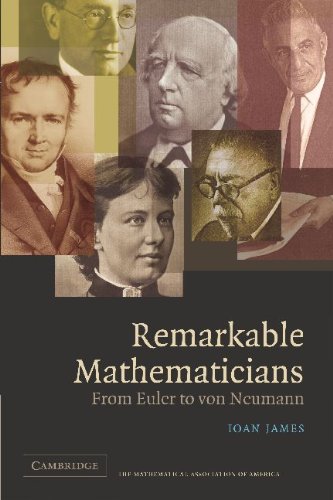
Ioan James introduces and profiles sixty mathematicians from the era when mathematics was freed from its classical origins to develop into its modern form. The subjects, all born between 1700 and 1910, come from a wide range of countries, and all made important contributions to mathematics, through their ideas, their teaching, and their influence. James emphasizes their varied life stories, not the details of their mathematical achievements. The book is organized chronologically into ten chapters, each of which contains biographical sketches of six mathematicians. The men and women James has chosen to portray are representative of the history of mathematics, such that their stories, when read in sequence, convey in human terms something of the way in which mathematics developed.

 Ioan James is a professor at the Mathematical Institute, University of Oxford. He is the author of Topological Topics (Cambridge, 1983), Fibrewise Topology (Cambridge, 1989), Introduction to Uniform Spaces (Cambridge, 1990), Topological and Uniform Spaces (Springer-Verlag New York, 1999), and co-author with Michael C. Crabb of Fibrewise Homotopy Theory (Springer-Verlag New York, 1998). 

James is the former editor of the London Mathematical Society Lecture Note Series and volume editor of numerous books. He is the organizer of the Oxford Series of Topology symposia and other conferences, and co-chairman of the Task Force for Mathematical Sciences of Campaign for Oxford

Ancient Mathematics

Serafina Cuomo

Routledge | 2001 | 303 páginas | PDF | 1 MB
The discoveries and insights of ancient mathematicians continue to inspire, amaze and fascinate the modern reader. From the theorem of Pythagoras to Euclid's "Elements', much of what we know today was built on the legacy of the ancients.
This volume is the first genuinely accessible survey of the discipline in all its brilliance and diversity. It covers the period between the fifth-century BCE to the sixth-century CE and such topics as mathematics and politics in classical Greece, the formation of mathematical traditions, and mathematics and Christianity. Also included are segments on individual ancient mathematicians.
Ancient Mathematics will be essential for science history students and a valuable resource for the non-specialist.