segunda-feira, 21 de abril de 2014

Which Numbers are Real?

Michael Henle

The Mathematical Association of America |2012 | 230 páginas | rar - pdf | 1,23 Mb

link (password : matav)

The set of real numbers is one of the fundamental concepts of mathematics. This book surveys alternative number systems: systems that generalise the real numbers yet stay close to the properties that make the reals central to mathematics. There are many alternative number systems, such as multidimensional numbers (complex numbers, quarternions), infinitely small and infinitely large numbers (hyperreal numbers) and numbers that represent positions in games (surreal numbers). Each system has a well-developed theory with applications in other areas of mathematics and science. They all feature in active areas of research and each has unique features that are explored in this book. Alternative number systems reveal the central role of the real numbers and motivate some exciting and eccentric areas of mathematics. What Numbers Are Real? will be an illuminating read for anyone with an interest in numbers, but specifically for advanced undergraduates, graduate students and teachers of university-level mathematics.

Contents
I. The reals.
1 Axioms for the Reals
2 Construction of the reals
II. Multi-dimensional numbers.
3 The complex numbers
4 The quaternions
III. Alternative lines.
5 The constructive reals
6 The hyperreals
7 The surreals.

101 Careers in Mathematics


(Classroom Resource Materials) 

 Andrew Sterrett 

 Mathematical Association of America | 2014 - 3ª edição |354 páginas | rar - pdf | 2,12 Mb

link (password : matav)

This third edition of the immensely popular 101 Careers in Mathematics contains updates on the career paths of individuals profiled in the first and second editions, along with many new profiles. No career counselor should be without this valuable resource.
The authors of the essays in this volume describe a wide variety of careers for which a background in the mathematical sciences is useful. Each of the jobs presented shows real people in real jobs. Their individual histories demonstrate how the study of mathematics was useful in landing well-paying jobs in predictable places such as IBM, AT&T, and American Airlines, and in surprising places such as FedEx Corporation, L.L. Bean, and Perdue Farms, Inc. You will also learn about job opportunities in the Federal Government as well as exciting careers in the arts, sculpture, music, and television. There are really no limits to what you can do if you are well prepared in mathematics.
The degrees earned by the authors profiled here range from bachelor s to master s to PhD in approximately equal numbers. Most of the writers use the mathematical sciences on a daily basis in their work. Others rely on the general problem-solving skills acquired in mathematics as they deal with complex issues.

The Infinite in the Infinite

Alistair MacIntosh Wilson

OUP Oxford | 1995 | 539 páginas | pdf | 11 Mb

link

This book is an extended history of mathematics that places mathematical development firmly in its historical context. Each section begins with a description of the geography and history of the country considered. From there, lively retelling of the creation myths and legends leads on to a description of how its people wrote and counted. This is followed by relevant mathematical material. The book covers; 
* The geometry of stone circles in Europe * The area of triangles and volume of pyramids that concerned the engineers of the Pharoahs * The Babylonian sexagesimal number system and our present measures of space and time which grew out of it * The use of the abacus and remainder theory in China * Greek mathematics from Pythagoras to Pappus. Detailed accounts of the work of apollonius and Archimedes are given. * The invention of trigonometry by Arab mathematicians * The solution of quadratic equations by completing the square developed in India Each chapter has a mathematical case study which is discussed both in the context of thetimes and in th light of more recent developments. Worked examples are also included. 
"The author has woven together a broad historical backgrounding and some fairly detailed but accessible mathematics in amost exciting way." John Fauvel, author of Let Newton Be!


CONTENTS
Page
1 Symphonies of stone 1
2 The pyramid builders 19
3 The Theban Mysteries 42
4 Babylon
Babylonian mathematics 53
5 The Middle Kingdom 73
Chinese mathematics 73
6 The Achaeans 105
7 A world made of numbers 113
Pythagoras 113
The shapes of numbers 115
The regular polyhedra 118
Euler's number 124
Polyhedra in the world 128
8 The thoughts of Zeus 133
The symmetries of polygons 133
The symmetry groups of the regular polyhedra 142
9 The philosopher's criticism 163
Geometry 163
The Peloponnesian War 168
Socrates 171
Plato 175
Aristotle 181
Aristotle's logic 183
The Stoics construct the truth 196
10 The Elements of Euclid 207
Euclid's dream 208
Similar triangles 215
The angles of triangles 220
The area of a triangle 227
Pythagoras' theorem 230
Triangles in circles 233
11 An island interlude 239
12 Proportion 252
The geometrical solution of aha problems 252
The theory of proportion 252
The construction of regular polygons 260
The uses of proportion 268
A problem of maxima 274
13 The Divine Archimedes 279
Archimedes 279
The measurement of a circle 285
The method of exhaustion 293
The surface area of a sphere 297
The volume of a sphere 304
The volume of a cone 308
The quadrature of a spiral 312
The quadrature of a parabola 313
Archimedes' principle 317
The Rancher's Dilemma 321
14 Apollonius the great geometer 324
Apollonius 324
Apollonius' Conics 326
The three conic sections 327
Tangents to conic sections 335
The property of the parabola used by Archimedes 337
The centres of conics 343
The foci of a conic 348
Reflection properties of conic sections 355
The focal construction of conics 358
15 The science of numbers 367
Pythagorean numerology 367
Prime numbers 368
Irrational numbers 375
Pythagorean triples 380
Patterns of primes 383
16 The School of Alexandria 388
Alexandria 388
Heron 392
Diophantus 399
Pappus
The last of the Greeks
The Eudemian summary
17 The dark subcontinent of India
The Aryans
Sanskrit and the Hindu numerals
Hindu astronomy
The mathematics of Brahmagupta and Mahavira
A pearl of number theory
18 The contribution of Islam
The conquests of the Arabs
Trigonometry
The uses of trigonometry
The geometry of the sphere
The gnomon curve
Algebra
The summation of powers of integers
Spain under Islam
Bibliography
Index

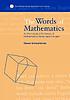
Origins of mathematical words: a comprehensive dictionary of Latin, Greek, and Arabic roots

Anthony Lo Bello 

Johns Hopkins University Press | 2013 | 369 páginas | rar - pdf | 1,9 Mb

link (password : matav)

pdf - 3,7 Mb - link

Do you ever wonder about the origins of mathematical terms such as ergodic, biholomorphic, and strophoid? Here Anthony Lo Bello explains the roots of these and better-known words like asymmetric, gradient, and average. He provides Greek, Latin, and Arabic text in its original form to enhance each explanation. This sophisticated, one-of-a-kind reference for mathematicians and word lovers is based on decades of the author's painstaking research and work. Origins of Mathematical Words supplies definitions for words such as conchoids (a shell-shaped curve derived from the Greek noun for "mussel") and zenith (Arabic for "way overhead"), as well as approximation (from the Latin proximus, meaning "nearest"). These and hundreds of other terms wait to be discovered within the pages of this mathematical and etymological treasure chest.

Livro relacionado:

Brain Teasers: 211 Logic Puzzles, Lateral Thinking Games, Mazes, Crosswords, and IQ Tests to Exercise Your Mind and Keep You Sharp 'til You're 100


Ian Livingstone e Jamie Thomson

Skyhorse Publishing |  2009 | 256 páginas | rar - epub | 4,8 Mb


link (password: matav)

A great way to have fun and build brain power, Brain Teasersoffers a variety of games to delight and challenge even the most advanced puzzler. Brain Teasers shows off some outrageously fun new mindbenders, like anasearches (a combination of an anagram, a crossword, and a word search), numberlockers (think of a crossword puzzle with numbers instead of words), and alphabetics (a miniature crossword puzzle that uses each letter of the alphabet exactly once). Perfect for anyone who sits down with the New York Times crossword puzzle every morning or works through Sudoku puzzles on the way home, this book is guaranteed to excite your mind and jump-start your brain.