domingo, 26 de julho de 2009

Matemática para os primeiros anos

Mathematics in the early years
Juanita V. Copley (Editor)

National Council of Teachers of Mathematics | 1999 | 230 páginas

De momento, só estão disponíveis 8 dos 26 capítulos do livro.

Capítulos:
Preface
Juanita V. Copley
(pdf | 293 kb | 4shared.com)
Part 1. The historical, theoretical, and social aspects of early childhood mathematics
1- Why Do We Teach Young Children So Little Mathematics? Some Historical Considerations (falta)
Robert Balfanz
2- Children's Ways of Knowing: Lessons from Cognitive Development Research
Catherine Sophian
(pdf | 3,11 Mb | 4shared.com)
3 - The Sociology of Day Care (falta)
Edward L. McDill e Gary Natriello
4 - Cultural Aspects of Young Children's Mathematics Knowledge
Steven R. Guberman
(html | on-line: spot.colorado.edu)

Part 2. Mathematics for the young child
5 - Ready To Learn: Developing Young Children's Mathematical Powers
Carole Greenes
(pdf | on-line: fdlrs-south.dade.k12.fl.us)
6 - The Development of Informal Counting, Number, and Arithmetic Skills and Concepts Arthur J. Baroody, Jesse L.M. Wilkins
(falta)
7 - Geometric and Spatial Thinking in Young Children
Douglas H. Clements
(pdf |1,02 Mb | on-line: eric.ed.gov)
8 - Rational-Number Learning in the Early Years: What Is Possible?
Robert P. Hunting
(pdf | 1,01 Mb | on-line: eric.ed.gov)
9 - Young Children Doing Mathematics: Observations of Everyday Activities
Herbert P. Ginsburg, Noriyuki Inoue, Kyoung-Hye Seo
(pdf | 2,63 Mb | 4shared.com)

Part 3. The implementation of mathematics programs
10 - Cognitively Guided Instruction in One Kindergarten Classroom (falta)
Janet Warfield, Mary Jo Yttri
11 - Supporting Students' Ways of Reasoning about Patterns and Partitions (falta)
Kay McClain, Paul Cobb
12 - The Effective Use of Computers with Young Children
Douglas H. Clements
(html | on-line: spot.colorado.edu)
13 - Making Connections: A 'Number Curriculum' for Preschoolers
Ruth Shane
(pdf | 304 kb | on-line: eric.ed.gov)
14 - Within Easy Reach: Using a Shelf-Based Curriculum To Increase the Range of Mathematical Concepts Accessible to Young Children (falta)
Gregory D. Nelson
15 - Teaching Mathematics through Musical Activities (falta)
Sang Lim Kim
16 - The Boston University-Chelsea Project (falta)
Carole Greenes
17 - The Outdoors as a Context for Mathematics in the Early Years (falta)
Carole G. Basile
18 - Using Storybooks To Help Young Children Make Sense of Mathematics (falta)
Haekyung Hong
19 - Movement, Mathematics, and Learning: Experiences Using a Family Learning (falta)
Grace Davila Coates, Jose Franco
20 - Math in Motion (falta)
Mary E. Rudisill, Michelle L. Hamilton, Melanie A. Hart
21 - Assessing the Mathematical Understanding of the Young Child (falta)
Juanita V. Copley

Part 4. Mathematics for everyone
22 - Improving Opportunities and Access to Mathematics Learning in the Early Years
Yolanda N. Padron
(falta)
23 - What To Do When They Don't Speak English: Teaching Mathematics to English-Language Learners in the Early Childhood Classroom (falta)
Laurie R. Weaver, Catherine Gaines
24 - Involving Parents of Four- and Five-Year-Olds in Their Children's Mathematics Education: The FAMILY MATH Experience (falta)
Grace Davila Coates, Virginia Thompson
25 - Perspectives on Mathematics Education and Professional Development through the Eyes of Early Childhood Administrators (falta)
Marianne Weber
26 - Early Childhood Mathematics in Japan (falta)
Giyoo Hatano, Kayoko Inagaki

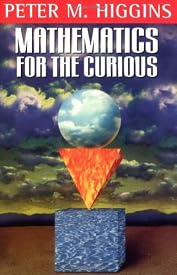
Mathematics for the Curious

Peter M. Higgins

Oxford University Press, USA | 1998 | 240 páginas | djvu | 1,73 Mb
link
link1

pdf - 21 Mb
link
link1
scribd.com


Descrição: When do the hands of a clock coincide? How likely is it that two children in the same class will share a birthday? How do we calculate the volume of a doughnut? Mathematics for the Curious provides anyone interested in mathematics with a simple and entertaining account of what it can do. Author Peter Higgins gives clear explanations of the more mysterious features of childhood mathematics as well as novelties and connections that prove that mathematics can be enjoyable and full of surprises. Topics include: the truth about fractions, the questions and their answers, and the golden ratio. Higgins poses entertaining puzzles and questions tempting the reader to ponder math problems with imagination instead of dread. Mathematics for the Curious is an accessible introduction to basic mathematics for beginning students and a lively refresher for adults

Mathematical Fallacies and Paradoxes


Bryan Bunch

Dover Publications | 1997 | 224 páginas | djvu

djvu - link direto
link
link1
depositfiles.com


Descrição: Stimulating, thought-provoking analysis of a number of the most interesting intellectual inconsistencies in mathematics, physics and language. Delightful elucidations of methods for misunderstanding the real world of experiment (Aristotle’s Circle paradox), being led astray by algebra (De Morgan’s paradox) and other mind-benders. Some high school algebra and geometry is assumed; any other math needed is developed in text.

Riddles in Mathematics

Eugene P. Northrop

D Van Nostrand Company, Inc. | 1944 | 262 páginas

djvu - 2,2 Mb - link direto
link
pdf - 12,6 Mb
link
depositfiles.com


Descrição: Presents over two hundred brain-teasers drawn from arithmetic, algebra, geometry, trigonometry and calculus.

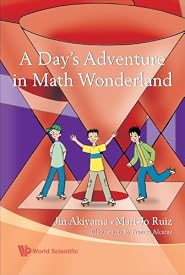
A Day's Adventure In Math Wonderland


Jin Akiyama, Mari-Jo Ruiz

World Scientific Publishing Company | 2008 | 233 páginas | pdf

link

Descrição:
Math Wonderland is a museum of interactive mathematical models in Hokkaido, Japan, founded by one of the authors, Jin Akiyama, in 2003. The models in Wonderland, many of which have been exhibited all over Japan and in cities around the world, are meant to help children and young adults discover and experience the wonders of mathematics.This book is centered around the experiences of three fictional middle-school students during a visit to Wonderland. They spend a day in Wonderland, handling the interactive models and participating in the activities offered there. At the end of the day, they leave with a genuine appreciation of mathematics gained from witnessing its beauty, applicability and inevitability.The book is an important contribution to the genre because it presents mathematics and models that have never before appeared in books in the same category: reversible solids, plane tiling with developments of tetrahedrons, and double-packable solids, which are derived from the authors’ own research papers published in mathematics journals. It is designed to entertain, inform and even teach some mathematics. Although it is targeted at young adults, parents and teachers may learn something from the book as well.

Developing Understanding In Primary Mathematics: Key Stages 1 & 2


Andrew Davis, D. Pettitt 

Routledge | 1994 | 176 páginas | PDF | 6 Mb

link

Descrição: The learning of mathematics can go beyond the acquisition of facts and rules; it is a subject which is constantly being developed, from community to community, and from one generation to the next. This text presents a philosophical yet classroom approach to mathematics teaching, and examines how mathematics is taught across the curriculum and age range in primary schools. The book explores the role of play, story, drama, pattern, sound, and children's drawings and games. It discusses how these themes can be used by the teacher, and the various interactions with pupils. The use of the teacher's own mathematics in order to facilitate children's understanding of mathematics is covered and the resultant volume contains many ideas for the teaching of maths.

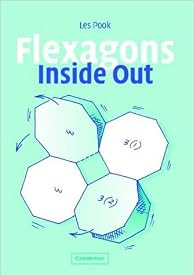
Flexagons Inside Out


Les Pook

Cambridge University Press | 2003 | 182 páginas | pdf | 618 kb

link direto
link direto
link
link1

Descrição: Flexagons are hinged polygons that have the intriguing property of displaying different pairs of faces when they are flexed. Workable paper models of flexagons are easy to make and entertaining to manipulate. Flexagons have a surprisingly complex mathematical structure and just how a flexagon works is not obvious on casual examination of a paper model. Flexagons may be appreciated at three different levels. Firstly as toys or puzzles, secondly as a recreational mathematics topic and finally as the subject of serious mathematical study. This book is written for anyone interested in puzzles or recreational maths. No previous knowledge of flexagons is assumed, and the only pre-requisite is some knowledge of elementary geometry. An attractive feature of the book is a collection of nets, with assembly instructions, for a wide range of paper models of flexagons. These are printed full size and laid out so they can be photocopied.

Research Ideas for the Classroom: High School Mathematics

Research Ideas for the Classroom: High School Mathematics
Patricia S. Wilson (Editor)

MacMillan | 1993 | 350 páginas

De momento, só estão disponíveis 2 dos 16 capítulos do livro.

Series Foreword
Sigrid Wagner
Introduction: Becoming Involved with Research
Patricia S. Wilson

PART I - Learning
1 - Cognitive Issues in Mathematics Education
Lee V. Stiff, Janet L. Johnson, e Mary R. Johnson
2 - Affective Issues in Mathematics Education
Douglas B. McLeod e Michele Ortega

PART II - Processes and Content
3 - Critical Thinking, Mathematical Reasoning, and Proof
Phares C. O'Daffer e Bruce A. Thornqulst
4 - Mathematical Problem Solving
James W. Wilson, Maria L. Fernandez, e Nelda Hadaway
on-line: jwilson.coe.uga.edu (html)
5 - Mathematical Symbols and Representations
Claude Janvier, Catherine Cirardon, e Jean-Charles Morand
6 - Improving the General Mathematics Experience
Harold L. Schocn e David Hallas
7 - Advancing Algebra
Sigrid Wagner e Sheila Parker
8 - Restructuring Geometry
William F. Burger e Barbara Culpepper
9 - Teaching and Learning Calculus
Joan Ferrini-Mundy e Darien Lauten
10 - Thinking about Uncertainty: Probability and Statistics
J. Michael Shaughnessy e Barry Bergman
11 - Computing Technology
M. Kathleen Heid e Terry Baylor
(pdf | 808 kb | 4share.com)

PART III - Teaching
12 - Instructional Activities and Decisions
Kim Prichard e Sue Bingaman
13 - Planning and Organizing Curriculum
Karen Brooks e Marilyn Suydam
14 - Inside the Teacher: Knowledge, Beliefs, and Attitudes
Catherine A. Brown e Jayne Baird
15 - Evaluation Issues
Elizabeth Badger, Thomas J. Cooney, e Timothy Kanold

PART IV - Classroom Research
16 - Teacher as Researcher: What Does It Really Mean?
Nina Kay Lankfor

Math Is Categorical

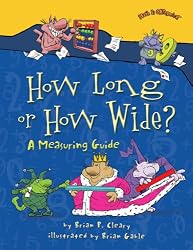
How Long or How Wide?: A Measuring Guide
(Math Is Categorical)
Brian P. Cleary

Millbrook Press | 2007 | 32 páginas | pdf | 5 Mb

link
link1

Descrição: Brian Cleary and Brian Gable bring their trademark sense of humor to the subject of measuring length. A rhyming text filled with funny examples explains how to use and compare metric and U.S. customary units of length. Readers are also introduced to the tools they need to measure length?rulers, metersticks, and more.

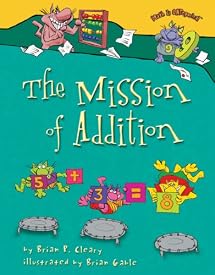
The Mission of Addition
(Math Is Categorical)
Brian P. Cleary

Millbrook Press | 2005 | pdf | 2,9 Mb

link
link1
mediafire.com

Descrição: This book helps kids become familiar with terms they'll encounter when learning to add, gives fun examples of adding, and includes practical applications that kids can relate to, all in the author's characteristic wacky rhyme.


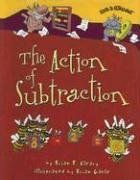
The Action of Subtraction
(Math Is Categorical)
Brian P. Cleary

Millbrook Press | 2006 | 31 páginas | pdf | 5 Mb

link
link1

The author and illustrator of the best-selling Words Are CATegorical(tm) series bring their trademark sense of humor to the subject of subtraction. Rhyming text filled with funny, countable examples shows what it means to take one number away from another. Readers are also introduced to the terminology they'll encounter as they learn to subtract.

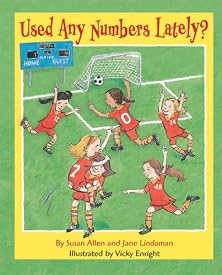
Used Any Numbers Lately?


Susan Allen, Jane Lindaman

Millbrook Press | 2008 | 31 páginas | pdf | 10 Mb

link
link1

Descrição: Have you used any numbers this week? You might be trying to remember when you last did a math problem???but think again! Have you made a phone call? Have you written someone's address? Have you worn a team jersey? Have you turned to a page in a book to do your homework assignment? Have you used any money? Or celebrated a birthday? Chances are you have used lots of numbers lately! Though you may not realize it, you see hundreds of numbers each day. This book shows you twenty-six different ways to use numbers???one for each letter of the alphabet. Can you think of more ways numbers are used? Search the pictures for ideas