quarta-feira, 26 de agosto de 2009

Boxes, Squares and Other Things


A Teacher's Guide for a Unit in Informal Geometry
Marion I. Walter

National Council of Teachers of Mathematics | 1970 | pdf | 2,6 Mb

on-line: eric.ed.gov

Descrição: This unit describes an experience in informal geometry that is based on work with construction paper and milk cartons. The description is mostly of work actually carried out by children in the elementary grades involving such mathematical concepts as congruence, symmetry, the idea of a geometric transformation, and some basic notions of elementary group theory. The purposes of the unit are (1) to give students experience in visualizing two and three dimensional objects, and (2) to give students opportunity to learn to raise questions, pose problems, and learn to solve them.

Projective Geometry: From Foundations to Applications


Albrecht Beutelspacher, Ute Rosenbaum

Cambridge University Press | 1998 | 268 páginas | djvu | 1,77 Mb

link direto

pdf - 11,5 Mb
maths.ed.ac.uk (link direto)
link

Descrição: This book introduces the basic ideas of mathematical proof to students embarking on university mathematics. The emphasis is on helping the reader to understand and construct proofs and write clear mathematics. The authors achieve this by exploring set theory, combinatorics and number theory, which include many fundamental mathematical ideas. This material illustrates how familiar ideas can be formulated rigorously, provides examples demonstrating a wide range of basic methods of proof, and includes some of the all time great classic proofs. The book presents mathematics as a continually developing subject. Material meeting the needs of readers from a wide range of backgrounds is included. The over 250 problems include questions to interest and challenge the most able student but also plenty of routine exercises to help familiarize the reader with the basic ideas.

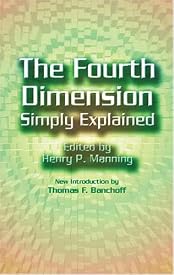
The Fourth Dimension Simply Explained


(Dover Science Books)
Henry P. Manning

Dover Publications | 2005 | 272 páginas | djvu | 5 Mb

link
link1

Descrição: Readable and informative, this collection of 22 essays employs a minimum of mathematics to explain how the fourth dimension may be studied, the relationship of non-Euclidean geometry to the fourth dimension, analogues to three-dimensional space, four-dimensional absurdities and curiosities, and the simpler properties of four-dimensional space.

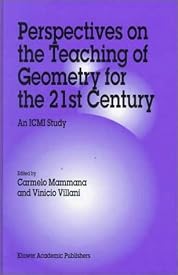
Perspectives on the Teaching of Geometry for the 21st Century


New ICMI Study Series , Vol. 5
Carmelo Mammana, Vinicio Villani (Editores)

Springer | 1998 | 353 páginas | rar -pdf | 10 Mb

link
password: matav


-->
Capítulos:
Introduction. 1 I. Geometry and Geometry-Teaching through the Ages 1
C. Mammana, V. Villani.
II. About the Present ICMI Study 4
V. Villani.
III. Acknowledgements 7
V. Villani.
1: Geometry: Past and Future. 9 I. Everlasting Geometry 9
V. Lundsgaard Hansen.
II. Finding Room in the Curriculum for Recent Geometry 18
J. Malkevitch.
III. Space and Plane 25
A. Douady.
2: Reasoning in Geometry. 29
I. About Reasoning in Geometry 29
R. Hershkowitz.
II. Geometry from a Cognitive Point of View 37
R. Duval.III.
Teaching and Learning Geometry in Contexts 52
M. Bartolini Bussi, P. Boero.
IV. Springboards to Geometry 62
R. Lehrer, T. Romberg.
V. The Role of Pupils' Spatial Knowledge in the Elementary Teaching of Geometry 71
R. Berthelot, M.H. Salin.
VI. Deductive and Intuitive Approaches to Solving Geometrical Problems 78
K. Jones.
3: Geometry in our World. 85
I. Geometry and Reality 85
J. Malkevitch.
II. Recent Applications of Geometry 100
W. Meyer.
III. Science and Technology in Geometry Textbooks 106
P. Legisa.
4: Computer Technology and the Teaching of Geometry. 109
Introduction 109
I. Osta.
I. Visual Phenomena in the Teaching/Learning of Geometry in a Computer-Based Environment 113
C.Laborde.
II. Proof in Dynamic Geometry Contexts 121
C. Hoyles, K. Jones.
III. CAD Tools and the Teaching of Geometry 128
I. Osta.
IV. The Computer as a Context for New Possible Geometrical Activities 144
K.-D. Graf, B. Hodgson.
5: Geometry in the Classroom 159
R. Douady, B. Parzysz.
6: The Evolution of Geometry Education since 1900. 193
I. The British Experience 194
H.B. Griffiths.
II. The Evolution of Curricula as Indicated by Different Kinds of Change in Geometry Textbooks 204
M. Galuzzi, et al.
III. General Tendencies in the Development of Geometry Teaching in the Past Two Decades 223
H.B. Griffiths, M. Neubrand.
Appendix:Influences of History and the General Social Development on the Teaching of Geometry 229
M. Galuzzi, M. Neubrand.
7: Changes and Trends in Geometry Curricula. 235
I. General Considerations on Curricula Designs in Geometry 235
V. Lundsgaard Hansen.
II. Examples of Curricula Designs in Geometry 243
C.E. Vasco, et al.
III. Looking Towards the 21st Century: Possible Trends in Geometry Curricula 260
V. Lundsgaard Hansen.
8: Assessment in Geometry. 263
I. Dimensions of Geometry and Assessment 263
M. Niss.
II.Assessing Reasoning Abilities in Geometry 275
J. Pegg, et al.
9: Teacher Qualifications and the Education of Teachers 297
M. Niss.
10: The Way Ahead 319
V. Villani on behalf of the International Program Committee.
Bibliography 329
Appendix: Perspectives on the Teaching of Geometry for the 21st Century 337
List of Participants to the Catania Conference. 347
Addresses of the Contributors. 348
Index. 351