domingo, 8 de novembro de 2009

Jornal Internacional de Estudos em Educação Matemática

Jornal Internacional de Estudos em Educação Matemática

Este jornal/periódico almeja:
· estimular a reflexão em educação matemática nos seus diferentes níveis;
· gerar discussões produtivas para área;
· encorajar a investigação e a pesquisa;
· promover a crítica e avaliação de idéias e os procedimentos utilizados em nossa área.

Seu público alvo é o educador matemático consciente de que o ensino e a aprendizagem de matemática são tópicos complexos sobre os quais muito ainda precisa ser revelado e compreendido.

Este jornal busca refletir tanto a variedade de pesquisas quanto a variedade de metodologias usadas nessas investigações. Para tal são aceitos artigos em português, inglês, francês e espanhol. Enfatizamos o alto nível dos artigos que vão alem de interesses nacionais ou locais.


on-line: periodicos.uniban.br

Vol. 1, No 1 (2009)

Sumário

Editorial

EditorialPDF
Janete Bolite Frant, Alessandro Jacques Ribeiro

Artigos

INVESTIGAÇÃO COLABORATIVA DE PROFESSORES E ENSINO DA MATEMÁTICA: CAMINHOS PARA O DESENVOLVIMENTO PROFISSIONALRESUMO PDF
João Pedro da Ponte, Luís Menezes
GESTURE, CONCEPTUAL INTEGRATION AND MATHEMATICAL TALKRESUMO PDF
Laurie Edwards
LEARNING IN VIRTUAL ENVIRONMENTS: A METHODOLOGY FOR THE ANALYSIS OF TEACHER DISCOURSERESUMO PDF
Marcelo Bairral
REFLEXÃO SOBRE A PRÁTICA DA CONTAGEM: DIÁLOGO ENTRE EDUCADOR INFANTIL, PESQUISADOR E CRIANÇARESUMO PDF
Maria Tereza Carneiro Soares, Denise Grein Santos, Maria Lucia Faria Moro
MATHÉMATIQUES, RÉALITÉ ET DIDACTIQUE DES DOMAINES D'EXPÉRIENCERESUMO PDF
Nadia Douek

TEACHER’S SEMIOTIC GAMES IN MATHEMATICS LABORATORYRESUMO PDF
Ornella Robutti

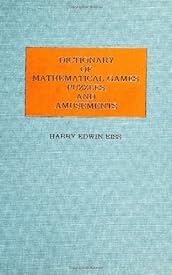
Dictionary of Mathematical Games, Puzzles, and Amusements

Harry Edwin Eiss

Greenwood Press | 1988 | 292 páginas | pdf

lib.freescienceengineering.org

djvu | 2,86 Mb

f3.tiera.ru
lib.freescienceengineering.org
depositfiles.com

Descrição: Mathematical play has challenged and stimulated human ingenuity throughout recorded history. It has ranged from the common sorts of brain teasers such as mazes, arithmetic story problems, and simple geometric puzzles to sophisticated explorations of questions that still concern modern mathematical theorists. This new dictionary provides a tantalizing variety of paradoxes, games, problems, and puzzles that will appeal to mathematics enthusiasts at every level of proficiency. Eiss introduces his subject with an overview of the history of recreational mathematics and its relation to some theoretical questions that have occupied mathematicians for centuries. Dictionary entries include problems posed by particular thinkers as well as traditional puzzlers that have come down to us anonymously. Information on the origins and history of many of the activities is supplied, and thorough cross-referencing enables the reader to locate all puzzles, games, and amusements of a similar type. The bibliography suggest sources of further information.