domingo, 26 de janeiro de 2014

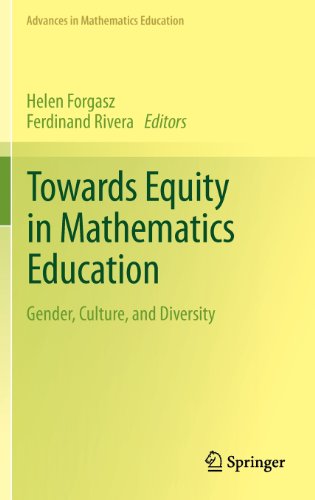
Towards Equity in Mathematics Education: Gender, Culture, and Diversity


(Advances in Mathematics Education) 

Helen Forgasz e Ferdinand Rivera

Springer | 2012 | 586 páginas | pdf | 5,5 Mb


link

​​This volume gathers together twenty major chapters that tackle a variety of issues associated with equity in mathematics education along the dimensions of gender, culture, curriculum diversity, and matters of a biological nature. The pursuit of equity in mathematics education is an important concern in the history of the present. Since there is no doubt about the significant role of mathematics in almost every aspect of life, it means that all individuals regardless of sex, in any age range, and in whatever context need to be provided with an opportunity to become mathematically able. The publication of this Springer volume on equity in mathematics education is situated at a time when there is strong and sustained research evidence indicating the persistence of an equity gap in mathematics, which has now enabled the mathematics education community to engage in a discourse of access for all. 
The research studies that are reported and discussed in the volume have been drawn from an international group of distinguished scholars whose impressive, forward-looking, and thought-provoking perspectives on relevant issues incite, broaden, and expand complicated conversations on how we might effectively achieve equity in mathematics education at the local, institutional, and systemic levels. Further, the up-to-date research knowledge in the field that is reflected in this volume provides conceptual and practical outlines for mechanisms of change, including models, examples, and usable theories that can inform the development of powerful equitable practices and the mobilization of meaningful equity interventions in different contexts of mathematics education.​

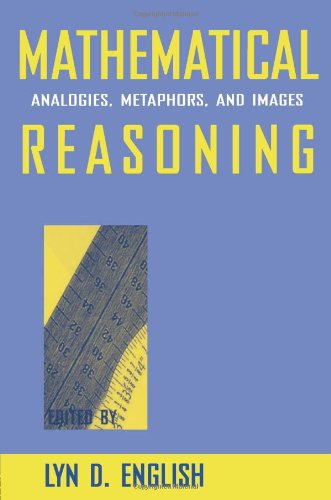
Mathematical Reasoning: Analogies, Metaphors, and Images


(Studies in Mathematical Thinking and Learning Series)

Lyn D. English


Routledge |1997 | 392 páginas | rar - epub | 2,3 Mb


link (password: matav)


How we reason with mathematical ideas continues to be a fascinating and challenging topic of research--particularly with the rapid and diverse developments in the field of cognitive science that have taken place in recent years. Because it draws on multiple disciplines, including psychology, philosophy, computer science, linguistics, and anthropology, cognitive science provides rich scope for addressing issues that are at the core of mathematical learning. 
Drawing upon the interdisciplinary nature of cognitive science, this book presents a broadened perspective on mathematics and mathematical reasoning. It represents a move away from the traditional notion of reasoning as "abstract" and "disembodied", to the contemporary view that it is "embodied" and "imaginative." From this perspective, mathematical reasoning involves reasoning with structures that emerge from our bodily experiences as we interact with the environment; these structures extend beyond finitary propositional representations. Mathematical reasoning is imaginative in the sense that it utilizes a number of powerful, illuminating devices that structure these concrete experiences and transform them into models for abstract thought. These "thinking tools"--analogy, metaphor, metonymy, and imagery--play an important role in mathematical reasoning, as the chapters in this book demonstrate, yet their potential for enhancing learning in the domain has received little recognition. 
This book is an attempt to fill this void. Drawing upon backgrounds in mathematics education, educational psychology, philosophy, linguistics, and cognitive science, the chapter authors provide a rich and comprehensive analysis of mathematical reasoning. New and exciting perspectives are presented on the nature of mathematics (e.g., "mind-based mathematics"), on the array of powerful cognitive tools for reasoning (e.g., "analogy and metaphor"), and on the different ways these tools can facilitate mathematical reasoning. Examples are drawn from the reasoning of the preschool child to that of the adult learner.


Contents: 

Preface. Part I: Introduction. 
L.D. English, Analogies, Metaphors, and Images: Vehicles for Mathematical Reasoning. 
Part II: Cognitive Foundations for a Mind-Based Mathematics. 
G. Lakoff, R.E. Núñez, The Metaphorical Structure of Mathematics: Sketching Out Cognitive Foundations for a Mind-Based Mathematics.
Part III: Mathematical Reasoning: Analogies. 
R.B. Davis, C.A. Maher, How Students Think: The Role of Representations. 
P.A. Alexander, C.S. White, M. Daugherty, Analogical Reasoning and Early Mathematics Learning.
B. Gholson, D. Smither, A. Buhrman, M.K. Duncan, K.A. Pierce, Children's Development of Analogical Problem-Solving Skill. 
L.D. English, Children's Reasoning Processes in Classifying and Solving Computational Word Problems. 
M. Bassok, Two Types of Reliance on Correlations Between Content and Structure in Reasoning About Word Problems. 
M.J. Rattermann, Commentary: Mathematical Reasoning and Analogy. 
Part IV: Mathematical Reasoning: Metaphors, Metonymies, and Images. 
N.C. Presmeg, Reasoning With Metaphors and Metonymies in Mathematics Learning. 
G.H. Wheatley, Reasoning With Images in Mathematical Activity. 
N.C. Presmeg, Generalization Using Imagery in Mathematics. 
D.H. Clements, J. Sarama, Children's Mathematical Reasoning With the Turtle Programming Metaphor. 
A. Sfard, Commentary: On Metaphorical Roots of Conceptual Growth.

The Universal Computer: The Road from Leibniz to Turing


Martin Davis

A K Peters/CRC Press | 2011 |  240 páginas | pdf

link

The breathtakingly rapid pace of change in computing makes it easy to overlook the pioneers who began it all. Written by Martin Davis, respected logician and researcher in the theory of computation, The Universal Computer: The Road from Leibniz to Turing explores the fascinating lives, ideas, and discoveries of seven remarkable mathematicians. It tells the stories of the unsung heroes of the computer age – the logicians.
The story begins with Leibniz in the 17th century and then focuses on Boole, Frege, Cantor, Hilbert, and Gödel, before turning to Turing. Turing’s analysis of algorithmic processes led to a single, all-purpose machine that could be programmed to carry out such processes—the computer. Davis describes how this incredible group, with lives as extraordinary as their accomplishments, grappled with logical reasoning and its mechanization. By investigating their achievements and failures, he shows how these pioneers paved the way for modern computing.
Bringing the material up to date, in this revised edition Davis discusses the success of the IBM Watson on Jeopardy, reorganizes the information on incompleteness, and adds information on Konrad Zuse. A distinguished prize-winning logician, Martin Davis has had a career of more than six decades devoted to the important interface between logic and computer science. His expertise, combined with his genuine love of the subject and excellent storytelling, make him the perfect person to tell this story.

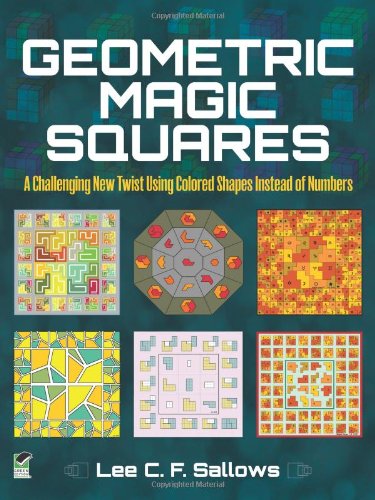
Geometric Magic Squares: A Challenging New Twist Using Colored Shapes Instead of Numbers


Lee Sallows

Dover Publications Inc. | 2013 | 160 páginas | epub | 15 Mb

link

Traditional magic squares employ a chessboard-like arrangement of numbers in which the total of all rows, columns, and diagonals add up to the same number. This innovative approach by a Dutch engineer challenges puzzlists to think two dimensionally by replacing numbers with colorful geometric shapes. Dozens of creative puzzles, suitable for ages 12 and up.

Contents
Part I: Geomagic Squares of 3×3 
1. Introduction
2. Geometric Magic Squares
3. The Five Types of 3×3 Area Square
4. Construction by Formula
5. Construction by Computer
6. 3×3 Squares
7. 3×3 Nasiks and Semi-Nasiks
8. Special Examples of 3×3 Squares
Part II: Geomagic Squares of 4×4 
9. Geo-Latin Squares
10. 4×4 Nasiks
11. Graeco-Latin Templates
12. Uniform Square Substrates
13. Dudeney’s 12 Graphic Types
14. The 12 Formulae
15. A Type I Geomagic Square
16. Self-Interlocking Geomagics
17. Form and Emptiness
18. Further Variations
Part III: Special Categories 
19. 2×2 Squares
20. Picture-Preserving Geomagics
21. 3-Dimensional Geomagics
22. Alpha-Geomagic Squares
23. Normal Squares of Order-4
24. Eccentric Squares
25. Collinear Collations
26. Concluding Remarks
Appendix I. A Formal Definition of Geomagic Squares
Appendix II. Magic Formulae
Appendix III. New Advances with 4×4 Magic Squares
Appendix IV. The Dual of the Lo shu
Appendix V. The Lost Theorem
Glossary 
References

An Introduction to Probability and Inductive Logic


Ian Hacking | Cambridge University Press | 2001 | 322 páginas | DjVu (2.8 mb)


link

This is an introductory textbook on probability and induction written by one of the world's foremost philosophers of science. The book has been designed to offer maximal accessibility to the widest range of students (not only those majoring in philosophy) and assumes no formal training in elementary symbolic logic. It offers a comprehensive course covering all basic definitions of induction and probability, and considers such topics as decision theory, Bayesianism, frequency ideas, and the philosophical problem of induction. 
 Contents
A Note on the Cover Illustration page ix
Foreword xi
Odd Questions xv
LOGIC
1 Logic 1
2 What Is Inductive Logic? 11
HOW TO CALCULATE PROBABILITIES
3 The Gambler's Fallacy 23
4 Elementary Probability Ideas 37
5 Conditional Probability 47
6 The Basic Rules of Probability 58
7 Bayes' Rule 69
HOW TO COMBINE PROBABILITIES AND UTILITIES
8 Expected Value 79
9 Maximizing Expected Value 98
10 Decision under Uncertainty 114
KINDS OF PROBABILITY
11 What Do You Mean? 127
12 Theories about Probability 140
PROBABILITY AS A MEASURE OF BELIEF
13 Personal Probabilities 151
14 Coherence 163
15 Learning from Experience 171 
PROBABILITY AS FREQUENCY
16 Stability 189
17 Normal Approximations 201
18 Significance and Power 209
19 Confidence and Inductive Behavior 229
PROBABILITY APPLIED TO PHILOSOPHY
20 The Philosophical Problem of Induction 247
21 Learning from Experience as an Evasion of the Problem
of Induction 256
22 Inductive Behavior as an Evasion of the Problem of
Induction 261
Answers to the Exercises 269
Further Reading 293
Index 300

The Emergence of Probability: A Philosophical Study of Early Ideas about Probability, Induction and Statistical Inference


(Cambridge Series on Statistical & Probabilistic Mathematics)

Ian Hacking | 2006 | 246 páginas | DjVu (3 mb)

link

 rar - epub | 664 kb - link (password: matav)

Historical records show that there was no real concept of probability in Europe before the mid-seventeenth century, although the use of dice and other randomizing objects was commonplace. Ian Hacking presents a philosophical critique of early ideas about probability, induction, and statistical inference and the growth of this new family of ideas in the fifteenth, sixteenth, and seventeenth centuries. Hacking invokes a wide intellectual framework involving the growth of science, economics, and the theology of the period. He argues that the transformations that made it possible for probability concepts to emerge have constrained all subsequent development of probability theory and determine the space within which philosophical debate on the subject is still conducted. First published in 1975, this edition includes an introduction that contextualizes his book in light of developing philosophical trends. Ian Hacking is the winner of the Holberg International Memorial Prize 2009.

CONTENTS
Introduction 2006 page xi
1 An absent family of ideas 1
Although dicing is one of the oldest of human pastimes, there is no known
mathematics of randomness until the Renaissance. None of the explanations
of this fact is compelling.
2 Duality 11
Probability, as we now conceive it, came into being about 1660. It was
essentially dual, on the one hand having to do with degrees of belief, on the
other, with devices tending to produce stable long-run frequencies.
3 Opinion 18
In the Renaissance, what was then called 'probability' was an attribute of
opinion, in contrast to knowledge, which could only be obtained by
demonstration. A probable opinion was not one supported by evidence, but
one which was approved by some authority, or by the testimony of respected
judges.
4 Evidence
31
Until the end of the Renaissance, one of our concepts of evidence was lacking:
that by which one thing can indicate, contingently, the state of something else.
Demonstration, versimilitude and testimony were all familiar concepts, but
not this further idea of the inductive evidence of things,
5 Signs 39
Probability is a child of the low sciences, such as alchemy or medicine, which
had to deal in opinion, whereas the high sciences, such as astronomy or
mechanics, aimed at demonstrable knowledge. A chief concept of the low
sciences was, that of the sign, here described in some detail. Observation of
signs was conceived of as reading testimony. Signs were more or less reliable.
Thus on the one hand a sign made an opinion probable (in the old sense of
Chapter 3) because it was furnished by the best testimony of all. On the other
hand, signs could be assessed by the frequency with which they spoke truly. At
the end of the Renaissance, the sign was transformed into the concept of
evidence described in Chapter 4. This new kind of evidence conferred
Contents
probability on propositions, namely made them worthy of approval. But it did
so in virtue of the frequency with which it made correct predictions. This
transformation from sign into evidence is the key to the emergence of a
concept of probability that is dual in the sense of Chapter 2.
6 The first calculations 49
Some isolated calculations on chances, made before 1660, are briefly
described.
7 The Roannez circle (1654) 57
Some problems solved by Pascal set probability rolling. From here until
Chapter 17 Leibniz is used as a witness to the early days of probability theory.
8 The great decision (1658?)
63
'Pascal's wager' for acting as if one believed in God is the first well-understood
contribution to decision theory.
9 The art of thinking (1662) 73
Something actually called 'probability' is first measured in the Port Royal
Logic, which is also one of the first works to distinguish evidence, in the sense
of Chapter 4, from testimony. The new awareness of probability, evidence
and conventional (as opposed to natural) sign, is illustrated by work of
Wilkins, first in 1640, before the emergence of probability, and then in 1668,
after the emergence.
10 Probability and the law (1665) 85
While young and ignorant of the Paris developments Leibniz proposed to
measure degrees of proof and right in law on a scale between 0 and 1, subject
to a crude calculation of what he called 'probability'.
11 Expectation (1657)
92
Huygens wrote the first printed textbook of probability using expectation as
the central concept. His justification of this concept is still of interest.
12 Political arithmetic (1662) 102
Graunt drew the first detailed statistical inferences from the bills of mortality
for the city of London, and Petty urged the need for a central statistical office.
13 Annuities (1671) 111
Hudde and de Witt used Dutch annuity records to infer a mortality curve on
which to work out the fair price for an annuity.
14 Equipossibility (1678) 122
The definition of probability as a ratio among 'equally possible cases1
originates with Leibniz. The definition, unintelligible to us, was natural at the
time, for possibility was either de re (about things) or de dicto (about
propositions). Probability was likewise either about things, in the frequency
sense, or about propositions, in the epistemic sense. Thus the duality of
probability was preserved by the duality of possibility.
15 Inductive logic 134
Leibniz anticipated Carnap's notion of inductive logic. He could do so
because of the central place occupied by the concept of possibility in his
scheme of metaphysics. Within that scheme, a global system of inductive logic
makes more sense than Carnap's does in our modern metaphysics.
16 The art of conjecturing (1692[?] published 1713) 143
The emergence of probability is completed with Jacques Bernoulli's book,
which both undertakes a self-conscious analysis of the concept of probability,
and proves the first limit theorem.
17 The first limit theorem 154
The possible interpretations of Bernoulli's theorem are described.
18 Design 166
The English conception of probability in the early eighteenth century, guided
by the Newtonian philosophy espoused by members of the Royal Society,
interprets the stability of stochastic processes proven by the limit theorems as
evidence of divine design.
19 Induction (1737) 176
Hume's sceptical problem of induction could not have arisen much before
1660, for there was no concept of inductive evidence in terms of which to raise
it. Why did it have to wait until 1737? So long as it was still believed that
demonstrative knowledge was possible, a knowledge in which causes were
proved from first principles, then Hume's argument could always be stopped.
It was necessary that the distinction between opinion and knowledge should
become a matter of degree. That means that high and low science had to
collapse into one another. This had been an ongoing process throughout the
seventeenth century. It was formalized by Berkeley who said that all causes
were merely signs. Causes had been the prerogative of high science, and signs
the tool of the low. Berkeley identified them and Hume thereby became
possible.
Bibliography 186
Index 203