2.ª edição
CRC | 2012 | 473 páginas | PDF | 3 Mb
link
ryushare.com
A Unified Account of Permutations in Modern Combinatorics
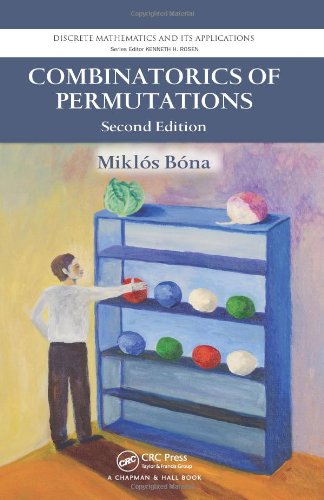
A 2006 CHOICE Outstanding Academic Title, the first edition of this bestseller was lauded for its detailed yet engaging treatment of permutations. Providing more than enough material for a one-semester course, Combinatorics of Permutations, Second Edition continues to clearly show the usefulness of this subject for both students and researchers.
Expanded Chapters
Much of the book has been significantly revised and extended. This edition includes a new section on alternating permutations and new material on multivariate applications of the exponential formula. It also discusses several important results in pattern avoidance as well as the concept of asymptotically normal distributions.
New Chapter
An entirely new chapter focuses on three sorting algorithms from molecular biology. This emerging area of combinatorics is known for its easily stated and extremely difficult problems, which sometimes can be solved using deep techniques from seemingly remote branches of mathematics.
Additional Exercises and Problems
All chapters in the second edition have more exercises and problems. Exercises are marked according to level of difficulty and many of the problems encompass results from the last eight years.
A Unified Account of Permutations in Modern CombinatoricsA 2006 CHOICE Outstanding Academic Title, the first edition of this bestseller was lauded for its detailed yet engaging treatment of permutations. Providing more than enough material for a one-semester course, Combinatorics of Permutations, Second Edition continues to clearly show the usefulness of this subject for both students and researchers.Expanded ChaptersMuch of the book has been significantly revised and extended. This edition includes a new section on alternating permutations and new material on multivariate applications of the exponential formula. It also discusses several important results in pattern avoidance as well as the concept of asymptotically normal distributions.New ChapterAn entirely new chapter focuses on three sorting algorithms from molecular biology. This emerging area of combinatorics is known for its easily stated and extremely difficult problems, which sometimes can be solved using deep techniques from seemingly remote branches of mathematics. Additional Exercises and ProblemsAll chapters in the second edition have more exercises and problems. Exercises are marked according to level of difficulty and many of the problems encompass results from the last eight years.