quarta-feira, 12 de fevereiro de 2014

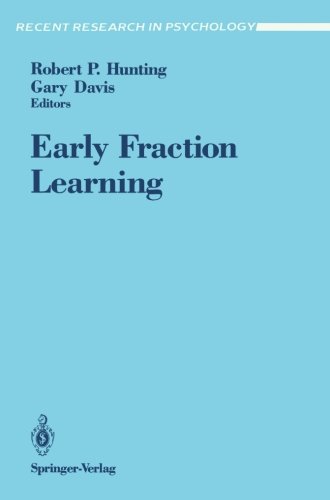
Early Fraction Learning


(Recent Research in Psychology)

 Robert Hunting e  Gary Davis

Springer | 1991 | 244 páginas | pdf | 9,1 Mb

link

Early Fraction learning is centrally of interest to students and researchersin mathematics education, tackling as it does one of that discipline's most vexing problems: why are fractions so difficult to learn and to teach?

Contents
Introduction
Robert P. Hunting, Gary Davis
Pre-fraction Concepts of Preschoolers
Robert P. Hunting, Christopher F. Sharpley
Dimensions of Young Children’s Conceptions of the Fraction One Half
Robert P. Hunting, Gary E. Davis
The Social Origins of Pre-fraction Knowledge in Three Year Olds
Robert P. Hunting
Higher Order Thinking in Young Children’s Engagements with a Fraction Machine
Robert P. Hunting, Gary Davis, John C. Bigelow
Fractions as Operators and as Cloning Machines
Gary Davis
Preschoolers’ Knowledge of Counting and Sharing in Discrete Quantity Settings
Kristine L. Pepper
Preschoolers’ Spontaneous Partitioning of Discrete Items
Gary Davis, Robert P. Hunting
Cognitive Issues about Dealing
Gary Davis
Sharing by Dealing as Problem Solving
Gary Davis, Kristine L. Pepper
Cognitive Research on Early Fraction Learning Applied to Classrooms: Two Experiments
Robert P. Hunting, Douglas M. Clarke, Charles Lovitt
The Interaction of Thought, Words, and Deeds in Children’s Early Fraction Learning
Robert P. Hunting
On Clinical Methods for Studying Young Children’s Mathematics
Gary Davis, Robert P. Hunting
A Fraction of Epistemology

Gary Davis

Elementary and Middle School Mathematics: Teaching Developmentally


(Teaching Student-Centered Mathematics Series)

John A. Van de Walle, Karen S. Karp e Jennifer M. Bay-Williams 

Pearson | 2012 - 8.ª edição | 575 páginas | rar - pdf | 23,4 Mb

link 
Password: matav

Written by leaders in the field, this best-selling book will guide teachers as they help all Pre-K — 8 learners make sense of math by supporting their own mathematical understanding and effective planning and instruction.

Elementary and Middle School Mathematics: Teaching Developmentallywas written to help teacher candidates and practicing teachers understand mathematics and become more confident in their ability to teach the subject to children in pre-K through eighth grade. Structured for easy reference, offering 23 chapters reflecting the latest research to consult throughout one’s teaching career, the revised edition infuses NCTM and Common Core State Standards with the benefits of problem-based mathematics instruction.
The Eighth Edition better prepares teachers to teach mathematics to all learners by including new strategies for English language learners and students with disabilities. The amount of coverage relating to mathematics in early childhood has been increased. More activities infusing technology and samples of authentic student work are introduced. Increased emphasis on formative assessment, showcased with an icon and notes throughout, guide teachers to master this difficult practice.

Contents
Section I Teaching Mathematics: Foundations and Perspectives
Chapter 1 T eaching Mathematics in the 21st Century 1
Chapter 2 Exploring What It Means to Know and Do Mathematics 13
Chapter 3 Teaching Through Problem Solving 32
Chapter 4 Planning in the Problem-Based Classroom 59
Chapter 5 Building Assessment into Instruction 78
Chapter 6 T eaching Mathematics Equitably to All Children 94
Chapter 7 Using Technological Tools to Teach Mathematics 113
Section II Development of Mathematical Concepts and Procedures
Chapter 8 Developing Early Number Concepts and Number Sense 128
Chapter 9 D eveloping Meanings for the Operations 148
Chapter 10 H elping Students Master the Basic Facts 171
Chapter 11 Developing Whole-Number Place-Value Concepts 192
Chapter 12 D eveloping Strategies for Addition and Subtraction Computation 216
Chapter 13 D eveloping Strategies for Multiplication and Division Computation 236
Chapter 14 Algebraic Thinking: Generalizations, Patterns, and Functions 258
Chapter 15 Developing Fraction Concepts 290
Chapter 16 Developing Strategies for Fraction Computation 315
Chapter 17 Developing Concepts of Decimals and Percents 338
Chapter 18 Proportional Reasoning 357
Chapter 19 Developing Measurement Concepts 375
Chapter 20 Geometric Thinking and Geometric Concepts 402
Chapter 21 Developing Concepts of Data Analysis 434
Chapter 22 Exploring Concepts of Probability 454
Chapter 23 Developing Concepts of Exponents, Integers, and Real Numbers 472
Appendix A Standards for Mathematical Practice 491
Appendix B Standards for Teaching Mathematics 493
Appendix C G uide to Blackline Masters 495

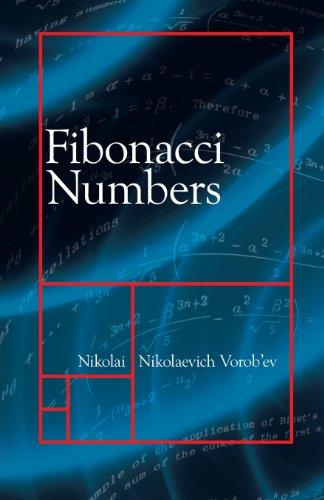
Fibonacci Numbers


(Dover Books on Mathematics)

Nikolai Nikolaevich Vorob'ev

Dover Publications |  2011 | 80 páginas | rar - epub | 1,4 Mb

link (password: matav)

versões anterior do livro neste blog

Fibonacci numbers date back to an 800-year-old problem concerning the number of offspring born in a single year to a pair of rabbits. This book offers the solution and explores the occurrence of Fibonacci numbers in number theory, continued fractions, and geometry. A discussion of the "golden section" rectangle, in which the lengths of the sides can be expressed as a ration of two successive Fibonacci numbers, draws upon attempts by ancient and medieval thinkers to base aesthetic and philosophical principles on the beauty of these figures. Recreational readers as well as students and teachers will appreciate this light and entertaining treatment of a classic puzzle.

CONTENTS
Foreword
Introduction
I.    The simplest properties of Fibonacci numbers
II.   Number-theoretic properties of Fibonacci numbers
III.  Fibonacci numbers and continued fractions
IV.  Fibonacci numbers and geometry

V.   Conclusion

Visualizing Elementary and Middle School Mathematics Methods


Joan Cohen Jones

Wiley | 2011 | 512 páginas | rar - PDF | 48,3 Mb

password: matav

The goal of Visualizing Elementary and Middle School Mathematics Methods is to teach mathematics in a way that excites and motivates readers, with an accessible format that serves as an introduction to the teaching of mathematics. This text, in partnership with National Geographic, is designed to present mathematics content and pedagogy in a fresh new way. This unique approach, while maintaining necessary rigor, provides the opportunity to set aside previous beliefs about mathematics and to learn concepts and pedagogy from a new perspective.
The structure of Visualizing Elementary and Middle School Mathematics Methods is similar to the format of other methods texts, however, it has many unique features that are designed to be engaging and make the text relevant for readers. It begins with a brief summary of the history of mathematics. Diversity is integrated into the content of every chapter, through Multicultural Perspectives in Mathematics.