Jacques Hadamard
Dover Publications Inc. | 1954 | 145 páginas | DJVU | 6 MB
on-line: archive.org
link
link1
depositfiles.com
scribd.com
Thoughtful and articulate study of the origin of ideas. Role of the unconscious in invention; the medium of ideas — do they come to mind in words? in pictures? in mathematical terms? Much more. "It is essential for the mathematician, and the layman will find it good reading." — Library Journal.
sábado, 28 de março de 2009
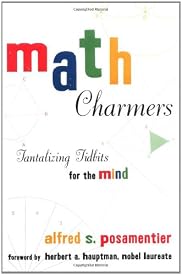
Math Charmers: Tantalizing Tidbits for the Mind
Alfred S. Posamentier, Herbert A. Hauptman
Prometheus Books| 2003 | 301 páginas | Djvu | 2,3 Mb
link direto
link
link1
depositfiles.com
We should all be having fun with math and helping our kids to do better in life by encouraging them to appreciate not only its usefulness but especially its charm. That's just what Posamentier sets out to do in this delightful exploration of maths' many intriguing, interesting, and fun qualities. This is the ideal book for adults looking for a way to turn their kids on to an important subject or discover for themselves what they might have missed in their own math education.
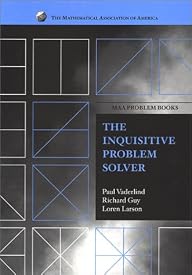
The Inquisitive Problem Solver
(MAA Problem Book Series)
Paul Vaderlind, Richard K. Guy, Loren C. Larson
The Mathematical Association of America | 2002 | 344 páginas | Djvu | 5,3 Mb
link direto
link
link1
depositfiles.com
mediafire.com
Referência em: MathEduc
The Inquisitive Problem Solver is a collection of mathematical miniatures composed to stimulate and entertain. On a deeper level, these little puzzles, accessible to a general audience, provide a setting rich in mathematical themes. One of the larger purposes of the book is to show how everyday situations can lead an inquisitive problem solver to profound and far-reaching mathematical principles. Discussions accompanying the problems reinforce important techniques in discrete mathematics, and the solutions - which require verbal arguments - show that proofs and careful reasoning are at the core of doing mathematics. In addition, anyone reading this book will learn that asking good questions is just as important to the progress of mathematics as answering questions. The book contains more than a dozen open problems for further research by amateurs or professionals. This treasury of problems will serve as a resource for anyone seeking to improve their problem-solving knowledge and know-how.
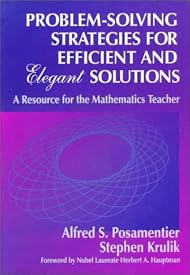
Problem-Solving Strategies for Efficient and Elegant Solutions: A Resource for the Mathematics Teaches
Alfred S. Posamentier, Stephen Krulik
Corwin Press | 1998 | 272 páginas | DJVU | 2,2 MB
link
link1
depositfiles.com
depositfiles.com
"This book is unique in that it provides alternatives to traditional problem-solving methods used by teachers. It is an attempt to break the mold of looking at only one way to solve a problem. The authors investigate ten strategies that can be used to solve mathematics problems as well as real life situations, using approximately 200 problems to demonstrate the ten strategies."
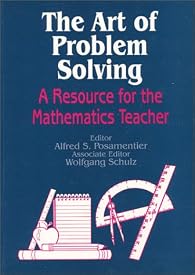
The Art of Problem Solving: A Resource for the Mathematics Teacher
Alfred S. Posamentier, Wolfgang Schulz
Corwin Press | 1995 | 480 páginas | DJVU | 3,8 MB
link
link1
depositfiles.com
Referência em: MathEduc
Problem solving has always been a fundamental element of mathematics. This innovative book challenges the perception that solving a problem is merely a means to an end. Focusing on problem solving as a subject in its own right, the contributors present a broad range of practical, theoretical, simple, intricate and purely mathematical examples.
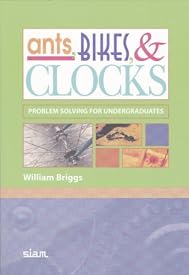
Ants, Bikes, and Clocks: Problem Solving for Undergraduates
William Briggs
IAM: Society for Industrial and Applied Mathematics | 2004 | 174 páginas | PDF | 1 Mb
link
link1
djvu | 1,7 Mb
link
link1
PDF - 10 Mb - sma1pekalongan.sch.id (link direto)
Referência em: MathEduc
Mathematics educators agree that problem solving is one of the essential skills their students should possess, yet few mathematics courses or textbooks are devoted entirely to developing this skill. Supported by narrative, examples, and exercises, Ants, Bikes, and Clocks: Problem Solving for Undergraduates is a readable and enjoyable text designed to strengthen the problem-solving skills of undergraduate students. The book, which provides hundreds of mathematical problems, gives special emphasis to problems in context, often called story problems or modeling problems, that require mathematical formulation as a preliminary step. Both analytical and computational approaches, as well as the interplay between them, are included. This engaging book will strengthen students' mathematical skills, introduce them to new mathematical ideas, demonstrate the connectedness of mathematics, and improve both their analytical and computational problem solving. Students are encouraged to use the computer, or any tool at hand, for experimentation or to test their ideas
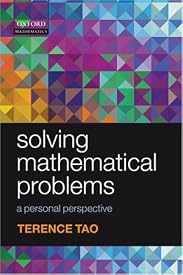
Solving Mathematical Problems: A Personal Perspective
Terence Tao
Oxford University Press | 2006 | 128 páginas | Djvu | 1,2 Mb
link
depositfiles.com
4shared.com
PDF - 1,5 Mb
link
rapidgator.net
Referência em: MathEduc
Authored by a leading name in mathematics, this engaging and clearly presented text leads the reader through the various tactics involved in solving mathematical problems at the Mathematical Olympiad level. Covering number theory, algebra, analysis, Euclidean geometry, and analytic geometry, Solving Mathematical Problems includes numerous exercises and model solutions throughout. Assuming only a basic level of mathematics, the text is ideal for students of 14 years and above in pure mathematics.
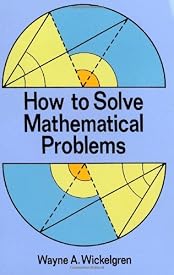
How to Solve Mathematical Problems
Wayne A. Wickelgren
Dover Publications | 272 páginas | Djvu | 2,4 MB
link
link1
depositfiles.com
4shared.com
Referência em: MathEduc
Seven problem-solving techniques include inference, classification of action sequences, subgoals, contradiction, working backward, relations between problems, and mathematical representation. Also, problems from mathematics, science, and engineering with complete solutions.
Problem-Solving Studies in Mathematics

John G. Harvey e Thomas A. Romberg
Wisconsin Research and Development Center for Individualized Schooling monograph series | 1980 | 287 páginas | pdf | 3,97 MB
on-line: eric (Nenhum link disponível)
This monograph focuses on educational research on the processes and natures of problem-solving activities in mathematics. The first chapter presents an overview to both the field and the document itself. All of the studies reported reflect interrelated investigations carried out at the University of Madison-Wisconsin, as partial fulfillments of Ph.D. requirements in Mathematics or Curriculum and Instruction. Chapter two describes 31 studies carried out between 1969 and 1978, and divides the research into three categories: instruction in heuristics, assessment of problem-solving performance, and correlates and factors of problem-solving performance. The next four sections are reports of studies on teaching problem solving, chapters seven and eight detail investigations on assessing problem-solving performance, and the last three portions describe studies on establishing correlates and factors of problem-solving performance.
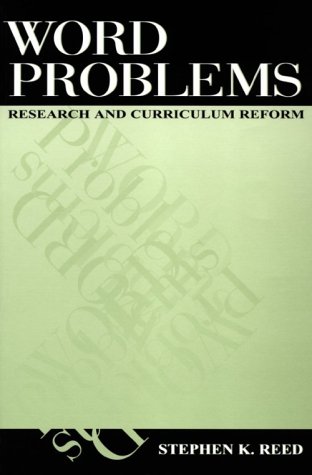
Word problems: Research and curriculum reform

(Studies in Mathematical Thinking and Learning Series)
Stephen K. Reed
Lawrence Erlbaum | 1998| 232 páginas | PDF | 3,7 Mb
mediafire.com
link
link1
pré-visualização: books.google
Referência em: MathEduc
Contents
Preface
1 Introduction
Part I Knowledge structures
2 Learning Rules
3 Conceptual Understanding
Part II Problems
4 Elementary Problems
5 Multistep Problems
6 Algebra Problems
Part III Transfer
7 Abstracting Solutions
8 Adapting Solutions
9 Representing Solutions
Part IV Important topics in the NCTM standards
10 Wor(l)d Problems
11 Estimation and Functions
12 Curriculum Reform
Referência em: MathEduc
Descrição: Research by cognitive psychologists and mathematics educators has often been compartmentalized by departmental boundaries. Word Problems integrates this research to show its relevance to the debate on the reform of mathematics education.
Beginning with the different knowledge structures that represent rule learning and conceptual learning, the discussion proceeds to the application of these ideas to solving word problems. This is followed by chapters on elementary, multistep, and algebra problems, which examine similarities and differences in the cognitive skills required by students as the problems become more complex. The next section, on abstracting, adapting, and representing solutions, illustrates different ways in which solutions can be transferred to related problems. The last section focuses on topics emphasized in the NCTM Standards and concludes with a chapter that evaluates some of the programs on curriculum reform.
Contents
Preface
1 Introduction
Part I Knowledge structures
2 Learning Rules
3 Conceptual Understanding
Part II Problems
4 Elementary Problems
5 Multistep Problems
6 Algebra Problems
Part III Transfer
7 Abstracting Solutions
8 Adapting Solutions
9 Representing Solutions
Part IV Important topics in the NCTM standards
10 Wor(l)d Problems
11 Estimation and Functions
12 Curriculum Reform
Problem Solving Through Recreational Mathematics
Bonnie Averbach, Orin Chein
Dover Publications | 1999 | 480 páginas | djvu | 7 Mb
link
link1
depositfiles.com (Djvu | 7 MB)
epub - 28 Mb - link
Referência em: MathEduc
Many of the most important mathematical concepts were developed from recreational problems. This book uses problems, puzzles, and games to teach students how to think critically. It emphasizes active participation in problem solving, with emphasis on logic, number and graph theory, games of strategy, and much more. Includes answers to selected problems.
Problem-Solving Strategies
(Problem Books in Mathematics)
Arthur Engel
Springer | 1999 | 403 páginas | pdf | 2 Mb
link direto
link
DjVu | 3,4 MB
4shared.com
link
PDF - 15 Mb
scribd.com
depositfiles.com
uploading.com
sma1pekalongan.sch.id (link direto - PDF - 22 Mb)
vestseller.com.br (link direto - incompleto)
Referência em: MathEduc
Descrição: Problem-Solving Strategies is a unique collection of competition problems from over twenty major national and international mathematical competitions for high school students. The discussion of problem solving strategies is extensive. It is written for trainers and participants of contests of all levels up to the highest level: IMO, Tournament of the Towns, and the noncalculus parts of the Putnam Competition. It will appeal to high school teachers conducting a mathematics club who need a range of simple to complex problems and to those instructors wishing to pose a "problem of the week", "problem of the month", and "research problem of the year" to their students, thus bringing a creative atmosphere into their classrooms with continuous discussions of mathematical problems. This volume is a must-have for instructors wishing to enrich their teaching with some interesting non-routine problems and for individuals who are just interested in solving difficult and challenging problems. Each chapter starts with typical examples illustrating the central concepts and is followed by a number of carefully selected problems and their solutions. Most of the solutions are complete, but some merely point to the road leading to the final solution. Very few problems have no solutions. Readers interested in increasing the effectiveness of the book can do so by working on the examples in addition to the problems thereby increasing the number of problems to over 1300. In addition to being a valuable resource of mathematical problems and solution strategies, this volume is the most complete training book on the market.
Problem-solving through problems
Loren C. Larson
Springer| 1992 | 332 páginas | djvu | 2,57 Mb
link
link1
filefactory.com
pdf -
link
sma1pekalongan.sch.id (link direto)
This is a practical anthology of some of the best elementary problems in different branches of mathematics. Arranged by subject, the problems highlight the most common problem-solving techniques encountered in undergraduate mathematics. This book teaches the important principles and broad strategies for coping with the experience of solving problems. It has been found very helpful for students preparing for the Putnam exam.
Discovering Mathematics: The Art of Investigation

Anthony Gardiner
Oxford University Press | 1987 | 206 páginas | djvu | 1,61 Mb
link
link1
The word "mathematics" usually conjures up a world of more-or-less familiar problems to be solved by more-or-less familiar techniques. This book examines a very different aspect of mathematics, namely how one can begin to explore unfamiliar, fresh ideas and chance observations, how one can pursue them through various stages until the light eventually begins to dawn, and how this whole process invariably throws up other interesting questions one might otherwise never have thought of. The items have been designed to provide certain basic experiences from struggling to explain simple, but puzzling mathematical phenomena, to discovering for oneself some new and totally unexpected bit of mathematics. Readers should have no difficulty with the mathematical techniques which are required. They should therefore be in a position to reflect on some of the more striking features of the process whereby unsuspected mathematical relationships are uncovered, and on the way they emerge
Problem Solving in the Mathematics Curriculum
MAA Notes, Number 1
Alan H Schoenfeld
Mathematical Association of America | 1983 | 137 páginas | pdf | 1,87 MB
libgen.info
ou procure em: link
Para vários artigos de Alan H. Schoenfeld visite a página do autor: gse.berkeley.edu
Referência em: MathEduc
Outros livros do mesmo autor, sobre resolução de problemas, não disponíveis para download:
Mathematical problem solving
Orlando: Academic Press, 1985
Problem solving: A world view
(Proceedings of the problem solving theme group at the V International Congress on Mathematical Education, Adelaide, Australia).
Nottingham, England: Shell Centre for Mathematical Education, 1988
Mathematical thinking and problem solving. Hillsdale, NJ: Erlbaum, 1994
pré-visualização em books.google.com
Exame de Livros de Matemática para o Ensino Médio
Colecção Professor de Matemática, n.º 19
Sociedade Brasileira de Matemática | 2001| 471 páginas
Nenhum link disponível
Descrição: O presente volume contém o resultado de um estudo detalhado de doze colecções de livros didácticos usados no ensino médio de Matemática no Brasil. São ao todo trinta e seis análises críticas de textos utilizados por professores e alunos de todo o país. Nelas, procurou-se não somente apontar acertos e defeitos, mas principalmente sugerir melhores opções no sentido de tornar o livro um valioso instrumento para a formação intelectual do jovem e sua inserção na sociedade moderna. A leitura desta obra será de grande interesse para os professores em geral, para os estudantes que se prepara para a carreira do magistério e para todos aqueles que se preocupam com a educação.
Subscrever:
Mensagens (Atom)