sábado, 1 de maio de 2010

Multicultural Mathematics: Interdisciplinary Cooperative-Learning Activities


Claudia Zaslavsky
Walch Education | 1993 | 144 páginas |  pdf | 3,6 Mb

link
link1

Descrição: 58 activities to supplement and enrich the regular mathematics curriculum.
Multicultural Mathematics is fascinating! The book is set up as a series of exercise sheets, dealing with ancient Egyptian, Chinese, African, American Indian, and other math systems, and it's all fun! The suggested age is 5th or 6th grade. It might also be a way to interest someone who's a little turned off on traditional math.

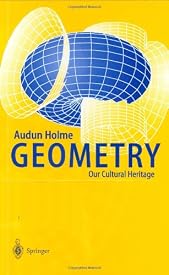
Geometry: Our Cultural Heritage


Audun Holme

Springer | 2002 | 410 páginas |  pdf | 8 Mb
link
link1

pdf | 19,76 Mb
scribd.com

Descrição: This book, aimed at future teachers of mathematics, contains selected topics from the history of geometry, with "modern" proofs of some of the results, as well as a fully modern treatment of selected basic issues in geometry. All too often the geometry which goes into the syllabus for teacher-students presents the material as pedantic and formalistic, suppressing its dynamic character and its role as part of the foundation for our common cultural heritage. The motivation for the book is to open up these aspects of the field. Another motivation is to provide an invitation to mathematics in general. It is an unfortunate fact that today, at a time when mathematics and knowledge of mathematics are more important than ever, phrases like math avoidance and math anxiety are very much in the public vocabulary.

Conteúdos
1. A cultural heritage -- 1. Early beginnings -- 2. The great river civilizations -- 3. Greek and Hellenic geometry -- 4. Geometry in the Hellenistic era -- 5. The geometry of yesterday and today -- 6. Geometry and the real world -- pt. 2. Introduction to geometry -- 7. Axiomatic geometry -- 8. Axiomatic projective geometry -- 9. Models for non-Euclidian geometry -- 10. Making things precise -- 11. Projective space -- 13. Geometry in the affine and the projective plane -- 13. Algebraic curves of higher degrees in the affine plane -- 14. Higher geometry in the projective plane -- 15. Sharpening the sword of algebra -- 16. Constructions with straightedge and compass -- 17. Fractal geometry -- 18. Catastrophe theory.

Encyclopedia of Mathematics

(Science Encyclopedia)
James Stuart Tanton

Facts on File | 2005 | 568 páginas | pdf | 7,4 Mb

link direto
link
4shared.com
scribd.com
uploading.com
ishare.iask.sina.com.cn


Descrição: Encyclopedia of Mathematics is a comprehensive one-volume encyclopedia designed for high school through early college students. More than 1,000 entries, more than 125 photographs and illustrations, and numerous essays cover the principal areas and issues that characterize this "new" area of science. This valuable resource unites disparate ideas and provides the meaning, history, context, and relevance behind each one. The easy-to-use format makes finding straightforward and natural answers to questions within arithmetic - such as algebra, trigonometry, geometry, probability, combinatorics, numbers, logic, calculus, and statistics - simple. Encyclopedia of Mathematics also gives historical context to mathematical concepts, with entries discussing ancient Arabic, Babylonian, Chinese, Egyptian, Greek, Hindu, and Mayan mathematics, as well as entries providing biographical descriptions of important people in the development of mathematic.


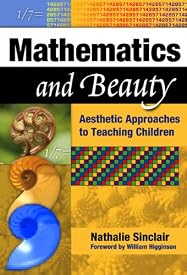
Mathematics and Beauty: Aesthetic Approaches to Teaching Children


Nathalie Sinclair

Teachers College Press | 2006 | 196 páginas |  pdf | 1 Mb

link direto
link

Descrição: Nathalie Sinclair makes a compelling case for the inclusion of the aesthetic in the teaching and learning of mathematics, and illuminates how the materials and approaches we use in the mathematics classroom can be enriched for the benefit of all learners.

Contents

Foreword by William Higginson
Acknowledgments
1. Introduction
Where Beautiful Mathematics Comes From
The Aesthetic as a Vital Lens on Learning
Plan for the Book
A Background Note
PART I: BEAUTY AND PLEASURE IN HUMAN EXPERIENCE
2. Reclaiming the Aesthetic from the Arts
The Fluidity of Human Faculties
The Aesthetic Nature of Inquiry
Connecting the Aesthetic to Learning: First Steps
Fitting the Pieces Together
3. "Wired" for Beauty and Pleasure
Homo Aestheticus
A "Sense of Order"
PART II: BEAUTY AND PLEASURE IN MATHEMATICS
4. Developing a Mathematical Aesthetic Lens
The Aesthetic
The Mathematical Aesthetic
The Mathematical Aesthetic in Action
The Aesthetics of Detachment
5. Aesthetics and the Development of Mathematics
Debriefing the Kissing Triangles
The Importance of the Mathematical Aesthetic
Fitting the Pieces Together
PART III: FOCUSING THE AESTHETIC LENS ON STUDENTS
6. The Motivational Role of the Aesthetic
The Aesthetic Dimension of Problem Selection
The Aesthetic Dimension of Problem Posing
Coloring with Numbers
Fitting the Pieces Together
7. The Generative Role of the Aesthetic
Three Cases of the Generative Role
Mindful Mathematics
Fitting the Pieces Together
8. The Evaluative Role of the Aesthetic
Which Solution Is Better?
Wonder and the Aesthetic
Valuing the Aesthetic
Fitting the Pieces Together: Aesthetics and Inquiry
PART IV: AESTHETIC ENCULTURATION
9. Peering Inside the Mathematics Culture
From Outside to Inside the Culture
What Do Mathematicians Value?
The Aesthetic Dimension of Mathematical Values
Mathematical Values in the Classroom
10. Mathematical Values in the Classroom
Revealing Values in Topics, Tasks, and Tools
Communicating Values in the Classroom
Notes
References
Index
About the Author


Learn from the Masters

(Classroom Resource Materials)
Frank Swetz, John Fauvel, Bengt Johansson, Victor Katz, Otto Bekken

The Mathematical Association of America | 1997 | 303 páginas | rar - pdf | 31 Mb

pdf - 33 Mb - link
djvu - link

Descrição: This book is for high school and college teachers who want to know how they can use the history of mathematics as a pedagogical tool to help their students construct their own knowledge of mathematics. Often, a historical development of a particular topic is the best way to present a mathematical topic, but teachers may not have the time to do the research needed to present the material. This book provides its readers with historical ideas and insights which can be immediately applied in the classroom. The book is divided into two sections: the first on the use of history in high school mathematics, and the second on its use in university mathematics. The articles are diverse, covering fields such as trigonometry, mathematical modeling, calculus, linear algebra, vector analysis, and celestial mechanics. Also included are articles of a somewhat philosophical nature, which give general ideas on why history should be used in teaching and how it can be used in various special kinds of courses. Each article contains a bibliography to guide the reader to further reading on the subject.

Índice

Preface
Part I: History in School Mathematics
1. History of Mathematics can Help Improve Instruction and Learning
Shmuel Avital
2. The Role in the History of Mathematics of Algorithms and Analogies
Phillip S. Jones
3. Using Problems from the History of Mathematics in Classroom Instructions
Frank J. Swetz
4. Revisiting the History of Logarithms
John Fauvel
5. Napeir's Logarithms Adapted for Today's Classroom
Victor J. Katz
6. Trigonometry Comes Out of the Shadows
Frank J. Swetz
7. Alluvial Deposits, Conic Sections, and Improper Glasses, or History of Mathematics Applied in the Classroom
Jan A. can Maanen
8. An Historical Example of Mathematical Modeling: The Trajectory of a Cannonball
Frank J. Swift
Part II: History in Higher Mathematics9. Concept of Function-Its History and Teaching
Man-Keung Siu
10. My Favorite Ways of Using History in Teaching Calculus
V. Fredrick Rickey
11. Improved Teaching of the Calculus Through the Use of Historical Materials
Michel Helfgott
12. Euler and Heuristic Reasoning
Man-Keung Siu
13. Converging Concepts of Series: Learning from History
Joel P. Lehmann
14. Historical Thoughts on Infinite Numbers
Lars Mejibo
15. Historical Ideas in Teaching Linear Algebra
Victor J. Katz
16. Wessel on Vectors
Otto B. Bekken
17. Who Needs Vectors?
Karen Reich
18. The Teaching of Abstract Algebra: An Historical Perspective
Israel Kleiner
19. Toward the Definition of an Abstract Ring
David M. Burton e Donovan H. Can Osdol
20. In Hilbert's Shadow: Notes Toward a Redefinition of Introductory Group Theory
Anthony D. Gardiner
21. An Episode in the History of Celestial Mechanics and Its Utility in the Teaching of Applied Mathematics
Eric J. Aiton
22. Mathematical Thinking and History of Mathematics
Man-Keung Siu
23. A Topics Course in Mathematics
Abe Shenitzer
Niels Henrik Abel (1802-1829): A Tribute
About the Authors
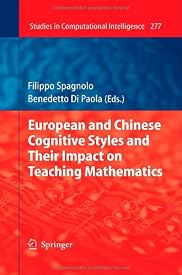
European and Chinese Cognitive Styles and their Impact on Teaching Mathematics

(Studies in Computational Intelligence)
Filippo Spagnolo, Benedetto Di Paola

Springer | 2010 | 300 páginas |  pdf | 2,85 Mb

link

Descrição: The book provides strong evidence that research on the cognitive processes from arithmetic thought to algebraic thought should take into consideration the socio-cultural context. It is an important contribution to the literature on linguistic structure in comparative studies related to Chinese student mathematics learning.This book not only makes a great contribution to research in mathematics education, the findings of this study also addressed insightful approaches and thoughts of understanding the development of algebraic thinking in cultural contexts for classroom teachers. Using written Chinese language from different theoretical references provided wonderful approaches for understanding student algebra cognitive development in a different way and calls educators for to pay special attention to an epistemological and linguistic view of algebraic development. The findings inform classroom teachers that the cultural context plays an important role in student learning mathematics. A typical analysis of the cognitive dimension involved in some in the historical and cultural contexts is a great resource for classroom teachers.

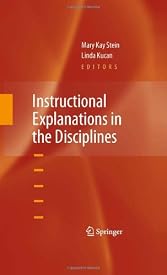
Instructional Explanations in the Disciplines


Mary Kay Stein, Linda Kucan

Springer | 2009 | 229 páginas | PDF | 5 Mb

link
link1
link2

Descrição: In today’s climate of accountability and standards, increasing attention is focused on teacher "quality," with less emphasis on what teachers actually do to interest and engage students in learning. This path-breaking volume addresses this research problem with a clear definition and a content-specific analysis of the most essential teaching moment—the instructional explanation—for vital new perspectives on educational method and process.Rich in examples from science, mathematics, and the humanities (and touching on areas of course development and pre-service training), Instructional Explanations in the Disciplines explores a variety of interactive contexts for teaching and learning, which may be collaborative between teachers, students, and others, performed in non-classroom settings, or assisted by technology. The book’s subject-matter-specific framework reveals key elements in the process, such as carefully examining the question to be answered, making connections with what is already known, and developing examples conducive to further understanding.Among the topics covered:The model as a method of explanation in scienceHow—and why—teachers explain things as they do"Let us explain with you": introducing instructional explanationsHow families talk about art in museum settings, and what we can learn from itDeveloping writing skills through students’ giving instructional explanationsInstructional explanation in the context of learning and identityInstructional Explanations in the Disciplines is a valuable addition to the education library, giving researchers new methods of unpacking educational process as few books before it.

Índice1 Introduction: Explaining Instructional Explanations . . 1Gaea LeinhardtPart I Instructional Explanations in the Teaching and Learning of Science2What Kind of Explanation is a Model? . . 9Richard Lehrer e Leona Schauble3 Learning, Identity, and Instructional Explanations. . 23Jorge Larreamendy-Joerns e Tatiana Muñoz4 Learning Chemistry: What, When, and How? . . 41David Yaron, Michael Karabinos, Karen Evans, Jodi Davenport, Jordi Cuadros, e James Greeno5 Negotiating the Goal of Museum Inquiry:How Families Engineer and Experiment . . 51Kyung Youn Kim e Kevin CrowleyPart II Instructional Explanations in the Teaching and Learning of Mathematics6 A Framing of Instructional Explanations: Let Us Explain With You . . 69Carla van de Sande e James G. Greeno7 How and Why Do Teachers Explain Things theWay They Do? . . 83Alan H. Schoenfeld8 The Explanatory Power of Examples in Mathematics: Challenges for Teaching . . 107Orit Zaslavsky9 Using Designed Instructional Activities to Enable Novices to Manage Ambitious Mathematics Teaching . 129Magdalene Lampert, Heather Beasley, Hala Ghousseini, Elham Kazemi, e Megan FrankePart III Instructional Explanations in the Teaching and Learning of the Humanities10 Learning History and Learning Language: Focusing on Language in Historical Explanations to Support English Language Learners . . . . 145Mariana Achugar e Catherine Stainton11 Instructional Explanations in a Legal Classroom: Are Students’ Argument Diagrams of Hypothetical Reasoning Diagnostic? . . . . . . 171Kevin D. Ashley e Collin Lynch12 Connecting with Art: How Families Talk About Art in a Museum Setting . . 189Karen Knutson e Kevin Crowley13 Developing Writing Skills Through Students Giving Instructional Explanations . 207Kwangsu Cho e Christian SchunnIndex . . 223

Mathematics Through Paper Folding


National Council of Teachers of Mathematics | 1975 | 60 páginas!  pdf | 2,32 Mb

sma1pekalongan.sch.id (link direto)
link
link1


Descrição: Paper folding not only simplifies the learning of mathematics it also builds an experiential base necessary for further learning. The exercises in this publication, appropriate at various grade levels, lead students to discover and demonstrate such mathematical relationships as reflections, transformations, and symmetry.