sábado, 9 de junho de 2012

The Anthropology of Numbers

Thomas Crump

Cambridge University Press | 1992 | 212 páginas | PDF | 4,49 Mb

link
link1

Why do the Nuer stipulate forty cattle in brideprice? Why is the number ten so important in North American mythology? What does the anthropologist Clifford Geertz really mean to say when he talks about the correspondence of Balinese time cycles? Numbers play some part, often quite central, in almost all known cultures, yet until now the subject has never been examined in detail from an anthropological perspective. This book is the first attempt to find out how people in a wide range of diverse cultures and in different historical contexts, use and understand numbers. The opening chapters provide the basis for looking at the way numbers operate in different contexts, by looking at the logical, psychological and linguistic implications. The following eight chapters deal with specific themes: ethnoscience, politics, measurement, time, money, music, games and architecture. The final chapter relates such operations to social, economic and cultural factors.

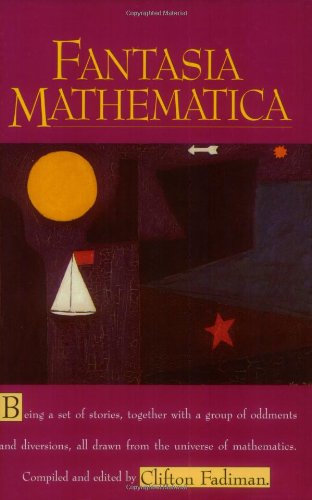
Fantasia Mathematica

Clifton Fadiman

Springer |  1997 | 298 páginas | djvu | 2,5Mb

link
link1

Clifton Fadiman's classic collection of mathematical stories, essays and anecdotes first published in 1958, is now back in print. Ranging from the poignant to the comical to the surreal, these selections include writing by Aldous Huxley, Martin Gardner, H.G. Wells, George Gamow, G.H. Hardy, Plato, Robert Heinlein, Arthur C. Clarke, and many others

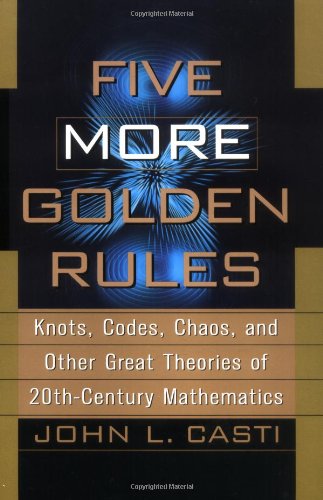
Five More Golden Rules: Knots, Codes, Chaos, and Other Great Theories of 20th-Century Mathematics

John L. Casti

Wiley | 2001 | 272 páginas | djvu | 3 Mb
link

CHM | 1,68 Mb


"Casti is one of the great science writers." -San Francisco Examiner
"Casti's gift is to be able to let the nonmathematical reader share in his understanding of the beauty of a good theory." -Christian Science Monitor
Following up the acclaimed Five Golden Rules, another quintet of gleaming math discoveries
With Five More Golden Rules, readers are treated to another fascinating set of theoretical gems from acclaimed popular science author John Casti. Injecting all-new ingredients into his trademark recipe of real-world examples, historical anecdotes, and straightforward explanations, Casti once again brings math to thrilling life. All who enjoyed the unique pleasures of the original will love this follow-up survey highlighting the creme de la creme of math in the last century.
Explores how knot theory informs the classic tale of Alexander the Great and the Gordian Knot
* Considers how the Shannon Coding Theory applies to decoding the human genome
John L. Casti, PhD (Santa Fe, NM), a resident member of the Santa Fe Institute, is a professor at the Technical University of Vienna and the author of Would-Be Worlds (Wiley) and Cambridge Quintet.

A treatise on plane trigonometry

Ernest William Hobson

1918 | Cambridge University Press

online: archive.org