terça-feira, 31 de março de 2009

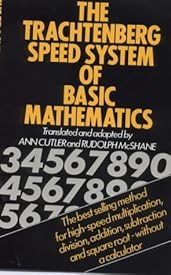
Speed System of Basic Mathematics


Jakow Trachtenberg

Souvenir Press Ltd | 1989 | 272 páginas | PDF

link
filefactory.com (31 Mb)
4shared.com (8,8 Mb)
scribd.com

epub - 4,5 Mb - link

djvu - link

The complete system of the Trachtenberg method of mathematics which makes possible high-speed arithmetical calculations with a remarkable degree of accuracy. This method is not only speedy but simple. Once one has mastered the rules, lightning calculation is as easy as reading a story. It looks like magic, but the rules are based on sound logic.

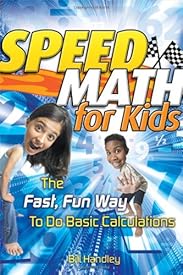
Speed Math for Kids: The Fast, Fun Way To Do Basic Calculations

Bill Handley
Jossey-Bass | 2007 | 256 páginas | PDF

link direto
link
uploading.com
depositfiles.com
4shared.com

Speed Math for Kids is your guide to becoming a math genius--even if you have struggled with math in the past. Believe it or not, you have the ability to perform lightning quick calculations that will astonish your friends, family, and teachers. You'll be able to master your multiplication tables in minutes, and learn basic number facts while doing it. While the other kids in class are still writing down the problems, you can be calling out the answers.

Speed Math for Kids is all about playing with mathematics. This fun-filled book will teach you:
* How to multiply and divide large numbers in your head
* What you can do to make addition and subtraction easy
* Tricks for understanding fractions and decimals
* How to quickly check answers every time you make a calculation
* And much more

If you're looking for a foolproof way to do multiplication, division, factoring estimating, and more, Speed Math for Kids is the book for you. With enough practice you'll go straight to the top of the class!

Contents
Preface v
Introduction 1
1 Multiplication: Getting Started 4
2 Using a Reference Number 13
3 Numbers Above the Reference Number 21
4 Multiplying Above & Below
the Reference Number 29
5 Checking Your Answers 34
6 Multiplication Using Any Reference Number 43
7 Multiplying Lower Numbers 59
8 Multiplication by 11 69
9 Multiplying Decimals 77
10 Multiplication Using Two Reference Numbers 87
11 Addition 106
12 Subtraction 116
13 Simple Division 130
14 Long Division by Factors 141
15 Standard Long Division Made Easy 149
16 Direct Long Division 157
17 Checking Answers (Division) 166
18 Fractions Made Easy 173
19 Direct Multiplication 185
20 Putting It All into Practice 195
Afterword 199
Appendix A Using the Methods in the Classroom 203
Appendix B Working Th rough a Problem 207
Appendix C Learn the 13, 14 and 15 Times Tables 209
Appendix D Tests for Divisibility 211
Appendix E Keeping Count 215
Appendix F Plus and Minus Numbers 217
Appendix G Percentages 219
Appendix H Hints for Learning 223
Appendix I Estimating 225
Appendix J Squaring Numbers Ending in 5 227
Appendix K Practice Sheets 231
Index 239
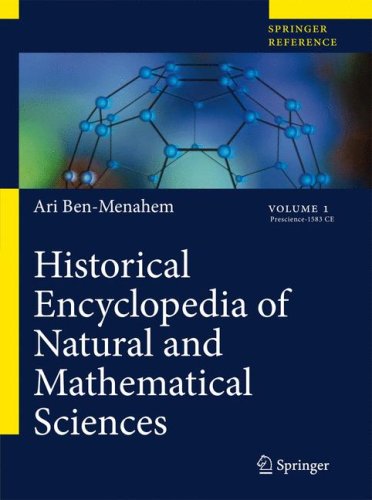
Historical Encyclopedia of Natural and Mathematical Sciences


Ari Ben-Menahem

Springer | 2009 | 5988 páginas | PDF

link direto
link
depositfiles.com
depositfiles.com


This milestone extensive work combines the essentials of history – biography, chronology, political and economic background – with the observations, theories, principles, laws and equations that constitute the specifics of science.
The 5800-page Encyclopedia arises from the conviction that the optimal perspective on science is through the lens of history, setting aside traditional divisions of discipline and specialty, and rising above geopolitical boundaries. Reaching from 4,200 BCE to the 21st century CE, the Encyclopedia tells (as the author himself puts it) "not only who did it and when it was done but also precisely what was done."
The author, Ari Ben-Menahem, surveys 100 generations of great thinkers, offering 2070 detailed biographies of scientists, engineers, explorers and inventors, who left their mark on the history of science and technology. The span of coverage is all-encompassing: mathematics, philosophy, logic, physical and environmental sciences (including physics, chemistry, astronomy, earth and space sciences and cosmology), life sciences (biology, medicine, physiology, botany, zoology and biochemistry), associated engineering disciplines, and the social sciences (among them economics, psychology, sociology, anthropology, linguistics and more).
The six-volume Encyclopedia also includes 380 articles summarizing the time-line of ideas in the leading fields of science, technology, mathematics and philosophy, plus useful tables, figures and photos, and 20 ‘Science Progress Reports’ detailing scientific setbacks. Interspersed throughout are quotations, gathered from the wit and wisdom of sages, savants and scholars throughout the ages from antiquity to modern times.

A History of Mathematics


Carl B. Boyer, Uta C. Merzbach, Isaac Asimov

Wiley | 1991 - 2ª edição | 736 páginas | PDF | 72 MB

nenhum link disponível

djvu - 8,9 Mb - link direto
link

Boyer and Merzbach distill thousands of years of mathematics into this fascinating chronicle. From the Greeks to Godel, the mathematics is brilliant  the cast of characters is distinguished  the ebb and flow of ideas is everywhere evident. And, while tracing the development of European mathematics, the authors do not overlook the contributions of Chinese, Indian, and Arabic civilizations. Without doubt, this is and will long remain a classic one-volume history of mathematics and mathematicians who create it."  William Dunham Author, Journey Through Genius, The Great Theorems of Mathematics "When we read a book like A History of Mathematics, we get the picture of a mounting structure, ever taller and broader and more beautiful and magnificent and with a foundation, moreover, that is as untainted and as functional now as it was when Thales worked out the first geometrical theorems nearly 26 centuries ago."  From the Foreword by Isaac Asimov "One of the most useful and comprehensive general introductions to the subject."  J. W. Dauben The City University of New York "Both readable and scholarly, this book can serve as a fine introduction to the topic and also a reference book."  J. David Bolter University of North Carolina Author of Turing's Man Revised to make it more accessible to a general audience, A History of Mathematics paints a vivid picture of humankind's relationship with numbers. Updated and expanded, it now offers broadened coverage of twentieth century advances in probability and computers, and updated references to further reading. A feature that will be of interest to every reader is an appendix containing an extensive chronological table of mathematical and general historical developments.


Carl B. Boyer

 John Wiley & Sons Inc; International Ed edition | 1968 - 1ª ediçao | 738 páginas

online: archive.org

Contents
Chapter I. Primitive Origins 
Chapter II. Egypt 
Chapter III. Mesopotamia 
Chapter IV. Ionia and the Pythagoreans
Chapter V. The Heroic Age
Chapter VI. The Age of Plato and Aristotle 
Chapter VII. Euclid of Alexandria
Chapter VIII. Archimedes of Syracuse
Chapter IX. Apollonius of Perga
Chapter X. Greek Trigonometry and Mensuration
Chapter XI. Revival and Decline of Greek Mathematics
Chapter XII. China and India
Chapter XIII. The Arabic Hegemony
Chapter XIV. Europe in the Middle Ages
Chapter XV. The Renaissance
Chapter XVI. Prelude to Modern Mathematics
Chapter XVII. The Time of Fermat and Descartes
Chapter XVIII. A Transitional Period
Chapter XIX. Newton and Leibniz 
Chapter XX. The Bernoulli Era 
Chapter XXI. The Age of Euler
Chapter XXII. Mathematicians of the French Revolution
Chapter XXIII. The Time of Gauss and Cauchy
Chapter XXIV. The Heroic Age in Geometry
Chapter XXV. The Arithmetization of Analysis
Chapter XXVI. The Rise of Abstract Algebra
Chapter XXVII. Aspects of the Twentieth Century
General Bibliography 679
Appendix: Chronological Table 683
Index 697