sábado, 21 de fevereiro de 2009
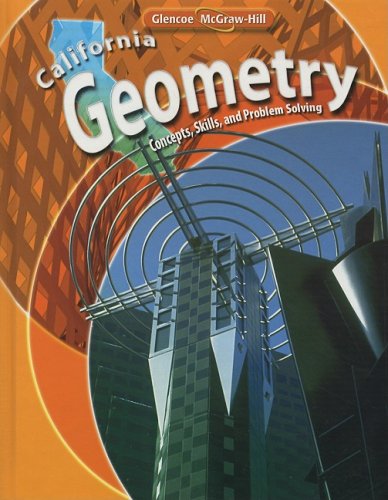
California Geometry: Concepts, Skills, and Problem Solving
Cindy J. Boyd, Jerry Cummins, Carol E. Malloy
McGraw-Hill/Glencoe | 2007 | 336 páginas | PDF | 63,5 MB
rapidshare.com
depositfiles.com
mediafire.com
rapidgator.net
ouglencoe.com
Access code: Nenhum código de acesso
Site do Manual: glencoe.com
CONTENTS
Unit 1: Geometric Structure
Chapter 1: Tools of Geometry
Chapter 2: Reasoning and Proof
Chapter 3: Parallel and Perpendicular Lines
Unit 2: Congruence
Chapter 4: Congruent Triangles
Chapter 5: Relationships with Triangles
Chapter 6: Quadrilaterals
Unit 3: Similarity
Chapter 7: Proportions and Similarity
Chapter 8: Right Triangles and Trigonometry
Chapter 9: Right Transformations
Unit 4: Two- and Three-Dimensional Measurements
Chapter 10: Circles
Chapter 11: Areas of Polygons and Circles
Chapter 12: Extending Surface Area
Chapter 13: Extending Volume
Student Handbook
- Built-In Workbooks
-- Prerequisite Skills
-- Extra Practice
-- Mixed Problem Solving and Proof
- Extension Lessons
-- Graphs of Linear Equations
-- Slopes of Perpendicular Lines
-- Trigonometric Identities
-- Circles and Regular Polygons
- Reference
-- Postulates, Theorems, and Corollaries
-- English-Spanish Glossary
-- Selected Answers
-- Photo Credits
WORKBOOKS
- Interactive Study Notebook with Foldables
- Enrichment
- Lesson Reading Guide
- Practice
- Study Guide and Intervention
- Skills Practice
- Word Problem Practice
Fun with Figures: Is It Maths or Magic?
K. Williams
Inspiration Books | 1998| 52 páginas | PDF | 1,2 MB
link
Fun with Figures is for those who think they are no good at maths – and for those who are good at maths. It is for those who would like to steal a little lightning. The book answers a need of our time, offering easy, enjoyable maths which improves mental agility and memory, promotes confidence and creativity – as well as being useful in everyday life.
Each double page shows a simple mathematical method and is independent of the others (with two exceptions, which are indicated). In addition to the various everyday situations indicated in this book, you will surely find many other occasions for the use of these easy methods. There are many exercises for you to practise and answers at the end of the book.
Explorando a Matemática
Exploring Maths:Class Book
Jonathan Longstaffe, Tony Fisher, Anita Straker, Rosalyn Hyde, Sue Jennings
Longman | 2009 | 347 pages | PDF | 14,7 MB
depositfiles.com
rapidshare.com
Anos de escolaridade: 1.º ao 3.º ano
Exploring Maths 1: Home Book
Jonathan Longstaffe, Tony Fisher, Anita Straker, Rosalyn Hyde, Sue Jennings
Longman | 2009 | PDF | 8,5 MB | 107 páginas
depositfiles.com
uploadbox.com
Exploring Maths 1:Teacher's book
Jonathan Longstaffe, Tony Fisher, Anita Straker, Rosalyn Hyde, Sue Jennings
Longman | 2009 | 386 páginas| PDF | 7 MB
depositfiles.com
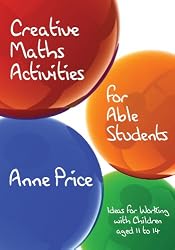
Creative Maths Activities for Able Students: Ideas for Working with Children Aged 11 to 14
Anne PricePaul Chapman Educational Publishing | 2006 | 128 páginas| PDF | 1,3 MB
link
Finding stimulating and challenging maths activities for able pupils in a mainstream classroom can be demanding for the busy teacher, especially if maths is not your specialism.
Based on her experience as an Advanced Skills Teacher and LEA Consultant, Anne Price explains the issues and theories surrounding the education of able pupils and links these to practical, creative examples to be used in the classroom.
Useful resources include:
- Photocopiable materials,
- Advice on different teaching styles,
- Activities and tasks for individuals, groups or the whole class
GATCOs, Numeracy Consultants, Learning Support Teachers and Student and class teachers looking for new and creative ways of teaching maths activities to able students will find this book invaluable.
Mathematics Classrooms in Twelve Countries: The Insider's Perspective
Este resumo não está disponível.
Clique aqui para ver a mensagem.
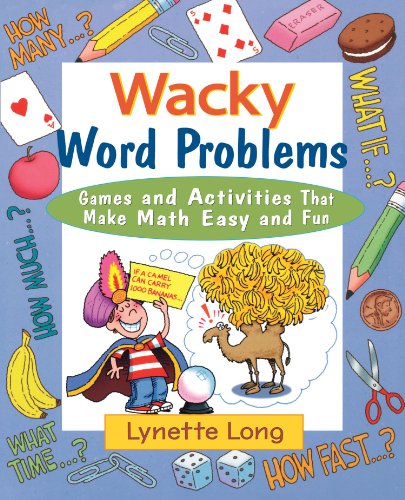
Wacky Word Problems: Games and Activities That Make Math Easy and Fun
(Magical Math)Lynette Long
Jossey-Bass | 2004 | 128 páginas | PDF | 5,3 Mb
scribd.com
link
Don't Just Learn Word Problems... Master Them!
Brimming with fun and educational games and activities, the Magical Math series provides everything you need to know to become a master of mathematics! In each of these books, Lynette Long uses her won unique style to help you truly understand mathematical concepts with common objects such as playing cards, dice, coins, and every mathematician's basic tools: paper and pencil.
Inside Wacky Word Problems, you'll discover how to decode many different types of word problems-from counting, logic, and percentage problems to distance, algebra, geometry, and graphing problems-in order to solve real-world dilemmas. While you play exciting games like Measurement Jeopardy and Percentage War, you'll learn how to identify word cues, develop reasoning skill,s and spot key formulas that will help you solve any problem with ease. You'll also boost your math skills as you enter into crazy contests with your friends, create mystery word problems, and play word-problem charades-and have a great time doing it!
So why wait? Jump right in and find out how easy it is to become a word-problem master!
MathMatters - Manuais escolares
MathMatters 1: An Integrated Program, Student EditionGlencoe/McGraw-Hill | 2005 | PDF | 13,2 MB | 661 páginas
Ano de escolaridade: 6.º ano
depositfiles.com ou
http://www.glencoe.com/ose/
Acess Code: E8BF0EC103 ou E4F74B5462
Site do manual:
http://glencoe.mcgraw-hill.com/sites/0078805694/

MathMatters 1: An Integrated Program, Extra Practice Workbook
Glencoe/McGraw-Hill | 2005 | PDF | 1,07 MB | 88 páginas
MathMatters 1: An Integrated Program, Reteaching WorkbookGlencoe/McGraw-Hill | 2005 | PDF | 1,28 MB | 88 páginas
depositfiles.com
MathMatters 2 - An Integrated ProgramChicha Lynch, Eugene Olmstead, Kenneth De Forest-Davis
McGraw-Hill/Glencoe | 2005 | PDF | 13,4 MB | 711 páginas
Ano de escolaridade: 7.º ano
depositfiles.com ou
http://www.glencoe.com/ose/
Acess Code: E1A789A863 ou A45ACEF615 ou FFE9272FFC
Site do manual:
http://glencoe.mcgraw-hill.com/sites/0078805716/
MathMatters 2: An Integrated Program, Extra Practice Workbook Glencoe/McGraw-Hill | 2005 | PDF | 1,36 MB | 95 páginas
depositfiles.com
uploading
rapidshare.com
MathMatters 2: An Integrated Program, Reteaching WorkbookChicha Lynch, Eugene Olmstead, Kenneth De Forest-Davis
McGraw-Hill/Glencoe | 2005 | PDF | 1,74 MB | 96 páginas
Mathmatters 3, An Integrated ProgramChicha Lynch, Eugene Olmstead
McGraw-Hill/Glencoe | 2005 | PDF | 13,3 MB | 796 páginas
Ano de escolaridade: 8.º ano
depositfiles.com rapidshare.com
Site do manual:
http://glencoe.mcgraw-hill.com/sites/0078805732/

MathMatters 3: An Integrated Program, Extra Practice Workbook
Glencoe/McGraw-Hill | 2005 | PDF | 1,01 MB | 109 páginas
depositfiles.com
Glencoe/McGraw-Hill | 2005 | PDF | 1,01 MB | 109 páginas
depositfiles.com

MathMatters 3: An Integrated Program, Reteaching Workbook
Glencoe/McGraw-Hill | 2005 | PDF | 1,11 MB | 109 páginas
depositfiles.com
AMSCO School Publications
Amsco's GeometryMarc Aerts,
Professional Book Distributors, Inc. | 2007 | 643 páginas| rar - PDF | 4,43 MB
uploading.com
Amsco's Integrated Algebra I Slide Rule
Florian Cajori
University of California press | 1920
archive.org
The slide rule, with its many variations, has been vital to mathematics and engineering since its invention in the 17th century. Interest in this field has grown dramatically and collectors can still find much material at affordable prices. Unfortunately there has been little information available except for manufacturers manuals and catalogs, making this reprint of Cajori's classic particularly valuable. Also included with this reprint of the 1910 edition is Cajori's extensive article On the History of Gunter's Scale and the Slide Rule during the 17th Century, published by the University of California in 1920, which sets forth his subsequent findings. There is also a helpful explanatory introduction by Dr. Robert K. Otnes, editor of the Journal of the Oughtred Society.
Outros livros de Florian Cajori on-line em: archive.org
The Illusion of Linearity: From Analysis to Improvement
Mathematics Education Library , Vol. 41Dirk De Bock, Wim Van Dooren, Dirk Janssens, Lieven Verschaffel
Springer | 2007 | 186 páginas | PDF | 845 kb
link
Referência em: MathEduc
Linear or proportional relationships are a major topic in mathematics education. However, recent research has shown that secondary school students have a strong tendency to apply the linear model also in situations wherein it is not applicable. This overgeneralization of linearity is sometimes referred to as the "illusion of linearity" and has a strong negative impact on students’ reasoning and problem solving skills.
"The Illusion of Linearity: From Analysis to Improvement" presents the reader with a comprehensive overview of the major findings of the recent research on the illusion of linearity. Although the empirical study of students’ improper linear reasoning clearly constitutes a new line of research, it owes a great deal to prior work in mathematics education research community such as the work of the scholars of the Freudenthal Institute on realistic mathematics education.
Based on both quantitative and qualitative research, "The Illusion of Linearity: From Analysis to Improvement" discusses the following issues: (1) how the illusion of linearity appears in diverse domains of mathematics and science and how it is conceptually related to other more general misconceptions identified in the research literature, (2) what are the crucial psychological, mathematical, and educational factors being responsible for the occurrence and persistence of the phenomenon, and (3) how the illusion of linearity can be remedied by appropriate instruction.
"The Illusion of Linearity: From Analysis to Improvement" is essential to those working in mathematics education, particularly teacher educators and curriculum research and development.
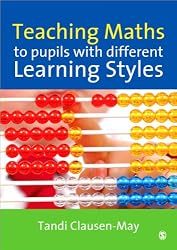
Teaching Maths to Pupils with Different Learning Styles
Tandi Clausen-MayPaul Chapman Educational Publishing | 2005 | 112 páginas| PDF | 2,5 Mb
depositfiles.com
link
Referência em: MathEduc
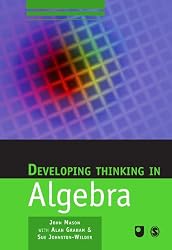
Developing Thinking in Algebra
John Mason, Alan Graham, Sue Johnston-WilderPaul Chapman Educational Publishing | 2005| 336 páginas | PDF | 2,8 Mb
Mason, Graham, and Johnston-Wilder have admirably succeeded in casting most of school algebra in terms of generalisation activity? not just the typical numerical and geometric pattern-based work, but also solving quadratics and simultaneous equations, graphing equations, and factoring. The authors raise our awareness of the scope of generalization and of the power of using this as a lens not just for algebra but for all of mathematics - Professor Carolyn Kieran, Departement de Mathematiques, Universite du Quebec a Montreal
Algebra has always been a watershed for pupils learning mathematics. This book will enable you to think about yourself as a learner of algebra in a new way, and thus to teach algebra more successfully, overcoming difficulties and building upon skills that all learners have.
This book is based on teaching principles developed by the team at The Open University's Centre for Mathematics Education which has a 20-year track record of innovative approaches to teaching and learning algebra. Written for teachers working with pupils aged 7-16, it includes numerous tasks ready for adaption for your teaching and discusses principles that teachers have found useful in preparing and conducting lessons.
This is a 'must have' resource for all teachers of mathematics, primary or secondary, and their support staff. Anyone who wishes to create an understanding and enthusiasm for algebra, based upon firm research and effective practice, will enjoy this book.
This book is the course reader for The Open University Course ME625 Developing Algebraic Thinking
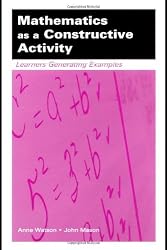
Mathematics as a Constructive Activity: Learners Generating Examples
(Studies in Mathematical Thinking and Learning Series)Anne Watson e John H. Mason
Lawrence Erlbaum Associates | 2005| 248 páginas | PDF | 10,33 Mb
minus.com
link
Referência em: MathEduc
This book explains and demonstrates the teaching strategy of asking learners to construct their own examples of mathematical objects. The authors show that the creation of examples can involve transforming and reorganizing knowledge and that, although this is usually done by authors and teachers, if the responsibility for making examples is transferred to learners, their knowledge structures can be developed and extended. A multitude of examples to illustrate this is provided, spanning primary, secondary, and college levels. Readers are invited to learn from their own past experience augmented by tasks provided in the book, and are given direct experience of constructing examples through a collection of many tasks at many levels. Classroom stories show the practicalities of introducing such shifts in mathematics education. The authors examine how their approach relates to improving the learning of mathematics and raise future research questions. *Based on the authors' and others' theoretical and practical experience, the book includes a combination of exercises for the reader, practical applications for teaching, and solid scholarly grounding. *The ideas presented are generic in nature and thus applicable across every phase of mathematics teaching and learning. *Although the teaching methods offered are ones that engage learners imaginatively, these are also applied to traditional approaches to mathematics education; all tasks offered in the book are within conventional mathematics curriculum content. Mathematics as a Constructive Activity: Learners Generating Examples is intended for mathematics teacher educators, mathematics teachers, curriculum developers, task and test designers, and classroom researchers, and for use as a text in graduate-level mathematics education courses
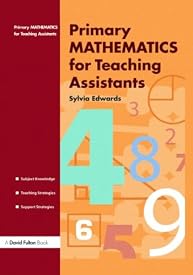
Primary Mathematics for Teaching Assistants
Sylvia EdwardsRoutledge | 2007 | 104 páginas | PDF | 4 Mb
depositfiles.com
link
This easy-to-use and accessible book has been specifically written for teaching assistants. It is packed with practical activities, ideas and strategies to help you to enhance your pupils’ numeracy and mathematics skills and build on your own subject knowledge. This book:
- includes a cross-curricular focus that shows how to stop pupils forgetting fundamental skills when changing subject
- suggests methods and ideas for assessment
- is written in line with the national strategies
- suggests activities for developing problem solving and thinking skills
- includes a breakdown of mathematical principles.
Use this book whether you’re studying for qualifications or just keen to support your pupils better.
Contents:
Introduction; What is numeracy? Critical principles for success; How numeracy lessons are organised; Numeracy at the Foundation Stage; Numeracy in Key Stage 1; Numeracy in Key Stage 2; Supporting the Assessment and Monitoring
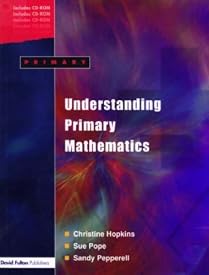
Understanding Primary Mathematics

Christine Hopkins, Sue Pope, Sandy Pepperell
David Fulton Publish | 2005 | 245 páginas | PDF | 1,4 MB
link
In this textbook, the foundations of mathematics are made explicit and the reader is guided through the background knowledge and understanding that are required for the subject, offering a well-structured overview of the important issues to be considered when learning about mathematics on a Primary QTS course, and a coherent approach to the content to be found in the standards for QTS, the National Curriculum at Key Stages 1 and 2 and the numeracy strategy.
The authors aim to help teachers review and restructure the understanding of mathematics gained during their education, progressing from partial memories of a few process to an understanding of why the skills they were taught make sense and how they fit into a coherent mathematics curriculum, arguing that to teach mathematics effectively it is not enough to be able to do the mathematics, you need to understand why you do what you do. Aimed at all teachers of primary mathematics, this book is also likely to be valuable to secondary teachers, parents, administrators and others interested in the foundations of school mathematics.
Written for trainee and practicing teachers, this book de-mystifies the primary mathematics UK curriculum and offers a valuable reference for effective mathematicss teaching.
Subscrever:
Mensagens (Atom)