sábado, 5 de abril de 2014

Math en jeux, niveau 4e 3e : 200 jeux pour aimer les maths


Xuan Quang-Bui, Marie Berrondo-Agrell

Bordas | 1990 | 161 páginas | djvu | 5 Mb


Oui, les Mathématiques peuvent être amusantes et l'on se passionnera à essayer de résoudre ces problèmes parfois bien comiques. Quel moyen plus agréable pour progresser en Mathématiques - et les aimer - lorsqu'on est en 4e ou en 3e, puisque ces jeux relèvent tous du niveau de ces classes ! Pleins d'humour, ces casse-tête sont classés selon leur difficulté et entièrement corrigés. Ils demandent, pour être résolus, astuce, bon sens et logique. Egayés de dessins pleins de malice, ils permettent de développer ingéniosité et capacité de raisonnement.

The Calculus Diaries: How Math Can Help You Lose Weight, Win in Vegas, and Survive a Zombie Apocalypse

Jennifer Ouellette

Penguin Books | 2010 | 338 páginas | rar - pdf | 1,5 Mb

link (password : matav)

epub - 1,7 Mb - link

Jennifer Ouellette never took math in college, mostly because she-like most people-assumed that she wouldn't need it in real life. But then the English-major-turned-award-winning-science-writer had a change of heart and decided to revisit the equations and formulas that had haunted her for years. The Calculus Diaries is the fun and fascinating account of her year spent confronting her math phobia head on. With wit and verve, Ouellette shows how she learned to apply calculus to everything from gas mileage to dieting, from the rides at Disneyland to shooting craps in Vegas-proving that even the mathematically challenged can learn the fundamentals of the universal language.


CONTENTS
Acknowledgments xiii
Prologue: I Could Be Mathier 1
To Infinity and Beyond 11
Drive Me Crazy 40
Casino Royale 65
The Devil’s Playground 93
Show Me the Money 119
A Pox upon It 140
Body Heat 171
The Catenary Tales 202
123456789 Surfi n’ Safari 225
Epilogue: The Mimetics of Math 249
Appendix 1 : Doing the Math 263
Appendix 2: Calculus of the Living Dead 293
Bibliography 299
Index 309

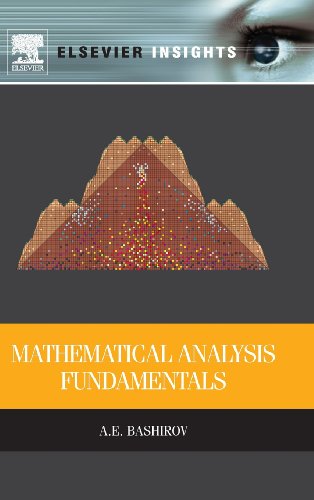
Mathematical Analysis Fundamentals

Agamirza Bashirov

Elsevier | 2014 | 363 páginas | rar - pdf | 2,77 Mb

link (password: matav)

The author's goal is a rigorous presentation of the fundamentals of analysis, starting from elementary level and moving to the advanced coursework. The curriculum of all mathematics (pure or applied) and physics programs include a compulsory course in mathematical analysis. This book will serve as can serve a main textbook of such (one semester) courses. The book can also serve as additional reading for such courses as real analysis, functional analysis, harmonic analysis etc. For non-math major students requiring math beyond calculus, this is a more friendly approach than many math-centric options.

  • Deeper discussion of the basic concept of convergence for the system of real numbers, pointing out its specific features, and for metric spaces 
  • Presentation of Riemann integration and its place in the whole integration theory for single variable, including the Kurzweil-Henstock integration Elements of multiplicative calculus aiming to demonstrate the non-absoluteness of Newtonian calculus.
  • Friendly and well-rounded presentation of pre-analysis topics such as sets, proof techniques and systems of numbers.

Contents
1 Sets and Proofs 1
1.1 Sets, Elements, and Subsets 1
1.2 Operations on Sets 3
1.3 Language of Logic 4
1.4 Techniques of Proof 7
1.5 Relations 11
1.6 Functions 15
1.7* Axioms of Set Theory 18
Exercises 20
2 Numbers 25
2.1 System N 25
2.2 Systems Z and Q 29
2.3 Least Upper Bound Property and Q 32
2.4 System R 34
2.5 Least Upper Bound Property and R 37
2.6* Systems R, C, and *R 41
2.7 Cardinality 43
Exercises 47
3 Convergence 51
3.1 Convergence of Numerical Sequences 51
3.2 Cauchy Criterion for Convergence 53
3.3 Ordered Field Structure and Convergence 55
3.4 Subsequences 57
3.5 Numerical Series 59
3.6 Some Series of Particular Interest 62
3.7 Absolute Convergence 64
3.8 Number e 71
Exercises 74
4 Point Set Topology 79
4.1 Metric Spaces 79
4.2 Open and Closed Sets 83
4.3 Completeness 89
4.4 Separability 93
4.5 Total Boundedness 95
4.6 Compactness 96
4.7 Perfectness 100
4.8 Connectedness 103
4.9* Structure of Open and Closed Sets 104
Exercises 106
5 Continuity 113
5.1 Definition and Examples 113
5.2 Continuity and Limits 117
5.3 Continuity and Compactness 120
5.4 Continuity and Connectedness 121
5.5 Continuity and Oscillation 123
5.6 Continuity of Rk-valued Functions 124
Exercises 126
6 Space C(E, E) 131
6.1 Uniform Continuity 131
6.2 Uniform Convergence 134
6.3 Completeness of C(E, E) 137
6.4 Bernstein and Weierstrass Theorems 138
6.5* Stone and Weierstrass Theorems 142
6.6* Ascoli–Arzelà Theorem 144
Exercises 146
7 Differentiation 149
7.1 Derivative 149
7.2 Differentiation and Continuity 151
7.3 Rules of Differentiation 155
7.4 Mean-Value Theorems 158
7.5 Taylor’s Theorem 163
7.6* Differential Equations 165
7.7* Banach Spaces and the Space C1 (a, b) 169
7.8 A View to Differentiation in Rk 172
Exercises 174
8 Bounded Variation 177
8.1 Monotone Functions 177
8.2 Cantor Function 181
8.3 Functions of Bounded Variation 183
8.4 Space BV(a, b) 185
8.5 Continuous Functions of Bounded Variation 189
8.6 Rectifiable Curves 191
Exercises 192
9 Riemann Integration 195
9.1 Definition of the Riemann Integral 195
9.2 Existence of the Riemann Integral 199
9.3 Lebesgue Characterization 204
9.4 Properties of the Riemann Integral 207
9.5 Riemann Integral Depending on a Parameter 213
9.6 Improper Integrals 217
Exercises 220
10 Generalizations of Riemann Integration 225
10.1 Riemann–Stieltjes Integral 225
10.2* Helly’s Theorems 232
10.3* Reisz Representation 236
10.4* Definition of the Kurzweil–Henstock Integral 239
10.5* Differentiation of the Kurzweil–Henstock Integral 245
10.6* Lebesgue Integral 246
Exercises 250
11 Transcendental Functions 253
11.1 Logarithmic and Exponential Functions 253
11.2* Multiplicative Calculus 256
11.3 Power Series 262
11.4 Analytic Functions 268
11.5 Hyperbolic and Trigonometric Functions 274
11.6 Infinite Products 279
11.7* Improper Integrals Depending on a Parameter 287
11.8* Euler’s Integrals 295
Exercises 300
12 Fourier Series and Integrals 307
12.1 Trigonometric Series 307
12.2 Riemann-Lebesgue Lemma 310
12.3 Dirichlet Kernels and Riemann’s Localization Lemma 313
12.4 Pointwise Convergence of Fourier Series 315
12.5* Fourier Series in Inner Product Spaces 321
12.6* Cesàro Summability and Fejér’s Theorem 328
12.7 Uniform Convergence of Fourier Series 332
12.8* Gibbs Phenomenon 335
12.9* Fourier Integrals 338
Exercises 342
Bibliography 347


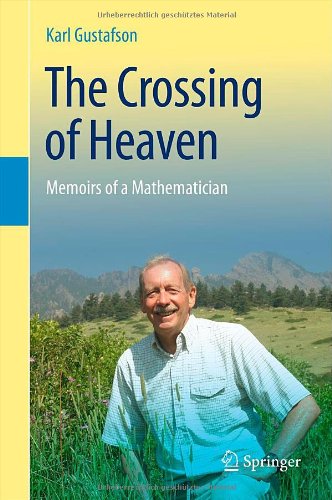
The Crossing of Heaven: Memoirs of a Mathematician


Karl Gustafson e Ioannis Antoniou
Springer | 2012 | páginas | pdf | 2,5 Mb


As one of the most prolific mathematicians of our time, Karl Gustafson has been a central figure in the astonishing technological revolution of the last half-century—a revolution which has transformed human life. This, his own account of his journey through those decades, takes the reader from his early pioneering work in computing and espionage, where his contribution was vital to the American Cold War effort, to his observations on core contemporary issues such as the stability of the world’s financial system.
Gustafson’s crucial role in top-secret military intelligence, which saw him tracking Russian submarines, intercepting electronic intelligence and writing the software for America’s first spy satellite, is related here for the first time. His narrative includes fascinating encounters with Nobel laureates and figures of historical importance, the European post-doctoral fellowships that expanded his perspectives on science and life, and hair-raising stories from his early rock-climbing days including brushes with death then and later, such as being struck by lightning and knocked unconscious near a mountain top. Gustafson’s wide-ranging mathematical accomplishments have led to invitations and travel throughout the world, and he tells of the great—and at times strange—personalities he has met along the way. His unique journey has included hard knocks and beautiful women, who have, as he likes to say, added to the great adventure.

Contents
Preface
1 The Child in Iowa.
2 The Boy in Boulder.
3 The Student in Poverty.
4 Computers and Espionage.
5 First Publication.
6 Into Academia.
7 The World Opens.
8 Personas and Personalities.
9 Wives, Lovers, Friends.- 
10 Close Calls.
11 Mathematics.
12 High Finance.
13 The Improbabilities.
14 Realities.-
15 The Crossing of Heaven.
Appendix.

Descartes's Secret Notebook: A True Tale of Mathematics, Mysticism, and the Quest to Understand the Universe

Amir D. Aczel

Broadway | 2006 | 288 páginas | rar - epub |3,23 Mb

link (password: matav)
(novo formato)

PDF | 17,5 Mb

René Descartes (1596—1650) is one of the towering and central figures in Western philosophy and mathematics. His apothegm ''Cogito, ergo sum'' marked the birth of the mind-body problem, while his creation of so-called Cartesian coordinates has made our intellectual conquest of physical space possible.
But Descartes had a mysterious and mystical side, as well. Almost certainly a member of the occult brotherhood of the Rosicrucians, he kept a secret notebook, now lost, most of which was written in code. After Descartes's death, Gottfried Leibniz, inventor of calculus and one of the greatest mathematicians of all time, moved to Paris in search of this notebook–and eventually found it in the possession of Claude Clerselier, a friend of Descartes's. Liebniz called on Clerselier and was allowed to copy only a couple of pages–which, though written in code, he amazingly deciphered there on the spot. Liebniz's hastily scribbled notes are all we have today of Descartes's notebook.
Why did Descartes keep a secret notebook, and what were its contents? The answers to these questions will lead the reader on an exciting, swashbuckling journey, and offer a fascinating look at one of the great figures of Western culture.

Contents
Acknowledgements
Introduction
Prologue: Leibniz's Search in Taris
1: The Gardens of Touraine
2: Jesuit Mathematics and the 'Pleasures of the Capital
3: The Dutch Puzzle
4: Three Dreams in an Oven by the Danube
5: The Athenians Are Vexed by a Persistent Ancient Plague
6: The Meeting with Faulhaber and the Battle of Prague
7: The Brotherhood
8: Swords at Sea and a (Meeting in the Marais
9: Descartes and the Ksicrucians
10: Italian Creations
11: Duel at Orleans, and the Siege of la Rgchelle
12: The Move to Holland and the Ghost of Galileo
13: A Secret Affair
14: Descartes' Philosophy and the Discourse on the Method
15: Descartes Understands the Ancient Delian Mystery
16: Princess Elizabeth
17: The Intrigues of Utrecht
18: The Qall of the Queen
19: The Mysterioust Death of Descartes
20: Leibniz's Quest for Descartes' Secret
21: Leibniz Breaks Descartes' Code and Solves the Mystery
A Twenty first-Century Epilogue
Notes

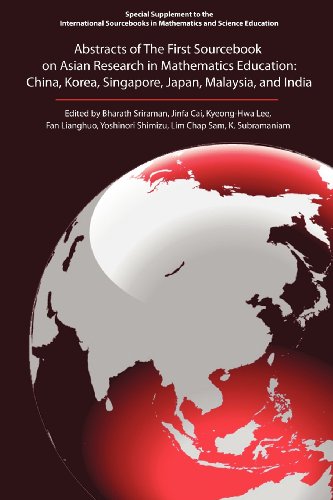
Abstracts of The First Sourcebook on Asian Research in Mathematics Education: China, Korea, Singapore, Japan, Malaysia, and India

 Bharath Sriraman, Jinfa Cai e Kyeong-Hwa Lee

Information Age Publishing LLC | 2012 | 270 páginas | rar - pdf | 3 Mb


link (password: matav)


Mathematics and Science education have both grown in fertile directions in different geographic regions. Yet, the mainstream discourse in international handbooks does not lend voice to developments in cognition, curriculum, teacher development, assessment, policy and implementation of mathematics and science in many countries. Paradoxically, in spite of advances in information technology and the "flat earth" syndrome, old distinctions and biases between different groups of researcher's persist. In addition limited accessibility to conferences and journals also contribute to this problem. 
The International Sourcebooks in Mathematics and Science Education focus on under-represented regions of the world and provides a platform for researchers to showcase their research and development in areas within mathematics and science education. The First Sourcebook on Asian Research in Mathematics Education: China, Korea, Singapore, Japan, Malaysia and India provides the first synthesized treatment of mathematics education that has both developed and is now prominently emerging in the Asian and South Asian world. The book is organized in sections coordinated by leaders in mathematics education in these countries and editorial teams for each country affiliated with them. The purpose of unique sourcebook is to both consolidate and survey the established body of research in these countries with findings that have influenced ongoing research agendas and informed practices in Europe, North America (and other countries) in addition to serving as a platform to showcase existing research that has shaped teacher education, curricula and policy in these Asian countries. The book will serve as a standard reference for mathematics education researchers, policy makers, practitioners and students both in and outside Asia, and complement the Nordic and NCTM perspectives.

Contents

CHINA
PART I: CULTURE, TRADITION, AND HISTORY
1. “Zhi Yì Xíng Nán (Knowing Is Easy and Doing Is Difficult)” or Vice Versa?: A Chinese Mathematician’s Observation on History and Pedagogy of Mathematics Activities
Man-Keung Siu . . . . 5
2. The Study on Application of Mathematics History in Mathematics Education in China
Zezhong Yang and Jian Wang . . . 7
3. Cultural Roots, Traditions, and Characteristics of Contemporary Mathematics Education in China
Xuhui Li, Dianzhou Zhang and Shiqi Li . . . 9

PART II: ASSESSMENT AND EVALUATION
4. Factors Affecting Mathematical Literacy Performance of 15-Year-Old Students in Macao: The PISA Perspective
Kwok-Cheung Cheung . . . 13
5. Has Curriculum Reform Made A Difference in the Classroom?: An Evaluation of the New Mathematics
Curriculum in Mainland China
Yujing Ni, Qiong Li, Jinfa Cai, and Kit-Tai Hau . . .  15
6. Effect of Parental Involvement and Investment on Mathematics Learning: What Hong Kong Learned
From PISA
Esther Sui Chu Ho . . . . . . 17
PART III: CURRICULUM
7. Early Algebra in Chinese Elementary Mathematics Textbooks: The Case of Inverse Operations
Meixia Ding . . . . . . . 21
8. The Development of Chinese Mathematics Textbooks for Primary and Secondary Schools Since
the Twentieth Century
Shi-hu Lv, Ting Chen, Aihui Peng, and Shangzhi Wang . . . . 23
9. Mathematics Curriculum and Teaching Materials in China from 1950–2000
Jianyue Zhang, Wei Sun, and Arthur B. Powell . . . . . . 25
10. Chinese Mathematics Curriculum Reform in the Twenty-first Century: 2000-2010
Jian Liu, Lidong Wang, Ye Sun, and Yiming Cao . . . 27
11. Basic Education Mathematics Curriculum Reform in the Greater Chinese Region: Trends and Lessons Learned
Chi-Chung Lam, Ngai-Ying Wong, Rui Ding, Siu Pang Titus Li, and Yun-Peng Ma . 29
12. Characterizing Chinese Mathematics Curriculum: A Cross-National Comparative Perspective
Larry E. Suter and Jinfa Cai . .  . . . 31

PART IV: MATHEMATICAL COGNITION
13. Promoting Young Children’s Development of Logical- Math Thinking Through Addition, Subtraction,
Multiplication, and Division in Operational Math
Zi-Juan Cheng . . . .. 35
14. Development of Mathematical Cognition in Preschool Children
Qingfen Hu and Jing Zhang . . . 37
15. Chinese Children’s Understanding of Fraction Concepts
Ziqiang Xin and Chunhui Liu . . . . . 39
16. Teaching and Learning of Number Sense in Taiwan
Der-Ching Yang . . . .. . . . . 41

17. Contemporary Chinese Investigations of Cognitive Aspects of Mathematics Learning
Ping Yu, Wenhua Yu, and Yingfang Fu . . . .. . . . 43
18. Chinese Mathematical Processing and Mathematical Brain
Xinlin Zhou, Wei Wei, Chuansheng Chen, and Qi Dong . . . . . . . . . . . . 45
PART V: TEACHING AND TEACHER EDUCATION
19. Comparing Teachers’ Knowledge on Multidigit Division Between the United States and China
Shuhua An and Song A. An . . .. . 49
20. Problem Solving in Chinese Mathematics Education: Research and Practice
Jinfa Cai, Bikai Nie, and Lijun Ye . . . . . .. 51

21. Developing a Coding System for Video Analysis of Classroom Interaction
Yiming Cao, Chen He, and Liping Ding . .. 53
22. Mathematical Discourse in Chinese Classrooms: An Insider’s Perspective
Ida Ah Chee Mok, Xinrong Yang, and Yan Zhu . .. . 55
23. Reviving Teacher Learning: Chinese Mathematics Teacher Professional Development in the Context of Educational Reform
Lynn W. Paine, Yanping Fang, and Heng Jiang .  . . . 57
24. The Status Quo and Prospect of Research on Mathematics Education for Ethnic Minorities in China
Hengjun Tang, Aihui Peng, Bifen Chen, Yu Bo, Yanping Huang, and Naiqing Song . .. . 59
25. Chinese Elementary Teachers’ Mathematics Knowledge for Teaching: Role of Subject Related Training, Mathematic Teaching Experience, and Current Curriculum Study in Shaping Its Quality
Jian Wang . . . 61

26. Why Always Greener on the Other Side?: The Complexity of Chinese and U.S. Mathematics Education
Thomas E. Ricks . .  . . 63
PART VI: TECHNOLOGY
27. A Chinese Software SSP for the Teaching and Learning of Mathematics: Theoretical and Practical Perspectives
Chunlian Jiang, Jingzhong Zhang, and Xicheng Peng . .. . 67
28. E-Learning in Mathematics Education
Siu Cheung Kong . . .. . . 69
KOREA

29. Korean Research in Mathematics Education
Kyeong-Hwa Lee, Jennifer M. Suh, Rae Young Kim, and Bharath Sriraman . . . 73
30. A Review of Philosophical Studies on Mathematics Education
JinYoung Nam . . . . . 77

31. Mathematics Curriculum
Kyungmee Park . . . .  . 79
32. Mathematics Textbooks
JeongSuk Pang . . . . . . . 81
33. Using the History of Mathematics to Teach and Learn Mathematics
Hyewon Chang . . . . . 83
34. Perspectives on Reasoning Instruction in the Mathematics Education
BoMi Shin . . .. . 85
35. Mathematical Modeling
Yeong Ok Chong . .  . . . 87

36. Gender and Mathematics
Eun Jung Lee . . . . . . 89
37. Mathematics Assessment
GwiSoo Na . . . 91
38. Examining Key Issues in Research on Teacher Education
Gooyeon Kim . .. . . . . 93
39. Trends in the Research on Korean Teachers’ Beliefs About Mathematics Education
Dong-Hwan Lee . .  . 95
SINGAPORE

40. A Review of Mathematical Problem-Solving Research Involving Students in Singapore Mathematics Classrooms (2001 to 2011): What’s Done and What More Can be Done
Chan Chun Ming Eric . . . . . . . . 99

41. Research on Singapore Mathematics Curriculum and Textbooks: Searching for Reasons Behind Students’ Outstanding Performance
Yan Zhu and Lianghuo Fan . . . 103
42. Teachers’ Assessment Literacy and Student Learning in Singapore Mathematics Classrooms
Kim Hong Koh .. . . 107
43. A Theoretical Framework for Understanding the Different Attention Resource Demands of Letter-Symbolic Versus Model Method
Swee Fong Ng . .  . . 111
44. A Multidimensional Approach to Understanding in Mathematics Among Grade 8 Students in Singapore
Boey Kok Leong, Shaljan Areepattamannil, and Berinderjeet Kaur . . . 115

MALAYSIA
45. Mathematics Education Research in Malaysia: An Overview
Chap Sam Lim, Parmjit Singh, Liew Kee Kor, and Cheng Meng Chew . . . 121
46. Research Studies in the Learning and Understanding of Mathematics: A Malaysian Context
Parmjit Singh and Sian Hoon Teoh . . . . . . 123
47. Numeracy Studies in Malaysia
Munirah Ghazali and Abdul Razak Othman . . .  . 125
48. Malaysian Research in Geometry
Cheng Meng Chew . .  . . . . 127

49. Research in Mathematical Thinking in Malaysia: Some Issues and Suggestions
Shafia Abdul Rahman  . . . 129
50. Studies About Values in Mathematics Teaching and Learning in Malaysia
Sharifah Norul Akmar Syed Zamri and Mohd Uzi Dollah . .  . . 131
51. Transformation of School Mathematics Assessment
Tee Yong Hwa, Chap Sam Lim, and Ngee Kiong Lau . . . . . . 133
52. Mathematics Incorporating Graphics Calculator Technology in Malaysia
Liew Kee Kor . .  . . . 135
53. Mathematics Teacher Professional Development in Malaysia
Chin Mon Chiew, Chap Sam Lim, and Ui Hock Cheah . . . 137

JAPAN
54. Mathematics Education Research in Japan: An Introduction
Yoshinori Shimizu . . . . . 141
55. A Historical Perspective on Mathematics Education Research in Japan
Naomichi Makinae . . . 143
56. The Development of Mathematics Education as a Research Field in Japan
Yasuhiro Sekiguchi . .  . . . 147
57. Research on Proportional Reasoning in Japanese Context
Keiko Hino . . . .. . 149
58. Japanese Student’s Understanding of School Algebra
Toshiakira Fujii . . . . . . 153

59. Proving as an Explorative Activity in Mathematics Education
Mikio Miyazaki and Taro Fujita .. . 157
60. Developments in Research on Mathematical Problem Solving in Japan
Kazuhiko Nunokawa . .  . . 161
61. Research on Teaching and Learning Mathematics With Information and Communication Technology
Yasuyuki Iijima . . . .. . . . . 165
62. “Inner Teacher”: The Role of Metacognition in Learning Mathematics and Its Implication to Improving Classroom Practice
Keiichi Shigematsu . .  . . 167
63. Cross-Cultural Studies on Mathematics Classroom Practices
Yoshinori Shimizu . . . . . . . . . . . . . . . . . . . . . . . . . . . . . . . . . . . . . . . 171
64. Systematic Support of Life-Long Professional Development for Teachers Through Lesson Study
Akihiko Takahashi . . . . . . . 175

INDIA
65. Evolving Concerns Around Mathematics as a School Discipline: Curricular Vision, Classroom Practice and the National Curriculum Framework (2005)
Farida Abdulla Khan . . . . 181
66. Curriculum Development in Primary Mathematics: The School Mathematics Project
Amitabha Mukherjee and Vijaya S. Varma . .. . . . 185
67. Intervening for Number Sense in Primary Mathematics
Usha Menon . . . . . . . 191

68. Some Ethical Concerns in Designing Upper Primary Mathematics Curriculum: A Report From the Field
Jayasree Subramanian, Sunil Verma, and Mohd. Umar . . . . . 199
69. Students’ Understanding of Algebra and Curriculum Reform
Rakhi Banerjee . . . .. . 207
70. Professional Development of In-Service Mathematics Teachers in India
Ruchi S. Kumar, K. Subramaniam, and Shweta Naik . . . . . 213
71. Insights Into Students’ Errors Based on Data From Large-Scale Assessments
Aaloka Kanhere, Anupriya Gupta, and Maulik Shah .  . . 219
72. Assessment of Mathematical Learning: Issues and Challenges
Shailesh Shirali . . . . 227

73. Technology and Mathematics Education: Issues and Challenges 233
Jonaki B. Ghosh . . .  . . 233
74. Mathematics Education in Precolonial and Colonial South India
Senthil Babu D. . . . . .. . . . . 243
75. Representations of Numbers in the Indian Mathematical Tradition of Combinatorial Problems
Raja Sridharan and K. Subramaniam . . .  . . 249


Outros livros sobre o ensino da matemática na região asiática: