segunda-feira, 31 de março de 2014

Mathematics Galore!, The First Five Years of the St. Mark’s Institute of Mathematics


 (Classroom Resource Materials)

James Tanton 


Mathematical Association of America | 2012 | 289 | pdf | 3,3 Mb


link


Mathematics Galore! Showcases some of the best activities and student outcomes of the St. Mark s Institute of Mathematics and invites you to engage the mathematics yourself! Revel in the delight of deep intellectual play and marvel at the heights to which young scholars can rise. See some great mathematics explained and proved via natural and accessible means.
Based on 26 essays ( newsletters ) and eight additional pieces,Mathematics Galore! offers a large sample of mathematical tidbits and treasures, each immediately enticing, and each a gateway to layers of surprising depth and conundrum. Pick and read essays in no particular order and enjoy the mathematical stories that unfold. Be inspired for your courses, your math clubs and your math circles, or simply enjoy for yourself the bounty of research questions and intriguing puzzlers that lie within.

Contents
Introduction;
Newsletters and commentaries;
1. Arctangents;
2. Benford's Law;
3. Braids;
4. CLIP Theory;
5. Dots and dashes;
6. Factor trees;
7. Folding fractions and conics;
8. Folding patterns and dragons;
9. Folding and pouring;
10. Fractions;
11. Integer triangles;
12. Lattice polygons;
13. Layered tilings;
14. The middle of a triangle;
15. Partitions;
16. Personalized polynomials;
17. Playing with Pi;
18. Pythagoras's Theorem;
19. On reflection;
20. Repunits and primes;
21. The Stern-Brocot Tree;
22. Tessellations;
23. Theon's ladder and squangular numbers;
24. Tilings and theorems;
25. The Tower of Hanoi;
26. Weird multiplication;
Appendices:
1. Numbers that are the sum of two squares;
2. Pick's theorem;
3. The Mobius function;
4. The Borsuk-Ulam theorem;
5. Galilean ratios;
6. A candy-sharing game;
7. Bending Buffon's needle;
8. On separating dots;
Indexes:
1. Index of terms;
2. Index of topics;
3. Classic theorems proved.


Outros livros do mesmo autor:


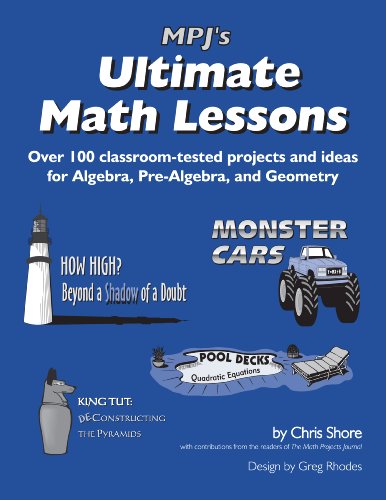
MPJ's Ultimate Math Lessons


Chris Shore

Math Projects Journal | 2011 | 294 páginas | rar - pdf | 22 Mb


link (password : matav)

MPJ's Ultimate Math Lessons is a resource for teachers of Algebra, Pre-Algebra, and Geometry in grades 6–12. It contains 80 innovative lessons and 27 thought-provoking articles taken directly from theMath Projects Journal, a periodical that, for more than six years, has helped teachers around the world improve student performance in mathematics.

Contents
Introduction
The MPJ Story
Acknowledgements
PRE-ALGEBRA LESSONS
How Big is Barbie
M&M Count and Crunch
Counting Fish
Donlt Break my Stride
4-Digit Problem
Wallflowers
The Postman Always Rings Twice
Piggy Banks
Candy Bars
Brownies
Beef Jerky
Playing with a Full Deck
ALGEBRA LESSONS
Number Tricks
11m Thinking of a Number...
Pig Pen Algebra
Rule Quest
Rising Water
The Student-Generated Word Problem
Algebra Walk
Staircases & Ramps
Tumbling Cars
Monster Cars
The Jogging Hare
CoolShoes.com
Land Cruiser
Stixture Problems
The Tortoise and The Hare
Rescue Mission
The X-Files
Olympic Swim Times
Robotic Disney
The Migratory Paths of Birds
Empty Box
The Pizza Box
Pool Decks
The Coin Fountain
Parabolic Pizza
Town Grid
The Billabong and the Bush
Zeno's Bouncing Ball
Calculator Logos
Original Works
GEOMETRY LESSONS
How High: Beyond a Shadow of a Doubt
How High: The Right Stuff
How High: Surveyor1s Trig Trick
How High: Do You Have the Inclination?
How High: The Chinese Difference
The Mason's Secret
The America1s Cup Sail
The Fire-Fish Story
Baseball Congruency
Shipping Conundrum
The Gum Drop
A Slice of Pi
Poison Weed
Polygon House
Swimming Pools
King Tut
The Luxor
The Shopkeeper1s Jar
Super Size ItI
Can There Be Giants?
Whatever Floats Your Boat
Shot Put Arc
Strike a Chord
Reflection Golf
Kaleidoscope
William Tell
The Selling of America
The Vector Map
Princess Dido and the Ox Skin
ARTICLES
QM14.5
TIMSS: A Call for Substance
TIMSS: A Tale of Three Countries
TIMSS: A TIMSS Primer
A Mountain of Vision
Portfolios
A Struggle Among Equals
Nuts & Bolts
Kicking the Habit
On a Good Day
Sleeping with the Enemy
Inside & Out
Measurement
Teaching Backwards
Ultimate Cosmic Power
Cannonballs and Concepts
Graphing for Meaning
Beavis and Barbie
Still All Full of Stuffinl
Godzilla or Godzuki
Sculpting Young Thinkers
Christmas Carols and Disco Tunes
Martian Math
The Economy of Thought
Universal Remote
The Railroad and the Kayak
Fluff-n-Stuff
Lesson Studies
Inspiration, Perspiration, Desperation
ADDITIONAL ACTIVITIES
The Dentists Puzzle
Psychic Probability
Around the World
Red Dot - Green Dot
The Tic-Tac Equation
The Handyman's Math Trick
Brother in the Box
Mega Translation
Age Trick
Math Walk
Twenty-One
Wipeout
Index

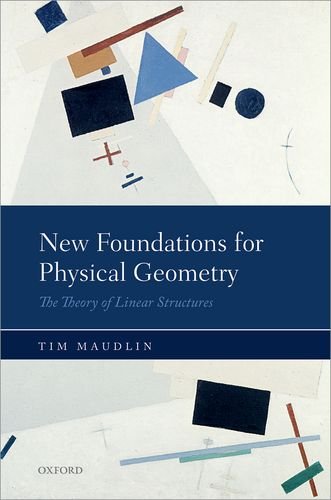
New Foundations for Physical Geometry: The Theory of Linear Structures

 
Tim Maudlin

Oxford University Press | 2014 | 374 páginas | rar - pdf | 1,94 Mb


link (password: matav)


Topology is the mathematical study of the most basic geometrical structure of a space. Mathematical physics uses topological spaces as the formal means for describing physical space and time. This book proposes a completely new mathematical structure for describing geometrical notions such as continuity, connectedness, boundaries of sets, and so on, in order to provide a better mathematical tool for understanding space-time. This is the initial volume in a two-volume set, the first of which develops the mathematical structure and the second of which applies it to classical and Relativistic physics.
The book begins with a brief historical review of the development of mathematics as it relates to geometry, and an overview of standard topology. The new theory, the Theory of Linear Structures, is presented and compared to standard topology. The Theory of Linear Structures replaces the foundational notion of standard topology, the open set, with the notion of a continuous line. Axioms for the Theory of Linear Structures are laid down, and definitions of other geometrical notions developed in those terms. Various novel geometrical properties, such as a space being intrinsically directed, are defined using these resources. Applications of the theory to discrete spaces (where the standard theory of open sets gets little purchase) are particularly noted. The mathematics is developed up through homotopy theory and compactness, along with ways to represent both affine (straight line) and metrical structure.
ContentsAcknowledgments x
Introduction 1
Metaphorical and Geometrical Spaces 6
A Light Dance on the Dust of the Ages 9
The Proliferation of Numbers 12
Descartes and Coordinate Geometry 14
John Wallis and the Number Line 16
Dedekind and the Construction of Irrational Numbers 20
Overview and Terminological Conventions 25
1. Topology and Its Shortcomings 28
Standard Topology 31
Closed Sets, Neighborhoods, Boundary Points, and Connected Spaces 33
The Hausdorff Property 36
Why Discrete Spaces Matter 45
The Relational Nature of Open Sets 47
The Bill of Indictment (So Far) 49
2. Linear Structures, Neighborhoods, Open Sets 54
Methodological Morals 54
The Essence of the Line 57
The (First) Theory of Linear Structures 59
Proto-Linear Structures 69
Discrete Spaces, Mr Bush’s Wild Line, the Woven Plane, and the Affine Plane 74
A Taxonomy of Linear Structures 79
Neighborhoods in a Linear Structure 81
Open Sets 85
Finite-Point Spaces 86
Return to Intuition 89
Directed Linear Structures 92
Linear Structures and Directed Linear Structures 96
Neighborhoods, Open Sets, and Topologies Again 97
Finite-Point Spaces and Geometrical Interpretability 99
A Geometrically Uninterpretable Topological Space 103
Segment-Spliced Linear Structures 104
Looking Ahead 107
Exercises 107
Appendix: Neighborhoods and Linear Structures 108
3. Closed Sets, Open Sets (Again), Connected Spaces 113
Closed Sets: Preliminary Observations 113
Open and Closed Intervals 114
IP-closed and IP-open Sets 115
IP-open Sets and Open Sets, IP-closed Sets and Closed Sets 117
Zeno’s Combs 120
Closed Sets, Open Sets, and Complements 123
Interiors, Boundary Points, and Boundaries 127
Formal Properties of Boundary Points 136
Connected Spaces 140
Chains and Connectedness 143
Directedness and Connectedness 148
Exercises 150
4. Separation Properties, Convergence, and Extensions 152
Separation Properties 152
Convergence and Unpleasantness 155
Sequences and Convergence 160
Extensions 163
The Topologist’s Sine Curve 165
Physical Interlude: Thomson’s Lamp 168
Exercises 172
5. Properties of Functions 174
Continuity: an Overview 174
The Intuitive Explication of Continuity and Its Shortcomings 175
The Standard Definition and Its Shortcomings 178
What the Standard Definition of “Continuity” Defines 183
The Essence of Continuity 186
Continuity at a Point and in a Direction 190
An Historical Interlude 192
Remarks on the Architecture of Definitions; Lineal Functions 194
Lines and Continuity in Standard Topology 199
Exercises 201
6. Subspaces and Substructures; Straightness and Differentiability 203
The Geometrical Structure of a Subspace: Desiderata 203
Subspaces in Standard Topology 205
Subspaces in the Theory of Linear Structures 206
Substructures 211
One Way Forward 218
Euclid’s Postulates and the Nature of Straightness 220
Convex Affine Spaces 227
Example: Some Conical Spaces 233
Tangents 235
Upper and Lower Tangents, Differentiability 244
Summation 253
Exercises 254
7. Metrical Structure 256
Approaches to Metrical Structure 256
Ratios Between What? 258
The Additive Properties of Straight Lines 260
Congruence and Comparability 262
Eudoxan and Anthyphairetic Ratios 274
The Compass 280
Metric Linear Structures and Metric Functions 285
Open Lines, Curved Lines, and Rectification 287
Continuity of the Metric 291
Exercises 294
Appendix: A Remark about Minimal Regular Metric Spaces 294
8. Product Spaces and Fiber Bundles 297
New Spaces from Old 297
Constructing Product Linear Structures 300
Examples of Product Linear Structures 303
Neighborhoods and Open Sets in Product Linear Structures 307
Fiber Bundles 309
Sections 313
Additional Structure 315
Exercises 318
9. Beyond Continua 320
How Can Continua and Non-Continua Approximate Each Other? 320
Continuous Functions 321
Homotopy 334
Compactness 339
Summary of Mathematical Results and Some Open Questions 345
Exercises 346
Axioms and Definitions 347

Bibliography 358
Index 361

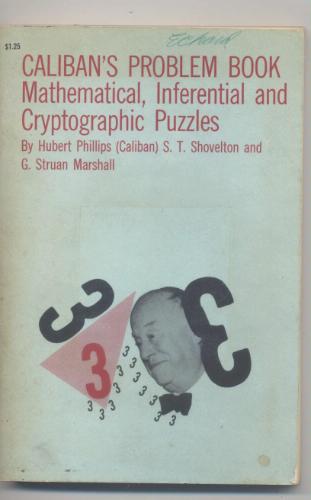
Caliban's Problem Book: Mathematical, Inferential and Cryptographic Puzzles

Hubert C. Phillips

 Dover Publications | 1961 | 191 páginas | djvu | 1,4 Mb


link
link1


The SimCalc Vision and Contributions: Democratizing Access to Important Mathematics


 (Advances in Mathematics Education, 4)

Stephen J. Hegedus e Jeremy Roschelle

 Springer | 2013 | 471 páginas | rar - pdf | 9 Mb

link (password : matav)

This volume provides essential guidance for transforming mathematics learning in schools through the use of innovative technology, pedagogy, and curriculum. It presents clear, rigorous evidence of the impact technology can have in improving students learning of important yet complex mathematical concepts - and goes beyond a focus on technology alone to clearly explain how teacher professional development, pedagogy, curriculum, and student participation and identity each play an essential role in transforming mathematics classrooms with technology. Further, evidence of effectiveness is complemented by insightful case studies of how key factors lead to enhancing learning, including the contributions of  design research, classroom discourse, and meaningful assessment. 
The volume organizes over 15 years of sustained research by multiple investigators in different states and countries who together developed an approach called "SimCalc" that radically transforms how Algebra and Calculus are taught.
The SimCalc program engages students around simulated motions, such as races on a soccer field, and builds understanding using visual representations such as graphs, and familiar representations such as stories to help students to develop meaning for more abstract mathematical symbols. Further, the SimCalc program leverages classroom wireless networks to increase participation by all students in doing, talking about, and reflecting on mathematics. Unlike many technology programs, SimCalc research shows the benefits of balanced attention to curriculum, pedagogy, teacher professional development, assessment and technology - and has proven effectiveness results at the scale of hundreds of schools and classrooms.
Combining the findings of multiple investigators in one accessible volume reveals the depth and breadth of the research program, and engages readers interested in:
*        Designing innovative curriculum, software, and professional development
·         Effective uses of technology to improve mathematics education
*        Creating integrated systems of teaching that transform mathematics classrooms
*        Scaling up new pedagogies to hundreds of schools and classrooms
*       Conducting research that really matters for the future of mathematics learning


*        Engaging students in deeply learning the important concepts in mathematics

Contents
Part I Philosophy & Background
Ubiratan D’Ambrosio
Introduction: Major Themes, Technologies, and Timeline  . 5
Jeremy Roschelle and Stephen Hegedus
The Mathematics of Change and Variation from a Millennial Perspective: New Content, New Context .. 13
James J. Kaput and Jeremy Roschelle
From Static to Dynamic Mathematics: Historical and Representational Perspectives . .. 27
Luis Moreno-Armella and Stephen Hegedus
Intersecting Representation and Communication Infrastructures .. . 47
Stephen Hegedus and Luis Moreno-Armella
Part II Aspects of Design
Reflections on Significant Developments in Designing SimCalc Software . 65
James Burke, Stephen Hegedus, and Ryan Robidoux
Designing for Generative Activities: Expanding Spaces for Learning and Teaching . . . . 85
Nancy Ares
SimCalc and the Networked Classroom . . .. . 99
Corey Brady, Tobin White, Sarah Davis, and Stephen Hegedus
Part III Impacts from Large-Scale Research
Jinfa Cai
SimCalc at Scale: Three Studies Examine the Integration of Technology, Curriculum, and Professional Development for Advancing Middle School Mathematics .  . 125
Jeremy Roschelle and Nicole Shechtman
Learning and Participation in High School Classrooms . . 145
Sara Dalton and Stephen Hegedus
Development of Student and Teacher Assessments in the Scaling Up SimCalc Project  . 167
Nicole Shechtman, Geneva Haertel, Jeremy Roschelle, Jennifer Knudsen, and Corinne Singleton
Sustainable Use of Dynamic Representational Environments: Toward a District-Wide Adoption of SimCalc-Based Materials . . 183
Phil Vahey, George J. Roy, and Vivian Fueyo
Impact of Classroom Connectivity on Learning and Participation .  203
Stephen Hegedus, Luis Moreno-Armella, Sara Dalton, Arden Brookstein, and John Tapper
Part IV Impacts from Small-Scale Research
Mathematical Discourse as a Process that Mediates Learning in SimCalc Classrooms . . 233
Jessica Pierson Bishop
Scaling Up Innovative Mathematics in the Middle Grades: Case Studies of “Good Enough” Enactments .  . . 251
Susan B. Empson, Steven Greenstein, Luz Maldonado, and Jeremy Roschelle
Changing from the Inside Out: SimCalc Teacher Changes in Beliefs and Practices . . 271
John Tapper
Connection Making: Capitalizing on the Affordances of Dynamic Representations Through Mathematically Relevant Questioning . . 285
Chandra Hawley Orrill
“They Need to Be Solid in Standard Skills First”: How Standards Can Become the Upper Bound  299
Margaret Dickey-Kurdziolek and Deborah Tatar
Part V International Contributions
Developing and Enhancing Elementary School Students’ Higher Order Mathematical Thinking with SimCalc .  319
Demetra Pitta-Pantazi, Paraskevi Sophocleous, and Constantinos Christou Adapting SimCalc to Different School Mathematics Cultures: A Case Study from Brazil . . 341
Rosana Nogueira de Lima, Lulu Healy, and Tânia M.M. Campos
Mathematical Modeling with SimCalc: Enhancing Students’ Complex Problem Solving Skills Using a Modeling Approach . . . 363
Nicholas G. Mousoulides
Approaching Calculus with SimCalc: Linking Derivative and Antiderivative . . . 383
Patricia Salinas
Part VI Extensions, Commentaries, & Future Visions
You Can Lead a Horse to Water: Issues in Deepening Learning Through Deepening Teaching .. 403
John Mason
Modeling as a Means for Making Powerful Ideas Accessible to Children at an Early Age . 419
Richard Lesh, Lyn English, Serife Sevis, and Chanda Riggs
The Kaputian Program and Its Relation to DNR-Based Instruction: A Common Commitment to the Development of Mathematics with Meaning .  437
Guershon Harel
The Evolution of Technology and the Mathematics of Change and Variation: Using Human Perceptions and Emotions to Make Sense of Powerful Ideas . .449
David Tall
Conversation About SimCalc, Its Evolution and Lessons Along the Way . 463
Eric Hamilton and Nora Sabelli
Index . . . 475

Wizards, aliens, and starships : physics and math in fantasy and science fiction

Charles L. Adler

Princeton University Press | 2014 | 392 páginas | rar - epub | 2,05 Mb

link (password: matav)

(novo formato)

Wizards, Aliens, and Starships will speak to anyone wanting to know about the correct--and incorrect--science of science fiction and fantasy.


From teleportation and space elevators to alien contact and interstellar travel, science fiction and fantasy writers have come up with some brilliant and innovative ideas. Yet how plausible are these ideas--for instance, could Mr. Weasley's flying car in the Harry Potter books really exist? Which concepts might actually happen, and which ones wouldn't work at all? Wizards, Aliens, and Starships delves into the most extraordinary details in science fiction and fantasy--such as time warps, shape changing, rocket launches, and illumination by floating candle--and shows readers the physics and math behind the phenomena.
With simple mathematical models, and in most cases using no more than high school algebra, Charles Adler ranges across a plethora of remarkable imaginings, from the works of Ursula K. Le Guin to Star Trek and Avatar, to explore what might become reality. Adler explains why fantasy in the Harry Potter and Dresden Files novels cannot adhere strictly to scientific laws, and when magic might make scientific sense in the muggle world. He examines space travel and wonders why it isn't cheaper and more common today. Adler also discusses exoplanets and how the search for alien life has shifted from radio communications to space-based telescopes. He concludes by investigating the future survival of humanity and other intelligent races. Throughout, he cites an abundance of science fiction and fantasy authors, and includes concise descriptions of stories as well as an appendix on Newton's laws of motion.

CONTENTS
1 PLAYING THE GAME 1
1.1 The Purpose of the Book 1
1.2 The Assumptions I Make 3
1.3 Organization 4
1.4 The Mathematics and Physics You Need 5
1.5 Energy and Power 6
I POTTER PHYSICS 11
2 HARRY POTTER AND THE GREAT CONSERVATION LAWS 13
2.1 The Taxonomy of Fantasy 13
2.2 Transfiguration and the Conservation of Mass 14
2.3 Disapparition and the Conservation of Momentum 16
2.4 Reparo and the Second Law of Thermodynamics 21
3 WHY HOGWARTS IS SO DARK 27
3.1 Magic versus Technology 27
3.2 Illumination 28
4 FANTASTIC BEASTS AND HOW TO DISPROVE THEM 38
4.1 Hic sunt Dracones 38
4.2 How to Build a Giant 39
4.3 Kleiber’s Law, Part 1: Mermaids 45
4.4 Kleiber’s Law, Part 2: Owls, Dragons, Hippogriffs, and Other Flying Beasts 49
II SPACE TRAVEL 57
5 WHY COMPUTERS GET BETTER AND CARS CAN’T (MUCH) 59
5.1 The Future of Transportation 59
5.2 The Reality of Space Travel 61
5.3 The Energetics of Computation 63
5.4 The Energetics of the Regular and the Flying Car 64
5.5 Suborbital Flights 68
6 VACATIONS IN SPACE 71
6.1 The Future in Science Fiction: Cheap, Easy Space Travel? 71
6.2 Orbital Mechanics 74
6.3 Halfway to Anywhere: The Energetics of Spaceflight 74
6.4 Financing Space Travel 82
7 SPACE COLONIES 86
7.1 Habitats in Space 86
7.2 O’Neill Colonies 87
7.3 Matters of Gravity 89
7.4 Artificial “Gravity” on a Space Station 93
7.5 The Lagrange Points 103
7.6 Off-Earth Ecology and Energy Issues 106
7.7 The Sticker Price 112
8 THE SPACE ELEVATOR 115
8.1 Ascending into Orbit 115
8.2 The Physics of Geosynchronous Orbits 116
8.3 What Is a Space Elevator, and Why Would We Want One? 118
8.4 Why Buildings Stand Up—or Fall Down 119
8.5 Stresses and Strains: Carbon Nanotubes 122
8.6 Energy, “Climbers,” Lasers, and Propulsion 123
8.7 How Likely Is It? 125
8.8 The Unapproximated Elevator 127
9 MANNED INTERPLANETARY TRAVEL 130
9.1 It’s Not an Ocean Voyage or a Plane Ride 130
9.2 Kepler’s Three Laws 131
9.3 The Hohmann Transfer Orbit 134
9.4 Delta v and All That 136
9.5 Getting Back 137
9.6 Gravitational Slingshots and Chaotic Orbits 138
9.7 Costs 142
10 ADVANCED PROPULSION SYSTEMS 145
10.1 Getting There Quickly 145
10.2 Why Chemical Propulsion Won’t Work 146
10.3 The Most Famous Formula in Physics 147
10.4 Advanced Propulsion Ideas 148
10.5 Old “Bang-Bang”: The Orion Drive 153
10.6 Prospects for Interplanetary Travel 155
11 SPECULATIVE PROPULSION SYSTEMS 157
11.1 More Speculative Propulsion Systems 157
11.2 Mass Ratios for Matter-Antimatter Propulsion Systems 168
11.3 Radiation Problems 173
12 INTERSTELLAR TRAVEL AND RELATIVITY 176
12.1 Time Enough for Anything 176
12.2 Was Einstein Right? 178
12.3 Some Subtleties 182
12.4 Constant Acceleration in Relativity 184
13 FASTER-THAN-LIGHT TRAVEL AND TIME TRAVEL 188
13.1 The Realistic Answer 188
13.2 The Unrealistic Answer 188
13.3 Why FTL Means Time Travel 190
13.4 The General Theory 193
13.5 Gravitational Time Dilation and Black Holes 195
13.6 Wormholes and Exotic Matter 198
13.7 The Grandfather Paradox and Other Oddities 205
III WORLDS AND ALIENS 215
14 DESIGNING A HABITABLE PLANET 217
14.1 Adler’s Mantra 218
14.2 Type of Star 221
14.3 Planetary Distance from Its Star 226
14.4 The Greenhouse Effect 229
14.5 Orbital Eccentricity 232
14.6 Planetary Size and Atmospheric Retention 233
14.7 The Anna Karenina Principle and Habitable Planets 237
14.8 Imponderables 239
15 THE SCIENTIFIC SEARCH FOR SPOCK 242
15.1 Exoplanets and Exoplants 242
15.2 Doppler Technique 246
15.3 Transits and the Kepler Mission 249
15.4 The Spectral Signatures of Life 250
15.5 Alien Photosynthesis 251
16 THE MATHEMATICS OF TALKING WITH ALIENS 255
16.1 Three Views of Alien Intelligences 255
16.2 Motivation for Alien Contact 259
16.3 Drake-Equation Models and the Mathematics of Alien Contact 267
IV YEAR GOOGOL 273
17 THE SHORT-TERM SURVIVAL OF HUMANITY 275
17.1 This Is the Way the World Will End 275
17.2 The Short-Term: Man-Made Catastrophes 275
18 WORLD-BUILDING 292
18.1 Terraforming 292
18.2 Characteristics of Mars 294
18.3 Temperature and the Martian Atmosphere 295
18.4 Atmospheric Oxygen 299
18.5 Economics 301
19 DYSON SPHERES AND RINGWORLDS 303
19.1 Dyson’s Sphere 303
19.2 The Dyson Net 305
19.3 Niven’s Ringworld 311
19.4 The Ringworld, GPS, and Ehrenfest’s Paradox 318
19.5 The Ringworld Is Unstable! 320
19.6 Getting There from Here—and Do We Need To? 324
20 ADVANCED CIVILIZATIONS AND THE KARDASHEV SCALE 326
20.1 The Kardashev Scale 326
20.2 Our Type 0.7 Civilization 327
20.3 Type I Civilizations 329
20.4 Moving Upward 331
20.5 Type II Civilizations 332
20.6 Type III Civilizations 334
21 A GOOGOL YEARS 336
21.1 The Future of the Future 336
21.2 The “Short Term”: Up to 500 Million Years or so 336
21.3 The “Medium Term”: Up to about 1013 Years 338
21.4 The “Long Term”: Up to a Googol Years 341
21.5 Black Hole–Powered Civilizations 344
21.6 Protons Decay—or Do They? 346
21.7 A Googol Years—All the Black Holes Evaporate 346
21.8 Our Last Bow 349
Acknowledgments 351
Appendix: Newton’s Three Laws of Motion 353
Bibliography 359
Index 371
domingo, 30 de março de 2014

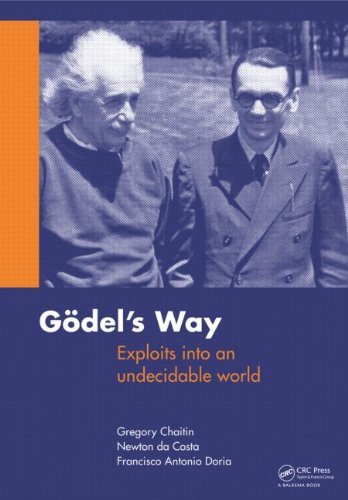
Goedel's Way: Exploits into an undecidable world


Gregory Chaitin, Francisco A Doria e Newton C.A. da Costa

CRC Press | 2011 | 162 páginas | pdf | 1,1 Mb


link

Kurt Gödel (1906-1978) was an Austrian-American mathematician, who is best known for his incompleteness theorems. He was the greatest mathematical logician of the 20th century, with his contributions extending to Einstein’s general relativity, as he proved that Einstein’s theory admits time machines. 
The Gödel incompleteness theorem - one cannot prove nor disprove all true mathematical sentences in the usual formal mathematical systems- is frequently presented in textbooks as something that happens in the rarefied realm of mathematical logic, and that has nothing to do with the real world. Practice shows the contrary though; one can demonstrate the validity of the phenomenon in various areas, ranging from chaos theory and physics to economics and even ecology. In this lively treatise, based on Chaitin’s groundbreaking work and on the da Costa-Doria results in physics, ecology, economics and computer science, the authors show that the Gödel incompleteness phenomenon can directly bear on the practice of science and perhaps on our everyday life.
This accessible book gives a new, detailed and elementary explanation of the Gödel incompleteness theorems and presents the Chaitin results and their relation to the da Costa-Doria results, which are given in full, but with no technicalities. Besides theory, the historical report and personal stories about the main character and on this book’s writing process, make it appealing leisure reading for those interested in mathematics, logic, physics, philosophy and computer science.

See also: http://www.youtube.com/watch?v=REy9noY5Sg8

Contents
1. Gödel, Turing 
2. Complexity, randomness 
3. A list of problems 
4. The halting function and its avatars 
5. Entropy, P vs. NP
6. Forays into uncharted landscapes.


The Child’s Conception of Geometry


Jean Piaget, Barbel Inhelder e Alina Szeminska

International Library of Psychology


Routledge |1999 - 2ª edição | 420 páginas | rar - pdf |7,9 Mb

link (password: matav)

The Child’s Conception of Geometry examines the development of geometric concepts in young children.
This volume from Piaget’s laboratory in Geneva deals primarily with the development of notions of measurement and geometrical concepts like coordinates, angles, and areas. It is a companion piece to The Child’s Conception of Space.

CONTENTS
Preface page vii
PART ONE - INTRODUCTION
I Change of Position 3
II Spontaneous Measurement 27
PART TWO - CONSERVATION AND MEASUREMENT OF LENGTH
III Reconstructing Relations of Distance 69
IV Change of Position and the Conservation of Length 90
V The Conservation and Measurement of Length 104
VI Subdividing a Straight Line 128
PART THREE - RECTANGULAR COORDINATES, ANGLES AND CURVES
VII Locating a Point in Two or Three Dimensional Space 153
VIII Angular Measurement 173
IX Two Problems of Geometrical Loci: the Straight Line and the Circle 209
X Representation of Circles, Mechanical and Composite Curves 226
PART FOUR - AREAS AND SOLIDS
XI The Conservation and Measurement of an Area and Subtracting Smaller Congruent Areas from Larger Congruent Areas 
XII Subdivision of Areas and the Concept of Fractions 302
XIII Doubling an Area or a Volume 336
XIV The Conservation and Measurement of Volume 354
PART FIVE CONCLUSIONS
XV The Construction of Euclidean Space: Three Levels 389
Index 409

Mathematics of the Transcendental: Onto-logy and being-there


Alain Badiou, A.J. Bartlett e Alex Ling

Bloomsbury Academic | 2014 | 291 páginas | rar - pdf | 2,74 Mb

link (password : matav)

In Mathematics of the Transcendental, Alain Badiou painstakingly works through the pertinent aspects of Category Theory, demonstrating their internal logic and veracity, their derivation and distinction from Set Theory, and the 'thinking of being'. In doing so he sets out the basic onto-logical requirements of his greater and transcendental logics as articulated in his magnum opus, Logics of Worlds. This important book combines both his elaboration of the disjunctive synthesis between ontology and onto-logy (the discourses of being as such and being-appearing) from the perspective of Category Theory and the categorial basis of his philosophical conception of 'being there'.
Hitherto unpublished in either French or English, Mathematics of the Transcendental provides Badiou's readers with a much-needed complete elaboration of his understanding and use of Category Theory. The book is an essential aid to understanding the mathematical and logical basis of his theory of appearing as elaborated in Logics of Worlds and other works and is essential reading for his many followers.

TABLE OF CONTENTS
Translators’ Introduction: The Categorial Imperative 1
PART ONE TOPOS, OR LOGICS OF ONTO-LOGY: AN INTRODUCTION FOR PHILOSOPHERS 11
1 General Aim 13
2 Preliminary Definitions 17
3 The Size of a Category 21
4 Limit and Universality 27
5 Some Fundamental Concepts 29
6 Duality 37
7 Isomorphism 41
8 Exponentiation 45
9 Universe, 1: Closed Cartesian Categories 51
10 Structures of Immanence, 1: Philosophical Considerations 55
11 Structures of Immanence, 2: Sub-Object 59
12 Structures of Immanence, 3: Elements of an Object 63
13 ‘Elementary’ Clarification of Exponentiation 67
14 Central Object (or Sub-Object Classifier) 71
15 The True, the False, Negation and More 77
16 The Central Object as Linguistic Power 85
17 Universe, 2: The Concept of Topos 89
18 Ontology of the Void and Difference 95
19 Mono., Epi., Equ., and Other Arrows 99
20 Topoi as Logical Places 113
21 Internal Algebra of 1 123
22 Ontology of the Void and Excluded Middle 141
23 A Minimal Classical Model 147
24 A Minimal Non-Classical Model 151
PART TWO BEING THERE: MATHEMATICS OF THE TRANSCENDENTAL 163
Introduction 165
A. Transcendental Structures 171
B. Transcendental Connections 183
B.1. Connections between the transcendental and set-theoretic ontology: Boolean algebras 183
B.2. Connections between the transcendental and logic in its ordinary sense (propositional logic and first order predicate logic) 195
B.3. Connection between the transcendental and the general theory of localizations: Topology 202
C. Theory of Appearing and Objectivity 217
D. Transcendental Projections: Theory of Localization 235
E. Theory of Relations: Situation as Universe 249
Appendix: On Three Different Concepts of Identity Between Two
Multiples or Two Beings 265
Translator’s Endnotes 269
Index 277


150 Puzzles in Crypt-Arithmetic


Maxey Brooke

Dover | 1963 | 77 páginas | pdf | 1,1 Mb

link
link1
scribd.com

Harmony of the World - 75 Years of Mathematics Magazine


Gerald L. Alexanderson e Peter Ross 


 Mathematical Association of America | 2007 | 302 páginas | rar - pdf |3,8 Mb

link (password : matav)

Who would expect to find in the pages of Mathematics Magazine the first full treatment of one of the more important and oft-cited twentieth century theorems in analysis, the Stone-Weierstrass Theorem in an article by Marshall Stone himself? Where else would one look for proofs of trigonometric identities using commutative ring theory? Or one of the earliest and best expository articles on the then new Jones knot polynomials, an article that won the prestigious Chauvenet Prize? Or an amusing article purporting to show that the value of has been time dependent over the years? These and much more are in this collection of the best from Mathematics Magazine. Readers are inundated with new material in the many mathematical journals. Gems from past issues of Mathematics Magazine or the Monthly or the College Mathematics Journal are read with pleasure when they appear but get pushed into the background when the next issues arrive. So from time to time it is rewarding to go back and see just what marvelous material has been published over many years, articles now to some extent forgotten. There is history of mathematics (algebraic numbers, inequalities, probability and the Lebesgue integral, quaternions, Pólya s enumeration theorem, and group theory) and stories of mathematicians (Hypatia, Gauss, E. T. Bell, Hamilton, and Euler). The list of authors is star-studded: E. T. Bell, Otto Neugebauer, D. H. Lehmer, Morris Kline, Einar Hille, Richard Bellman, Judith Grabiner, Paul Erdos, B. L. van der Waerden, Paul R. Halmos, Doris Schattschneider, J. J. Burckhardt, Branko Grunbaum, and many more. Eight of the articles included have received the Carl B. Allendoerfer or Lester R. Ford Awards.

Contents
The name of each article is followed by a notation indicating the field of mathematics from which it comes: (Al) algebra, (AM) applied mathematics, (An) analysis, (CG) combinatorics and graph theory, (G) geometry, (H) history, (L) logic, (M) miscellaneous, (NT) number theory, (PS) probability/statistics, and (T) topology.
Introduction .  .vii
A Brief History of Mathematics Magazine .  . xi
Part I: The First Fifteen Years .. .1
Perfect Numbers, Zena Garrett (NT) .. .3
Rejected Papers of Three Famous Mathematicians, Arnold Emch (H) .  5
Review of Men of Mathematics, G. Waldo Dunnington (H) .. 9
Oslo under the Integral Sign, G. Waldo Dunnington (H) . 11
Vigeland’s Monument to Abel in Oslo, G. Waldo Dunnington (H) . .19
The History of Mathematics, Otto Neugebauer (H) . .. .23
Numerical Notations and Their Influence on Mathematics, D. H. Lehmer (NT) .  .29
Part II: The 1940s  .33
The Generalized Weierstrass Approximation Theorem, Marshall H. Stone (An) . . .35
Hypatia of Alexandria, A. W. Richeson (H) .. . 45
Gauss and the Early Development of Algebraic Numbers, E. T. Bell (Al)  . . 51
Part III: The 1950s . . 69
The Harmony of the World, Morris Kline (M) .. 71
What Mathematics Has Meant to Me, E. T. Bell (M) .. .79
Mathematics and Mathematicians from Abel to Zermelo, Einar Hille (H) .  81
Inequalities, Richard Bellman (An) . . 95
A Number System with an Irrational Base, George Bergman (NT) . 99
Part IV: The 1960s  .107
Generalizations of Theorems about Triangles, Carl B. Allendoerfer (G) . .109
A Radical Suggestion, Roy J. Dowling (NT) . .115
Topology and Analysis, R. C. Buck (An, T). 117
The Sequence fsin ng, C. Stanley Ogilvy (An) . .. . 121
Probability Theory and the Lebesgue Integral, Truman Botts (PS) . . . 123
On Round Pegs in Square Holes and Square Pegs in Round Holes, David Singmaster (G) . . 129
t : 1832–1879, Underwood Dudley (M) . . . . 133
Part V: The 1970s .  . 135
Trigonometric Identities, Andy R. Magid (Al) . .  .137
A Property of 70, Paul Erdos (NT) . . . .139
Hamilton’s Discovery of Quaternions, B. L. van der Waerden (Al, H) .  . 143
Geometric Extremum Problems, G. D. Chakerian and L. H. Lange (G . .151
Polya’s Enumeration Theorem by Example, Alan Tucker (CG) . 161
Logic from A to G, Paul R. Halmos (L) . . . . 169
Tiling the Plane with Congruent Pentagons, Doris Schattschneider (G) .. . 175
Unstable Polyhedral Structures, Michael Goldberg (G) . . 191
Part VI: The 1980s .  .197
Leonhard Euler, 1707–1783, J. J. Burckhardt (H) .  . .199
Love Affairs and Differential Equations, Steven H. Strogatz (An)  . 211
The Evolution of Group Theory, Israel Kleiner (Al) . . . 213
Design of an Oscillating Sprinkler, Bart Braden (AM) . . . 229
The Centrality of Mathematics in the History of Western Thought, Judith V. Grabiner (M) . ..237
Geometry Strikes Again, Branko Gr¨unbaum (G) .. 247
Why Your Classes Are Larger than “Average”, David Hemenway (PS) . 255
The New Polynomial Invariants of Knots and Links, W. B. R. Lickorish and Kenneth C. Millett (CG, T)  . 257
Briefly Noted .. 273
The Problem Section . . . 279
Index . . . .281
About the Editors . . . 287

sábado, 29 de março de 2014

Explaining Beauty in Mathematics: An Aesthetic Theory of Mathematics

(Synthese Library) 

Ulianov Montano 

Springer | 2014 | 224 páginas | rar - pdf | 1,1 Mb


link (password: matav)

This book develops a naturalistic aesthetic theory that accounts for aesthetic phenomena in mathematics in the same terms as it accounts for more traditional aesthetic phenomena. Building upon a view advanced by James McAllister, the assertion is that beauty in science does not confine itself to anecdotes or personal idiosyncrasies, but rather that it had played a role in shaping the development of science. Mathematicians often evaluate certain pieces of mathematics using words like beautiful, elegant, or even ugly. Such evaluations are prevalent, however, rigorous investigation of them, of mathematical beauty, is much less common. The volume integrates the basic elements of aesthetics, as it has been developed over the last 200 years, with recent findings in neuropsychology as well as a good knowledge of mathematics.
The volume begins with a discussion of the reasons to interpret mathematical beauty in a literal or non-literal fashion, which also serves to survey historical and contemporary approaches to mathematical beauty. The author concludes that literal approaches are much more coherent and fruitful, however, much is yet to be done. In this respect two chapters are devoted to the revision and improvement of McAllister’s theory of the role of beauty in science. These antecedents are used as a foundation to formulate a naturalistic aesthetic theory. The central idea of the theory is that aesthetic phenomena should be seen as constituting a complex dynamical system which the author calls the aesthetic as processtheory.
The theory comprises explications of three central topics: aesthetic experience (in mathematics), aesthetic value and aesthetic judgment. The theory is applied in the final part of the volume and is used to account for the three most salient and often used aesthetic terms often used in mathematics: beautiful, elegant and ugly. This application of the theory serves to illustrate the theory in action, but also to further discuss and develop some details and to showcase the theory’s explanatory capabilities.

Contents
Introduction.
Part 1. Antecedents.
Chapter 1. On Non-literal Approaches.
Chapter 2. Beautiful, Literally.
Chapter 3. Ugly, Literally.
Chapter 4. Problems of the Aesthetic Induction.
Chapter 5. Naturalizing the Aesthetic Induction.
Part 2. An Aesthetics of Mathematics.
Chapter 6. Introduction to a Naturalistic Aesthetic Theory.
Chapter 7. Aesthetic Experience.
Chapter 8. Aesthetic Value.
Chapter 9. Aesthetic Judgement I: Concept.
Chapter 10. Aesthetic Judgement II: Functions.
Chapter 11. Mathematical Aesthetic Judgements.
Part 3. Applications.
Chapter 12. Case Analysis I: Beauty.
Chapter 13. Case Analysis II: Elegance.
Chapter 14. Case Analysis III: Ugliness, Revisited.
Chapter 15. Issues of Mathematical Beauty, Revisited.

A History of Astronomy

Walter William Bryant

London Methuen 1907

online: archive.org


Routledge | 2013 | 434 páginas | rar - pdf | 5,52 Mb

link (password: matav)

A History of Astronomy, first published in 1907, offers a comprehensive introduction to the steady development of the science since its inception in the ancient world up to the momentous progress of the nineteenth century. It includes biographical material relating to the most famous names in the study of astronomy – Copernicus, Galileo, Newton, Herschel – and their contributions, clear and accessible discussions of key discoveries, as well as detailing the incremental steps in technology with which many of the turning points in astronomy were intimately bound up.

CONTENTS
CHAP. PAGE
I. EARLY NOTIONS
II. THE EASTERN NATIONS OF ANTIQUITY 8
III. THE GREEKS 14
IV. THE ARABS 25
V. THE REVIVAL-COPERNICUS-TYCHO BRAHE 28
VI. KEPLER-GALl LEO 39
'VII. NEWTON 47
VIII. NEWTON'S SUCCESSORS: LAPLACE 53
IX. FLAMSTEED-HALLEy-BRADLEy-HERSCHEL 63
X. THE EARLY NINETEENTH CENTURy-NEPTUNE 73
XI. HERSCHEL-BESSEL-STRUVE • 83
XII. COMETS • 96
XIII. THE SUN-EcLIPSES-PARALLAX 103
XIV. GENERAL ASTRONOMY AND CELESTIAL MECHANICS 118
XV. OBSERVATORIES AND INSTRUMENTS • 132
XVI. ADJUSTMENT OF OBSERVATIONS. PERSONAL ERRORS 141
XVII. THE SUN 146
XVIII. SOLAR SPECTROSCOPY 159
XIX. SOLAR ECLIPSES-SPECTROSCOPY 169
XX. THE MOON 183
XXI. THE EARTH 192
XXII. THE INTERIOR PLANETS 201
XXIII. MARS 209
XXIV. MINOR PLANETS 219
XXV. THE MAJOR PLANETS 226
XXVI. THE SOLAR SYSTEM • 24I
XXVII. COMETS, METEORS, ZODIACAL LIGHT 247
XXVIII. THE STARS-CATALOGUES-PROPER MOTION-PARALLAX-MAGNITUDE 27I
XXIX. DOUBLE STARS 292
XXX. VARIABLE STARS 303
XXXI. CLUSTERS-NEBULIE-MILKY WAY. 318
XXXII. STELLAR SPECTROSCOPY 327
XXXIII. CONCLUSION • 340

Learning Mathematics and Logo


Celia Hoyles e Richard Noss

The MIT Press | 1992 | 492 páginas | pdf | 22,4 Mb


link

link1

These original essays summarize a decade of fruitful research and curriculum development using the LISP-derived language Logo. They discuss a range of issues in the areas of curriculum, learning, and mathematics, illustrating the ways in which Logo continues to provide a rich learning environment, one that allows pupil autonomy within challenging mathematical settings.
Essays in the first section discuss the link between Logo and the school mathematics curriculum, focusing on the ways in which pupils' Logo activities relate to and are influenced by the ideas they encounter in the context of school algebra and geometry.
In the second section the contributions take up pedagogical styles and strategies. They tackle such cognitive and metacognitive questions as, What range of learning styles can the Logo setting accommodate? How can teachers make sense of pupils' preferred strategies? And how can teachers help students to reflect on the strategies they are using?
Returning to the mathematical structures, essays in the third section consider a variety of mathematical ideas, drawing connections between mathematics and computing and showing the ways in which constructing Logo programs helps or does not help to illuminate the underlying mathematics.


Contents
Contributors vii
Series Foreword ix
Foreword by Seymour Papert xi
Preface xvii
Acknowledgments xxiii
LOGO IN THE CURRICULUM
Introduction to Part I 3
The Notion of Variable in the Context of Turtle Graphics 11
Joel Hillel
2 What Is Algebraic about Programming in Logo? 37
Rosamund Sutherland
3 Conceptually Defined Turtles 55
Herbert Loethe
4 The Turtle Metaphor as a ToOl for Children's Geometry 97
Chronis Kynigos
5 A Logo Microworld for Transformation Geometry 127
Laurie D. Edwards
II STYLES AND STRATEGIES
Introduction to Part II 159
6 LEGO-Logo: A Vehicle for Learning 165
Sylvia Weir
7 On Intra- and Interlndividual Differences in Children's Learning Styles 191
Tamara Lemerise
8 Mathematics in a Logo Environment: A Recursive Look at a Complex Phenomenon 223
Thomas E. Kieren
9 Between Logo and Mathematics: A Road of Tunnels and Bridges 247
Jean-Luc Gurtner
III EXPRESSING MATHEMATICAL STRUCTURES
Introduction to Part ", 27 1
10 Processes: A Dynamical Integration of Computer Science into Mathematical Education 279
Bruno Vitale
Of Geometry, Turtles, and Groups
Uri Leron and Rina Zazkis
Patterns, Permutations, and Groups
Trevor Fletcher
Avoiding Recursion 393
Brian Harvey
IV AFTERWORD
Introduction to Part IV 429
Looking Back and Looking Forward
Richard Noss and Celia Hoyles
Index 47 1