sábado, 8 de maio de 2010

The Emergence of Mathematical Meaning: interaction in Classroom Cultures


(Studies in Mathematical Thinking and Learning Series)
Paul Cobb, Heinrich Bauersfeld

Routledge | 1995 | 320 páginas |  pdf | 25 Mb

link
link1


This book grew out of a five-year collaboration between groups of American and German mathematics educators. The central issue addressed accounting for the messiness and complexity of mathematics learning and teaching as it occurs in classroom situations. The individual chapters are based on the view that psychological and sociological perspectives each tell half of a good story. To unify these concepts requires a combined approach that takes individual students' mathematical activity seriously while simultaneously seeing their activity as necessarily socially situated. Throughout their collaboration, the chapter authors shared a single set of video recordings and transcripts made in an American elementary classroom where instruction was generally compatible with recent reform recommendations. As a consequence, the book is much more than a compendium of loosely related papers.

The combined approach taken by the authors draws on interactionism and ethnomethodology. Thus, it constitutes an alternative to Vygotskian and Soviet activity theory approaches. The specific topics discussed in individual chapters include small group collaboration and learning, the teacher's practice and growth, and language, discourse, and argumentation in the mathematics classroom. This collaborative effort is valuable to educators and psychologists interested in situated cognition and the relation between sociocultural processes and individual psychological processes


Índice
Preface
1 Introduction: The Coordination of Psychological and Sociological Perspectives in Mathematics Education 1
2 The Teaching Experiment Classroom 17
3 Mathematical Learning and Small-Group Interaction: Four Case Studies 25
4 Children's Talk in Inquiry Mathematics Classrooms 131
5 Thematic Patterns of Interaction and Sociomathematical Norms 163
6 An Emerging Practice of Teaching 203
7 The Ethnography of Argumentation 229
8 "Language Games" in the Mathematics Classroom: Their Function and Their Effects 271
Glossary 293
Author Index 299
Subject Index 303

Course in Combinatorics

2.ª Edição
J. H. van Lint, R. M. Wilson

Cambridge University Press | 2001 | 550 páginas | pdf | 2,4 Mb

link direto
link
depositfiles.com
scribd.com
ryushare.com

Combinatorics, a subject dealing with ways of arranging and distributing objects, involves ideas from geometry, algebra, and analysis. The breadth of the theory is matched by that of its applications, which include topics as diverse as codes, circuit design and algorithm complexity. It has thus become an essential tool in many scientific fields. In this second edition the authors have made the text as comprehensive as possible, dealing in a unified manner with such topics as graph theory, extremal problems, designs, colorings, and codes. The depth and breadth of the coverage make the book a unique guide to the whole of the subject. It is ideal for courses on combinatorical mathematics at the advanced undergraduate or beginning graduate level, and working mathematicians and scientists will also find it a valuable introduction and reference.

Teaching and Learning Algebra


Doug French

Continuum | 2002 | 208 páginas | pdf | 4 Mb

link
link1

Algebra is probably the most difficult aspect of mathematics to teach successfully and it is widely viewed by pupils as "boring" and "pointless". Nonetheless, it provides the key to the great power and potential interest of mathematics. At a time when much is being done to improve children's understanding of number, algebra teaching is too often characterized by ineffective rote learning approaches with little heed being taken of research findings and the potential of technology. This authoritative book shows a way forward.

Approaches to Algebra: Perspectives for Research and Teaching


(Mathematics Education Library)
N. Bednarz, C. Kieran, L. Lee

Springer | 1996 | 368 páginas | PDF | 14 Mb

link
link1

In the international research community, the teaching and learning of algebra have received a great deal of interest. The difficulties encountered by students in school algebra show the misunderstandings that arise in learning at different school levels and raise important questions concerning the functioning of algebraic reasoning, its characteristics, and the situations conducive to its favorable development. This book looks more closely at some options that aim at giving meaning to algebra, and which are considered in contemporary research: generalization, problem solving, modeling, and functions. Salient research on these four perspectives addressed the question of the mergence and development of algebraic thinking by a dual focus on epistemological (via the history of the development of algebra) and didactic concerns. Through the theoretical issues raised and discussed, and the indication of given situations which can promote the development of algebraic thinking, Approaches to Algebra will be of interest and value to researchers and teachers in the field of mathematics education.
Contents
Introduction.
1. Approaches to Algebra: Perspectives for Research and Teaching; N. Bednarz, et al.
Part I: Historical Perspectives in the Development of Algebra.
2. From Euclid to Descartes: Algebra and its Relation to Geometry; L. Charbonneau.
3. The Roles of Geometry and Arithmetic in the Development of Algebra: Historical Remarks from a Didactic Perspective; L. Radford.
4. The Role of Problems and Problem Solving in the Development of Algebra; T. Rojano.
Part II: A Generalization Perspective on the Introduction of Algebra.
5. Expressing Generality and Roots of Algebra; J. Mason.
6. An Initiation into Algebraic Culture Through Generalization Activities; L. Lee.
7. Some Reflections on Teaching Algebra Through Generalization; L. Radford.
Part III: A Problem-Solving Perspective on the Introduction of Algebra.
8. Emergence and Development of Algebra as a Problem-Solving Tool: Continuities and Discontinuities with Arithmetic; N. Bednarz, B. Janvier.
9. Developing Algebraic Aspects of Problem Solving within a Spreadsheet Environment; T. Rojano.
10. Rough or Smooth? The Transition from Arithmetic to Algebra in Problem Solving; D. Wheeler.
11. Algebraic Thought and the Role of a Manipulable Symbolic Language; A. Bell.
12. Placement and Function of Problems in Algebraic Treatises from Diophantus to Viète; L. Charbonneau, J. Lefebvre.
13. Problem-Solving Approaches to Algebra: Two Aspects; A. Bell.
14. `When is a Problem?': Question from History and Classroom Practice in Algebra; J. Mason.
Part IV: A Modeling Perspective on the Introduction of Algebra.
15. Mathematical Narratives, Modeling, and Algebra; R. Nemirovsky.
16. Reflections on Mathematical Modeling and the Redefinition of Algebraic Thinking; M.K. Heid.
17. Modeling and the Initiation into Algebra; C. Janvier.
Part V: A Functional Perspective on the Introduction of Algebra.
18. A Technology-Intensive Functional Approach to the Emergence of Algebraic Thinking; M.K. Heid.
19. Introducing Algebra by means of a Technology-Supported, Functional Approach; C. Kieran, et al.
20. A Functional Approach to Algebra: Two Issues that Emerge; R. Nemirovsky.
Part VI: Synthesis and Directions for Future Research.
21. Backwards and Forwards: Reflections on Different Approaches to Algebra; D. Wheeler. References.

Young Mathematicians at Work, 3: Constructing Fractions, Decimals, and Percents


Catherine Twomey Fosnot, Maarten Dolk

Heinemann | 2002 | 192 páginas | pdf | 2,619 Mb

link


In our efforts to reform mathematics education, we've learned a tremendous amount about young students' strategies and the ways they construct knowledge, without fully understanding how to support such development over time. The Dutch do. So, funded by the National Science Foundation and ExxonMobil, Mathematics in the City was begun, a collaborative inservice project that pooled the best thinking from both countries. In Young Mathematicians at Work, Catherine Fosnot and Maarten Dolk reveal what they learned after several years of intensive study in numerous urban classrooms.
In this third volume in a series of three, Fosnot and Dolk focus on how children in grades 5-8 construct their knowledge of fractions, decimals, and percents. Their book:
  • describes and illustrates what it means to do and learn mathematics.
  • contrasts word problems with true problematic situations which support and enhance investigation and inquiry.
  • provides strategies to help teachers turn their classrooms into math workshops.
  • explores the cultural and historical development of fractions, decimals, and their equivalents and the ways in which children develop similar ideas and strategies.
  • defines and gives examples of modeling, noting the importance of context.
  • discusses calculation using number sense and the role of algorithms in computation instruction.
  • describes how to strengthen performance and portfolio assessment.
  • focuses on teachers as learners by encouraging them to see themselves as mathematicians.

Young Mathematicians at Work, 2: Constructing Multiplication and Division


Catherine Twomey Fosnot, Maarten Dolk

Heinemann | 2001 | 192 páginas | pdf | 3,6 Mb

link
link1

In this second volume in a series of three, Fosnot and Dolk focus on how to develop an understanding of multiplication and division in grades 3-5.

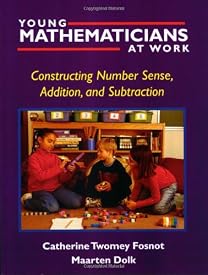
Young Mathematicians at Work, 1: Constructing Number Sense, Addition, and Subtraction


Catherine Twomey Fosnot, Maarten Dolk

Heinemann | 2001 | 224 páginas | PDF | 3 Mb

lib.freescienceengineering.org

In our efforts to reform mathematics education, we've learned a tremendous amount about young students' strategies and the ways they construct knowledge, without fully understanding how to support such development over time. The Dutch do. So, funded by the NSF and Exxon, Mathematics in the City was begun, a collaborative inservice project that pooled the best thinking from both countries. In Young Mathematicians at Work, Catherine Fosnot and Maarten Dolk reveal what they learned after several years of intensive study in numerous urban classrooms.
The first in a three-volume set, Young Mathematicians at Work focuses on young children between the ages of four and eight as they construct a deep understanding of number and the operations of addition and subtraction. Rather than offer unrelated activities, Fosnot and Dolk provide a concerted, unified description of development, with a focus on big ideas, progressive strategies, and emerging models. Drawing from the work of the Dutch mathematician Hans Freudenthal, they define mathematics as "mathematizing"—the activity of structuring, modeling, and interpreting one's "lived world" mathematically. And they describe teachers who use rich problematic situations to promote inquiry, problem solving, and construction, and children who raise and pursue their own mathematical ideas.
In contrast to other books on math reform, Young Mathematicians at Work provides a new look at the teaching of computation. It moves beyond the current debate about algorithms to argue for deep number sense and the development of a repertoire of strategies based on landmark numbers and operations. Sample minilessons on the use of the open number line model are provided to show you how to support the development of efficient computation.


Contents:

1. "Mathematics" or "Mathematizing"?
2. The Landscape of Learning
3. Number Sense on the Horizon
4. Place Value on the Horizon
5. Developing Mathematical Models
6. Addition and Subtraction Facts on the Horizon
7. Algorithms Versus Number Sense
8. Developing Efficient Computation with Minilessons
9. Assessment
10. Teachers as Mathematicians