Basich Whintey
Mcgraw-hill | 2008 | 87 páginas | PDF | 8,97 Mb
link
link1
Site do Manual
glencoe.mcgraw-hill.com
California Math Triumphs is an intensive intervention resource for students who are two or more years below grade level. The series provides step-by-step intervention, vocabulary support, and data-driven decision making to help students succeed in high school mathematics.
Designed to support students needing the most intensive intervention, Math Triumphs: Fractions and Decimals helps build mastery of the foundational skills and concepts from prior grades that are prerequisites to the current grade level. Uniquely scaffolded practice problems provide support by breaking down each skill into the simplest understanding.
CONTENTS
Volume 2A - Chapter 1: Parts of a Whole
Volume 2A - Chapter 2: Equivalence of Fractions
sábado, 23 de junho de 2012
Masculinities in Mathematics
(Educating Boys, Learning Gender)
Heather Mendick
Open University Press | 2006 | 192 Páginas| PDF | 1,57 Mb
link
link1
"We desperately need more people with good mathematical qualifications to fill many posts in numerate occupations, yet the numbers choosing to continue studying mathematics have fallen over the last 10 years. This book is important as it investigates how mathematics is aligned with masculinity and hence is not attractive to a significant part of the population. It is also challenging, scholarly, and a thoroughly good read. It reports the results of carefully designed research on gender and choice, and includes some fascinating individual case-studies. It should make us all reflect on what we are doing and how we can repair the damage." Margaret Brown, Professor of Mathematical Education, King's College London
"The book speaks to me as one of those texts that will become seminal in mathematics education. It is original, refreshing, and despite a complicated plot, points to some ways forward. It is engagingly written, if at times perhaps a little bit no-nonsense in tone. It will be of interest to teachers and teacher educators, as well as providing a theoretical stance that should inform future research." British Educational Research Journal
The study of mathematics, together with other 'gendered' subjects such as science and engineering, usually attracts more male than female pupils, particularly at more advanced levels. In this book Heather Mendick explores this phenomenon, addressing the important question of why more boys than girls choose to study mathematics. She combines new research with an original theoretical approach to argue that 'doing mathematics is doing masculinity'. The book illuminates what studying mathematics means for both students and teachers and offers a broad range of insights into students' views and practices. In addition to the words of young people learning mathematics, the masculinity of mathematics is explored through historical material and cinematic representations. Heather Mendick discusses the ways in which the alignment of mathematics with masculinity creates tensions for girls and women doing the subject. These tensions are sensitively explored through interviews with young men and women, to show how doing mathematics fits or conflicts with their gender identities. Finally, the book explores the implications for teachers, including ways to promote gender equity in mathematics education. This is key reading for students on courses in gender and education, mathematics education, gender and curriculum, and social justice.
This book illuminates what studying mathematics means for both students and teachers and offers a broad range of insights into students' views and practices. In addition to the words of young people learning mathematics, the masculinity of mathematics is explored through historical material and cinematic representations. The author discusses the ways in which the alignment of mathematics with masculinity creates tensions for girls and women doing the subject. These tensions are sensitively explored through interviews with young men and women, to show how doing mathematics fits or conflicts with their gender identities. Finally, the book explores the implications for teachers, including ways to promote gender equity in mathematics education. Following an introduction, this book is divided into three parts. Part 1, Scene Setting, presents the first chapters of the book: (1) Engendering Mathematics; and (2) Introducing the Study. Part 2, Sex by Numbers, continues with chapters: (3) Being/Doing "Good at Maths"; (4) Proving Something to Others; (5) Proving Something to Themselves; and (6) Changing Directions. Finally, Part 3, Queering Gender and Maths, concludes the book with the remaining chapters: (7) Making Choices Social: Refusing Essences in the Classroom; (8) Supporting Gender Transgression: Being and Acting Different in Maths; and (9) Opening Up Mathematics: Living with Uncertainty.
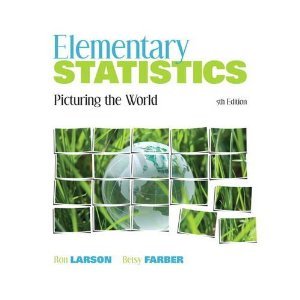
Elementary Statistics: Picturing the World
Ron Larson
5.ª Edição
Addison Wesley | 2012 | PDF | 786 páginas | 12,8 Mb
5.ª Edição
Addison Wesley | 2012 | PDF | 786 páginas | 12,8 Mb
Elementary Statistics: Picturing the World, Fifth Edition, offers our most accessible approach to statistics–more than 750 graphical displays that illustrate data, readers are able to visualize key statistical concepts immediately. Adhering to the philosophy that students learn best by doing, this book relies heavily on examples–25% of the examples and exercises are new for this edition. Larson and Farber continue to demonstrate that statistics is all around us and that it’s easy to understand.
Table of Contents
Part One. Descriptive Statistics
1. Introduction to Statistics
1.1. An Overview of Statistics
1.2. Data Classification
1.3. Data Collection and Experimental Design
2. Descriptive Statistics
2.1. Frequency Distributions and Their Graphs
2.2. More Graphs and Displays
2.3. Measures of Central Tendency
2.4. Measures of Variation
2.5. Measures of Position
Part Two. Probability & Probability Distributions
3. Probability
3.1. Basic Concepts of Probability and Counting
3.2. Conditional Probability and the Multiplication Rule
3.3. The Addition Rule
3.4. Additional Topics in Probability and Counting
4. Discrete Probability Distributions
4.1. Probability Distributions
4.2. Binomial Distributions
4.3. More Discrete Probability Distributions
5. Normal Probability Distributions
5.1. Introduction to Normal Distributions and the Standard Normal Distribution
5.2. Normal Distributions: Finding Probabilities
5.3. Normal Distributions: Finding Values
5.4. Sampling Distributions and the Central Limit Theorem
5.5. Normal Approximations to Binomial Distributions
Part Three. Statistical Inference
6. Confidence Intervals
6.1. Confidence Intervals for the Mean (Large Samples)
6.2. Confidence Intervals for the Mean (Small Samples)
6.3. Confidence Intervals for Population Proportions
6.4. Confidence Intervals for Variance and Standard Deviation
7. Hypothesis Testing with One Sample
7.1. Introduction to Hypothesis Testing
7.2. Hypothesis Testing for the Mean (Large Samples)
7.3. Hypothesis Testing for the Mean (Small Samples)
7.4. Hypothesis Testing for Proportions
7.5. Hypothesis Testing for Variance and Standard Deviation
8. Hypothesis Testing with Two Samples
8.1. Testing the Difference Between Means (Large Independent Samples)
8.2. Testing the Difference Between Means (Small Independent Samples)
8.3. Testing the Difference Between Means (Dependent Samples)
8.4. Testing the Difference Between Proportions
Part Four. More Statistical Inference
9. Correlation and Regression
9.1 Correlation
9.2. Linear Regression
9.3. Measures of Regression and Prediction Intervals
9.4. Multiple Regression
10. Chi-Square Tests and the F-Distribution
10.1. Goodness-of-Fit Test
10.2. Independence
10.3. Comparing Two Variances
10.4. Analysis of Variance
11. Nonparametric Tests
11.1. The Sign Test
11.2. The Wilcoxon Tests
11.3. The Kruskal-Wallis Test
11.4. Rank Correlation
11.5. The Runs Test
Appendix A. Alternative Presentation of the Standard Normal Distribution
Standard Normal Distribution Table (0-to-z)
Alternative Presentation of the Standard Normal Distribution
Appendix B. Tables
Table 1 Random Numbers
Table 2 Binomial Distribution
Table 3 Poisson Distribution
Table 4 Standard Normal Distribution
Table 5 t-Distribution
Table 6 Chi-Square Distribution
Table 7 F-Distribution
Table 8 Critical Values for the Sign Test
Table 9 Critical Values for the Wilcoxon Signed-Rank Test
Table 10 Critical Values for the Spearman Rank Correlation
Table 11 Critical Values for the Pearson Correlation Coefficient
Table 12 Critical Values for the Number of Runs
Appendix C. Normal Probability Plots and Their Graphs
Answers to the Try It Yourself Exercises
Odd Answers
Index
Photo Credits
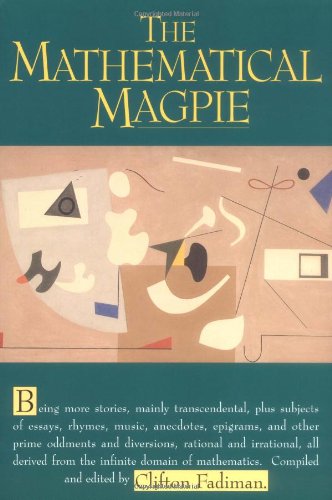
The Mathematical Magpie
Springer | 1997 | 303 páginas | djvu | 3,9 Mb
The companion volume to Fantasia Mathematica, first published in 1962, this second anthology of mathematical writings is even more varied and contains stories, cartoons, essays, rhymes, music, anecdotes, aphorisms, and other oddments. Authors include Arthur C. Clarke, Isaac Asimov, Mark Twain, and Lewis Carroll. 19 illus.
Subscrever:
Mensagens (Atom)