domingo, 23 de setembro de 2012

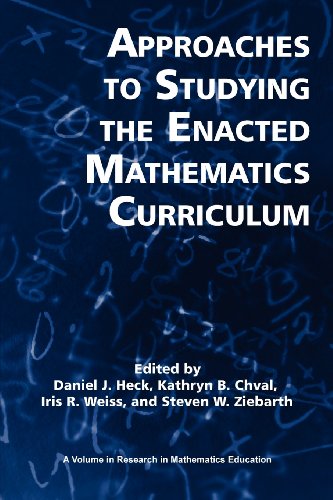
Approaches to Studying the Enacted Mathematics Curriculum


Research in Mathematics Education


Daniel J. Heck, Kathryn B. Chval, Iris R. Weiss, Steven W. Ziebarth

Information Age Publishing | 2012 | 218 páginas | RAR - PDF | 2,7 Mb

link (password :matav)

Curriculum materials are among the most pervasive and powerful influences on school mathematics. In many mathematics classes, student assignments, the questions the teacher asks, the ways students are grouped, the forms of assessment, and much more originate in curriculum materials. At the same time, teachers have considerable latitude in how they use their curriculum materials. Two classes making use of the same materials may differ markedly in what mathematics content is emphasized and how students are engaged in learning that content. This volume considers a variety of research tools for investigating the enactment of mathematics curriculum materials, describing the conceptualization, development, and uses of seven sets of tools. Mathematics education researchers, curriculum developers, teacher educators, district supervisors, teacher leaders, and math coaches will find insights that can improve their work, and guidance for selecting, adapting, and using tools for understanding the complex relationship between curriculum materials and their enactment in classroom instruction.


CONTENTS
Preface. 

Acknowledgments. 
Introduction, Daniel J. Heck, Kathryn B. Chval, Iris R. Weiss, and Steven W. Ziebarth. 
Instruments Used by the University of Chicago School Mathematics Project to Study the Enacted Curriculum, Denisse R. Thompson and Sharon L. Senk. 
Using Concerns-Based Adoption Model Theory to Develop Tools to Examine Variations in Mathematics Textbook Implementation, Mary Ann Huntley. 
Developing Measures of Fidelity of Implementation for Mathematics Curriculum Materials Enactment, Daniel J. Heck, Kathryn B. Chval, Iris R. Weiss, and Steven W. Ziebarth. 
The Development of Multiple Measures of Curriculum Implementation in Secondary Mathematics Classrooms: Insights From a Three-Year Curriculum Evaluation Study, James E. Tarr, Melissa D. McNaught, and Douglas A. Grouws. 
Measuring Implementation of Instructional Materials to Support Conceptual Understanding and Accumulation of Knowledge, Jeanne R. Century Cassie freeman, and Mollie Rudnick. 
A Tool for Analyzing Instructional Practices and Curriculum Materials in the Context of Specific Mathematics Learning Goals, Linda Dager Wilson and Jo Ellen Roseman.
The Surveys of Enacted Curriculum as a Measure of Implementation, Jennifer McMaken and Andrew C. Porter. 
Issues to Consider in Measuring Enactment of Curriculum Materials, Daniel J. Heck, Kathryn B. Chval, Iris R. Weiss, and Steven W. Ziebarth. 
About the Authors.


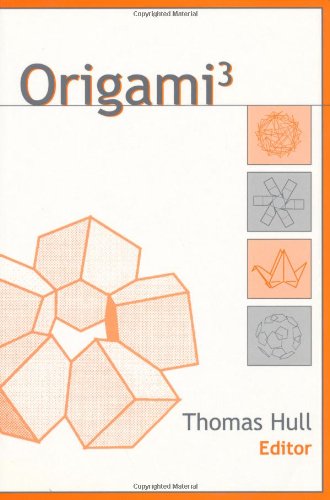
Origami 3: Third International Meeting of Origami Science, Mathematics, and Education

Thomas Hull

A K Peters/CRC Press | 2002 | 352 páginas | RAR - PDF | 3,04 Mb

uploading.com (password : matav)
2012092303

The book contains papers from the proceedings of the 3rd International Meeting of Origami Science, Math, and Education, sponsored by OrigamiUSA. They cover topics ranging from the mathematics of origami using polygon constructions and geometric projections, applications, and science of origami, and the use of origami in education.


Table of Contents
Preface ix
Part One: Mathematics of Origami 1
Recent Results in Computational Origami
Erik D. Demaine and Martin L. Demaine 3
A Disk-Packing Algorithm for an Origami Magic Trick
Marshall Bern, Erik Demaine, David Eppstein, and Barry Hayes . . 17
The Combinatorics of Flat Folds: A Survey
Thomas C. Hull 29
A Mathematical Model for Non-Flat Origami
sarah-marie belcastro and Thomas C. Hull 39
The Definition of Iso-Area Folding
Jun Maekawa 53
The Geometry of Orizuru
Toshikazu Kawasaki 61
The Validity of the Orb, an Origami Model
Jeannine Mosely 75
Mathematical Origami: Another View of Alhazen's Optical Problem
Roger C. Alperin 83
Just Like Young Gauss Playing with a Square: Folding the Regular 17-gon
Robert Geretschläger 95
Paper-Folding Constructions in Euclidean Geometry: An Exercise in Thrift
Benedetto Scimemi 107
Part Two: Origami Science and Applications 119
Computer Tools and Algorithms for Origami Tessellation Design
Alex Bateman 121
The Foldinator Modeler and Document Generator
John Szinger 129
The Application of Origami Science to Map and Atlas Design
Koryo Miura 137
Origami Pots
Tomoko Fuse, Akira Nagashima, Yasuhiro Ohara and Hiroshi Okumura 147
Polypolyhedra in Origami
Robert J. Lang 153
Origami with Trigonometric Functions
Miyuki Kawamura 169
A Study of Twist Boxes
Noriko Nagata 179
To Fold or to Crumple?
B. A. DiDonna 187
Folded Tubes as Compared to Kikko ("Tortoise-Shell") Bamboo
Biruta Kresling 197
Square Cycles: An Introduction to the Analysis of Flexagons
Ethan Berkove and Jeffrey Dumont 209
Self-Assembling Global Shape Using Concepts from Origami
Radhika Nagpal 219
Part Three: Origami in Education 233
Applications of Origami to the Teaching of Sophisticated Communication Techniques
Deborah Foreman-Takano 235
Origami and the Adult ESL Learner
Lillian Yee Ho 247
Exploring the Possibilities of a Module
Krystyna Burczyk and Wojciech Burczyk 257
Using Graphs to Color Origami Polyhedra
Charlene Morrow 269
Circular Origami: A Survey of Recent Results
Eva Knoll 283
In Praise of the Papercup: Mathematics and Origami at the University
Emma Frigerio 291
Using Triangular Boxes from Rectangular Paper to Enrich Trigonometry and Calculus
V’Ann Cornelius and Arnold Tubis 299
Fold Paper and Enjoy Math: Origamics
Kazuo Haga 307
Origami as a Model for Development in Organisms
Norman Budnitz 329
Instances of Origami within Mathematics Content Texts for Preservice Elementary School Teachers
Jack A. Carter and Beverly J. Ferrucci 337
Contributors 345
Index 349

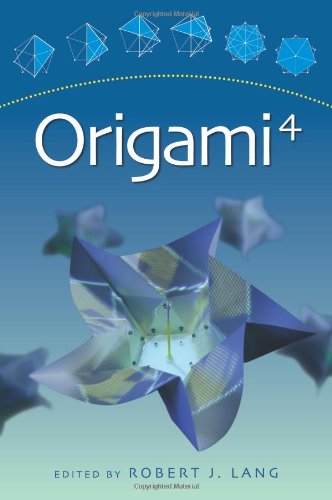
Outro livro contendo os artigos das conferências "International Meeting of Origami Science, Mathematics, and Education", disponível neste blog


Robert J. Lang (2009). Origami 4 - Fourth International Meeting of Origami Science, Mathematics, and Education. A K Peters