domingo, 22 de março de 2009

Mathematics classrooms that promote understanding


(Studies in Mathematical Thinking and Learning.)
Elizabeth Fennema, Thomas A. Romberg

Lawrence Erlbaum | 1999 | 216 páginas | PDF | 8 Mb


Referência em: MathEduc

Mathematics Classrooms That Promote Understanding synthesizes the implications of research done by the National Center for Research in Mathematical Sciences on integrating two somewhat diverse bodies of scholarly inquiry: the study of teaching and the study of learning mathematics.

This research was organized around content domains and/or continuing issues of education, such as equity and assessment of learning, and was guided by two common goals--defining the mathematics content of the K-12 curriculum in light of the changing mathematical needs of citizens for the 21st century, and identifying common components of classrooms that enable students to learn the redefined mathematics with understanding. To accomplish these goals, classrooms in which instruction facilitated the growth of understanding were established and/or studied. This volume reports and discusses the findings which grew out of this research, and subsequent papers and discussions among the scholars engaged in the endeavor.

Section I, "Setting the Stage," focuses on three major threads: What mathematics should be taught; how we should define and increase students' understanding of that mathematics; and how learning with understanding can be facilitated for all students. Section II, "Classrooms That Promote Understanding," includes vignettes from diverse classrooms that illustrate classroom discourse, student work, and student engagement in the mathematics described in Chapter 1 as well as the mental activities described in Chapter 2. These chapters also illustrate how teachers deal with the equity concerns described in Chapter 3. Section III addresses "Developing Classrooms That Promote Understanding."

The knowledge of the teaching/learning process gained from the research reported in this volume is a necessary prerequisite for implementing the revisions called for in the current reform movement. The classrooms described show that innovative reform in teaching and learning mathematics is possible. Unlike many volumes reporting research, this book is written at a level appropriate for master's degree students. Very few references are included in the chapters themselves; instead, each chapter includes a short annotated list of articles for expanded reading which provides the scholarly basis and research substantiation for this volume.

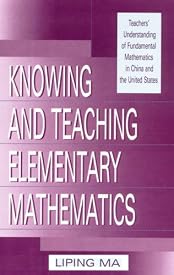
Knowing and Teaching Elementary Mathematics: Teachers' Understanding of Fundamental Mathematics in China and the United States


(Studies in Mathematical Thinking and Learning)
Liping Ma

Lawrence Erlbaum | 1999 | 192 páginas | 590 KB


uploading.com

Referência em: MathEduc

Chinese students typically outperform U.S. students on international comparisons of mathematics competency. Paradoxically, Chinese teachers receive far less education than U.S. teachers--11 to 12 years of schooling versus 16 to 18 years of schooling.

Studies of U.S. teacher knowledge often document insufficient subject matter knowledge in mathematics. But, they give few examples of the knowledge teachers need to support teaching, particularly the kind of teaching demanded by recent reforms in mathematics education.

This book describes the nature and development of the "profound understanding of fundamental mathematics" that elementary teachers need to become accomplished mathematics teachers, and suggests why such teaching knowledge is much more common in China than the United States, despite the fact that Chinese teachers have less formal education than their U.S. counterparts.

The studies described in this book suggest that Chinese teachers begin their teaching careers with a better understanding of elementary mathematics than that of most U.S. elementary teachers. Their understanding of the mathematics they teach and--equally important--of the ways that elementary mathematics can be presented to students, continues to grow throughout their professional lives.

Teaching conditions in the United States, unlike those in China, militate against the development of elementary teachers’ mathematical knowledge and its organization for teaching. The concluding chapter of the book suggests changes in teacher preparation, teacher support, and mathematics education research that might allow teachers in the United States to attain profound understanding of fundamental mathematics.

Teaching, Multimedia, and Mathematics: Investigations of Real Practice


(The Practitioner Inquiry Series)

Magdalene Lampert, Deborah Ball

Teachers College Press | 1998 | 244 páginas | 2,47 Mb

link
Referência em: MathEduc

Magdalene Lampert and Deborah Ball draw on their experience as teachers, teacher educators and researchers on teaching in the development of teacher education. In this text, they engage prospective teachers in investigating primary records of practice, and making sense of teaching and learning.

Knowing what Students Know The Science and Design of Educational Assessment

James W. Pellegrino, Naomi Chudowsky, Robert Glaser

Committee on the Foundations of Assessment, Board on Testing and Assessment, National Research Council | 2001| 366 páginas

on-line: nap.edu
link


Education is a hot topic. From the stage of presidential debates to tonight's dinner table, it is an issue that most Americans are deeply concerned about. While there are many strategies for improving the educational process, we need a way to find out what works and what doesn't work as well. Educational assessment seeks to determine just how well students are learning and is an integral part of our quest for improved education.

The nation is pinning greater expectations on educational assessment than ever before. We look to these assessment tools when documenting whether students and institutions are truly meeting education goals. But we must stop and ask a crucial question: What kind of assessment is most effective?

At a time when traditional testing is subject to increasing criticism, research suggests that new, exciting approaches to assessment may be on the horizon. Advances in the sciences of how people learn and how to measure such learning offer the hope of developing new kinds of assessments-assessments that help students succeed in school by making as clear as possible the nature of their accomplishments and the progress of their learning.

Knowing What Students Know essentially explains how expanding knowledge in the scientific fields of human learning and educational measurement can form the foundations of an improved approach to assessment. These advances suggest ways that the targets of assessment-what students know and how well they know it-as well as the methods used to make inferences about student learning can be made more valid and instructionally useful. Principles for designing and using these new kinds of assessments are presented, and examples are used to illustrate the principles. Implications for policy, practice, and research are also explored.

With the promise of a productive research-based approach to assessment of student learning, Knowing What Students Know will be important to education administrators, assessment designers, teachers and teacher educators, and education advocates.

Fostering Children's Mathematical Power: An Investigative Approach To K-8 Mathematics Instruction


Arthur J. Baroody, Ronald T. Coslick

Lawrence Erlbaum | 1998 | 632 páginas | epub | 8,67 Mb

link

Referência em: MathEduc

Teachers have the responsibility of helping all of their students construct the disposition and knowledge needed to live successfully in a complex and rapidly changing world. To meet the challenges of the 21st century, students will especially need mathematical power: a positive disposition toward mathematics (curiosity and self confidence), facility with the processes of mathematical inquiry (problem solving, reasoning and communicating), and well connected mathematical knowledge (an understanding of mathematical concepts, procedures and formulas). This guide seeks to help teachers achieve the capability to foster children's mathematical power - the ability to excite them about mathematics, help them see that it makes sense, and enable them to harness its might for solving everyday and extraordinary problems. The investigative approach attempts to foster mathematical power by making mathematics instruction process-based, understandable or relevant to the everyday life of students. Past efforts to reform mathematics instruction have focused on only one or two of these aims, whereas the investigative approach accomplishes all three. By teaching content in a purposeful context, an inquiry-based fashion, and a meaningful manner, this approach promotes chilren's mathematical learning in an interesting, thought-provoking and comprehensible way. This teaching guide is designed to help teachers appreciate the need for the investigative approach and to provide practical advice on how to make this approach happen in the classroom. It not only dispenses information, but also serves as a catalyst for exploring, conjecturing about, discussing and contemplating the teaching and learning of mathematics.

Making Connections in Primary Mathematics


Sylvia Turner, Judith McCullouch

David Fulton Publish | 2004 | 134 páginas |PDF | 1,6 Mb

link

Referência em: MathEduc

There are many connecting ideas in primary mathematics. The main aim of this book is to identify these connections in order to help teachers develop children's understanding of mathematics the book:
· Emphasizes the relationship between language, notation and representation
· Identifies misconceptions that can develop from false connections
· Gives activities for students to clarify their understanding
This book can be used by both students training to be teachers and by teachers re-considering their approach to mathematics as part of professional development.

Radical Equations Math Literacy and Civil Rights


Robert P. Moses, Charles E. Cobb Jr

Beacon Press | 2001| 233 páginas | PDF | 1,4 MB

link

Referência em: MathEduc

They seem like unrelated concepts: civil rights and math literacy; Freedom Summer and the Algebra Project. When the individual who links them is Bob Moses, however, the unanticipated connections are worth exploring. Moses was a Student Nonviolent Coordinating Committee organizer in Mississippi in the 1960s. In part 1, he discusses the lessons of that experience, particularly involving the entire community and defining a goal (in Mississippi, voting rights) that empowers the community to address its other needs. In the twenty-first century, Moses argues, "the most urgent social issue affecting poor people and people of color is economic access . . . [and] economic access and full citizenship depend crucially on math and science literacy." For two decades, Moses and his associates have been developing an approach to middle-school math aimed at preparing every child for high-school and then college mathematics. Part 2 of Radical Equations traces that effort, its experiential pedagogy, and its application in urban and rural school districts. A surprising study of continuity and change in the struggle to reduce inequality and empower communities.

Mathematical and Analogical Reasoning of Young Learners


Lyn D. English

Lawrence Erlbaum | 2004 | 224 páginas | pdf | 10,6 Mb

link
scribd.com
depositfiles.com

Referência em: MathEduc


Mathematical and Analogical Reasoning of Young Learners provides foundational knowledge of the nature, development, and assessment of mathematical and analogical reasoning in young children. Reasoning is fundamental to understanding mathematics and is identified as one of the 10 key standards for school mathematics for the new millennium. The book draws on longitudinal and cross-cultural studies, conducted in the United States and Australia, of children's reasoning development as they progressed from preschool through the end of second grade.

 The multifaceted analysis of young children's development of mathematical and analogical reasoning focuses on individual learners, their learning environments, and the interaction between the two. The multidisciplinary team of authors present multiple perspectives and multiple methodologies, and provide valuable information on organizing and sustaining interdisciplinary and cross-cultural inquiry. Key issues addressed include:
 *the relationship between mathematical and analogical reasoning;
 *how changes in children's reasoning relate to the implicit instruction they receive in their classrooms;
 *analyses of the participating teachers' knowledge, beliefs, and practices with respect to mathematical and analogical reasoning of young learners; and
 *ways in which we might promote development of mathematical and analogical reasoning in young children.

 This volume is highly relevant for mathematics educators, researchers in mathematics education, educational psychologists, early childhood teachers, and others interested in mathematical development of young children, in particular, the development of their reasoning processes.

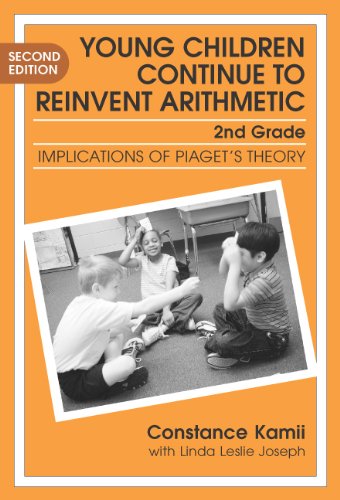
Young Children Continue to Reinvent Arithmetic


2nd Grade
Constance Kamii e Linda Leslie Joseph

Teachers College| 2004 | 195 páginas | pdf | 1,2 MB

link
link1

Responding to their research on how children learn mathematics, this work has revised this textbook to provide practical advice on what works and what should be avoided when teaching second graders.

Referência em: MathEduc