quinta-feira, 10 de abril de 2014
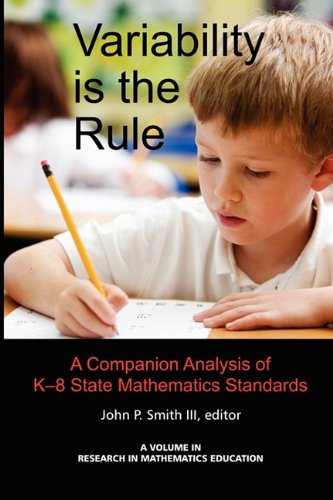
Variability is the Rule A Companion Analysis of K-8 State Mathematics Standards
(Research in Mathematics Education)
John P. Smith III
Information Age Publishing | 2010 | 234 páginas | rar - pdf |4 Mb
link (password: matav)
A volume in the series: Research in Mathematics Education. Series Editor(s): Barbara J. Dougherty, Iowa State University In response to No Child Let Behind, states have developed mathematics curriculum frameworks that outline their intended curriculum for grades K-8. While some have indicated that districts or individual schools may use their framework as a model for specific curricular programs, others have taken a more prescriptive or even mandatory stance. Collectively, these frameworks present a sense of the national mathematics program and what we expect students learn. This volume follows The Intended Curriculum as Represented in State Mathematics Curriculum Standards: Consensus or Confusion? (Reys). While the Reys volume focused on number and operations, algebra and reasoning strands, the Smith volume analyzes geometry, measurement, probability, and statistics strands. It also presents an analysis what verbs used tell us about the cognitive demand of grade level expectations. This volume, even more than the Reys volume, emphasizes the theme of variability in the content, expression, and clarity of grade level expectations across the states. As the nation moves toward implementation of the Common Core Standards, this volume highlights some of the challenges teachers and other school personnel face in interpreting mathematics grade-level standards as goals for classroom teaching. The shift from 50 state standards to one document does not resolve this basic challenge.
CONTENTS
Acknowledgments. . . . . . . . .vii
1. Introduction: An Analysis of State Standards in Two Mathematical Domains
John P. Smith III, Gregory Larnell, and James E. Tarr . .. . . 1
2. An Analysis of K−8 Measurement Grade Level Expectations
Sarah E. Kasten and Jill Newton . . . 13
3. The Treatment of Transformations in K–8 Geometry and Measurement Grade Level Expectations
Sasha Wang and John P. Smith III .. . . 41
4. An Examination of K−8 Geometry State Standards Through the Lens of the van Hiele Levels of Geometric Thinking
Jill Newton . . . .. . . 71
5. Verbs and Cognitive Demand in K–8 Geometry and Measurement Grade Level Expectations
Gregory V. Larnell and John P. Smith III .. . 95
6. The Statistical Process: A View Across K–8 State Standards
Jill Newton, Aladar Horvath, and Leslie Dietiker . . . 119
7. An Analysis of K–8 Probability Standards
Shannon Dingman and James E. Tarr . . . . . 161
8. Major Lessons from the Second Round of Standards Analyses
John P. Smith III, Glenda T. Lappan, and James E. Tarr . . . . 193
Diophantos of Alexandria: A Study in the History of Greek Algebra
Thomas Little Heath
Cambridge, University press | 1985 | 298 páginas
online: ualberta.ca
archive.org
hathitrust.org
forgottenbooks.org
pdf - link (google books)
The Greek mathematician Diophantos of Alexandria lived during the third century CE. Apart from his age (he reached eighty-four), very little else is known about his life. Even the exact form of his name is uncertain, and only a few incomplete manuscripts of his greatest work, Arithmetica, have survived. In this impressive scholarly investigation, first published in 1885, Thomas Little Heath (1861-1940) meticulously presents what can be gleaned from Greek, Latin and Arabic sources, and guides the reader through the algebraist's idiosyncratic style of mathematics, discussing his notation and originality. This was the first thorough survey of Diophantos' work to appear in English. Also reissued in this series are Heath's two-volume History of Greek Mathematics, his treatment of Greek astronomy through the work of Aristarchus of Samos, and his edition in modern notation of the Treatise on Conic Sections by Apollonius of Perga.
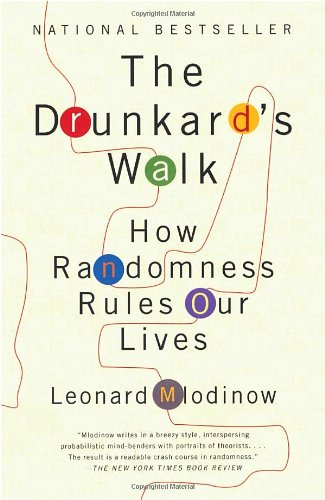
The Drunkard's Walk: How Randomness Rules Our Lives
Leonard Mlodinow
Pantheon Books, New York | 2008 | 268 páginas | pdf |920 kb
epub - 1,3 Mb
mobi - 1,2 Mb
With the born storyteller's command of narrative and imaginative approach, Leonard Mlodinow vividly demonstrates how our lives are profoundly informed by chance and randomness and how everything from wine ratings and corporate success to school grades and political polls are less reliable than we believe.By showing us the true nature of chance and revealing the psychological illusions that cause us to misjudge the world around us, Mlodinow gives us the tools we need to make more informed decisions. From the classroom to the courtroom and from financial markets to supermarkets, Mlodinow's intriguing and illuminating look at how randomness, chance, and probability affect our daily lives will intrigue, awe, and inspire.
CONTENTS
Chapter 1: Peering through the Eyepiece of RandomnessThe hidden role of chance…when human beings can be outperformed by a rat.
Chapter 2: The Laws of Truths and Half-TruthsThe basic principles of probability and how they are abused…why a good story is often less likely to be true than a flimsy explanation.
Chapter 3: Finding Your Way through a Space of PossibilitiesA framework for thinking about random situations…from a gambler in plague-ridden Italy to Let’s Make a Deal.
Chapter 4: Tracking the Pathways to SuccessHow to count the number of ways in which events can happen, and why it matters…the mathematical meaning of expectation.
Chapter 5: The Dueling Laws of Large and Small NumbersThe extent to which probabilities are reflected in the results we observe…Zeno’s paradox, the concept of limits, and beating the casino at roulette.
Chapter 6: False Positives and Positive FallaciesHow to adjust expectations in light of past events or new knowledge…mistakes in conditional probability from medical screening to the O. J. Simpson trial and the prosecutor’s fallacy.
Chapter 7: Measurement and the Law of ErrorsThe meaning and lack of meaning in measurements…the bell curve and wine ratings, political polls, grades, and the position of planets.Chapter 8: The Order in ChaosHow large numbers can wash out the disorder of randomness…or why 200,000,000 drivers form a creature of habit.Chapter 9: Illusions of Patterns and Patterns of IllusionWhy we are often fooled by the regularities in chance events…can a million consecutive zeroes or the success of Wall Street gurus be random?Chapter 10: The Drunkard’s WalkWhy chance is a more fundamental conception than causality…Bruce Willis, Bill Gates, and the normal accident theory of life.
Outro livro do mesmo autor:
|
por Leonard Mlodinow
Idioma: Inglês
Editora: New York : Free Press, ©2001.
|
A Beautiful Mind : A Biography of John Forbes Nash
Sylvia Nasar
First Simon & Schuster | 2011 | 464 páginas | epub | 1,3 Mb
mobi - 1,8 Mb
“HOW COULD YOU, A MATHEMATICIAN, BELIEVE THAT EXTRATERRESTRIALS WERE SENDING YOU MESSAGES?” the visitor from Harvard asked the West Virginian with the movie-star looks and Olympian manner. “Because the ideas I had about supernatural beings came to me the same way my mathematical ideas did,” came the answer. “So I took them seriously.”
Thus begins the true story of John Nash, the mathematical genius who was a legend by age thirty when he slipped into madness, and who—thanks to the selflessness of a beautiful woman and the loyalty of the mathematics community—emerged after decades of ghostlike existence to win a Nobel Prize for triggering the game theory revolution. The inspiration for an Academy Award–winning movie, Sylvia Nasar’s now-classic biography is a drama about the mystery of the human mind, triumph over adversity, and the healing power of love.
ContentsForeword
Prologue
Part One: A Beautiful Mind
1: Bluefield (1928–45)
2: Carnegie Institute of Technology (June 1945–1948)
3: The Center of the Universe (Princeton, Fall 1948)
4: School of Genius (Princeton, Fall 1948)
5: Genius (Princeton, 1948–49)
6: Games (Princeton, Spring 1949)
7: John von Neumann (Princeton, 1948–49)
8: The Theory of Games
9: The Bargaining Problem (Princeton, Spring 1949)
10: Nash’s Rival Idea (Princeton, 1949–50)
11: Lloyd (Princeton, 1950)
12: The War of Wits (RAND,Summer 1950)
13: Game Theory at RAND
14: The Draft (Princeton, 1950–51)
15: A Beautiful Theorem (Princeton, 1950–51)
16: MIT
17: Bad Boys
18: Experiments (RAND, Summer 1952)
19: Reds (Spring 1953)
20: Geometry
Part Two: Separate Lives
21: Singularity
22: A Special Friendship (Santa Monica, Summer 1952)
23: Eleanor
24: Jack
25: The Arrest (RAND, Summer 1954)
26: Alicia
27: The Courtship
28: Seattle (Summer 1956)
29: Death and Marriage (1956–57)
Part Three: A Slow Fire Burning
30: Olden Lane and Washington Square (1956–57)
31: The Bomb Factory
32: Secrets (Summer 1958)
33: Schemes (Fall 1958)
34: The Emperor of Antarctica
35: In the Eye of the Storm (Spring 1959)
36: Day Breaks in Bowditch Hall (McLean Hospital, April–May 1959)
37: Mad Hatter’s Teas (May–June 1959)
Part Four: The Lost Years
38: Citoyen du Monde (Paris and Geneva, 1959–60)
39: Absolute Zero (Princeton, 1960)
40: Tower of Silence (Trenton State Hospital, 1961)
41: An Interlude of Enforced Rationality (July 1961–April 1963)
42: The “Blowing-Up” Problem (Princeton and Carrier Clinic, 1963–65)
43: Solitude (Boston, 1965–67)
44: A Man All Alone in a Strange World (Roanoke, 1967–70)
45: Phantom of Fine Hall (Princeton, 1970s)
6: A Quiet Life (Princeton, 1970–90)
Part Five: The Most Worthy
47: Remission
48: The Prize
49: The Greatest Auction Ever (Washington, D.C., December 1994)
50: Reawakening (Princeton, 1995–97)
Epilogue
Notes
Select Bibliography
Acknowledgments
Index
Subscrever:
Mensagens (Atom)