sexta-feira, 30 de março de 2012

Introduction to Graph Theory

2.ª Edição

Douglas B. West

Prentice Hall | 2000 | 589 páginas | Djvu | 7 Mb

link direto
link

PDF
scribd.com

This book fills a need for a thorough introduction to graph theory that features both the understanding and writing of proofs about graphs. Verification that algorithms work is emphasized more than their complexity. An effective use of examples, and huge number of interesting exercises, demonstrate the topics of trees and distance, matchings and factors, connectivity and paths, graph coloring, edges and cycles, and planar graphs. For those who need to learn to make coherent arguments in the fields of mathematics and computer science.

Graph Edge Coloring: Vizing's Theorem and Goldberg's Conjecture


(Wiley Series in Discrete Mathematics and Optimization)

Michael Stiebitz

Wiley | 2012 | 344 páginas | PDF | 12,69 Mb

link
uploading.com

Features recent advances and new applications in graph edge coloring
Reviewing recent advances in the Edge Coloring Problem, Graph Edge Coloring: Vizing's Theorem and Goldberg's Conjecture provides an overview of the current state of the science, explaining the interconnections among the results obtained from important graph theory studies. The authors introduce many new improved proofs of known results to identify and point to possible solutions for open problems in edge coloring.
The book begins with an introduction to graph theory and the concept of edge coloring. Subsequent chapters explore important topics such as:
  • Use of Tashkinov trees to obtain an asymptotic positive solution to Goldberg's conjecture
  • Application of Vizing fans to obtain both known and new results
  • Kierstead paths as an alternative to Vizing fans
  • Classification problem of simple graphs
  • Generalized edge coloring in which a color may appear more than once at a vertex
This book also features first-time English translations of two groundbreaking papers written by Vadim Vizing on an estimate of the chromatic class of a p-graph and the critical graphs within a given chromatic class.
Written by leading experts who have reinvigorated research in the field, Graph Edge Coloring is an excellent book for mathematics, optimization, and computer science courses at the graduate level. The book also serves as a valuable reference for researchers interested in discrete mathematics, graph theory, operations research, theoretical computer science, and combinatorial optimization.

The Elements Of Non Euclidean Geometry


Julian Lowell Coolidge

OXFORD AT THE CLARENDON PRESS | 1909

online: archive.org


djvu - 2,1 Mb - link
pdf - scribd.com

Chapters Include: Foundation For Metrical Geometry In A Limited Region; Congruent Transformations; The Three Hypotheses; The Introduction Of Trigonometric Formulae; Analytic Formulae; Consistency And Significance Of The Axioms; The Geometric And Analytic Extension Of Space; The Groups Of Congruent Transformations; Point, Line, And Plane Treated Analytically; The Higher Line Geometry; The Circle And The Sphere; Conic Sections; Quadric Surfaces; Areas And Volumes; Introduction To Differential Geometry; etc.

Introduction To Non Euclidean Geometry

Harold E. Wolfe

The Dryden Press | 1945

online: archive.org

Introduction to NON-EUCLIDEAN GEOMETRY by HAROLD E. WOLFE . PREFACE This book has been written in an attempt to provide a satisfactory textbook to be used as a basis for elementary courses in Non-Euclid ean Geometry. The need for such a volume, definitely intended for classroom use and containing substantial lists of exercises, has been evident for some time. It is hoped that this one will meet the re quirements of those instructors who have been teaching the subject tegularly, and also that its appearance will encourage others to institute such courses. x The benefits and amenities of a formal study of Non-Euclidean Geometry are generally recognized. Not only is the subject matter itself valuable and intensely fascinating, well worth the time of any student of mathematics, but there is probably no elementary course which exhibits so clearly the nature and significance of geometry and, indeed, of mathematics in general. However, a mere cursory acquaintance with the subject will not do. One must follow its development at least a little way to see how things come out, and try his hand at demonstrating propositions under circumstances such that intuition no longer serves as a guide. For teachers and prospective teachers of geometry in the secondary schools the study of Non-Euclidean Geometry is invaluable. With out it there is strong likelihood that they will not understand the real nature of the subject they are teaching and the import of its applications to the interpretation of physical space. Among the first books on Non-Euclidean Geometry to appear in English was one, scarcely more than a pamphlet, written in 1880 by G. Chrystal. Even at that early date the value of this study for those preparing to teach was recognized. In the preface to this little brochure, Chrystal expressed his desire to bring pangeometrical speculations under the notice of those engaged in the teaching of geometry He wrote It will not be supposed that I advocate the introduction of pan geometry as a school subject it is for the teacher that I advocate vi PREFACE such a study. It is a great mistake to suppose that it is sufficient for the teacher of an elementary subject to be just ahead of his pupils. No one can be a good elementary teacher who cannot handle his subject with the grasp of a master. Geometrical insight and wealth of geometrical ideas, either natural or acquired, are essential to a good teacher of geometry and I know of no better way of cultivat ing them than by studying pan geometry. Within recent years the number of American colleges and uni versities which offer courses in advanced Euclidean Geometry has increased rapidly. There is evidence that the quality of the teaching of geometry in our secondary schools has, accordingly, greatly improved. But advanced study in Euclidean Geometry is not the only requisite for the good teaching of Euclid. The study of Non-Euclidean Geometry takes its place beside it as an indispensable part of the training of a well-prepared teacher of high school geometry. This book has been prepared primarily for students who have completed a course in calculus. However, although some mathe matical maturity will be found helpful, much of it can be read profitably and with understanding by one who has completed a secondary school course in Euclidean Geometry. He need only omit Chapters V and VI, which make use of trigonometry and calcu lus, and the latter part of Chapter VII. In Chapters II and III, the historical background of the subject has been treated quite fully. It has been said that no subject, when separated from its history, loses more than mathematics. This is particularly true of Non-Euclidean Geometry...

Non-Euclidean Geometry: A Critical And Historical Study Of Its Development


Roberto Bonola

Chicago Open Court Pub. Co | 1912

online: archive.org

Examines various attempts to prove Euclid's parallel postulate — by the Greeks, Arabs and Renaissance mathematicians. Ranging through the 17th, 18th, and 19th centuries, it considers forerunners and founders such as Saccheri, Lambert, Legendre, W. Bolyai, Gauss, Schweikart, Taurinus, J. Bolyai and Lobachewsky. Includes 181 diagrams.


Table of Contents

Chapter I. The Attempts to prove Euclid's Parallel Postulate.
1-5. The Greek Geometers and the Parallel Postulate
6. The Arabs and the Parallel Postulate
7-10. The Parallel Postulate during the Renaissance and the 17th Century
Chapter II. The Forerunners on Non-Euclidean Geometry.
11-17. GEROLAMO SACCHERI (1667-1733)
18-22. JOHANN HEINRICH LAMBERT (1728-1777)
23-26. The French Geometers towards the End of the 18th Century
27-28. ADRIEN MARIE LEGENDRE (1752-1833)
29. WOLFGANG BOLYAI (1775-1856)
30. FRIEDRICH LUDWIG WACHTER (1792-1817)
30. (bis) BERNHARD FRIEDRICH THIBAUT (1776-1832)
Chapter III. The Founders of Non-Euclidean Geometry.
31-34. KARL FRIEDRICH GAUSS (1777-1855)
35. FERDINAND KARL SCHWEIKART (1780-1859)
36-38. FRANZ ADOLF TAURINUS (1794-1874)
Chapter IV. The Founders of Non-Euclidean Geometry (Cont.).
39-45. NICOLAI IVANOVITSCH LOBATSCHEWSKY (1793-1856)
46-55. JOHANN BOLYAI (1802-1860)
56-58. The Absolute Trigonometry
59. Hypotheses equivalent to Euclid's Postulate
60-65. The Spread of Non-Euclidean Geometry
Chapter V. The Later Development of Non-Euclidean Geometry.
66. Introduction
Differential Geometry and Non-Euclidean Geometry
67-69. Geometry upon a Surface
70-76. Principles of Plane Geometry on the Ideas of RIEMANN
77. Principles of RIEMANN'S Solid Geometry
78. The Work of HELMHOLTZ and the Investigations of LIE
Projective Geometry and Non-Euclidean Geometry
79-83. Subordination of Metrical Geometry to Projective Geometry
84-91. Representation of the Geometry of LOBATSCHEWSKY-BOLYAI on the Euclidean Plane
92. Representation of RIEMANN'S Elliptic Geometry in Euclidean Space
93. Foundation of Geometry upon Descriptive Properties
94. The Impossibility of proving Euclid's Postulate
Appendix I. The Fundamental Principles of Statistics and Euclid's Postulate.
1-3. On the Principle of the Lever
4-8. On the Composition of Forces acting at a Point
9-10. Non-Euclidean Statics
11-12. Deduction of Plane Trigonometry from Statics
Appendix II. CLIFFORD'S Parallels and Surface. Sketch of CLIFFFORD-KLEIN'S Problems.
1-4. CLIFFORD'S Parallels
5-8. CLIFFORD'S Surface
9-11. Sketch of CLIFFORD-KLEIN'S Problem
Appendix III. The Non-Euclidean Parallel Construction and other Allied Constructions.
1-3. The Non-Euclidean Parallel Construction
4. Construction of the Common Perpendicular to two non-intersecting Straight Lines
5. Construction of the Common Parallel to the Straight Lines which bound an Angle
6. Construction of the Straight Line which is perpendicular to one of the lines bounding an acute Angle and Parallel to the other
7. The Absolute and the Parallel Construction
Appendix IV. The Independence of Projective Geometry from Euclid's Postu
1. Statement of the Problem
2. Improper Points and the Complete Projective Plane
3. The Complete Projective Line
4. Combination of Elements
5. Improper Lines
6. Complete Projective Space
7. Indirect Proof of the Independence of Projective Geometry from the Fifth Postulate
8. BELTRAMI'S Direct Proof of this Independence
Appendix V. The Impossibility of proving Euclid's Postulate. An Elementary Demonstration of this Impossibility founded upon the Properties of the System of Circles orthogonal to a Fixed Circle.
1. Introduction
2-7. The System of Circles passing through a Fixed Point
8-12. The System of Circles orthogonal to a Fixed Circle
Index of Authors
The Science of Absolute Space and the Theory of Parallels

Basic College Mathematics: A Text Workbook


Charles P. McKeague

Brooks Cole | 2010 - 3ª edição | 670 páginas | PDF | 32 Mb


Pat McKeague's passion and dedication to teaching mathematics and his ongoing participation in mathematical organizations provides the most current and reliable textbook series for both instructors and students. When writing a textbook, Pat McKeague's main goal is to write a textbook that is user-friendly. Students develop a thorough understanding of the concepts essential to their success in mathematics with his attention to detail, exceptional writing style, and organization of mathematical concepts. BASIC COLLEGE MATHEMATICS: A TEXT/WORKBOOK, Third Edition offers a unique and effortless way to teach your course, whether it is a traditional lecture course or a self-paced format. In a lecture-course format, each section can be taught in 45-to-50-minute class sessions, affording instructors a straightforward way to prepare and teach their course. In a self-paced format, Pat's proven EPAS approach (Example, Practice Problem, Answer and Solution) moves students through each new concept with ease and assists students in breaking up their problem-solving into manageable steps.
The Third Edition of BASIC COLLEGE MATHEMATICS has new features that will further enhance your students' learning, including boxed features entitled Improving Your Quantitative Literacy, Getting Ready for Chapter Problems, Section Objectives, and Enhanced and Expanded Review Problems. These features are designed so your can students to practice and reinforce conceptual learning. Furthermore, Enhanced WebAssign for Developmental Math, is an assignable assessment and algorithmic homework system that consists of videos, tutorials and active examples keyed to problem level.
Features
  • EPAS SYSTEM. Pat''s proven learning system EPAS (which stands for Example, Practice Problem, Answer, Solution) moves students easily through each new concept by breaking down problem solving into manageable steps.
  • GETTING READY FOR CLASS. Located before each problem set, these problems require written responses from students, and can be answered by reading the preceding section. When completed before the students come to class, they provide helpful discussion points.
  • BLUEPRINT FOR PROBLEM SOLVING. A hallmark of the McKeague series, BLUEPRINT FOR PROBLEM SOLVING provides students with a supportive guide to problem-solving by outlining the steps needed to successfully attempt application problems that involve equations in one variable.
  • FACTS FROM GEOMETRY. Introduces new ideas in geometry throughout the book, followed by examples to show students how geometry relates to the mathematics they are learning.
  • CHAPTER OPENERS. Each chapter opens with an introduction in which a real-world application is used to stimulate interest in the chapter and to make the link between math and its real-world applications to students. These openings are also expanded on later in the chapter.

1. WHOLE NUMBERS.
Place Value and Names for Numbers. Addition with Whole Numbers, and Perimeter. Rounding numbers, Estimating Answers, and Displaying Information. Subtraction with Whole Numbers. Multiplication with Whole Numbers, and Area. Division with Whole Numbers. Exponents and Order of Operations. Summary. Review. Test. Projects.
2. FRACTIONS AND MIXED NUMBERS.
Meaning and Properties of Fractions. Prime Numbers, Factors, and Reducing to Lowest Terms. Multiplication with Fractions, and the Area of a Triangle. Division with Fractions. Addition and Subtraction with Fractions. Mixed-Number Notation. Multiplication and Division with Mixed Numbers. Addition and Subtraction with Mixed Numbers. Combinations of Operations and Complex Fractions. Summary. Review. Cumulative Review. Test. Projects.
3. DECIMALS.
Decimal Notation and Place Value. Addition and Subtraction with Decimals. Multiplication with Decimals. Division with Decimals. Fractions and Decimals. Square Roots and the Pythagorean Theorem. Summary. Review. Cumulative Review. Test. Projects.
4. RATIO AND PROPORTION.
Ratios, Rates, and Unit Pricing. Proportions. Applications. Similar Figures. Summary. Review. Cumulative Review. Test. Projects.
5. PERCENT.
Percents, Decimals, and Fractions. Basic Percent Problems. General Applications of Percents. Sales Tax and Commission. Percent Increase or Decrease, and Discount. Interest. Summary. Review. Cumulative Review. Test. Projects.
6. DESCRIPTIVE STATISTICS.
Mean, Median, and Mode. Tables and Bar Charts. Scatter Diagrams and Line Graphs. Pie Charts. Summary. Review. Cumulative Review. Test. Projects.
7. MEASUREMENT.
Length. Area and Volume. Weight. Converting between the Two Systems, and Temperature. Summary. Review. Cumulative Review. Test. Projects.
8. GEOMETRY.
Perimeter and Circumference. Area. Volume. Angles and Triangles. Summary. Review. Cumulative Review. Test. Projects.
9. INTRODUCTION TO ALGEBRA.
Positive and Negative Numbers. Addition with Negative Numbers. Subtraction with Negative Numbers. Multiplication with Negative Numbers. Division with Negative Numbers. Summary. Review. Cumulative Review. Test. Projects.
10. SOLVING EQUATIONS.
The Distributive Property and Algebraic Expressions. The Addition Property of Equality. The Multiplication Property of Equality. Linear Equations in One Variable. Applications. Summary. Review. Cumulative Review. Test. Projects.

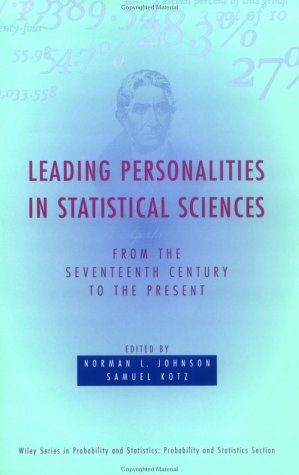
Leading Personalities in Statistical Sciences: From the Seventeenth Century to the Present

(Wiley Series in Probability and Statistics)

Wiley | 1997 | 432 páginas | PDF | 15,89 Mb

link
uploading.com


A fascinating chronicle of the lives and achievements of the men and women who helped shapethe science of statistics
This handsomely illustrated volume will make enthralling reading for scientists, mathematicians, and science history buffs alike. Spanning nearly four centuries, it chronicles the lives and achievements of more than 110 of the most prominent names in theoretical and applied statistics and probability. From Bernoulli to Markov, Poisson to Wiener, you will find intimate profiles of women and men whose work led to significant advances in the areas of statistical inference and theory, probability theory, government and economic statistics, medical and agricultural statistics, and science and engineering. To help readers arrive at a fuller appreciation of the contributions these pioneers made, the authors vividly re-create the times in which they lived while exploring the major intellectual currents that shaped their thinking and propelled their discoveries.
Lavishly illustrated with more than 40 authentic photographs and woodcuts
  • Includes a comprehensive timetable of statistics from the seventeenth century to the present
  • Features edited chapters written by 75 experts from around the globe
  • Designed for easy reference, features a unique numbering scheme that matches the subject profiled with his or her particular field of interest

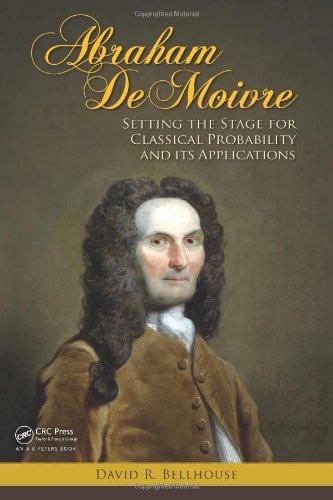
Abraham De Moivre: Setting the Stage for Classical Probability and Its Applications

David R. Bellhouse

A K Peters/CRC Press | 2011 | 266 páginas | PDF | 3,55 Mb

link direto
link

Extensively researched, this book traces the life and work of Abraham De Moivre as well as the state of probability and statistics in eighteenth-century Britain. It is the first extensive biography of De Moivre and is based on recently discovered material and translations, including some of De Moivre’s letters.
The book begins with discussions on De Moivre’s early life in France and his initial work in pure mathematics with some excursions into celestial mechanics. It then describes his fundamental contributions to probability theory and applications, including those in finance and actuarial science. The author explores how De Moivre’s wide network of personal and professional connections often motivated his research. The book also covers De Moivre’s contemporaries and his impact on the field. Written in a clear, approachable style, this biography will appeal to historians and practitioners of the art of probability and statistics in a wide range of applications, including finance and actuarial science.


Review

This is a very scholarly piece of work, with many references to original documents … Bellhouse’s book should fascinate most academics in that, beside going with the uttermost detail into De Moivre’s contributions to probability, it uncovers the way (mathematical) research was done in the 17th and 18th century England … Another fascinating aspect of the book is the way English (incl. De Moivre) and Continental mathematicians fought and bickered on the priority of discoveries. … this is a highly pleasant and easily readable [book] on the career of a major mathematician and one of the founding fathers of probability theory. David Bellhouse is to be congratulated on the scholarship exhibited by this book and on the painstaking pursuit of all historical documents related with De Moivre’s life.
—Christian Robert on his blog, March 2012

About the Author

David Bellhouse is a professor in the Department of Statistical and Actuarial Sciences at the University of Western Ontario. His research interests include statistical theory and methods as well as the history of probability, statistics, actuarial science, and mathematics.


Table of Contents
Preface ix
Acknowledgments xiii
Chapter 1: Early Life in France 15
Chapter 2: Points of Connection 25
Chapter 3: Getting Established in England 39
Chapter 4: Scotica Mathematica 51
Chapter 5: The Breakthrough: De Mensura Sortis 63
Chapter 6: A Newtonian Intermezzo 87
Chapter 7: Miscellanea Mathematica 101
Chapter 8: The Doctrine of Chances and the Doctrine Disputed 111
Chapter 9: Doctrinal Dissemination and Further Development 133
Chapter 10: De Moivre as Teacher 145
Chapter 11: Life Annuities 153
Chapter 12: The Decade of the Doctrine Enhanced 173
Chapter 13: The Two Thomases 191
Chapter 14: Old Age 205
Endnotes 217
Bibliography 239

Didactical Phenomenology of Mathematical Structures

(Mathematics Education Library)

Hans Freudenthal

Springer | 1999 | 606 páginas| PDF | 4,6 Mb


Our mathematical concepts, structures, ideas have been invented as tools to organise the phenomena of the physical, social and mental world. Phenomenology of a mathematical concept, structure, or idea means describing it in its relation to the phenomena for which it was created, and to which it has been extended in the learning process of mankind, and, as far as this description is concerned with the learning process of the young generation, it is didactical phenomenology, a way to show the teacher the places where the learner might step into the learning process of mankind. Not in its history but in its learning process that still continues, which means dead ends must be cut and living roots spared and reinforced.

quinta-feira, 29 de março de 2012

Gottfried Wilhelm Leibniz: The Polymath Who Brought Us Calculus

M. . W. Tent

A K Peters/CRC Press | 2011 | 260 páginas | PDF | 2,4 Mb


Gottfried Wilhelm Leibniz: The Polymath Who Brought Us Calculus focuses on the life and accomplishments of one of the seventeenth century’s most influential mathematicians and philosophers. The book, which draws on Leibniz’s written works and translations, and reconstructs dialogues Leibniz may have had based on the historical record of his life experiences, portrays Leibniz as both a phenomenal genius and a real person.
Suitable for middle school age readers, the book traces Leibniz’s life from his early years as a young boy and student to his later work as a court historian. It discusses the intellectual and social climate in which he fought for his ideas, including his rather contentious relationship with Newton (both claimed to have invented calculus). The text describes how Leibniz developed the first mechanical calculator that could handle addition, subtraction, multiplication, and division. It also examines his passionate advocacy of rational arguments in all controversial matters, including the law, expressed in his famous exclamation calculemus: let us calculate to see who is right.
Leibniz made groundbreaking contributions to mathematics and philosophy that have shaped our modern views of these fields.

Ancient Puzzles: Classic Brainteasers and Other Timeless Mathematical Games of the Last Ten Centuries

Dominic Olivastro

Bantam | 1993 | 288 Páginas |  PDF | 12,6 Mb

scribd.com

djvu - 2,7 Mb
link
link1

Olivastro's combination of history and puzzles-to-solve may intimidate or simply put off some readers who are strictly of the "let's play" school. Others will be enthralled to learn of the antiquity of some of today's still-popular numeric puzzles. Along the way, the author delivers some fascinating information, such as the origin of the word stockholder and of a magic square devised by Benjamin Franklin. Here are some great ideas for enlivening a math classroom or blending math with history or social studies.

Mathematical Amazements and Surprises: Fascinating Figures and Noteworthy Numbers


Alfred S. Posamentier e Ingmar Lehmann

Prometheus Books | 2009 |  269 Páginas | DjVu | 6,3 Mb


What are the odds of finding two people who share the same birth date in a room of thirty-five? Most people would guess they’re pretty low. In actuality, the probability is better than 80 percent. This is just one of many entertaining examples of mathematical curiosities presented in this book. If you have been waiting for a book that will evoke the delight and intrigue that mathematics has to offer, this is the book for you. Mathematics educators Alfred S Posamentier and Ingmar Lehmann have created the perfect introduction to the wonders of mathematics for the general reader, requiring only a high school background in the subject. Among the entertaining and useful tricks they teach are shortcuts in arithmetic, such as ways to determine at a glance the exact divisors of any given number. They also demonstrate how the properties of certain numbers can lead to infinite loops. What is particularly exciting is how many correct answers turn out to be counterintuitive. Exploring all these features will instill insights into the nature of numbers, improve your ability to manipulate them, and give you an appreciation for the inherent elegance of mathematics. Posamentier and Lehmann evoke the beauty of mathematics through the visual aspect of geometry. Enjoy with them the riches of the aesthetic and surprising properties to be found in triangles, quadrilaterals, and circles. As you marvel at the many unusual relationships and novelties revealed in this ingenious and delightful presentation, you will be learning more maths than you ever thought possible – and will be relishing every moment of it!

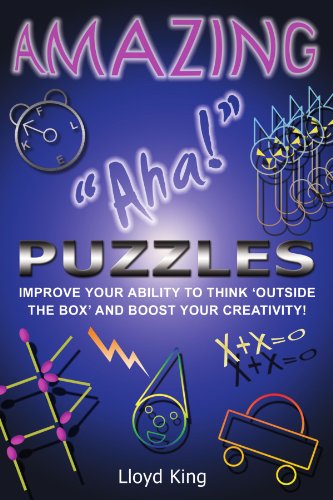
Amazing "Aha!" Puzzles

Lloyd King
Lulu.com | 2006 | 180 páginas | PDF | 2,4 Mb


DO YOU WANT TO IMPROVE YOUR ABILITY TO THINK 'OUTSIDE THE BOX' AND BOOST YOUR CREATIVITY?

This truly mind-altering and inspirational book of more than 300 brand new lateral puzzles provides a fantastic opportunity for anyone to improve their creativity and mental flexibility. It is packed with all kinds of fun and imaginative problems of varying degrees of difficulty that encourage you to break out of familiar thought patterns and to think creatively and ‘outside the box’. In addition, the puzzles have extremely rewarding and addictive "Aha!" answers absolutely guaranteed to make you both groan and smile at the same time. This book will keep you perplexed and entertained for many enjoyable hours, days and weeks to come.

Mathematics: Marvels and Milestones


A. Audichya

Oxford Book Company | 2010 | : 224 páginas | PDF | 7,8 Mb


To transport the reader to the highest level of mathematical awareness and to acquaint him with outstanding mathematical achievements. The foremost of them all is the pluralization of mathematics, i.e.,where we had geometry, we now have geometries, and algebras rather than algebra, and number systems rather than number system. It is intended for the intelligent layman who is in search of short and pointed answers to his queries but is little inclined to undertake detai led study of mathematical ideas and concepts. 

quarta-feira, 28 de março de 2012

The Algebra Teacher's Guide to Reteaching Essential Concepts and Skills: 150 Mini-Lessons for Correcting Common Mistakes

 (Jossey-Bass Teacher)

Judith A. Muschla

Jossey-Bass | 2011 | 336 páginas | PDF | 6,59 Mb

link
uploading.com
rapidgator.net

Easy to apply lessons for reteaching difficult algebra concepts
Many students have trouble grasping algebra. In this book, bestselling authors Judith, Gary, and Erin Muschla offer help for math teachers who must instruct their students (even those who are struggling) about the complexities of algebra. In simple terms, the authors outline 150 classroom-tested lessons, focused on those concepts often most difficult to understand, in terms that are designed to help all students unravel the mysteries of algebra. Also included are reproducible worksheets that will assist teachers in reviewing and reinforcing algebra concepts and key skills.
  • Filled with classroom-ready algebra lessons designed for students at all levels
  • The 150 mini-lessons can be tailored to a whole class, small groups, or individual students who are having trouble
  • This practical, hands-on resource will help ensure that students really get the algebra they are learning

Division de Un Segmento en La Razao Dada


N. M. Beskin

MIR | 1976 | PDF | 14 Mb

O objetivo deste livro é levar o leitor à profundidade. Análise de um problema mais básico ("dividir o segmento em uma razão dada adquirir novas habilidades que os conhecimentos complementares matemáticos podem ser ampliados para o comprimento ea largura do sujeito do conhecimento Ampliar significa estudar novos ramos da matemática;.. Aprofundar significa uma análise aprofundada questões que fazem parte do currículo. Não há matemático que a pretensão de saber todo o caminho deste ou daquele ramo de lamateria, como no estudo de cada problema, é o mais elementar, sempre revelar ligações inesperadas com outros problemas, Portanto, este processo de aprofundamento é interminável.

Fracciones Maravillosas


Beskin

Mir | 1987 | 98 páginas | PDF | 11 Mb

link
link1
4shared.com
scribd.com

Este libro está destinado a escolares quienes se interesan por las matemáticas. Está dedicado a uno de los apartados más cautivadores de la aritmética, la aproximación de los números reales mediante los racionales. La teoría de las fracciones continuas es bastante amplia. En el presente libro se exponen únicamente los datos fundamentales. Sin embargo, en el mismo está presente todo lo que debe conocer cada uno quien se interesa por las matemáticas. Los especialistas deben conocer mucho más.

Mathematics Teacher's Handbook

Mike Ollerton

Continuum | 2009 | 184 páginas | PDF | 4,6 Mb


This is a comprehensive handbook for mathematics teachers with practical advice on all aspects of the maths curriculum including developing an effective classroom culture, assessment and progressing mathematical concept development.'It has challenged the way I approach, teach, and even think about maths myself. It is great to read a book written with such passion offering suggestions that anyone can try the next day. The ideas I have tried have been really successful and provided enjoyable and sometimes memorable experiences. The book makes you think, and the challenge is to change not just what you are thinking but what you are actually doing in the classroom and see for yourself what effect it has on the learning taking place' - Zoe Jagelman, KS2 Teacher, St Michael's CE School Bothel.This comprehensive handbook provides mathematics teachers with practical advice on: starting teaching in the mathematics classroom; developing an effective classroom culture; understanding the balance between teaching and learning mathematics; using assessment as an integral part of teaching and learning; and progressing mathematical concept development.This handbook is a must for every mathematics teacher!

terça-feira, 27 de março de 2012

Flow: Nature's Patterns

Philip Ball

O U P | 2009 | 272 Páginas |  PDF | 3,9 Mb


From the swirl of a wisp of smoke to eddies in rivers, and the huge persistent storm system that is the Great Spot on Jupiter, we see similar forms and patterns wherever there is flow - whether the movement of wind, water, sand, or flocks of birds. It is the complex dynamics of flow that structures our atmosphere, land, and oceans.

Part of a trilogy of books exploring the science of patterns in nature by acclaimed science writer Philip Ball, this volume explores the elusive rules that govern flow - the science of chaotic behavior.

Branches: Nature's Patterns: A Tapestry in Three Parts

Philip Ball

Oxford University Press | 2009 | 272 páginas | PDF | 6 MB

scribd.com

epub - 6 Mb - link

As part of a trilogy of books exploring the science of patterns in nature, acclaimed science writer Philip Ball here looks at the form and growth of branching networks in the natural world, and what we can learn from them.

Many patterns in nature show a branching form - trees, river deltas, blood vessels, lightning, the cracks that form in the glazing of pots. These networks share a peculiar geometry, finding a compromise between disorder and determinism, though some, like the hexagonal snowflake or the stones of the Devil's Causeway fall into a rigidly ordered structure. Branching networks are found at every level in biology - from the single cell to the ecosystem. Human-made networks too can come to share the same features, and if they don't, then it might be profitable to make them do so: nature's patterns tend to arise from economical solutions.

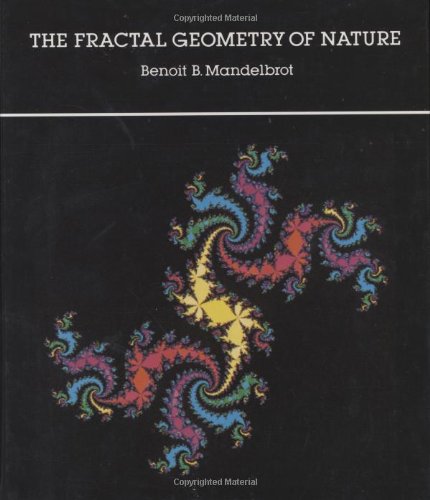
The Fractal Geometry of Nature

Benoit B. Mandelbrot

W. H. Freeman | 1983 | 472 páginas | djvu | 8 Mb


PDF - 31,5 Mb - link

Clouds are not spheres, mountains are not cones, and lightening does not travel in a straight line. The complexity of nature's shapes differs in kind, not merely degree, from that of the shapes of ordinary geometry, the geometry of fractal shapes. 

Now that the field has expanded greatly with many active researchers, Mandelbrot presents the definitive overview of the origins of his ideas and their new applications. The Fractal Geometry of Nature is based on his highly acclaimed earlier work, but has much broader and deeper coverage and more extensive illustrations.

Uses of Infinity

 (New mathematical library)

Leo Zippin

Yale University | 1962 | 158 páginas | djvu | 1,14 Mb

link direto
link
uploading.com

pdf - link

This intriguing, accessible work leads readers to an excellent grasp of the fundamental notions of infinity used in the calculus and in virtually all other mathematical disciplines. Each chapter's teachings are supplemented by challenging problems, with solutions at the end of the book

The Man Who Knew Infinity


Robert Kanigel

Washington Square Press | 1991 | 464 páginas | djvu | 4,2 Mb

libgen.net
libgen.net

PDF - 15 Mb

libgen.net


A biography of the Ramanujan describes how the natural genius of an unschooled Indian clerk came to the attention of a preeminent mathematician and the world.

Algebraic Mind


Gary F. Marcus

The MIT Press | 2003 | 240 páginas | PDF | 1,1 Mb

link


 In The Algebraic Mind, Gary Marcus attempts to integrate two theories about how the mind works, one that says that the mind is a computer-like manipulator of symbols, and another that says that the mind is a large network of neurons working together in parallel. Resisting the conventional wisdom that says that if the mind is a large neural network it cannot simultaneously be a manipulator of symbols, Marcus outlines a variety of ways in which neural systems could be organized so as to manipulate symbols, and he shows why such systems are more likely to provide an adequate substrate for language and cognition than neural systems that are inconsistent with the manipulation of symbols. Concluding with a discussion of how a neurally realized system of symbol-manipulation could have evolved and how such a system could unfold developmentally within the womb, Marcus helps to set the future agenda of cognitive neuroscience.

Sets, Functions, and Logic: An Introduction to Abstract Mathematics


Third Edition
(Chapman Hall/CRC Mathematics Series)

Keith Devlin

Chapman and Hall/CRC | 2003 | 160 páginas | PDF | 1,53 Mb

link

Keith Devlin. You know him. You've read his columns in MAA Online, you've heard him on the radio, and you've seen his popular mathematics books. In between all those activities and his own research, he's been hard at work revising Sets, Functions and Logic, his standard-setting text that has smoothed the road to pure mathematics for legions of undergraduate students.

Now in its third edition, Devlin has fully reworked the book to reflect a new generation. The narrative is more lively and less textbook-like. Remarks and asides link the topics presented to the real world of students' experience. The chapter on complex numbers and the discussion of formal symbolic logic are gone in favor of more exercises, and a new introductory chapter on the nature of mathematics--one that motivates readers and sets the stage for the challenges that lie ahead. 

Students crossing the bridge from calculus to higher mathematics need and deserve all the help they can get. Sets, Functions, and Logic, Third Edition is an affordable little book that all of your transition-course students not only can afford, but will actually read…and enjoy…and learn from.

Probability For Dummies

Deborah Rumsey

For Dummies | 2006 | 384 páginas | PDF | 4,5 Mb

depositfiles.com
uploading.com


Packed with practical tips and techniques for solving probability problems

Increase your chances of acing that probability exam -- or winning at the casino!

Whether you're hitting the books for a probability or statistics course or hitting the tables at a casino, working out probabilities can be problematic. This book helps you even the odds. Using easy-to-understand explanations and examples, it demystifies probability -- and even offers savvy tips to boost your chances of gambling success!

Discover how to
* Conquer combinations and permutations
* Understand probability models from binomial to exponential
* Make good decisions using probability
* Play the odds in poker, roulette, and other games 

segunda-feira, 26 de março de 2012

Math Wars: A Guide for Parents and Teachers

Carmen Latterell

Praeger Publishers | 2004 | PDF | 200 páginas | PDF | 1,1 Mb


This book is written for parents and other interested parties so that they can understand the great debate taking place in many states in this country about how to teach basic math. The debate centers around the standards written by the National Council of Teachers of Mathematics (NCTM), which call for a radically different approach to mathematics education. Because the issues are so heated between the NCTM-oriented curricula and traditional curricula (the curricula that NCTM-oriented replaced), the term Math Wars was coined to describe them.
Parents are concerned about their children's math learning. Teachers are concerned about math teaching. When parents see what children are bringing home under the new curriculum, it is clear that their children are not working on the same mathematics that parents remember from the time when they were in school. But, the problem goes beyond grades K-12. Post-secondary mathematics courses are the fear of many students. The standards created by the NCTM do not necessarily prepare students for success, either on SATs or in college.
Besides lack of knowledge about mathematics education, many parents have an additional problem in that they feel they lack knowledge in mathematics itself. This is very intimidating; thus it is difficult for parents to do anything about the confusing state of mathematics education. This book provides some answers.

Mathematics and Logic

Mark Kac

Dover Publications | 1992 | 192 páginas

PDF - 6,33 Mb - link

djvu - 1,6 Mb - link

Fascinating study considers the origins and nature of mathematics, its development and role in the history of scientific thinking, impact of high-speed computers, 20th-century changes in the foundations of mathematics and mathematical logic, mathematization of science and technology, much more. Compelling reading for anyone interested in the evolution of mathematical thought. Includes 34 illustrations. 1968 edition.

The Annotated Flatland: A Romance of Many Dimensions

Ian Stewart

Basic Books | 2008 | 272 páginas | PDF | 1,45 Mb

link direto
link direto1
link
rapidgator.net


Flatland is a unique, delightful satire that has charmed readers for over a century. Published in 1884 by the English clergyman and headmaster Edwin A. Abbott, it is the fanciful tale of A. Square, a two-dimensional being who is whisked away by a mysterious visitor to The Land of Three Dimensions, an experience that forever alters his worldview.
Like the original, Ian Stewart’s commentary takes readers on a strange and wonderful journey. With clarity and wit, Stewart illuminates Abbott’s numerous Victorian references and touches on such diverse topics as ancient Babylon, Karl Marx, Mary Shelley’s Frankenstein, Mt. Everest, H.G. Wells, and phrenology. The Annotated Flatland makes fascinating connections between Flatland and Abbott’s era, resulting in a classic to rival Abbott’s own, and a book that will inspire and delight curious readers for generations to come.

Precalculus Enhanced with Graphing Utilities

Michael Sullivan
(6.ª Edição)

Pearson | 2012 | 1152 páginas | PDF | 36,9 MB

link

Michael Sullivan’s time-tested approach focuses students on the fundamental skills they need for the course:preparing for class, practicing with homework, and reviewing the concepts. The Enhanced with Graphing Utilities Serieshas evolved to meet today’s course needs by integrating the usage of graphing calculator, active-learning, and technology in new ways to help students be successful in their course, as well as in their future endeavors.

In the Sixth Edition, new worksheets in MyMathLab—developed from the authors’ experience in the classroom—provide mixed review for students who having trouble reconciling various topics, and also give students an opportunity to show their work. The “Are You Prepared?” section openers focus on students mastering the prerequisite material before beginning a new topic, and for the first time, those exercises are assignable in MyMathLab. Concept and Vocabulary exercises are also now assignable in MyMathLab as reading quizzes.


Table of Contents

1. Graphs
1.1 The Distance and Midpoint Formulas; Graphing Utilities; Introduction to Graphing Equations
1.2 Intercepts; Symmetry; Graphing Key Equations
1.3 Solving Equations Using a Graphing Utility
1.4 Lines
1.5 Circles
            Chapter Review
            Chapter Test
            Cumulative Review
            Chapter Projects

2. Functions and Their Graphs
2.1 Functions
2.2 The Graph of a Function
2.3 Properties of Functions
2.4 Library of Functions; Piecewise-defined Functions
2.5 Graphing Techniques: Transformations
2.6 Mathematical Models: Building Functions
            Chapter Review
            Chapter Test
            Cumulative Review
            Chapter Projects

3. Linear and Quadratic Functions
3.1 Linear Functions, Their Properties, and Linear Models
3.2 Building Linear Models from Data
3.3 Quadratic Functions and Their Properties
3.4 Building Quadratic Models from Verbal Descriptions and Data
3.5 Inequalities Involving Quadratic Functions
            Chapter Review
            Chapter Test
            Cumulative Review
            Chapter Projects


4. Polynomial and Rational Functions
4.1 Polynomial Functions and Models
4.2 The Real Zeros of a Polynomial Function
4.3 Properties of Rational Functions
4.4 The Graph of a Rational Function
4.5 Polynomial and Rational Inequalities
4.6 Complex Zeros; Fundamental Theorem of Algebra
            Chapter Review
            Chapter Test
            Cumulative Review
            Chapter Projects

5. Exponential and Logarithmic Functions
5.1 Composite Functions
5.2 One-to-One Functions; Inverse Functions
5.3 Exponential Functions
5.4 Logarithmic Functions
5.5 Properties of Logarithms
5.6 Logarithmic and Exponential Equations
5.7 Financial Models
5.8 Exponential Growth and Decay Models; Newton's Law; Logistic Growth and Decay Models
5.9 Building Exponential, Logarithmic, and Logistic Models from Data
            Chapter Review
            Chapter Test
            Cumulative Review
            Chapter Projects

6. Trigonometric Functions
6.1 Angles and Their Measure
6.2 Trigonometric Functions: Unit Circle Approach
6.3 Properties of the Trigonometric Functions
6.4 Graphs of the Sine and Cosine Functions
6.5 Graphs of the Tangent, Cotangent, Cosecant, and Secant Functions
6.6 Phase Shift; Building Sinusoidal Models
            Chapter Review
            Chapter Test
            Cumulative Review
            Chapter Projects

7. Analytic Trigonometry
7.1 The Inverse Sine, Cosine, and Tangent Functions
7.2 The Inverse Trigonometric Functions (Continued)
7.3 Trigonometric Equations
7.4 Trigonometric Identities
7.5 Sum and Difference Formulas
7.6 Double-angle and Half-angle Formulas
7.7 Product-to-Sum and Sum-to-Product Formulas
            Chapter Review
            Chapter Test
            Cumulative Review
            Chapter Projects

8. Applications of Trigonometric Functions
8.1 Right Triangle Trigonometry; Applications
8.2 The Law of Sines
8.3 The Law of Cosines
8.4 Area of a Triangle
8.5 Simple Harmonic Motion; Damped Motion; Combining Waves
            Chapter Review
            Chapter Test
            Cumulative Review
            Chapter Projects

9. Polar Coordinates; Vectors
9.1 Polar Coordinates
9.2 Polar Equations and Graphs
9.3 The Complex Plane; DeMoivre's Theorem
9.4 Vectors
9.5 The Dot Product
9.6 Vectors in Space
9.7 The Cross Product
            Chapter Review
            Chapter Test
            Cumulative Review
            Chapter Projects

10. Analytic Geometry
10.1 Conics
10.2 The Parabola
10.3 The Ellipse
10.4 The Hyperbola
10.5 Rotation of Axes; General Form of a Conic
10.6 Polar Equations of Conics
10.7 Plane Curves and Parametric Equations
            Chapter Review
            Chapter Test
            Cumulative Review
            Chapter Projects

11. Systems of Equations and Inequalities
11.1 Systems of Linear Equations: Substitution and Elimination
11.2 Systems of Linear Equations: Matrices
11.3 Systems of Linear Equations: Determinants
11.4 Matrix Algebra
11.5 Partial Fraction Decomposition
11.6 Systems of Nonlinear Equations
11.7 Systems of Inequalities
11.8 Linear Programming
            Chapter Review
            Chapter Test
            Cumulative Review
            Chapter Projects

12. Sequences; Induction; the Binomial Theorem
12.1 Sequences
12.2 Arithmetic Sequences
12.3 Geometric Sequences; Geometric Series
12.4 Mathematical Induction
12.5 The Binomial Theorem
            Chapter Review
            Chapter Test
            Cumulative Review
            Chapter Projects

13. Counting and Probability
13.1 Counting
13.2 Permutations and Combinations
13.3 Probability
            Chapter Review
            Chapter Test
            Cumulative Review
            Chapter Projects

14. A Preview of Calculus: The Limit, Derivative, and Integral of a Function
14.1 Finding Limits Using Tables and Graphs
14.2 Algebra Techniques for Finding Limits
14.3 One-sided Limits; Continuous Functions
14.4 The Tangent Problem; The Derivative
14.5 The Area Problem; The Integral
            Chapter Review
            Chapter Test
            Cumulative Review
            Chapter Projects

Appendix A. Review
A.1 Algebra Essentials
A.2 Geometry Essentials
A.3 Polynomials
A.4 Synthetic Division
A.5 Rational Expressions
A.6 Solving Equations
A.7 Complex Numbers; Quadratic Equations in the Complex Number System
A.8 Problem Solving: Interest, Mixture, Uniform Motion, Constant Rate Jobs
A.9 Interval Notation; Solving Inequalities
A.10 nth Roots; Rational Exponents

Appendix B. The Limit of a Sequence; Infinite Series

Answers
Index