terça-feira, 21 de janeiro de 2014

Elliptic Tales: Curves, Counting, and Number Theory


Avner Ash e Robert Gross 

Princeton University Press | 2012 | 276 páginas | pdf | 3 Mb

link direto
link

Elliptic Tales describes the latest developments in number theory by looking at one of the most exciting unsolved problems in contemporary mathematics--the Birch and Swinnerton-Dyer Conjecture. The Clay Mathematics Institute is offering a prize of $1 million to anyone who can discover a general solution to the problem. In this book, Avner Ash and Robert Gross guide readers through the mathematics they need to understand this captivating problem.
The key to the conjecture lies in elliptic curves, which are cubic equations in two variables. These equations may appear simple, yet they arise from some very deep--and often very mystifying--mathematical ideas. Using only basic algebra and calculus while presenting numerous eye-opening examples, Ash and Gross make these ideas accessible to general readers, and in the process venture to the very frontiers of modern mathematics. Along the way, they give an informative and entertaining introduction to some of the most profound discoveries of the last three centuries in algebraic geometry, abstract algebra, and number theory. They demonstrate how mathematics grows more abstract to tackle ever more challenging problems, and how each new generation of mathematicians builds on the accomplishments of those who preceded them. Ash and Gross fully explain how the Birch and Swinnerton-Dyer Conjecture sheds light on the number theory of elliptic curves, and how it provides a beautiful and startling connection between two very different objects arising from an elliptic curve, one based on calculus, the other on algebra.

Contents
Prologue 1
PART I. DEGREE
Chapter1. Degree of aCurve 13
1. Greek Mathematics 13
2. Degree 14
3. Parametric Equations 20
4. Our Two Definitions of Degree Clash 23
Chapter 2. AlgebraicClosures 26
1. Square Roots of Minus One 26
2. Complex Arithmetic 28
3. Rings and Fields 30
4. Complex Numbers and Solving Equations 32
5. Congruences 34
6. Arithmetic Modulo a Prime 38
7. Algebraic Closure 38
Chapter3. The Projective Plane 42
1. Points at Infinity 42
2. Projective Coordinates on a Line 46
3. Projective Coordinates on a Plane 50
4. Algebraic Curves and Points at Infinity 54
5. Homogenization of Projective Curves 56
6. Coordinate Patches 61
Chapter 4. Multiplicities and Degree 67
1. Curves as Varieties 67
2. Multiplicities 69
3. Intersection Multiplicities 72
4. Calculus for Dummies 76
Chapter5. Bezout’s ´ Theorem 82
1. A Sketch of the Proof 82
2. An Illuminating Example 88
PART II. ELLIPTIC CURVES AND ALGEBRA
Chapter6. Transition to EllipticCurves 95
Chapter7. Abelian Groups 100
1. How Big Is Infinity? 100
2. What Is an Abelian Group? 101
3. Generations 103
4. Torsion 106
5. Pulling Rank 108
Appendix: An Interesting Example of Rank and Torsion 110
Chapter8. Nonsingular Cubic Equations 116
1. The Group Law 116
2. Transformations 119
3. The Discriminant 121
4. Algebraic Details of the Group Law 122
5. Numerical Examples 125
6. Topology 127
7. Other Important Facts about Elliptic Curves 131
5. Two Numerical Examples 133
Chapter9. Singular Cubics 135
1. The Singular Point and the Group Law 135
2. The Coordinates of the Singular Point 136
3. Additive Reduction 137
4. Split Multiplicative Reduction 139
5. Nonsplit Multiplicative Reduction 141
6. Counting Points 145
7. Conclusion 146
Appendix A: Changing the Coordinates of the Singular Point 146
Appendix B: Additive Reduction in Detail 147
Appendix C: Split Multiplicative Reduction in Detail 149
Appendix D: Nonsplit Multiplicative Reduction in Detail 150
Chapter10. EllipticCurves over Q 152
1. The Basic Structure of the Group 152
2. Torsion Points 153
3. Points of Infinite Order 155
4. Examples 156
PART III. ELLIPTIC CURVES AND ANALYSIS
Chapter11. Building Functions 161
1. Generating Functions 161
2. Dirichlet Series 167
3. The Riemann Zeta-Function 169
4. Functional Equations 171
5. Euler Products 174
6. Build Your Own Zeta-Function 176
Chapter12. AnalyticContinuation 181
1. A Difference that Makes a Difference 181
2. Taylor Made 185
3. Analytic Functions 187
4. Analytic Continuation 192
5. Zeroes, Poles, and the Leading Coefficient 196
Chapter13.L-functions 199
1. A Fertile Idea 199
2. The Hasse-Weil Zeta-Function 200
3. The L-Function of a Curve 205
4. The L-Function of an Elliptic Curve 207
5. Other L-Functions 212
Chapter14. Surprising Properties of L-functions 215
1. Compare and Contrast 215
2. Analytic Continuation 220
3. Functional Equation 221
Chapter15. TheConjecture of Birch and Swinnerton-Dyer 225
1. How Big Is Big? 225
2. Influences of the Rank on the Np’s 228
3. How Small Is Zero? 232
4. The BSD Conjecture 236
5. Computational Evidence for BSD 238
6. The Congruent Number Problem 240
Epilogue 245
Retrospect 245
Where Do We Go from Here? 247

Sugestão de tibu

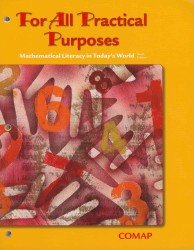
For All Practical Purposes Mathematical Literacy in Today’s World

COMAP

W. H. Freeman | 2011 - 9ª edição| 930 páginas | pdf | 35 Mb

link direto
link

For All Practical Purposes (FAPP) remains the leading textbook for turning liberal arts students into skilled math users and consumers. The text conveys the power of mathematics by presenting expert coverage of applied math concepts in fields as diverse as manufacturing and distribution, politics, the economy, architecture, technology, and the natural world, accompanied by classic and contemporary examples and exercises.

The COMAP approach presented in FAPP makes contemporary mathematical ideas exciting, relevant, and fun. The text motivates students to think about and appreciate how math affects the world around them. Students learn the basics of management science, statistics, finance, game theory, voting, and other topics in a relatable context, developing the knowledge and skills that will benefit them in future courses, their careers, and their lives.

The new edition maintains the strengths that have kept this text a best-seller while also including new examples, new exercises, new pedagogy, and enhanced media tools for students and instructors to support the teaching and learning goals.


Contents
Part I: Management Science
Chapter 1: Urban Services
Chapter 2: Business Efficiency
Chapter 3: Planning and Scheduling
Chapter 4: Linear Programming
Part II: Statistics: The Science of Data
Chapter 5: Exploring Data: Distributions
Chapter 6: Exploring Data: Relationships
Chapter 7: Data for Decisions
Chapter 8: Probability: the Mathematics of Chance
Part III: Voting and Social Choice
Chapter 9: Social Choice: The Impossible Dream
Chapter 10: The Manipulability of Voting Systems
Chapter 11: Weighted Voting Systems
Chapter 12: Electing the President
Part IV: Fairness and Game Theory
Chapter 13: Fair Division
Chapter 14: Apportionment
Chapter 15: Game Theory: The Mathematics of Competition
Part V: The Digital Revolution
Chapter 16: Identification Numbers
Chapter 17: Information Science
Part VI: On Size and Growth
Chapter 18: Growth and Form
Chapter 19: Symmetry and Patterns
Chapter 20: Tilings
Part VII: Your Money and Resources
Chapter 21: Savings Models
Chapter 22: Borrowing Models
Chapter 23: The Economics of Resources

Sugestão de tibu

Distilling Ideas An Introduction to Mathematical Thinking


Brian P. Katz e Michael Starbird
Mathematical Association of America | 2013 | 188 páginas | pdf | 2,1 Mb

link direto

rar - pdf - 1,7 Mb - link

Mathematics is not a spectator sport: successful students of mathematics grapple with ideas for themselves. Distilling Ideaspresents a carefully designed sequence of exercises and theorem statements that challenge students to create proofs and concepts. As students meet these challenges, they discover strategies of proofs and strategies of thinking beyond mathematics. In order words, Distilling Ideas helps its users to develop the skills, attitudes, and habits of mind of a mathematician and to enjoy the process of distilling and exploring ideas.
Distilling Ideas is an ideal textbook for a first proof-based course. The text engages the range of students' preferences and aesthetics through a corresponding variety of interesting mathematical content from graphs, groups, and epsilon-delta calculus. Each topic is accessible to users without a background in abstract mathematics because the concepts arise from asking questions about everyday experience. All the common proof structures emerge as natural solutions to authentic needs.Distilling Ideas or any subset of its chapters is an ideal resource either for an organized Inquiry Based Learning course or for individual study.
A student response to Distilling Ideas: "I feel that I have grown more as a mathematician in this class than in all the other classes I've ever taken throughout my academic life."

Contents
Preface ix
1 Introduction 1
1.1 Proof and Mathematical Inquiry . . . . . . . . . . 1
2 Graphs 5
2.1 The Konigsberg Bridge Problem . . . . . . . . . . 5
2.2 Connections . . . . . . . . . . . . . . . . . . . . . 6
2.3 Taking a Walk . . . . . . . . . . . . . . . . . . . . 16
2.4 Trees . . . . . . . . . . . . . . . . . . . . . . . . . 23
2.5 Planarity . . . . . . . . . . . . . . . . . . . . . . . 25
2.6 Euler Characteristic . . . . . . . . . . . . . . . . . 27
2.7 Symmetries . . . . . . . . . . . . . . . . . . . . . 32
2.8 Colorability . . . . . . . . . . . . . . . . . . . . . 34
2.9 Completing theWalk around Graph Theory . . . . 40
3 Groups 43
3.1 Examples Lead to Concepts . . . . . . . . . . . . . 43
3.2 Clock-Inspired Groups . . . . . . . . . . . . . . . 52
3.3 Symmetry Groups of Regular Polygons . . . . . . 55
3.4 Subgroups, Generators, and Cyclic Groups . . . . . 56
3.5 Sizes of Subgroups and Orders of Elements . . . . 62
3.6 Products of Groups . . . . . . . . . . . . . . . . . 64
3.7 Symmetric Groups . . . . . . . . . . . . . . . . . 65
3.8 Maps between Groups . . . . . . . . . . . . . . . . 68
3.9 Normal Subgroups and Quotient Groups . . . . . . 76
3.10 More Examples* . . . . . . . . . . . . . . . . . . 80
3.11 Groups in Action* . . . . . . . . . . . . . . . . . . 81
3.12 The Man Behind the Curtain . . . . . . . . . . . . 85
4 Calculus 89
4.1 Perfect Picture . . . . . . . . . . . . . . . . . . . . 89
4.2 Convergence . . . . . . . . . . . . . . . . . . . . . 91
4.3 Existence of Limits . . . . . . . . . . . . . . . . . 104
4.4 Continuity . . . . . . . . . . . . . . . . . . . . . . 114
4.5 Zeno’s ParadoxTM . . . . . . . . . . . . . . . . . 123
4.6 Derivatives . . . . . . . . . . . . . . . . . . . . . 127
4.7 Speedometer Movie and Position . . . . . . . . . . 135
4.8 Applications of the Definite Integral . . . . . . . . 137
4.9 Fundamental Theorem of Calculus . . . . . . . . . 141
4.10 From Vague to Precise . . . . . . . . . . . . . . . 145
5 Conclusion 149
5.1 Distilling Ideas . . . . . . . . . . . . . . . . . . . 149
Annotated Index 153
List of Symbols 165

Sugestão de tibu


Lecture Notes on Mathematical Olympiad Courses: For Junior Section


Xu Jiagu

World Scientific Publishing Company | 2012 |


vol. 1  - 178 páginas | pdf

link

Link 1

vol. 2 - 170 páginas | pdf

link

link 2

Olympiad mathematics is not a collection of techniques of solving mathematical problems but a system for advancing mathematical education. This book is based on the lecture notes of the mathematical Olympiad training courses conducted by the author in Singapore. Its scope and depth not only covers and beyond the usual syllabus, but introduces a variety of concepts and methods in modern mathematics as well. In each lecture, the concepts, theories and methods are taken as the core. The examples serve to explain and enrich their intentions and to indicate their applications. Besides, appropriate number of test questions is available for the readers' practice and testing purpose. Their detailed solutions are also conveniently provided. The examples are not very complicated so readers can easily understand. There are many real competition questions included which students can use to verify their abilities. These test questions originate from many countries all over the world. This book will serve as a useful textbook of mathematical Olympiad courses, a self-study lecture notes for students, or as a reference book for related teachers and researchers.

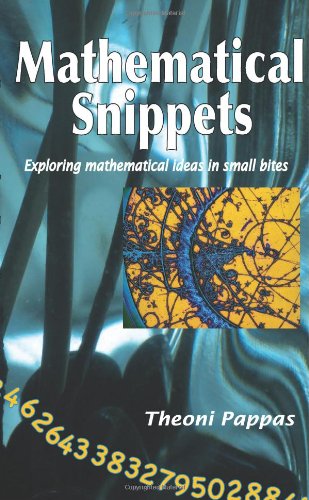
Mathematical Snippets: Exploring mathematical ideas in small bites


Theoni Pappas

Wide World Publishing | 2008 | 192 Páginas  | pdf | 9,9Mb

link (novo ficheiro)
password: matav

Epub | 6 Mb


From nutritional labels and box office statistics to terabytes and megapixels, the 21st century world is awash in numbers. How can the average Joe or Jane make sense of all that data? The key, Theoni Pappas argues, is math. In Mathematical Snippets, she draws readers into the fascinating world of math without overwhelming them with mind-numbing equations. Short, engaging sections on everything from golf to game theory introduce mathematical concepts and celebrate math’s impact on daily life.

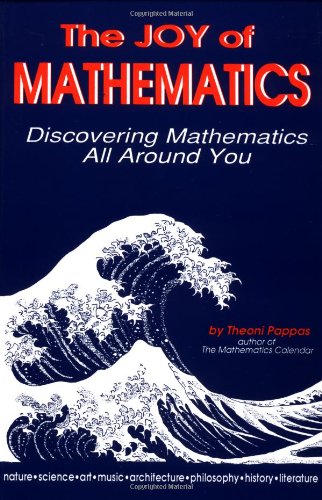
Outros livros da mesma autora, disponíveis no blog: