sexta-feira, 27 de fevereiro de 2009

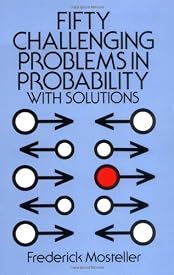
Fifty Challenging Problems in Probability with Solutions

Frederick Mosteller

Dover Publications | 1987 | 88 páginas | djvu

link direto - 0,8 Mb
link
depositfiles.com (Djvu | 1,5 MB)
depositfiles.com


Descrição: Remarkable selection of puzzlers, graded in difficulty, that illustrate both elementary and advanced aspects of probability. Selected for originality, general interest or because they demonstrate valuable techniques, the problems are ideal as a supplement to courses in probability or statistics, or as stimulating recreation for the mathematically minded. Detailed solutions.

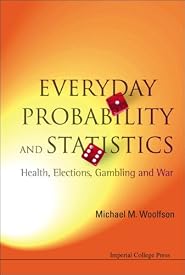
Everyday Probability a Statistics: Health, Elections, Gambling and War

Michael M. Woolfson

World Scientific Publishing Company | 2005 | 223 páginas  | PDF | 2,2 MB

f3.tiera.ru (link direto)
m.friendfeed-media.com (link direto)
link

Probability and statistics impinge on the life of the average person in a variety of ways -- as is suggested by the title of this book. Very often, information is provided that is factually accurate but intended to present a biased view. This book presents the important results of probability and statistics without making heavy mathematical demands on the reader. It should enable an intelligent reader to properly assess statistical information and to understand that the same information can be presented in different ways.
Contents: The Nature of Probability; Combining Probabilities; A Day at the Races; Making Choices and Selections; Non-Intuitive Examples of Probability; Probability and Health; Combining Probabilities, The Craps Game Revealed; The UK National Lottery, Loaded Dice and Crooked Wheels; Block Diagrams; The Normal (or Gaussian) Distribution; Statistics -- The Collection and Analysis of Numerical Data; The Poisson Distribution and Death by Horse Kicks; Predicting Voting Patterns; Taking Samples -- How Many Fish in the Pond?; Differences -- Rats and IQs; Crime is Increasing and Decreasing; My Uncle Joe Smoked 60 a Day; Chance, Luck and Making Decisions.

A History of Probability and Statistics and Their Applications before 1750


Anders Hald

Wiley-Interscience | 2003  | 608 páginas| PDF | 13,5 Mb


"This is a marvelous book . . . Anyone with the slightest interest in the history of statistics, or in understanding how modern ideas have developed, will find this an invaluable resource."

A Passion for Mathematics: Numbers, Puzzles, Madness, Religion, and the Quest for Reality

Clifford A. Pickover

Wiley | 2005 | 408 páginas | PDF  | 5,7 MB

link direto
link

A Passion for Mathematics is an educational, entertaining trip through the curiosities of the math world, blending an eclectic mix of history, biography, philosophy, number theory, geometry, probability, huge numbers, and mind-bending problems into a delightfully compelling collection that is sure to please math buffs, students, and experienced mathematicians alike. In each chapter, Clifford Pickover provides factoids, anecdotes, definitions, quotations, and captivating challenges that range from fun, quirky puzzles to insanely difficult problems. Readers will encounter mad mathematicians, strange number sequences, obstinate numbers, curious constants, magic squares, fractal geese, monkeys typing Hamlet, infinity, and much, much more. A Passion for Mathematics will feed readers’ fascination while giving them problem-solving skills a great workout!

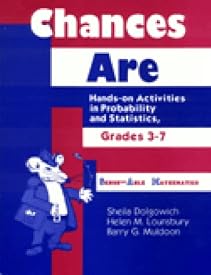
Chances Are: Hands-on Activities in Probability and Statistics

Grades 3-7
Sheila Dolgowich, Helen M. Lounsbury, Barry G. Muldoon

Anos de escolaridade: 3.º a 7.º ano

Teacher Ideas Press | 1995  | 125 páginas | epub | 3,5 Mb

link

Use these hands-on activities to introduce students to a variety of mathematical concepts that are directly tied to the NCTM Standards and to recent research in the field of math instruction. Parent letters, attitude surveys, group rating sheets, and a student response journal are included in a special assessment section. Grades 3-7. (Great for the multi-age classroom!)

Chance, Luck, and Statistics


Horace C. Levinson

Dover Publications | 2001 | 384 páginas | PDF | 12 Mb

on-line: dspace.ucalgary.ca

link
link1

djvu - 2 Mb
link
link1

Descrição: In simple, nontechnical language, this volume explores the fundamentals governing chance and applies them to sports, government, business, and other fields. Part I concerns the theory of probability in relation to superstitions, fallacies, and betting odds. Part II applies probability theory to statistics, including its relevance to warfare, sports, social problems, stocks, and other areas. "The style is clear and lively. The treatment ... is remarkably accurate. In short, it is a good book."--Scientific Monthly.

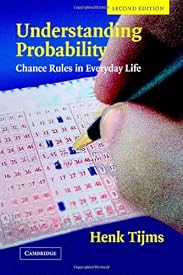
Understanding Probability: Chance Rules in Everyday Life

Henk Tijms

Cambridge University Press | 2007 |  | 452 páginas | PDF | 3,3 Mb

twominutestomidnight (link direto)
link
link1

In this fully revised second edition of Understanding Probability, the reader can learn about the world of probability in an informal way. The author demystifies the law of large numbers, betting systems, random walks, the bootstrap, rare events, the central limit theorem, the Bayesian approach and more. This second edition has wider coverage, more explanations and examples and exercises, and a new chapter introducing Markov chains, making it a great choice for a first probability course. But its easy-going style makes it just as valuable if you want to learn about the subject on your own, and high school algebra is really all the mathematical background you need.

Referência em: MathEduc

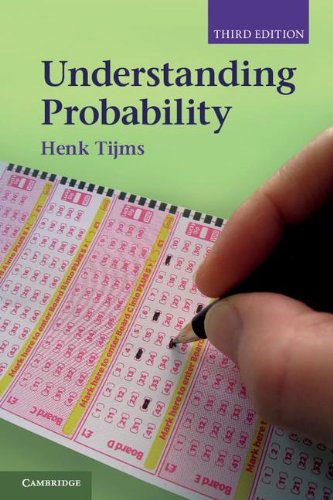
3.ª edição:


Understanding Probability (2012)

A First Course in Probability

Sheldon M. Ross

Prentice Hall College Div | 1997 - 5ª ed.| 514 páginas | Djvu | 4 Mb

link
link1

Referência em: MathEduc

This market leader is written as an elementary introduction to the mathematical theory of probability for students in mathematics, engineering, and the sciences who possess the prerequisite knowledge of elementary calculus. A major thrust of the Fifth Edition has been to make the book more accessible to today's students. The exercise sets have been revised to include more simple, mechanical problems and a new section of Self-Test Problems with fully worked out solutions conclude each chapter. In addition, many new applications have been added to demonstrate the importance of probability in real situations. A software diskette, referenced in text and packaged with each copy of the book, provides an easy to use tool for students to derive probabilities for binomial, Poisson, and normal random variables, illustrate and explore the central limit theorem, work with the strong law of large numbers, and more.

Historical Topics For The Mathematics Classroom

31.º Yearbook
Arthur E. Hallerberg, John K. Baumgart, Duane E. Deal, Bruce R. Vogeli

National Council of Teachers of Mathematics | 1969 | DjVu | 5,36 Mb

link
link1
link2

Referência em: MathEduc

The National Council of Teachers of Mathematics (NCTM) has published this updated edition in response to a continuing demand for historical materials to be used in teaching mathematics. This publication was originally issued in 1969 as the "Thirty-first Yearbook." Its primary objective is to make available to mathematics classes important material from the history and development of mathematics, with the hope that the knowledge will increase students' interest in mathematics and its cultural aspects. Additional bibliographic listings cover the proliferation of historical material in the 20 years between 1969 and 1989. Chapters include: (1) "The History of Mathematics as a Teaching Tool"; (2) "The History of Numbers and Numerals"; (3) "The History of Computation"; (4) "The History of Geometry"; (5) "The History of Algebra"; (6) "The History of Trigonometry"; (7) "The History of the Calculus"; (8) "Development of Modern Mathematics"; and (9) "The Science of Patterns." An appendix, listing "Resources beyond this Yearbook," is appended. (YP)

Episodes From The Early History Of Mathematics


Asger Aaboe

Mathematical Association of America | 1998 | 144 páginas |  rar - pdf |5,7 Mb


link (password: matav) 
(novo ficheiro)

Mathematical Association of America | 1975 | 141 páginas | DjVu | 1,2 Mb
libgen.info
libgen.info

Professor Aaboe gives here the reader a feeling for the universality of important mathematics, putting each chosen topic into its proper setting, thus bringing out the continuity and cumulative nature of mathematical knowledge. The material he selects is mathematically elementary, yet exhibits the depth that is characteristic of truly great thought patterns in all ages. The success of this exposition is due to the author's unique approach to his subject. He wisely refrains from attempting a general survey of mathematics in antiquity, but selects, instead, a few representative items that he can treat in detail. He describes Babylonian mathematics as revealed from cuneiform texts discovered only recently, as well as more familiar topics developed by the Greeks. Although each chapter can be read as a separate unit, there are many connecting threads. Aaboe stays as close to the original texts as is comfortable for a modern reader, and the bibliography enables the interested student to delve more deeply into any aspect of ancient mathematics that catches his or her fancy.

Contents
Introduction
Chapter 1 Babylonian Mathematics
1.1 Sources 5
1.2 The Babylonian Number System. A Multiplication Table 6
1.3 The Babylonian Number System. A Table of Positional of Reciprocals 10
1.4 Positional Number Systems 16
1.5 Babylonian Arithmetic 20
1.6 Three Babylonian Mathematical Texts 23
1.7 Summary
Chapter 2 Early Greek Mathematics and Euclid’s Construction of the Regular Pentagon
2.1 Sources
2.2 Greek Mathematics before Euclid
2.3 Euclid’s Elements
2.4 Euclid’s Construction of the Regular Pentagon
Chapter 3 Three Samples of Archimedean Mathematics
3.1 Archimedes’ Life
3.2 Archimedes’ Works
3.3 Constructions of Regular Polygons
3.4 Archimedes’ Trisection of an Angle
3.5 Archimedes’ Construction of the Regular Heptagon
3.6 Volume and Surface of a Sphere According to The Method
Chapter 4 Ptolemy’s Construction of a Trigonometric Table 101
4.1 Ptolemy and The Almugest 101
4.2 Ptolemy’s Table of Chords and Its Uses 103
4.3 Ptolemy’s Construction of the Table of Chords 112
Appendix Ptolemy’s Epicyclic Models 126
Solutions to Problems 128

Bibliography 131

The Challenge of Developing Statistical Literacy, Reasoning and Thinking

Dani Ben-Zvi , Joan Garfield (Eds)

Springer| 2004 | 423 páginas | PDF | 4 MB

link
link1
link2

Research in statistics education is an emerging field, with much of the work being published in diverse journals across many disciplines. Locating and synthesizing this research is often a challenging task, as is connecting the research literature to practical issues of teaching and assessing students. This book is unique in that it collects, presents, and synthesizes cutting edge research on different aspects of statistical reasoning and applies this research to the teaching of statistics to students at all educational levels. Unlike other books on how to teach statistics, or educational materials to help students learn statistics, this book presents the research foundation on which teaching should be based. The chapters in this volume are written by the today's leading researchers in statistics education.This volume will prove of great value to mathematics and statistics education researchers, statistics educators, statisticians, cognitive psychologists, mathematics teachers, mathematics and statistics curriculum developers, and quantitative literacy experts in education and government.
Contents
List of Authors
Foreword
Preface
PART I: INTRODUCTION TO STATISTICAL LITERACY, REASONING, AND THINKING
1. Statistical Literacy, Reasoning, and Thinking: Goals, Definitions, and Challenges
2. Towards an Understanding of Statistical Thinking
3. Statistical Literacy: Meanings, Components, Responsibilities
4. A Comparison of Mathematical and Statistical Reasoning
5. Models of Development in Statistical Reasoning
PART II: STUDIES OF STATISTICAL REASONING
6. Reasoning about Data Analysis
7. Learning to Reason about Distribution
8. Conceptualizing an Average as a Stable Feature of a Noisy Process
9. Reasoning about Variation
10. Reasoning about Covariation
11. Students’ Reasoning about the Normal Distribution
12. Developing Reasoning about Samples
13. Reasoning about Sampling Distributions
PART III: INSTRUCTIONAL, CURRICULAR AND RESEARCH ISSUES
14. Primary Teachers’ Statistical Reasoning about Data
15. Secondary Teachers’ Statistical Reasoning in Comparing Two Groups
16. Principles of Instructional Design for Supporting the Development of Students’ Statistical Reasoning
17. Research on Statistical Literacy, Reasoning, and Thinking: Issues, Challenges, and Implications
Author Index
Subject Index

Internationalisation and Globalisation in Mathematics and Science Education


Atweh, B.; Calabrese Barton, A.; Borba, M.; Gough, N.; Keitel, C.; Vistro-Yu, C.; Vithal, R. (Eds.)

Springer | 2007| 544 páginas | PDF | 3 Mb

link
link1

Referência em: MathEduc

In the new times of globalisation, international academic contacts and collaborations are ever increasing. They are taking many forms, from international conferences and publications, student and academic exchange, cross cultural research projects, curriculum development to professional development activities and affect every aspect of academic life from teaching, research to service.

This book aims to develop theoretical frameworks of the phenomena of internationalisation and globalisation. It identifies related ethical, moral, political and economic issues facing mathematics and science educators. It provides a venue for the publication of results of international comparisons on cultural differences and similarities rather than merely on achievement and outcomes. The book represents the different voices and interests from around the world rather than consensus on issues, and serves as a forum for critical discussion of the various models and forms of international projects and collaborations.

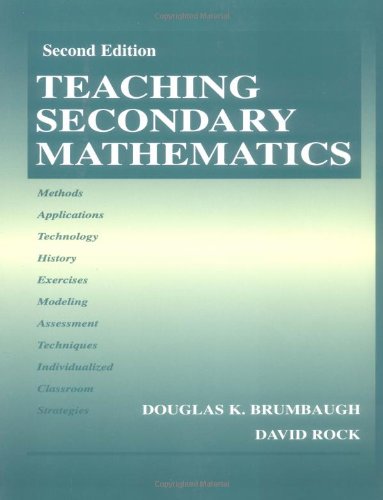
Teaching Secondary Mathematics


Douglas K. Brumbaugh; David Rock
2.ª edição

Lawrence Erlbaum | 2001 | epub | 5,9 Mb

link

Referência em: MathEduc

Teaching Secondary Mathematics, Second Edition is practical, student-friendly, and solidly grounded in up-to-date research and theory. The text is organized in three parts: General Fundamentals; Mathematics Education Fundamentals; and Content and Strategies. Throughout, emphasis is given to: 
* Technology as a teaching tool. Technology is emphasized throughout the text, and many examples for use in secondary classrooms are included. 
*Development of teaching professionals.By encouraging students to do a variety of problems, and to discuss and reflect on the problem settings, their teaching professionalism is extended and enhanced, they become more self-motivated, and can become life-long learners. 
*Pedagogical features that engage and motivate students.A variety of activities stimulate the student to extend the knowledge base and begin building a framework that will be used in the secondary classroom, including reflective thought questions, mathematical challenges, technology-based applications, student-life-based exercises, games, tricks, and group discussions. Icons identify strands that students will find useful as they continue their professional development. 
New in the Second Edition:
* All chapters are thoroughly revised and updated to incorporate current research and thinking. 
* The National Council of Teachers of Mathematics Standards 2000 are integrated throughout the text.
* The technology chapter is rewritten to reflect recent technological advancements.
* A totally new chapter on probability and statistics is included; it discusses developments that have come charging onto the scene as a result of the data-rich society in which we live.
* An application or activity lesson that puts the topics being discussed into action has been added to most chapters. 
Value-added software!MathXpert Plus(TM) Calculus Assistant (a trademark of Recognix, Inc. dba MathXpert) is now packaged with the text. It provides a unique opportunity for learning algebra-based mathematics from Algebra 1 and 2 through trigonometry, pre-calculus, and calculus. There are over 6,700 built-in problems, but users can edit these problems, or type in their own problems. Problems are systematically solved as well as graphed. The solution, with statements and reasons for each step, is displayed on screen. This solution can be developed by the user step-by-step, or generated automatically by the program. If the user opts to develop a solution, general or specific hints are provided to guide the user to the correct solution. MathXpert Plus(TM) Calculus Assistant is a powerful teaching tool. It provides graph capability that uses variables with automatically created increase/decrease buttons, and assists teachers in presenting new topics to students. Multiple graphs can be displayed on one screen or several screens at the same time. The inclusion of MathXpert Plus(TM) Calculus Assistant with this text--at a great savings over the regular price--provides an outstanding opportunity for students to begin a collection of software that will help them become more effective teachers of mathematics at the secondary level.

Secondary Analysis of the TIMSS Data

David F. Robitaille, Albert E. Beaton

Springer | 2002 | 440 páginas | PDF | 18,5 MB

link


Descrição: The goal of this volume is to use the data from IEA's Third International Mathematics and Science Study (TIMSS) to investigate significant questions related to mathematics and science education as well as a number of methodological issues. The authors of the papers included in this collection come from eleven of the TIMSS countries, and they are prominent in their respective fields. The book will be of interest to readers interested in comparative education, mathematics and science education, curriculum, and survey research methodology.A study such as TIMSS costs a great deal of money to carry out; and, if the true value of that investment is to be realized, much more research of the kind reported in this collection is needed. The papers included provide insights into the impact that TIMSS has had in the participating countries. They also serve as excellent examples of the kind of follow-up research that is needed.

Embracing Mathematics, On Becoming a Teacher and Changing with Mathematics


Peter Appelbaum e David Scott Allen

Routledge | 2008 | 369 páginas | PDF | 7 MB


link
link1

This alternative textbook for courses on teaching mathematics asks teachers and prospective teachers to reflect on their relationships with mathematics and how these relationships influence their teaching and the experiences of their students. Applicable to all levels of schooling, the book covers basic topics such as planning and assessment, classroom management, and organization of classroom experiences; it also introduces some novel approaches to teaching mathematics, such as psychoanalytic perspectives and post-modern conceptions of curriculum. Traditional methods-of-teaching issues are recast in a new discourse, provoking new ideas for making mathematics education meaningful to teachers as well as their students. Co-authored by a professor and coordinator of mathematics education programs, with illustrative contributions from practicing elementary, middle, and high school mathematics teachers, this book is a unique collaboration across all pre-college grades, making it ideal for teacher discussion groups at any level.

Embracing Mathematics:

  • integrates pedagogy and content exploration in ways that are unique in mathematics education
  • features textboxes with reflection questions and suggested explorations that can be easily utilized as homework for a course or as discussion opportunities for teacher reading groups
  • offers examples of teachers’ action research projects that grew out of their interactions with the main chapters in the book
  • is not narrowly limited to mathematics education but incorporates curriculum studies – an invaluable asset that allows instructors to find more ways to engage students in self-reflexive acts of teaching
Embracing Mathematics is intended as a method text for undergraduate and master’s-level mathematics education courses and more specialized graduate courses on mathematics education, and as a resource for teacher discussion groups.

Contents
PREFACE: How Can I (Better) Embrace Mathematics? — David Scott Allen xvii
ACKNOWLEDGMENTS: Peter Appelbaum xxi
ACKNOWLEDGMENTS: David Scott Allen xxiii
PROLOGUE — Peter Appelbaum 1
Response to Prologue: Be a Student of Mathematics Learners 14
CHAPTER 1: Planning and Assessment 19
Response to Chapter 1: Engage Yourself in Meaningful Observation 35
Action Research 1 — Isaiah Manzella, Numbers on Trial 40
MathWorlds 1: Reverse Answer to Questions 49
CHAPTER 2: A Psychoanalytic Perspective 51
Response to Chapter 2: Ask Yourself to Change 83
Action Research 2 — Karen Cipriano, Flexible Interview Project 86
MathWorlds 2: Multiple Answers 89
CHAPTER 3: You Are a Mathematician 91
Response to Chapter 3: Explore the Vastness of Mathematics 122
Action Research 3 — Karen Cipriano, Mathematics Journals 127
MathWorlds 3: Reading and Writing Mathematics 129
CHAPTER 4: Critical Thinkers Thinking Critically 130
Response to Chapter 4: It is Critical to Think 146
Action Research 4 — Ada Rocchi, Lesson: World Population and Wealth 148
MathWorlds 4: Pitching Questions at Various Levels 158
CHAPTER 5: Consuming Culture: Commodities and Cultural Resources 159
Response to Chapter 5: Emphasize the Meaning-making of Mathematics 177
Action Research 5 — Colleen Murphy, A School-wide Survey 180
MathWorlds 5: Turning “Puzzles” into “Problems” or “Exercises” 184
CHAPTER 6: Metaphors for the Classroom Space 187
Response to Chapter 6: Take Ownership of your Classroom Space 212
Action Research 6 — Kristen Iaccio, Linking Mathematics to Social Issues 216
MathWorlds 6: Same Math, Different Metaphors 223
CHAPTER 7: Places where People Learn Mathematics 225
Response to Chapter 7: The Classroom is Always Changing 245
Action Research 7 — Petal Sumner, Empowering Students Who Don’t Learn 248
CHAPTER 8: When Students Don’t Learn 253
Response to Chapter 8: We Are All Students 282
EPILOGUE: Becoming a Teacher and Changing with Mathematics 286
AFTERWORD: What will You Write in Your Chapter? 296
APPENDICES
1. Infrastructure for a Unit 298
2. Criteria for Working as a Mathematician 300
3. Mathematician’s Notebook—Checkpoint 304
4. “Polya Was a Mathematician” Songsheet 305
5. Taking Action 306
6. MathWorlds Hints and Comments — Bernadette Bacino 310

Learning Mathematics: From Hierarchies to Networks


Studies in Mathematics Education Series, N.º 15
Leone Burton
Routledge | 1999 | 280 páginas | PDF | 1,34 Mb

link

Learning Mathematics brings together a collection of interrelated and forward-looking chapters by internationally recognized experts that explores changes in the theories and practices of learning (and teaching) mathematics.
The authors reject a traditional, transmission view of the teaching of mathematics which has proved so ineffective for learning. In its place they offer information gathered from research and from practice about effects on the learners seeking to create and negotiate meaning. Learners are presented as actively attempting to make sense of the mathematics they encounter, and learners, teachers and researchers are offered examples of ho such sense-making activities, incorporated into mathematics classrooms, impact on coming to know.
The book celebrates both diversity, in the range of different perspectives, contributions and topics, and unity, in the linking chapters and themes, It will be fascinating reading for those mathematics educators who are eager to engage with a socio-cultural perspective in order to better understand the complexity of learning mathematics.

Symbolizing and Communicating in Mathematics Classrooms Perspectives on Discourse, Tools, and Instructional Design


Paul Cobb, Erna Yackel, Kay McClain
Lawrence Erlbaum | 2000 | 412 páginas | PDF

link

Referência em: MathEduc

This volume grew out of a symposium on discourse, tools, and instructional design at Vanderbilt University in 1995 that brought together a small international group to grapple with issues of communicating, symbolizing, modeling, and mathematizing, particularly as these issues relate to learning in the classroom. The participants invited to develop chapters for this book--all internationally recognized scholars in their respective fields--were selected to represent a wide range of theoretical perspectives including mathematics education, cognitive science, sociocultural theory, and discourse theory. The work is distinguished by the caliber of the contributors, the significance of the topics addressed in the current era of reform in mathematics education, and the diversity of perspectives taken to a common set of themes and issues.

The book is intended for those who are seeking to expand their understanding of the complexity of learning in order to enhance the learning experiences students have in schools, primarily researchers, instructional designers, and graduate students in mathematics education, as well as those in other fields including science education, instructional design in general, discourse theory, and semiotics.
The Nature and Origin of Mathematical Skills

J.I.D. Campbell

North Holland | 1992 | 580 páginas |

PDF - 9 Mb - link
link1
PDF | 21,25 Mb -link

Descrição:
A broad range of current experimental research on numerical cognition and the acquisition of mathematical skills is covered in this volume. The individual chapters provide in-depth analysis of specific issues, methodologies, phenomena, and theory. The book is divided into two parts. In the first part the focus is on the acquisition and development of numerical skills. Part 2 of the book contains research on the information-processing basis of numerical skills, focusing on the mechanisms of perception, attention, and memory that support number skills.The range of theoretical and methodological orientations represented in the volume captures both the diversity and coherence of contemporary research into mathematical skills. The research of educational psychologists, cognitive psychologists, and cognitive neuropsychologists mutually informs and reinforces theoretical developments within each area. The multidisciplinary interest in mathematics skills reflects the pervasiveness and importance of mathematics in education, technology, and science, and also indicates that questions about mathematical competence address important issues in diverse areas of psychology and cognitive science.

List of contents
Origins of Mathematical Abilities
What a Number Is: Mathematical Foundations and Developing Number Concepts
Kevin F. Miller
Relationships Children Construct Among English Number Words, Multiunit Base-Ten Blocks, and Written Multidigit Addition
Karen C. Fuson, Judith L. Fraivillig, & Birch H. Burghardt
Understanding Elementary Mathematics
Jeffrey Bisanz & Jo-Anne LeFevre
Mathematical Misunderstandings: Qualitative Reasoning About Quantitative Problems
Richard E. Mayer, Anne Bovenmyer Lewis, & Mary Hegarty 137
The Role of Expertise in Solving Arithmetic and Algebra Word Problems by Analogy
Laura R. Novick
The Development of Skill in Mental Arithmetic: An Individual Differences Perspective
Keith F. Widaman & Todd D. Little
Part 2 Numerical Cognition: Representation, Process, and
Architecture
A Theory of Enumeration That Grows Out of a General Theory of Vision: Subitizing, Counting, and FINSTs
Lana M. Trick
Working Memory, Automaticity, and Problem Dimculty
Mark H. Ashcraft, Rick D. Donley, Margaret A. Halas, & Mary Vakali
Representation and Retrieval of Arithmetic Facts: A Network-Interference Model and Simulation
Jamie I. D. Campbell & Michael Oliphmt
MATHNET Preliminary Results From a Distributed Model of Arithmetic Fact Retrieval
Michael McCloskey & A. Margrethe Lindemann
Inhibitory Mechanisms in Normal and Dysfunctional Number Processing
James M. Clark
Cognitive Number Processing: An Encoding-Complex Perspective
Jamie I. D. Campbell & James M. Clark
The Functional Architecture of Numerical Processing Mechanisms: Defending the Modular Model
Michael McCloskey, Paul Macaruso, Tony Whetstone
In Defense of the Encoding-complex Approach: Reply to McCloskey, Macaruso, & Whetstone
Jamie I. D. Campbell

The Language of Mathematics: Telling Mathematical Tales


Bill Barton
Springer | 2007 | 188 páginas | PDF | 643 kb

link direto
uploading.com
4shared.com
4shared.com
link

Referência em: MathEduc

The Language of Mathematics: Telling Mathematical Tales emerges from several contemporary concerns in mathematics, language, and mathematics education, but takes a different stance with respect to language. Rather than investigating the way language or culture impacts mathematics and how it is learned, this book begins by examining different languages and how they express mathematical ideas. The picture of mathematics that emerges is of a subject that is much more contingent, relative, and subject to human experience than is usually accepted. Bartons thesis takes the idea of mathematics as a human creation, and, using the evidence from language, comes to more radical conclusions than usual.
Everyday mathematical ideas are expressed quite differently in different languages. Variety occurs in the way languages express numbers, describe position, categorise patterns, as well as in the grammar of mathematical discourse. The first part of The Language of Mathematics: Telling Mathematical Tales explores these differences and thus illustrates the possibility of different mathematical worlds. This section both provides evidence of language difference with respect to mathematic talk and also demonstrates the congruence between mathematics as we know it and the English language. Other languages are not so congruent.
Part II discusses what this means for mathematics and argues for alternative answers to conventional questions about mathematics: where it comes from, how it develops, what it does and what it means. The notion that mathematics is the same for everyone, that it is an expression of universal human thought, is challenged. In addition, the relationship between language and mathematical thought is used to argue that the mathematical creativity embedded in minority languages should continue to be explored
The final section explores implications for mathematics education, discussing the consequences for the ways in which we learn and teach mathematics.
The Language of Mathematics: Telling Mathematical Tales will appeal to those interested in exploring the nature of mathematics, mathematics educators, researchers and graduate students of mathematics education.

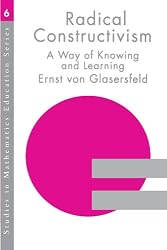
Radical Constructivism: A Way of Knowing and Learning

(Studies in Mathematics Education Series, N.º 6)
E. von Glasersfeld

Routledge | 1995 | 242 páginas | PDF | 713 kb

link
link1
uploading.com

ERIC (PDF | 4,21 MB)

Radical constructivism is a theory of knowing that provides a pragmatic approach to questions about reality, truth, language and human understanding. It introduces a change to many basic ideas, and consequently has a profound influence on the general attitude towards the world we experience. By generating awareness of the thinker's active role in building up concepts, the new orientation liberates the individual from spurious tethers and shows that it is ultimately ourselves who are responsible for what we think and do. To educators, the book suggests that the most important task is not to convey ready-made knowledge but to teach the art of constructing it. In this volume, Glaserfeld offers a theoretical account of radical constructivism. It is an elegantly and thoroughly argued account of this epistemological position, providing a profound analysis of its concepts. The book traces two genealogies of the theory. The first is the constructivist strand in the history of philosophy from the pre-Socratics via Jean Piaget to the present. The second is his own intellectual biography, illustrating how a number of lines of thought became synthesised into radical constructivism. Given its diverse roots, the first full articulation of the theory is likely to have an influence that extends beyond mathematics education.

This book gives a definitive theoretical account of radical constructivism., a theory of knowing that provides a pragmatic approach to questions about reality, truth, language and human understanding. The chapter are: (1) "Growing up Constructivist: Languages and Thoughtful People," (2) "Unpopular Philosophical Ideas: A History in Quotations," (3) "Piaget's Constructivist Theory of Knowing," (4) "The Construction of Concepts," (5) "Reflection and Abstraction," (6) "Constructing Agents: The Self and Others," (7) "On Language, Meaning, and Communication," (8) "The Cybernetic Connection," (9) "Units, Plurality and Number," and (10) "To Encourage Students' Conceptual Constructing." Each chapter contains notes. (Contains 218 references.)

Referência em: MathEduc


The Sociology of Mathematics Education: Mathematical Myths / Pedagogic Texts

(Studies in Mathematics Education Series, 7)
Paul Dowling
Routledge | 1998 | 335 páginas | PDF | 3 Mb

link
uploading.com

Referência em: MathEduc

Raises two important and related issues: the changing social aspects of math and the quality of math schemes and textbooks. Math is no longer a subject studies by intellectuals but has become a subject for study by all children aged 5 to 16 years. The continuing failure of many children in this subject is cause for concern. Dowling critically examines textbooks, and the part they play in children's learning. He clearly shows the reader how to analyze and evaluate textbooks they are currently using. This interrogation of classroom resources has important implications for teaching strategies and for textbook design and use.

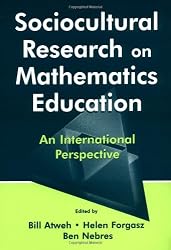
Sociocultural Research on Mathematics Education: An International Perspective

Bill Atweh, Helen Forgasz, Ben Nebres

Lawrence Erlbaum | 2001 | 480 páginas | pdf | 22,52 Mb

link

Referência em: MathEduc

This book, based on research on sociocultural aspects of mathematics education, presents contemporary and international perspectives on social justice and equity issues that impact mathematics education. In particular, it highlights the importance of three interacting and powerful factors--gender, social, and cultural dimensions. The book is research based and presents recommendations for practice and policy and identifying areas for further research. It addresses all aspects of formal and informal mathematics education and applications and all levels of formal schooling. The book is especially intended for researchers, graduate students, and policymakers in the field of mathematics education. Chapters include: (1) "A Cultural/Discursive Psychology for Mathematics Teaching and Learning" (Stephen Lerman); (2) "Mathematics Education in Late Modernity: Beyond Myths and Fragmentation" (Paul Dowling); (3) "Breaking Political Neutrality: The Critical Engagement of Mathematics Education with Democracy" (Ole Skovsmose and Paola Valero); (4) "Mathematical Literacy and Common Sense in Mathematics Education" (Uwe Gellert, Eva Jablonka, and Christine Keitel); (5) "Internationalization and Globalization of Mathematics Education: Toward an Agenda for Research/Action" (Bill Atweh and Phil Clarkson); (6) "Globalization and the Politics of Mathematics Education" (Jan Thomas); (7) "Situated Sociocultural Mathematics Education: Vignettes from Southeast Asian Practices" (Khoon Yoong Wong, Zaitun Binti Hj Mohd Taha, and Palanisamy Veloo); (8) "Mathematical Ideas and Indigenous Languages" (Bill Barton and Roslyn Frank); (9) "The Sociopolitical Context of Mathematics Education in Guatemala through the Words and Practices of Two Teachers" (Richard S. Kitchen); (10) "Continuous In-Service Professional Development of Teachers and School Change: Lessons From Mexico" (Bill Atweh and Marcos Daniel Arias Ochoa); (11) "Resourcing Practice and Equity: A Dual Challenge for Mathematics Education" (Jill Adler); (12) "Mathematics, Social Class, and Linguistic Capital: An Analysis of Mathematics Classroom Interactions" (Robyn Zevenbergen); (13) "Longitudinal Evaluation of Mathematics Participation in American Middle and High Schools" (Xin Ma); (14) "Sociocultural Considerations and Latino Mathematics Achievement: A Critical Review" (Luis Ortiz-Franco and William V. Flores); (15) "The Social Constructs of the Mathematical Experiences of African-American Students" (Vivian R. Moody); (16) "Numeracy: Negotiating the World through Mathematics" (Betty Johnston and Keiko Yasukawa); (17) "Modeling with Purpose: Mathematics as a Critical Tool" (Swapna Mukhopadhyay and Brian Greer); (18) "Contribution of Ethnomathematics to Mainstream Mathematics Classroom Practice" (Gloria Stillman and Jo Balatti); (19) "Teaching and Learning School Mathematics by Building on Students' Out-of-School Mathematics Practice" (Joanna O. Masingila and Rapti de Silva); (20) "'A+ for Girls, B for Boys': Changing Perspectives on Gender Equity and Mathematics" (Helen Forgasz and Gilah Leder); (21) "Single-Gender Schooling in the Public Sector in California: Promise and Practice" (Joanne Rossi Becker); (22) "Fables: The Tortoise? The Hare? The Mathematically Underachieving Male?" (Leone Burton); (23) "Girls, Mathematics, and Technology" (Nicola Yelland); and (24) "Creating a Connected, Equitable Mathematics Classroom: Facilitating Gender Equity" (Joanne E. Goodell and Lesley H. Parker).

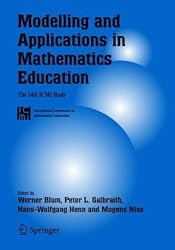
Modelling and Applications in Mathematics Education: The 14th ICMI Study

Werner Blum, Peter L. Galbraith, Hans-Wolfgang Henn, Mogens Niss

Springer-Verlag | 2006 | 515 páginas | 22 MB

link
link1

Referência em: MathEduc

The overall goal of Modelling and Applications in Mathematics Education is to provide a comprehensive overview of the state-of-the-art in the field of modelling and applications in mathematics education. Key issues are dealt with, among which are the following:
Epistemology and the relationships between mathematics and the "rest of the world"; the meaning of mathematical modelling and its process components; the respect in which the distinction between pure mathematics and applications of mathematics make sense
Authenticity and Goals dealing with modelling and applications in mathematics teaching; appropriate balance between modelling activities and other mathematical activities; the role that authentic problem situations play in modelling and applications activities
Modelling Competencies: characterizing how a student's modelling competency can be characterized; identifiable sub-competencies, and the ways they constitute a general modelling competency; developing competency over time
Mathematical Competencies: identifying the most important mathematical competencies that students should acquire, and how modelling and applications activities can contribute toward building up these competencies; the meaning of "Mathematical Literacy" in relation to modelling
Modelling Pedagogy: appropriate pedagogical principles and strategies for the development of modelling courses and their teaching; the role of technology in the teaching of modelling and applications
Implementation and Practice: the role of modelling and applications in everyday mathematics teaching; major impediments and obstacles; advancing the use of modelling examples in everyday classrooms; documenting successful implementation of modelling in mathematics teaching
Assessment and Evaluation: assessment modes that capture the essential components of modelling competency; modes available for modelling and applications courses and curricula; appropriate strategies to implement new assessment and evaluation modes in practice
The contributing authors are eminent members of the mathematics education community. Modelling and Applications in Mathematics Education will be of special interest to mathematics educators, teacher educators, researchers, education administrators, curriculum developers and student teachers.


TABLE OF CONTENTS
PREFACE xi
1 INTRODUCTION 1
1 MOGENS NISS, WERNER BLUM & PETER GALBRAITH 3
Introduction
2 PLENARIES 33
2.1 CLAUDI ALSINA 35
Less chalk, less words, less symbols ... more objects, more context, more actions
2.2 MORTEN BLOMH0J & TOMAS HOJGAARD JENSEN 45
What's all the fuss about competencies?
2.3 JERE CONFREY & ALAN MALONEY 57
A theory of mathematical modelling in technological settings
2.4 HELEN M. DOERR 69
What knowledge do teachers need for teaching mathematics through applications and modelling?
2.5 PETER GALBRAITH 79
Beyond the low hanging fruit
2.6 BRIAN GREER, LIEVEN VERSCHAFFEL & 89
SWAPNA MUKHOPADHYAY
Modelling for life: Mathematics and children's experience
2.7 GABRIELE KAISER & KATJA MAASS 99
Modelling in lower secondary mathematics classroom - problems and opportunities
2.8 HENRY POLLAK 109
Mathematical modelling - A conversation with Henry Pollak
3 ISSUES IN APPLICATIONS AND MODELLING 121
3.1 EPISTEMOLOGY AND MODELLING 123
3.1.0 JERECONFREY 125
Epistemology and modelling - overview
3.1.1 FERDINANDO ARZARELLO, GIOVANNI PEZZI & ORNELLA ROBUTTI
Modelling body motion: An approach to functions using measuring instruments
3.1.2 KOENO GRAVEMEIJER 137
Emergent modelling as a precursor to mathematical modelling
3.1.3 GILA HANNA & HANS NIELS JAHNKE 145
Proving and modelling
3.1.4 RICHARD LEHRER & LEONA SCHAUBLE 153
A developmental approach for supporting the epistemology of modelling
3.1.5 RICHARD LESH & CAROLINE YOON 161
What is distinctive in (our views about) models and modelling perspectives on mathematics problem solving, learning, and teaching?
3.1.6 RUDOLF STRASSER 171
Everyday instruments: On the use of mathematics
3.2 AUTHENTICITY AND GOALS 179
3.2.0 PETER GALBRAITH 181
Authenticity and Goals - overview
3.2.1 CINZIA BONOTTO 185
How to replace word problems with activities of realistic mathematical modelling
3.2.2 EVA JABLONKA 193
The relevance of modelling and applications: Relevant to whom and for what purpose?
3.2.3 TORULF PALM 201
Features and impact of the authenticity of appHed mathematical school tasks
3.2.4 RALPH SCHWARZKOPF 209
Elementary modelling in mathematics lessons: The interplay between "real-world" knowledge and "mathematical structures"
3.3 MODELLING COMPETENCIES 217
3.3.0 BRIAN GREER & LiEVEN VERSCHAFFEL 219
Modelling compentencies - overview
3.3.1 HERBERT HENNING & MIKE KEUNE 225
Levels of modelling competencies
3.3.2 MIHAELA SINGER 233
Modelling both complexity and abstraction: A paradox?
3.3.3 DIRK DE BOCK, WIM VAN DOOREN & DIRK JANSSENS 241
Studying and remedying students' modelling competencies: Routine behaviour or adaptive expertise
3.3.4 KEN HOUSTON 249
Assessing the "phases" of mathematical modelling
3.3.5 ZALMAN USISKIN 257
The arithmetic operations as mathematical models
3.4 APPLICATIONS & MODELLING FOR MATHEMATICS 265
3.4.0 ERIC MULLER & HUGH BURKHARDT 267
Applications and modelling for mathematics - overview
3.4.1 MALCOLM SWAN, ROSS TURNER & CAROLINE YOON, WITH ERIC MULLER
The roles of modelling in learning mathematics
3.4.2 LYNN ARTHUR STEEN & Ross TURNER WITH HUGH BURKHARDT
Developing mathematical literacy
3.4.3 S0REN ANTONIUS , CHRIS HAINES, THOMAS HOJGAARD JENSEN & MOGENS NiSS WITH HUGH BURKHARDT
Classroom activities and the teacher
3.4.4 DANIEL PEAD & BILL RALPH WITH ERIC MULLER 309
Uses of technologies in learning mathematics through modelling
3.5 MODELLING PEDAGOGY 319
3.5.0 HANS-WOLFGANG HENN 321
Modelling pedagogy - overview
3.5.1 OLIVE CHAPMAN 325
Mathematical modelling in high school mathematics: Teachers' thinking an practise
3.5.2 THOMAS LINGEFJARD 333
Mathematical modelling in teacher education - necessity or unnecessarily
3.5.3 STEPHAN HUSSMANN 341
Building concepts and conceptions in technology-based open learning environments
3.5.4 DJORDJE KADIJEVICH 349
Towards a wider implementation of mathematical modelling
at upper secondary and tertiary levels
3.5.5 AKIO MATSUZAKI 357
How might we share models through cooperative mathematical modelling? Focus on situations based on individual experiences
3.6 IMPLEMENTATION AND PRACTICE 365
3.6.0 THOMAS LINGEFJARD 367
Implementation and Practice - overview
3.6.1 MICHELE ARTAUD 371
Some conditions for modelling to exist in mathematics classrooms
3.6.2 WILFRIED HERGET & MARLENE TORRES-SKOUMAL 379
Picture (im)perfect mathematics!
3.6.3 EWALAKOMA 387
Learning mathematical modelling - from the perspective of probability and statistics education
3.6.4 GEOFF WAKE 395
Considering workplace activity from a mathematical modelling perspective
3.7 ASSESSMENT AND EVALUATION 403
3.7.0 PETER GALBRAITH 405
Assessment and evaluation - overview
3.7.1 S0REN ANTONIUS 409
Modelling based project examination
3.7.2 CHRISTOPHER HAINES & ROSALIND CROUCH 417
Mathematical modelling and applications: Ability and competence frameworks
3.7.3 JERRY LEGE 425
"To model, or to let them model?" That is the question!
3.7.4 Ross TURNER 433
Modelling and applications in PISA
3.7.5 PAULINE Vos 441
Assessment of applied mathematics and modelling: Using a laboratory-like environment
4 EDUCATIONAL LEVELS 449
4.1 MARIA SALETT BIEMBENGUT 451
Modelling and applications in primary education
4.2 TOSHIKAZUIKEDA 457
Possibilities for, and obstacles to teaching applications and modelling in the lower secondary levels
4.3 GLORIA STILLMAN 463
Upper secondary perspectives on applications and Modelling
4.4 CLAUDI ALSINA 469
Teaching applications and modelling at tertiary level
4.5 THOMAS LINGEFJARD 475
Modelling in teacher education
5 CASES IN APPLICATIONS AND MODELLING 483
5.1 KATIE MAKAR & JERE CONFREY 485
Moving the context of modelling to the forefront: Preservice teachers' investigations of equity in testing
5.2 CHRISTINE SUURTAMM & GEOFFREY ROULET 491
Modelling in Ontario: Success in moving along the continuum
5.3 GLORIA STILLMAN 497
Implementation case study: Sustaining curriculum change
5.4 CYRIL JULIE & ViMOLAN MUDALY 503
Mathematical modelling of social issues in school mathematics in South Africa
BIBLIOGRAPHY 511

INDEX 519

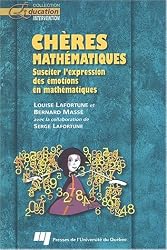
Cheres Mathematiques: Susciter L'expression Des emotions En Mathematiques


Louise Masse, Bernard Lafortune, Serge Lafortune

Presses de l'Universite du Quebec | 2002| 140 páginas | PDF | 3,5 MB

link
link1

Qu'elles nous séduisent, nous effraient, nous laissent indifférents ou soulèvent des passions, les maths font parler d'elles. Avec Chères mathématiques, Louise Lafortune et Bernard Massé s'adressent tant aux intervenantes et intervenants du milieu scolaire qu'aux parents d'élèves. Ainsi, à la lecture de cet ouvrage, les adultes qui désirent réfléchir sur leurs réactions vis-à-vis des mathématiques pourront amorcer une démarche d'analyse de leurs émotions. À travers les huit chapitres présentés, ils y trouveront des activités pédagogiques qui alimenteront leur réflexion et des témoignages, scénarios et explications qui apporteront un éclairage différent sur les émotions ressenties. Cet ouvrage s'accompagne d'une vidéocassette (vendue séparément chez l'éditeur) présentant huit capsules associées aux chapitres du livre. Les capsules, conçues par Louise Lafortune et réalisées par Serge Lafortune, sont inspirées de réalisations d'enfants (dessins, poèmes mathématiques ou lettres adressées aux mathématiques) dans le but de faire émerger les émotions que les élèves, de même que plusieurs adultes, ressentent à l'égard des mathématiques

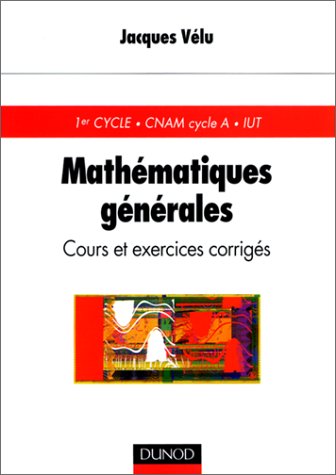
Mathématiques générales


Jacques Vélu

Dunod | 2000 | 316 páginas | Djvu | 3 MB

link
link1