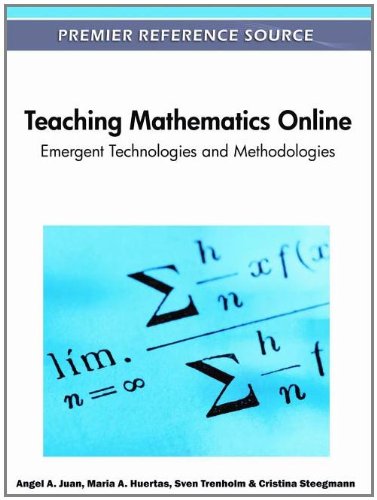
Angel A. Juan, Maria A. Huertas,
Sven Trenholm
e Cristina Steegmann
Information Science Pub | 2011 | 398 páginas | PDF | 14,3 Mb
Educational technologies (e-learning environments or learning management systems for individual and collaborative learning, Internet resources for teaching and learning, academic materials in electronic format, specific subject-related software, groupware and social network software, etc.) are changing the way in which higher education is delivered. Teaching Mathematics Online: Emergent Technologies and Methodologies shares theoretical and applied pedagogical models and systems used in math e-learning including the use of computer supported collaborative learning, which is common to most e-learning practices. The book also forecasts emerging technologies and tendencies regarding mathematical software, learning management systems, and mathematics education online and presents up-to-date research work on how mathematics education is changing in a global and Web-based world.
CHAPTER SYNOPSIS
The chapters in this book have been divided into three sections: (i) Blended Experiences in Mathematics e-Learning, (ii) Pure Online Experiences in Mathematics e-Learning, and (iii) Mathematics Software & Web Resources for Mathematics e-Learning. What follows is a chapter-by chapter overview for each of these areas.
Section I - Blended Experiences in Mathematics e-Learning
Chapter 1: “A Model for Asynchronous Discussions in a Mathematics Content Course,” T. Miller presents an asynchronous model for online discussions in a mathematics content course for elementary mathematics teachers. The model facilitates students’ motivation and collaborative learning, representing a natural extension of the in-class discussions, lecture, and activities.
Chapter 2: “A Blended Learning Approach in Mathematics,” B. Abramovitz et al. describe a blended experience in Calculus courses for undergraduate engineering students. According to the authors, their blended model contributed to making students more active and motivated learners and also served to promote student-instructor interaction.
Chapter 3 “Screencasting for Mathematics Online Learning – a case study of a first year Operations Research course at a dual-mode Australian university,” B. Loch introduces a case study regarding the use of screencasting technology in an Operations Research course taken simultaneously by on-campus and distance students. The chapter discusses issues such as online student’s isolation, portability of materials and “just-in-time” guidance and support.
Chapter 4: “Mathematics Education: teaching and learning opportunities in blended learning,” G. Albano discusses some Web-based experiences developed at two different Italian universities to help provide some insight into opportunities offered by e-learning platforms in blended environments. Among other results, the author concludes that her students prefer the blended mathematics course over the traditional one.
Chapter 5: “Best Practices for Hybrid Mathematics Courses,” D. Perdue uses an informal style to discuss some “best practices” she uses in her blended mathematics courses. By using these practices, the author analyzes how she spends more class time discussing the relevant material with her students and how they have become increasingly active participants in their own learning process.
Chapter 6: “Implementation of Learning Outcomes in Mathematics for Non-Mathematics Major by using e-Learning,” B. Divjak presents some experiences related to blended mathematics courses carried out at the University of Zagreb. In these experiences, the author examines how blended courses can be efficiently supported by Information Technologies and social software such as wikis, e-portfolios, et cetera.
Section II - Purely Online Experiences in Mathematics e-Learning
Chapter 7: “Online Communities of Practice as Vehicles for Teacher Professional Development,” M. Meletiou-Mavrotheris explores how Web-based technologies can be effectively employed to promote the creation of online communities of practice that share knowledge and experiences regarding math-related contents and courses. In particular, she analyzes an online learning experience regarding a multinational group of elementary and middle school teachers of Statistics.
Chapter 8: “Mathematics Bridging Education using an Online, Adaptive e-Tutorial: preparing international students for higher education,” D. Tempelaar et al. describe and evaluate a postsecondary online program designed to facilitate the transition from high-school maths to university maths. The program is based on the administration of an entry test and the organization of an online summer course. A quantitative analysis provides some insight on the relevance of several factors affecting students’ academic performance.
Chapter 9: “Teaching Mathematics Teachers Online: Strategies for Navigating the Intersection of Andragogy, Technology, and Reform-based Mathematics Education,” D. Jarvis investigates some of the factors and strategies that, according to his ten-year experience as an online instructor, help to successfully combine technology and emergent online teaching models to provide adult mathematics education.
Chapter 10: “Developing Teachers’ Mathematical Knowledge for Teaching through Online Collaboration,” J. Silverman and E. Clay provide several case studies that highlight the potential that online collaboration hold for supporting mathematics teachers’ collaboration. In their own words, “the asynchronous and permanent nature of online environments allow for potentially pivotal utterances […] to be taken up as a focus of conversation by the remainder of the class and, when they are not taken up, allow instructors to create bridges between teachers’ current understandings and the instructional goals.”
Chapter 11: “Self-Regulated Learning and Self Assessment in Online Mathematics Bridging Courses,” R. Biehler et al. introduce an innovative way of teaching and learning mathematics online and designed to facilitate the transition from secondary to higher-education. They present some multimedia learning materials developed by an inter-university project and discuss the acceptance and success of their courses among students.
Chapter 12: “Long-Term Experiences in Mathematics E-Learning in Europe and the USA: A Comparative Study Regarding Differing Higher-Education Models,” S. Trenholm et al. perform a comparative study regarding some long-term experiences teaching mathematics online at four different universities in Europe and the US. The analysis highlights common patterns and also differences among the diverse models considered. Some key factors for successful mathematics e-learning practices are identified.
Section III - Mathematics Software & Web Resources for Mathematics e-Learning
Chapter 13: “My Equations are the Same as Yours!: computer aided assessment using a Gröbner basis approach,” M. Badger and C. Sangwin show an example of how computer-aided assessments can automatically evaluate whether or not two systems of equations are equivalent.
Chapter 14: “Interacive Web-based Tools for Learning Mathematics: best practices,” B. Cherkas and R. Welder examine and classify a number of popular and relevant websites for collegiate mathematics based on their interactivity, dynamic capabilities, pedagogical strengths and weakness, the practices they employ, and their potential to enhance mathematical learning.
Chapter 15: “NAUK.si – using learning blocks to prepare e-content for teaching mathematics,” M. Lokar et al. exhibit the NAUK group, which is working on the development of mathematics learning blocks and tools for easy creation of mathematics contents. A practical example completes the chapter and illustrates the flexibility and potential of the NAUK system.
Chapter 16: “Software Tools Used in Math Refresher Courses at the University of Alcala, Spain,” J. Alcazar et al. present a mathematics teaching experience based on the combination of the Moodle platform and mathematical software such as WIRIS, GeoGebra, SAGE, and Wolfram Alpha.
Chapter 17: “Formula Editors and Handwriting in Mathematical e-Learning,” M. Misfeldt and A. Sanne report on an experience in which they compare Moodle’s formula editor with the use of direct scanner-based handwriting. According to their results, despite the existence of modern formula editors, handwriting continues to be a relevant way of communicating mathematics in e-learning programs.
Chapter 18: “The Role of Technology in Mathematics Support: a pilot study,” C. Mac an Bhaird and A. O’Shea discuss the importance of technology to enhance mathematics education and support. They present their experiences on the development of online mathematics courses and online learning materials. They also provide some feedback from their students and discuss the benefits and challenges of techniques such as screencasting.
FINAL WORDS
To the best of our knowledge, this is the first international book focused on Mathematics e-learning in higher education, an emerging area both in research and academic practice. Accordingly, we expect this book to be a valuable tool for researchers in the fields of Mathematics education and e-learning, academics involved in e-learning research, faculty teaching mathematics online, as well as instructional designers and online coordinators implementing courses in Mathematics e-learning. The text will also be potentially useful for senior year undergraduate or graduate studies in computer sciences, management, or mathematics education.