Sergei Abramovich
Nova Science Pub Inc | 2011 | 261 páginas | PDF | 7,4 Mb
link
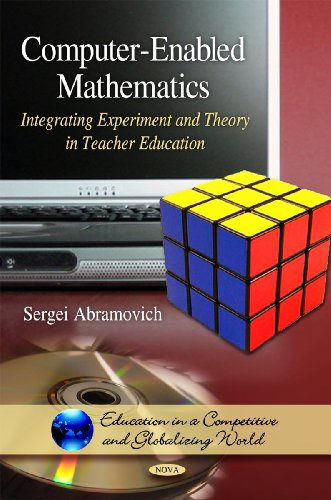
This book addresses core recommendations by the Conference Board of the Mathematical Sciences - an umbrella organisation consisting of sixteen professional societies in the United States - regarding the mathematical preparation of the teachers. According to the Board, the concept of a capstone course in a mathematics education programincludes teachers' learning to use commonly available educational software with the goal to reach a certain depth of the mathematics curriculum through appropriately designed computational experiments. In turn, the notion of experiment in the teaching of mathematics sets up a path toward enhancing the 'E' component of the teachers' literacy in the STEM disciplines. This book discusses experiences in teaching a computer-enhanced capstone course for prospective teachers of high school mathematics
This book addresses core recommendations by the Conference Board of the Mathematical Sciences - an umbrella organisation consisting of sixteen professional societies in the United States - regarding the mathematical preparation of the teachers. According to the Board, the concept of a capstone course in a mathematics education programincludes teachers' learning to use commonly available educational software with the goal to reach a certain depth of the mathematics curriculum through appropriately designed computational experiments. In turn, the notion of experiment in the teaching of mathematics sets up a path toward enhancing the 'E' component of the teachers' literacy in the STEM disciplines. This book discusses experiences in teaching a computer-enhanced capstone course for prospective teachers of high school mathematics
Table of Contents:
Preface
Chapter 1: The multiplication table from an advanced standpoint, 1-36
Chapter 2: Algebraic equations with parameters, PP. 37-68
Chapter 3: Inequalities and spreadsheet modeling, PP. 69-94
Chapter 4: Geometric probabilities, PP. 95-127
Chapter 5: Combinatorial explorations, PP. 129-169
Chapter 6: Historical perspectives, PP. 171-198
Chapter 7: Computational experiments and formal demonstration in trigonometry, PP. 199-224
Chapter 8: Developing models for computational problem solving, PP. 225-250
Chapter 9: Programming details, PP. 251-259

Sem comentários:
Enviar um comentário