domingo, 15 de março de 2009

A History of Mathematics: From Mesopotamia to Modernity

Luke Hodgkin

Oxford University Press, USA | 2005 | 294 páginas| PDF


math-cs.aut.ac.ir (link direto)
static.schoolrack.com (linkdireto)
f3.tiera.ru (linkdireto)
link


A History of Mathematics: From Mesopotamia to Modernity covers the evolution of mathematics through time and across the major Eastern and Western civilizations. It begins in Babylon, then describes the trials and tribulations of the Greek mathematicians. The important, and often neglected, influence of both Chinese and Islamic mathematics is covered in detail, placing the description of early Western mathematics in a global context. The book concludes with modern mathematics, covering recent developments such as the advent of the computer, chaos theory, topology, mathematical physics, and the solution of Fermat's Last Theorem. Containing more than 100 illustrations and figures, this text, aimed at advanced undergraduates and postgraduates, addresses the methods and challenges associated with studying the history of mathematics. The reader is introduced to the leading figures in the history of mathematics (including Archimedes, Ptolemy, Qin Jiushao, al-Kashi, al-Khwasizmi, Galileo, Newton, Leibniz, Helmholtz, Hilbert, Alan Turing, and Andrew Wiles) and their fields. An extensive bibliography with cross-references to key texts will provide invaluable resource to students and exercises (with solutions) will stretch the more advanced reader.

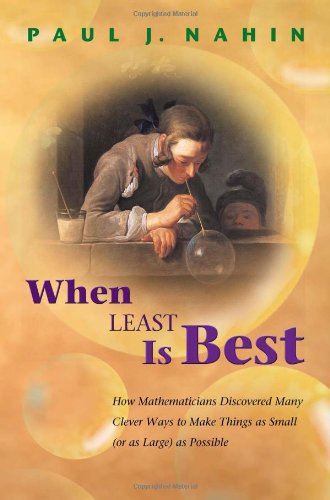
When Least Is Best: How Mathematicians Discovered Many Clever Ways to Make Things as Small (or as Large) as Possible

Paul J. Nahin

Princeton University Press | 2007 | 400 páginas | Djvu | 2,4 MB

link
link1
link2

What is the best way to photograph a speeding bullet? Why does light move through glass in the least amount of time possible? How can lost hikers find their way out of a forest? What will rainbows look like in the future? Why do soap bubbles have a shape that gives them the least area?

By combining the mathematical history of extrema with contemporary examples, Paul J. Nahin answers these intriguing questions and more in this engaging and witty volume. He shows how life often works at the extremes--with values becoming as small (or as large) as possible--and how mathematicians over the centuries have struggled to calculate these problems of minima and maxima. From medieval writings to the development of modern calculus to the current field of optimization, Nahin tells the story of Dido's problem, Fermat and Descartes, Torricelli, Bishop Berkeley, Goldschmidt, and more. Along the way, he explores how to build the shortest bridge possible between two towns, how to shop for garbage bags, how to vary speed during a race, and how to make the perfect basketball shot.

Written in a conversational tone and requiring only an early undergraduate level of mathematical knowledge, When Least Is Best is full of fascinating examples and ready-to-try-at-home experiments. This is the first book on optimization written for a wide audience, and math enthusiasts of all backgrounds will delight in its lively topics.

Companion Encyclopedia of the History and Philosophy of the Mathematical Sciences


Vol. 2
(Routledge reference)
Grattan-Guinness I

Routledge | 1992 | 1819 páginas | epub | 7,22 Mb

link

Comentário em: MAA

Mathematics is one of the most basic -- and most ancient -- types of knowledge. Yet the details of its historical development remain obscure to all but a few specialists. The two-volume Companion Encyclopedia of the History and Philosophy of the Mathematical Sciences recovers this mathematical heritage, bringing together many of the world's leading historians of mathematics to examine the history and philosophy of the mathematical sciences in a cultural context, tracing their evolution from ancient times to the twentieth century.
In 176 concise articles divided into twelve parts, contributors describe and analyze the variety of problems, theories, proofs, and techniques in all areas of pure and applied mathematics, including probability and statistics. This indispensable reference work demonstrates the continuing importance of mathematics and its use in physics, astronomy, engineering, computer science, philosophy, and the social sciences. Also addressed is the history of higher education in mathematics. Carefully illustrated, with annotated bibliographies of sources for each article, The Companion Encyclopedia is a valuable research tool for students and teachers in all branches of mathematics.

Contents of Volume 1: -Ancient and Non-Western Traditions -The Western Middle Ages and the Renaissance -Calculus and Mathematical Analysis -Functions, Series, and Methods in Analysis -Logic, Set Theories, and the Foundations of Mathematics -Algebras and Number Theory

Contents of Volume 2: -Geometries and Topology -Mechanics and Mechanical Engineering -Physics, Mathematical Physics, and Electrical Engineering -Probability, Statistics, and the Social Sciences -Higher Education andInstitutions -Mathematics and Culture -Select Bibliography, Chronology, Biographical Notes, and Index

Prince of Mathematics: Carl Friedrich Gauss


M. B. W. Tent

A K Peters Ltd | 2006 | 264 páginas| PDF | 14 Mb

link
link1

djvu - 1,3 Mb

link
link1

The author narrates the life of Carl Friedrich Gauss, the 18th century mathematician, from his prodigious childhood to his extraordinary achievements that earned him the title "Prince of Mathematics". Along the way, the author introduces her readers to a different culture, the era of small states in Germany where advancement on merits, such as Gauss, was supported by enlightened rulers, competing for intellectual excellence and economic advantage through scientific progress in their small states. Based on extensive research of original and secondary sources, the author has created an historical narrative that will inspire young readers and even curious adults with a story full of human touch and personal achievement.

Gauss: A Biographical Study

Walter K. Buhler

Springer | 1981 | 208 páginas | djvu | 2 MB

link direto
link
link1

This book describes the life of the mathematician and scientist Carl Friedrich Gauss. Gauss lived in a period of extraordinary political and social developments, even measured by the standards of our own fast moving and eventful age. He was 12 years old when the French Revolution broke out, 29 when the seemingly eternal, l000-year-old Holy Roman Empire was dissolved, 38 when Napoleon was defeated, and over 70 when Germany had its own liberal revolution in 1848. During the same period, the so-called first industrial revolution took place, with its lasting and incisive effects on everyday life and the political and social order. It is clear that all this affected Gauss's life in an explicit and tangible way.

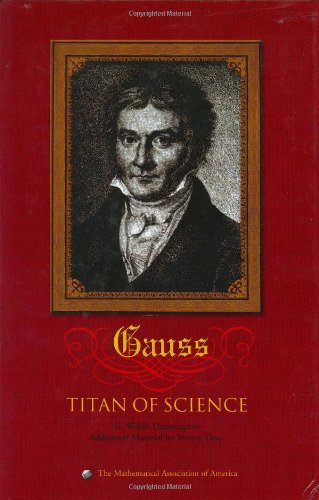
Carl Friedrich Gauss: Titan of Science

(Spectrum) 

G. Waldo Dunnington


The Mathematical Association of America | 2004 | 568 páginas | DjVu | 8,69 MB

link direto
link
link1

Referência em: MathEduc

This biography of Gauss, Germany's greatest mathematician, is easily the most comprehensive in English. Long out of print and very rare in the used book market, this valuable piece of scholarship is being reissued in an augmented form with additional material by the eminent British mathematical historian, Jeremy Gray.

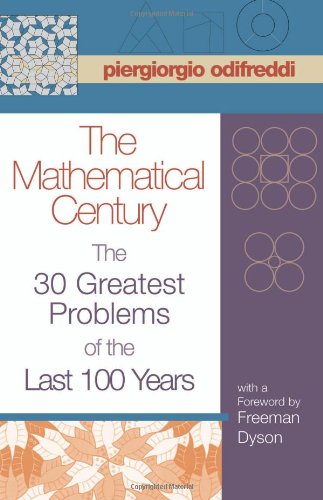
The Mathematical Century: The 30 Greatest Problems of the Last 100 Years

Piergiorgio Odifreddi

Princeton University Press | 2004 | 224 páginas |

(djvu - 1,6 Mb)

link
libgen.info
libgen.info

(PDF | 7,8 MB)
scribd.com

Referência em: MathEduc


The twentieth century was a time of unprecedented development in mathematics, as well as in all sciences: more theorems were proved and results found in a hundred years than in all of previous history. In The Mathematical Century, Piergiorgio Odifreddi distills this unwieldy mass of knowledge into a fascinating and authoritative overview of the subject. He concentrates on thirty highlights of pure and applied mathematics. Each tells the story of an exciting problem, from its historical origins to its modern solution, in lively prose free of technical details.

Odifreddi opens by discussing the four main philosophical foundations of mathematics of the nineteenth century and ends by describing the four most important open mathematical problems of the twenty-first century. In presenting the thirty problems at the heart of the book he devotes equal attention to pure and applied mathematics, with applications ranging from physics and computer science to biology and economics. Special attention is dedicated to the famous "23 problems" outlined by David Hilbert in his address to the International Congress of Mathematicians in 1900 as a research program for the new century, and to the work of the winners of the Fields Medal, the equivalent of a Nobel prize in mathematics.

This eminently readable book will be treasured not only by students and their teachers but also by all those who seek to make sense of the elusive macrocosm of twentieth-century mathematics.


TABLE OF CONTENTS:
Foreword xi
Acknowledgments xvii
Introduction 1
CHAPTER 1: THE FOUNDATIONS 8
1.1. The 1920s: Sets 10
1.2. The 1940s: Structures 14
1.3. The 1960s: Categories 17
1.4. The 1980s: Functions 21
CHAPTER TWO: PURE MATHEMATICS 25
2.1. Mathematical Analysis: Lebesgue Measure (1902) 29
2.2. Algebra: Steinitz Classification of Fields (1910) 33
2.3. Topology: Brouwer's Fixed-Point Theorem (1910) 37
2.4. Number Theory: Gelfand Transcendental Numbers (1929) 39
2.5. Logic: Gödel's Incompleteness Theorem (1931) 43
2.6. The Calculus of Variations: Douglas's Minimal Surfaces (1931) 47
2.7. Mathematical Analysis: Schwartz's Theory of Distributions (1945) 52
2.8. Differential Topology: Milnor's Exotic Structures (1956) 56
2.9. Model Theory: Robinson's Hyperreal Numbers (1961) 59
2.10. Set Theory: Cohen's Independence Theorem (1963) 63
2.11. Singularity Theory: Thom's Classification of Catastrophes (1964) 66
2.12. Algebra: Gorenstein's Classification of Finite Groups (1972) 71
2.13. Topology: Thurston's Classification of 3-Dimensional Surfaces (1982) 78
2.14. Number Theory: Wiles's Proof of Fermat's Last Theorem (1995) 82
2.15. Discrete Geometry: Hales's Solution of Kepler's Problem (1998) 87
CHAPTER THREE: APPLIED MATHEMATICS 92
3.1. Crystallography: Bieberbach's Symmetry Groups (1910) 98
3.2. Tensor Calculus: Einstein's General Theory of Relativity (1915) 104
3.3. Game Theory: Von Neumann's Minimax Theorem (1928) 108
3.4. Functional Analysis: Von Neumann's Axiomatization of Quantum Mechanics (1932) 112
3.5. Probability Theory: Kolmogorov's Axiomatization (1933) 116
3.6. Optimization Theory: Dantzig's Simplex Method (1947) 120
3.7. General Equilibrium Theory: The Arrow-Debreu Existence Theorem (1954) 122
3.8. The Theory of Formal Languages: Chomsky's Classification (1957) 125
3.9. Dynamical Systems Theory: The KAM Theorem (1962) 128
3.10. Knot Theory: Jones Invariants (1984) 132
CHAPTER FOUR: MATHEMATICS AND THE COMPUTER 139
4.1. The Theory of Algorithms: Turing's Characterization (1936) 145
4.2. Artificial Intelligence: Shannon's Analysis of the Game of Chess (1950) 148
4.3. Chaos Theory: Lorenz's Strange Attractor (1963) 151
4.4. Computer-Assisted Proofs: The Four-Color Theorem of Appel and Haken (1976) 154
4.5. Fractals: The Mandelbrot Set (1980) 159
CHAPTER FIVE: OPEN PROBLEMS 165
5.1. Arithmetic: The Perfect Numbers Problem (300 BC) 166
5.2. Complex Analysis: The Riemann Hypothesis (1859) 168
5.3. Algebraic Topology: The Poincare Conjecture (1904) 172
5.4. Complexity Theory: The P=NP Problem (1972) 176
Conclusion 181
References and Further Reading 187
Index 189


Great Feuds in Mathematics: Ten of the Liveliest Disputes Ever


Hal Hellman

Wiley | 2006 | 256 páginas | DjVu | 2 MB

link
link1
link2

"Those who think that mathematicians are cold, mechanical proving machines will do well to read Hellman's book on conflicts in mathematics. The main characters are as excitable and touchy as the next man. But Hellman's stories also show how scientific fights bring out sharper formulations and better arguments."
-Professor Dirk van Dalen, Philosophy Department, Utrecht University

Contents
Acknowledgments.
Introduction.
1. Tartaglia versus Cardano • Solving Cubic Equations.
2. Descartes versus Fermat • Analytic Geometry and Optics.
3. Newton versus Leibniz • Credit for the Calculus.
4. Bernoulli versus Bernoulli • Sibling Rivalry of the Highest Order.
5. Sylvester versus Huxley • Mathematics: Ivory Tower or Real World?
6. Kronecker versus Cantor • Mathematical Humbug.
7. Borel versus Zermelo • The “Notorious Axiom”.
8. Poincaré versus Russell • The Logical Foundations of Mathematics.
9. Hilbert versus Brouwer • Formalism versus Intuitionism.
10. Absolutists/Platonists versus Fallibilists/Constructivists • Are Mathematical Advances Discoveries or Inventions?
Epilogue.
Notes.
Bibliography.
Index.

Archimedes: What Did He Do Besides Cry Eureka?

(Classroom Resource Material)
Sherman Stein

The Mathematical Association of America | 1999 | 168 páginas | djvu | 1,1 Mb

link
link1

Referência em: MathEduc

Many people have heard two things about Archimedes: he was the greatest mathematician of antiquity, and he ran naked from his bath crying 'Eureka!'. However, few people are familiar with the actual accomplishments upon which his enduring reputation rests, and it is the aim of this book to shed light upon this matter. Archimedes' ability to achieve so much with the few mathematical tools at his disposal was astonishing. He made fundamental advances in the fields of geometry, mechanics, and hydrostatics. No great mathematical expertise is required of the reader, and the book is well illustrated with over 100 diagrams. It will prove fascinating to students and professional mathematicians alike.

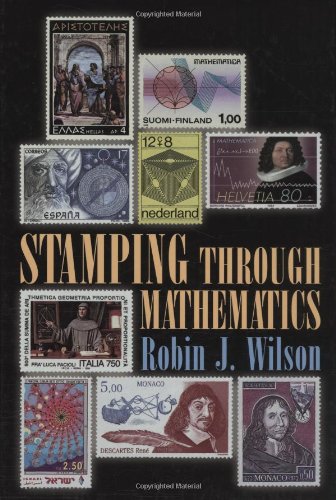
Stamping Through Mathematics


Robin J. Wilson

Springer | 2001 | 136 páginas | PDF | 25 MB

link
link1

Referência em: MathEduc

Para várias imagens de selos referentes à matemática veja, on-line:
jeff560.tripod.com

The astonishing variety and beauty of mathematical elements in stamp design is brought to life in this collection of more than 350 stamps, illustrated with mathematical figures, people, and content, each reproduced in enlarged format, in full color. It's a perfect gift book for anyone interested in stamps, or in the surprising use of mathematics in the real world. The author is widely known in the math community for his regular column on stamps in the magazine The Mathematical Intelligencer.

Leonhard Euler: Life, Work and Legacy


(Studies in the History and Philosophy of Mathematics, Volume 5)
Robert E. Bradley, C. Edward Sandifer (Eds)

Elsevier Science | 2007 | 542 páginas | 32 MB

link direto
link
ishare.iask.sina.com

The year 2007 marks the 300th anniversary of the birth of one of the Enlightenments most important mathematicians and scientists, Leonhard Euler. This volume is a collection of 24 essays by some of the worlds best Eulerian scholars from seven different countries about Euler, his life and his work.

Some of the essays are historical, including much previously unknown information about Euler's life, his activities in the St. Petersburg Academy, the influence of the Russian Princess Dashkova, and Euler's philosophy. Others describe his influence on the subsequent growth of European mathematics and physics in the 19th century. Still others give technical details of Euler's innovations in probability, number theory, geometry, analysis, astronomy, mechanics and other fields of mathematics and science.

- Over 20 essays by some of the best historians of mathematics and science, including Ronald Calinger, Peter Hoffmann, Curtis Wilson, Kim Plofker, Victor Katz, Ruediger Thiele, David Richeson, Robin Wilson, Ivor Grattan-Guinness and Karin Reich
- New details of Euler's life in two essays, one by Ronald Calinger and one he co-authored with Elena Polyakhova
- New information on Euler's work in differential geometry, series, mechanics, and other important topics including his influence in the early 19th century

Euler: The Master of Us All


(Dolciani Mathematical Expositions, N.º 22)
William Dunham

The Mathematical Association of America | 1999 | 192 páginas | DjVu | 1,6 MB

link
link1
filefactory.com

PDF - 7 Mb
4shared.com

Referência em: MathEduc

Leonhard Euler was one of the most prolific mathematicians that have ever lived. This book examines the huge scope of mathematical areas explored and developed by Euler, which includes number theory, combinatorics, geometry, complex variables and many more. The information known to Euler over 300 years ago is discussed, and many of his advances are reconstructed. Readers will be left in no doubt about the brilliance and pervasive influence of Euler's work.

An Imaginary Tale: The Story of √-1


Paul J. Nahin

Princeton University Press | 1998 | 257 páginas| PDF | 2,56 Mb

link
link1
scribd.com


Comentário em: MAA


Today complex numbers have such widespread practical use--from electrical engineering to aeronautics--that few people would expect the story behind their derivation to be filled with adventure and enigma. In An Imaginary Tale, Paul Nahin tells the 2000-year-old history of one of mathematics' most elusive numbers, the square root of minus one, also known as i. He recreates the baffling mathematical problems that conjured it up, and the colorful characters who tried to solve them.

In 1878, when two brothers stole a mathematical papyrus from the ancient Egyptian burial site in the Valley of Kings, they led scholars to the earliest known occurrence of the square root of a negative number. The papyrus offered a specific numerical example of how to calculate the volume of a truncated square pyramid, which implied the need for i. In the first century, the mathematician-engineer Heron of Alexandria encountered I in a separate project, but fudged the arithmetic; medieval mathematicians stumbled upon the concept while grappling with the meaning of negative numbers, but dismissed their square roots as nonsense. By the time of Descartes, a theoretical use for these elusive square roots--now called "imaginary numbers"--was suspected, but efforts to solve them led to intense, bitter debates. The notorious i finally won acceptance and was put to use in complex analysis and theoretical physics in Napoleonic times.

Addressing readers with both a general and scholarly interest in mathematics, Nahin weaves into this narrative entertaining historical facts and mathematical discussions, including the application of complex numbers and functions to important problems, such as Kepler's laws of planetary motion and ac electrical circuits. This book can be read as an engaging history, almost a biography, of one of the most evasive and pervasive "numbers" in all of mathematics

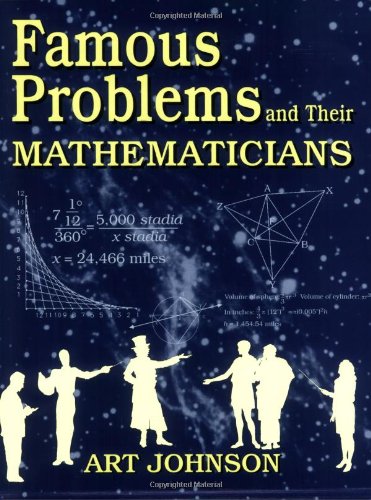
Famous Problems and Their Mathematicians

Art Johnson

Teacher Ideas Press | 1999 | 179 páginas | PDF | 1 Mb

link
link1

Why did ordering an omelet cost one mathematician his life? Answers to this and other questions are found in this exciting new resource that shows your students how 60 mathematicians discovered mathematical solutions through everyday situations. These lessons are easily incorporated into the present curriculum as an introduction to a math concept, a homework piece, or an extra challenge. Teacher notes and suggestions for the classroom are followed by extension problems and additional background material. This is a great way to spark student interest in math. Grades 5-12.

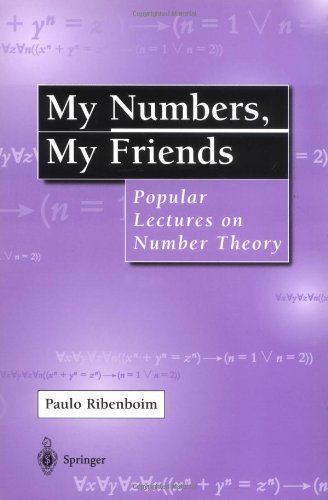
My Numbers, My Friends : Popular Lectures on Number Theory

Paulo Ribenboim

Springer | 2000 | 392 Páginas | PDF | 1,6 MB

link direto
link direto
link
link1
mediafire.com
scribd.com

Referência em: MathEduc

This selection of expository essays by Paulo Ribenboim should be of interest to mathematicians from all walks. Ribenboim, a highly praised author of several popular titles, writes each essay in a light and humorous language without secrets, making them thoroughly accessible to everyone with an interest in numbers. This new collection includes essays on Fibonacci numbers, prime numbers, Bernoulli numbers, and historical presentations of the main problems pertaining to elementary number theory, such as Kummers work on Fermat's last theorem.

Imagining Numbers (particularly the square root of minus fifteen)


Barry Mazur

Penguin Books Ltd | 2004 | 288 páginas | DjVu | 2,6 MB

link
link1
link2

PDF -6 Mb
link
plunder.com (7zip - pdf | 2,46 Mb | password: queenmagic)


Barry Mazur invites lovers of poetry to make a leap into mathematics. Through discussions of the role of the imagination and imagery in both poetry and mathematics, Mazur reviews the writings of the early mathematical explorers and reveals the early bafflement of these Renaissance thinkers faced with imaginary numbers. Then he shows us, step-by-step, how to begin imagining these strange mathematical objects ourselves.

Number: The Language of Science


The Masterpiece Science Edition
Tobias Dantzig , Joseph Mazur e Barry Mazur

Pi Press | 2005 | 416 páginas | PDF | 1,5 Mb

blngcc.files (link direto)
sma1pekalongan.sch.id (link direto)
f3.tiera.ru (link direto)
foo.fixme.ch (link direto)
link
link1
rapidshare.com
scribd.com

Number is an eloquent, accessible tour de force that reveals how the concept of number evolved from prehistoric times through the twentieth century. Tobias Dantzig shows that the development of math—from the invention of counting to the discovery of infinity—is a profoundly human story that progressed by “trying and erring, by groping and stumbling.” He shows how commerce, war, and religion led to advances in math, and he recounts the stories of individuals whose breakthroughs expanded the concept of number and created the mathematics that we know today.

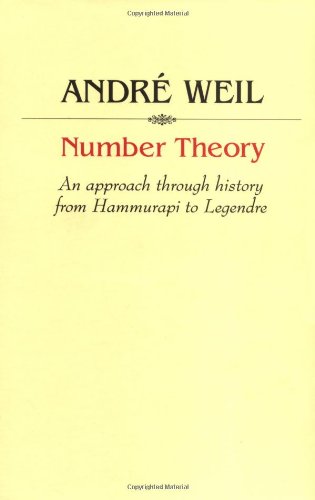
Number Theory: An approach through history from Hammurapi to Legendre


André Weil

Birkhäuser Boston | 1987 | 404 páginas| djvu | 6,8 MB

link direto
en.bookfi.org
libgen.net
en.bookfi.org
libgen.net


Referência em: MathEduc


Number Theory or arithmetic, as some prefer to call it, is the oldest, purest, liveliest, most elementary yet sophisticated field of mathematics. It is no coincidence that the fundamental science of numbers has come to be known as the "Queen of Mathematics." Indeed some of the most complex conventions of the mathematical mind have evolved from the study of basic problems of number theory.
André Weil, one of the outstanding contributors to number theory, has written an historical exposition of this subject; his study examines texts that span roughly thirty-six centuries of arithmetical work — from an Old Babylonian tablet, datable to the time of Hammurapi to Legendre’s Essai sur la Théorie des Nombres (1798). Motivated by a desire to present the substance of his field to the educated reader, Weil employs an historical approach in the analysis of problems and evolving methods of number theory and their significance within mathematics. In the course of his study Weil accompanies the reader into the workshops of four major authors of modern number theory (Fermat, Euler, Lagrange and Legendre) and there he conducts a detailed and critical examination of their work. Enriched by a broad coverage of intellectual history, Number Theory represents a major contribution to the understanding of our cultural heritage.

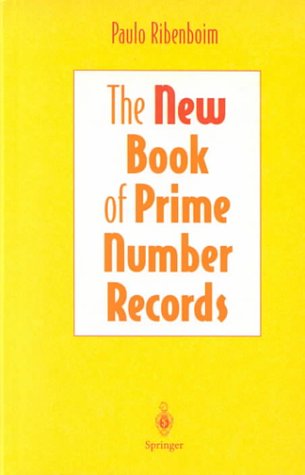
The New Book of Prime Number Records

Paulo Ribenboim

Springer | 1996 | 572 páginas | djvu | 3,2 Mb

link
link1
link2

DjVu | 11,50 MB
link
4shared.com
rapidshare.com

The Guinness Book made records immensely popular. This book is devoted, at first glance, to present records concerning prime numbers. But it is much more. It explores the interface between computations and the theory of prime numbers. The book contains an up-to-date historical presentation of the main problems about prime numbers, as well as many fascinating topics, including primality testing. It is written in a language without secrets, and thoroughly accessible to everyone. 
The new edition has been significantly improved due to a smoother presentation, many new topics and updated records.


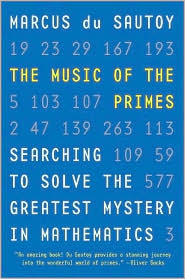
The Music of the Primes: Searching to Solve the Greatest Mystery in Mathematics


Marcus du Sautoy

Harper Perennial | 2004 | 352 páginas | PDF | 1,2 MB

scribd.com
4shared.com
link direto

In the tradition of Fermat’s Enigma and Pi, Marcus du Sautoy tells the illuminating, authoritative, and engagingstory of Bernhard Reimann and the ongoing quest tocapture the holy grail of mathematics—the formula to predict prime numbers.Oliver Sacks, author of The Man Who Mistook His Wife for a Hat, callsTheMusic of the Primes “an amazing book. . . . I could not put it down once Ihad started.” Simon Winchester, author of The Professor and the Madman,writes, “this fascinating account, decoding the inscrutable language of themathematical priesthood, is written like the purest poetry. Marcus du Sautoy's enthusiasm shines through every line of this hymnto the joy of high intelligence, illuminating as it does so even the darkestcorners of his most arcane universe.”