quinta-feira, 12 de março de 2009

A Experiência Matemática no Ensino Básico

Programa de Formação Contínua em Matemática para Professores dos 1.º e 2.º Ciclos do Ensino BásicoAna Maria Roque Boavida, Ana Luisa Paiva, Graça Cebola, Isabel Vale e Teresa Pimentel
Ministério da Educação, Direcção-Geral de Inovação e de Desenvolvimento Curricular | 2008 | 133 páginas | PDF | 7,34 MB

link direto

Nota de apresentação..... 5
Introdução ....... 7
Capítulo Resolução de Problemas em Matemática ... 11
1.1 Introdução .... 13
1.2 Problemas e estratégias de resolução .... 14
1.2.1 O que é um problema?..... 15
1.2.2 Diferentes tipos de problemas ..... 16
1.2.3 Estratégias.... 22
1.3 Formulação de problemas...... 27
1.3.1 Estratégias de formulação de problemas ..... 28
1.4 Selecção e enriquecimento de tarefas.... 31
A concluir...... 33
Capítulo Conexões Matemáticas.... 35
2.1 Introdução ....... 37
2.2 Conexões com a vida real ... 38
2.3 Conexões com outras áreas ..... 42
2.3.1 Conexões com a Literatura Infantil ..... 42
2.3.2 Conexões com o Estudo do Meio − Ciências da Natureza ... 45
2.3.3 Conexões com a Expressão Musical ... 46
2.4 Conexões dentro da própria Matemática...... 49
2.4.1 Conexões entre Geometria e Número ....... 49
2.4.2 Conexões entre Geometria e Medida.... 53
2.4.3 Conexões entre operações aritméticas ..... 55
A concluir.... 58
Capítulo Comunicação Matemática.... 59
3.1 Introdução.... 61
3.2 Comunicar para aprender...... 62
3.3 A pergunta como catalisador da comunicação ..... 64
3.4 Escrever em Matemática ..... 68
3.5 Representação e linguagens .... 71
A concluir....... 78
Capítulo Argumentação em Matemática... 79
4.1 Introdução ......... 81
4.2 Argumentação em Matemática: características e significado ..... 82
4.2.1 A natureza discursiva da argumentação .... 82
4.2.2 A natureza dialéctica da argumentação... 84
4.2.3 O carácter social da argumentação.... 89
4.3 Contextos e percursos argumentativos .... 93
A concluir ...... 102
Capítulo Integrando Conteúdos e Processos Matemáticos.... 103
5.1 Introdução..... 105
5.2 Integração via tarefas matemáticas ..... 106
5.2.1 Par ou ímpar .... 106
5.2.2 Triângulos e outras figuras... 112
5.2.3 Números e capicuas ..... 116
5.2.4 Percursos no relvado...... 120
5.3 Aspectos de uma cultura de integração..... 123
Conclusão...... 127
Bibliografia ...... 129

Análise de Dados

Análise de Dados: texto de apoio para os professores do 1.º ciclo
Maria Eugénia Graça Martins, Luísa Canto e Castro Loura, Maria de Fátima Mendes

Ministério da Educação, Direcção-Geral de Inovação e de Desenvolvimento Curricular | 2007 | 174 páginas | PDF | 3,45 MB

on-line: link

Sentido de número e organização de dados


(Textos de Apoio para Educadores de Infância)
Joana Pacheco de Castro, Marina Rodrigues

Ministério da Educação, Direcção-Geral de Inovação e de Desenvolvimento Curricular | 2008 | 105 páginas | PDF | 1,43 MB

on-line: Nenhum link disponível

Geometria

(textos de apoio para educadores de infância)
Maria de Fátima Mendes, Catarina Coutinho Delgado

Ministério da Educação, Direcção-Geral de Inovação e de Desenvolvimento Curricular | 2008 | 85 páginas | PDF | 925 KB

link direto

Preâmbulo 7
A Geometria no Jardim-de-infância 9
1. Orientar 15
1.1. Localizar 16
Tarefa – Adivinha em quem estou a pensar! 16
Tarefa – Brincar com o Noddy 17
1.2. Tomar um ponto de vista 18
Tarefa – Descobre quem fez o desenho 18
Tarefa – Brincar às escondidas 19
Tarefa – Desenhar vistas 20
2. Construir 23
2.1. Construções com materiais diversos 25
Tarefa – Construções com caixas 26
Tarefa – Construção de alimentos a partir de uma ementa 26
Tarefa – Construir figuras usando uma corda 27
2.2. Construções com materiais de geometria 28
Tarefa – Construções com blocos a partir de uma imagem 28
Tarefa – Construir figuras a partir de figuras 31
2.3. Construções com papel 33
Tarefa – Dobrar um quadrado 34
Tarefa – Construir um porta CD 35
3. Operar com formas e figuras 37
Tarefa – Movimentar, aumentar e diminuir figuras 38
Tarefa – Estrelas e mais estrelas 39
Tarefa – Alegre ou triste? 40
Tarefa – Criar um friso 41
Tarefa – Observar e desenhar sombras 42
4. Geometria e Medida 45
4.1. Comparar e ordenar 47
Tarefa – Medir e ordenar as alturas das crianças da sala 49
Tarefa – Comparar capacidades usando água 52
4.2. Utilizar uma unidade de medida 54
Tarefa – Medir comprimentos e distâncias 56
Tarefa – Um aquário para o Nemo 56
Tarefa – Fazer colchas para a cama das bonecas 57
4.3. Um caminho para a utilização de um instrumento
de medida padronizado 58
5. Geometria e Padrões 61
Tarefa – Padrões com cubos 63
Tarefa – Padrões utilizando blocos lógicos 65
Tarefa – Direita e esquerda 65
Tarefa – Em cima e em baixo 67
Tarefa – Um placard com um padrão geométrico 68
Tarefa – Construir um padrão com carimbos 69
Tarefa – Observar padrões à nossa volta 70
6. Tarefas Integradoras 73
Tarefa – Preparar a visita de um amigo imaginário 75
Tarefa – A mãe da Maíza é que conta 78
Bibliografia 81
Anexos 83

Engaging Young Children in Mathematics Standards for Early Childhood Mathematics Education


Douglas H. Clements, Ann-Marie DiBiase, Ann-Marie DiBiase, Julie Sarama (Ed.)

Routledge | 2004 | 496 páginas |  rar - PDF | 7 Mb

link (edição de 2011)
password: matav

PDF | 27 Mb
link
link1

Site sobre o livro: gse.buffalo.edu
Para vários artigos sobre o projecto para o ensino no pré-escolar(Building Blocks): gse.buffalo.edu
ou ligue-se à página de Douglas H. Clements: gse.buffalo.edu
Referência em: MathEduc

Presents the combined wisdom of experts - including mathematicians, mathematics educators, researchers, curriculum developers, teachers, and policy makers - regarding early childhood mathematics education theory, research, and practice.
Table of Contents
Preface
PART I: MAJOR THEMES AND RECOMMENDATIONS
Summary of Part I: Assumptions and Recommendations
1 Major Themes and Recommendations
PART II: ELABORATION OF MAJOR THEMES AND RECOMMENDATIONS
Section 1: Standards in Early Childhood Education
2 Standards for Preschool and Kindergarten Mathematics Education
3 Mathematics Curriculum in the Early Childhood Context
Section 2: Math Standards and Guidelines
4 What Is Developmentally Appropriate in Early Childhood Mathematics Education? Lessons From New Research
5 Pre-K to Grade 2 Goals and Standards: Achieving 21 st-Century Mastery for All
6 The Role of Psychological Research in the Development of Early Childhood Mathematics Standards
7 The Developmental Bases for Early Childhood Number and Operations Standards
8 PSSM From a Constructivist Perspective
9 A Prospective Developmental Perspective on Early Mathematics Instruction
10 Geometric and Spatial Thinking in Early Childhood Education
11 Measurement in Pre-K to Grade 2 Mathematics
Section 3: Curriculum, Learning, Teaching, and Assessment
12 Making Sense
13 Number Worlds: A Research-Based Mathematics Program for Young Children
14 Fostering Preschool Children's Mathematical Knowledge: Findings From the Berkeley Math Readiness Project
15 Technology in Early Childhood Mathematics: Building Blocks as an Innovative Technology-Based Curriculum
16 Mathematics Problem-Solving Adventures: A Language-Arts-Based Supplementary Series for Early Childhood That Focuses on Spatial Sense
Section 4: Professional Development
17 Early Childhood Mathematics Instruction: Seeing the Opportunities Among the Challenges
18 The Early Childhood Collaborative: A Professional Development Model to Communicate and Implement the Standards
19 The Professional Development Challenge in Preschool Mathematics
Section 5: Toward The Future: Implementation And Policy
20 Mathematics Guidelines for Preschool
Author Index
Subject Index

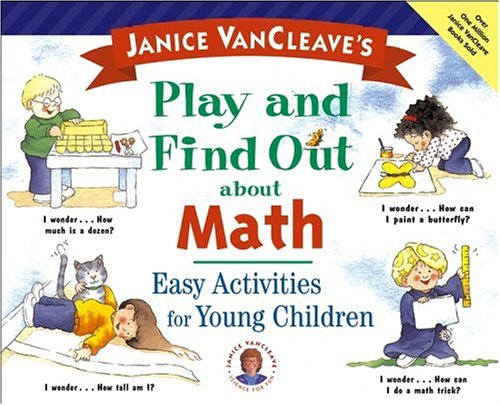
Janice VanCleave's Play and Find Out about Math: Easy Activities for Young Children


Janice VanCleave

John Wiley & Sons | 1997 | 128 páginas | chm - 4 Mb

link
link1


How much is one-half of something?
How can I draw a star?
How long is five seconds?

Come and find out! How? By choosing one of the 50 simple activities in Janice VanCleave's Play and Find Out about Math. Your child will discover the answers to lots of fun questions as you team up to play together and explore the wonder of our world. Each activity includes illustrations, a list of easy-to-find materials, and simple, step-by-step instructions.


Big math activities for young children for preschool, kindergarten, and primary children


James Overholt, Jackie White-Holtz, Sydney Dickson

Delmar Cengage Learning | 1998 | 272 páginas | epub | 8,14 Mb

link

This practical guide to math related education for young children is a reality based text that provides a wide selection of activities and investigations for young children. Activities are easy to understand and use inexpensive and readily available materials. Multilevel activities provide increasingly advanced skills for preschool through third grade and have been designed to promote mathematical reasoning, communication and problem solving skills which can excite young learners about math.

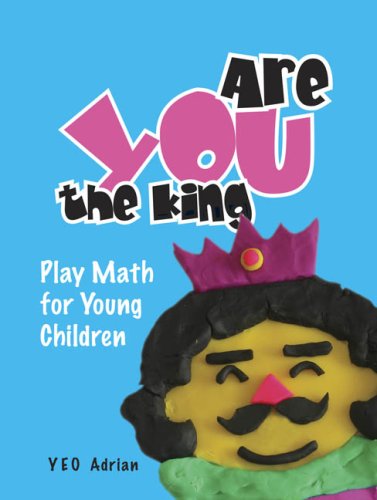
Are You the King, or Are You the Joker?: Play Math for Young Children


Y. E. O. Adrian

World Scientific Publishing Company | 2006 | 148 páginas | 16 MB

link

This unique book - based on the author's experience in teaching his grandchildren mathematics the fun way - provides the knowledge and skills to teach math to young children, through learning games with playing cards. Children grow to associate math with fun, pleasure and parental love and attention. The author's innovative approach to teaching math to young children is an ideal and highly productive way for parents and grandparents to spend quality time with their young loved ones. The book will be an immense help for children's progress in math in the kindergarten and school.

ICT and Primary Mathematics: A Teacher's Guide


John William, Nick Easingwood

RoutledgeFalmer | 2004 | 224 páginas | PDF | 11,4 Mb

link
depositfiles.com

This book is for teachers who are looking for interesting and practical ways to incorporate ICT into their daily lesson plans. It shows how ICT can be used as a tool for mathematics, but more importantly how its proper use can enhance the mathematics being taught. The authors cover all current aspects of ICT and mathematics, including:
  • databases
  • spreadsheets
  • logo and the use of floor turtles and control technology
  • handling of resources including interactive whiteboards
  • management of ICT within the classroom
  • how ICT can be used to present mathematical topics and links to other areas of the curriculum.
With plenty of suggestions on how to use the software and hardware described in the book, this is a useful resource for all primary teachers, particularly subject co-ordinators for ICT and mathematics. It will also be of interest to students on PGCE and Initial Teacher Training courses.

Teaching Mathematics 3-5 Developing learning in the Foundation Stage


Sue Gifford

Open University Press | 2005 | 208 páginas | PDF | 1 Mb

link direto
link
scribd.com

This book provides a research background for adults helping three to five year olds learn mathematics, including social and emotional processes as well as key mathematical ideas and common difficulties. It includes implications for practice and proposes presented with a playful and sensitive approach. It is illustrated with examples from the author's own research and work with practitioners. Following the introduction, the first chapter, Now We Are Teaching Three Year Olds Maths: Recent Changes to Early Years Mathematics, is presented. Section One, What Do We Know about How Young Children Learn Maths? A Holistic Approach, contains the following chapters: (2) Cognitive Processes; (3) Emotional Processes; (4) Social Processes; and (5) Physical Processes. Section Two, Implications for Practical Pedagogy, presents the second group of chapters: (6) What Do We Know about How Children Learn in Early Years Settings?; (7) What Does Teaching Mean with Very Young Children? and (8) Approaches to Planning and Assessment. Section Three, The Mathematics Curriculum: Appropriate Expectations and Common Difficulties, contains the final chapters: (9) Number; (10) Shape and Space; (11) Measures; and (12) Problem Solving. Following a conclusion, the last chapter of the book, Looking to the Future, is presented.

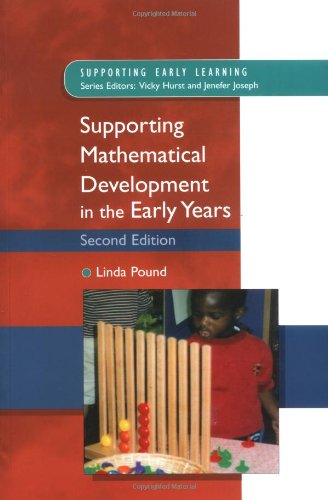
Supporting Mathematical Development in the Early Years

Linda Pound

Open University Press | 2006 | 176 páginas | 2,24 MB

link

This book provides practical guidance for parents, teachers, and other early years workers who want to give children a good start in mathematical development. Showing how competent children are as mathematicians from an early age, the book offers an overview of young children's mathematical behaviour at home and in early years settings. This book explores the role of staff in observing, planning for and supporting children's learning by using a variety of strategies, and makes suggestions for promoting effective partnerships between the parents or principal carers and early years staff. The book also considers the importance of play and imagination to the development of abstract thought. This second edition is comprehensively updated throughout and includes new material on Special Educational Needs, the very early years, the role of play, the role of ICT, and examples of outdoor play. This book is organized into the following six chapters: (1) Mathematics at home and at school; (2) Successful learning: enjoying thinking mathematically; (3) A curriculum to promote mathematical thinking; (4) Implementing a curriculum for mathematical thinking; (5) Observing, planning and supporting mathematical thinking and learning; and (6) Parents and professional working together. This book ends with a conclusion

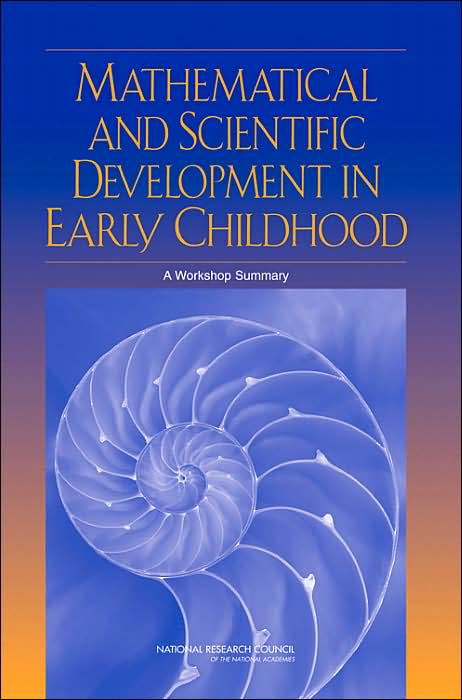
Mathematical And Scientific Development In Early Childhood: A Workshop Summary


Alix Beatty

National Academies Press | 2004 | 54 páginas

on-line em: books.nap.edu

Thinking and Learning about Maths in the Early Years


Linda Pound

Routledge | 2008 | 119 páginas | PDF | 696 Kb

link
link1

How can early years practitioners help young children to become not only numerate but aspiring mathematicians who love numbers, shapes and mathematical comparisons?
The introduction of the Foundation Stage has led to practitioners seeking ways to teach maths which are more in line with the creative and playful ways young children learn other subjects.
Linda Pound draws on current thinking about children's mathematical development to show how you can encourage and enhance the numeracy skills of any child in the early years by linking maths to every-day life situations and making it a playful and enjoyable cross-curricular activity.
This highly practical and engaging text includes chapters on:
  • why maths is often seen as 'hard' and what practitioners can do to help young children be more successful
  • exploring shapes, space, measures and patterns
  • how to make maths more fun and playful, using games, humour, stories and rhymes
  • using music and dance to enhance mathematical understanding
  • encouraging children to see the connection between maths and everyday experiences through, for example sorting, matching and guessing
  • creating an environment for mathematical development, indoors and out
Concluding with a chapter on how practitioners and parents can become more confident in their use of maths, this user-friendly text, packed full of ideas, is essential reading for practitioners in any early years setting. Students on Early Education courses will also find much here to inspire them.


Numeracy and Learning Difficulties: Approaches to Teaching and Assessment

Peter Westwood

Australian Council for Educational Research | 2001 | 136 páginas | PDF |

link

Referência em: MathEduc

By understanding why children struggle with maths, teachers are better equipped to provide effective support and nurture confidence in low-achievers. 

Numeracy and Learning Difficulties includes how to tackle common learning difficulties by following different teaching practices and principles, identifying gaps in students' knowledge and developing curricula that bridges these gaps, improves numerical literacy using probem-solving strategies and skills, and a handy checklist of benchmanrks in achievement.

What Teachers Need to Know About Numeracy


Peter Westwood


Australian Council Educational Research (ACER) | 2008 | 112 páginas |  PDF | 3,56 MB

link
link1

There is an increasing need for numeracy skills in all aspects of life and What Teachers Need to Know About Numeracy explores the issues that are emerging regarding the teaching of these skills, beginning with preschool and the early years of primary school through to adults with poor numeracy skills. It draws on research and relevant literature from several different countries to provide a comprehensive overview of the subject and contains many links to other sources of information and additional resources

Literacy Strategies for Improving Mathematics Instruction


Euthecia Hancewicz, Loretta Heuer, Diana Metsisto, Cynthia L. Tuttle

ASCD | 2005 | 113 páginas |  PDF | 1,15 Mb

link
link1

What makes mathematics so confusing to students? To succeed in the study of arithmetic, geometry, or algebra, students must learn what is effectively a second language of mathematical terms and symbols. In Literacy Strategies for Improving Mathematics Instruction, Joan M. Kenney and her coauthors describe common ways in which students misinterpret the language of mathematics, and show teachers what they can do to ensure that their students become fluent in that language.
The authors synthesize the research on what it takes to decode mathematical text, explain how teachers can use guided discourse and graphic representation to help students develop mathematical literacy skills, offer guidance on using action research to enhance mathematics instruction, and discuss the importance of student-centered learning and concept-building skills in the classroom. Real-life vignettes of student struggles illuminate the profound effect of literacy problems on student achievement in mathematics.
This book will help teachers better understand their students’ difficulties with mathematics and take the steps necessary to alleviate them. Abundantly researched and filled with helpful strategies and resources, it is an invaluable resource for mathematics teachers at all levels.
Joan M. Kenney has been both a research scientist and a mathematics teacher at the secondary and college levels. Most recently, she served as codirector of the Balanced Assessment Program at the Harvard University Graduate School of Education.


  • Preface
  • Chapter 1. Mathematics as Language— by Joan M. Kenney
  • Chapter 2. Reading in the Mathematics Classroom— by Diana Metsisto
  • Chapter 3. Writing in the Mathematics Classroom— by Cynthia L. Tuttle
  • Chapter 4. Graphic Representation in the Mathematics Classroom— by Loretta Heuer
  • Chapter 5. Discourse in the Mathematics Classroom— by Euthecia Hancewicz
  • Chapter 6. Creating Mathematical Metis— by Joan M. Kenney
  • Appendix. Structured Agendas Used to Research This Book
  • References and Resources
  • About the Authors

Introducing Difficult Mathematics Topics in the Elementary Classroom: A Teachers Guide to Initial Lessons


Frank Gardella

Routledge | 2008 | 157 páginas | PDF | 1 Mb

link
link1

This exciting text for the pre-service elementary teacher provides hands on mathematics lessons they can use to introduce mathematical concepts and skills that students find particularly challenging. Each chapter is divided into four sections: The Activity employs an engaging thought experiment to help the reader 'visit a classroom' to understand how the lesson used to introduce the concept or skill would materialize in the class; The Mathematics provides the necessary mathematical background used in the lesson to make the actual teaching/learning situation comfortable for both the teachers and the learner; The Plan provides the reader with an actual lesson plan to engage the Activity in the classroom setting; and, Putting It All Together pulls the previous sections together with a summary of the chapter as well as further information for making the lesson successful.By providing models of what excellent lessons on a given topic look like, knowledge of the mathematics involved, and a concrete lesson plan structure this much-needed resource is the definitive mathematics planning vehicle that every teacher will want before they set foot in their own elementary classroom

Mathematical Discourse: Language, Symbolism And Visual Images


Kay L. O'Halloran

Continuum International Publishing Group | 2005 | 226 páginas | PDF | 7,8 Mb

link

This book develops a theory of mathematics as a multi-semiotic discourse from the perspective of M. A. K. Halliday's systemic functional linguistics. From this perspective mathematical discourse is seen to involve the use of the three semiotic resources of language, visual images and mathematical symbolism. These semiotic resources are considered as functional sign systems which are organised grammatically. O'Halloran suggests that mathematical texts represent specific semiotic choices from the available grammatical systems. From this she articulates the ways in which a social semiotic perspective can inform mathematics teaching and learning.

Índice
Contents
Acknowledgements
Copyright Permission Acknowledgements
1 Mathematics as a Multisemiotic Discourse
1.1 The Creation of Order
1.2 Halliday's Social Semiotic Approach
1.3 Mathematics as Multisemiotic
1.4 Implications of a Multisemiotic View
1.5 Tracing the Semiotics of Mathematics
1.6 Systemic Functional Research in Multimodality
2 Evolution of the Semiotics of Mathematics
2.1 Historical Development of Mathematical Discourse
2.2 Early Printed Mathematics Books
2.3 Mathematics in the Early Renaissance
2.4 Beginnings of Modern Mathematics: Descartes and Newton
2.5 Descartes' Philosophy and Semiotic Representations
2.6 A New World Order
3 Systemic Functional Linguistics (SFL) and Mathematical Language
3.1 The Systemic Functional Model of Language
3.2 Interpersonal Meaning in Mathematics
3.3 Mathematics and the Language of Experience
3.4 The Construction of Logical Meaning
3.5 The Textual Organization of Language
3.6 Grammatical Metaphor and Mathematical Language
3.7 Language, Context and Ideology
4 The Grammar of Mathematical Symbolism
4.1 Mathematical Symbolism
4.2 Language-Based Approach to Mathematical Symbolism
4.3 SF Framework for Mathematical Symbolism
4.4 Contraction and Expansion of Experiential Meaning
4.5 Contraction of Interpersonal Meaning
4.6 A Resource for Logical Reasoning
4.7 Specification of Textual Meaning
4.8 Discourse, Grammar and Display
4.9 Concluding Comments
5 The Grammar of Mathematical Visual Images
5.1 The Role of Visualization in Mathematics
5.2 SF Framework for Mathematical Visual Images
5.3 Interpersonally Orientating the Viewer
5.4 Visual Construction of Experiential Meaning
5.5 Reasoning through Mathematical Visual Images
5.6 Compositional Meaning and Conventionalized Styles of Organization
5.7 Computer Graphics and the New Image of Mathematics
6 Intersemiosis: Meaning Across Language, Visual Images and Symbolism
6.1 The Semantic Circuit in Mathematics
6.2 Intersemiosis: Mechanisms, Systems and Semantics
6.3 Analysing Intersemiosis in Mathematical Texts
6.4 Intersemiotic Re-Contexualization in Newton's Writings
6.5 Semiotic Metaphor and Metaphorical Expansions of Meaning
6.6 Reconceptualizing Grammatical Metaphor
7 Mathematical Constructions of Reality
7.1 Multisemiotic Analysis of a Contemporary Mathematics Problem
7.2 Educational Implications of a Multisemiotic Approach to Mathematics
7.3 Pedagogical Discourse in Mathematics Classrooms
7.4 The Nature and Use of Mathematical Constructions
References
Index