terça-feira, 21 de julho de 2009

Mathematical Recreations


Maurice Kraitchik

Dover | 1953 | 330 páginas | djvu | 3,57 Mb

link
link1
link2

Descrição: Ranging from ancient Greek and Roman problems to modern applications and techniques, this book features 250 lively puzzles and problems, with solutions.

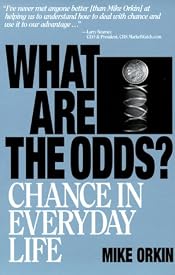
What Are The Odds?: Chance In Everyday Life


Mike Orkin

W. H. Freeman | 2000 | 160 páginas | djvu | 953 kb

link
link1
uploading.com
depositfiles.com

pdf - 1 Mb
link
link1

Descrição: Did you know that if you drive ten miles to buy a Powerball ticket, you're sixteen times more likely to die in a car crash than you are to win the jackpot? Or that, while it is nearly impossible for a coin to land on heads one hundred times in a row, it is equally improbable for any other specific sequence to come up? As Orkin's Law of Absurdity states, "Everything is impossible, yet something must happen." Full of surprising facts and useful information, What Are the Odds? is a delightful introduction to how chance works and the role it plays in our everyday lives. It answers such practical questions as:
* When is a weird event due to chance and when is it due to something else?
* Can you make a living as a gambler? If so, which games should you play?
* Are some things possible, but so unlikely that they will never happen?
* Should "Survival of the Fittest" apply to business?
* How do you determine which strategy to use when you have no ideas what your opponent will do?
* How can you be cooperative without being exploited? A fun guide to the principles that govern chance and the games people play, whether in a casino or in everyday life, What Are the Odds? is guaranteed to entertain and enlighten anyone interested in the nature of chance.

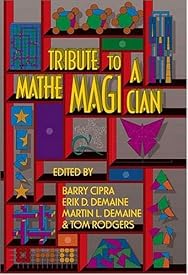
Tribute to a Mathemagician


Barry Cipra, Erik D. Demaine, Martin L. Demaine, Tom Rodgers

AK Peters | 2004 | 262 páginas | djvu | 3,8 Mb

link direto
link

Descrição: The tradition of a publication based on the Gathering for Gardner continues with this new carefully selected and edited collection in which Martin Gardner and friends inspire and entertain. The contributors to this volume—virtually a list of Who's Who in the World of Puzzles—trace their inspiration to Martin Gardner's puzzle column in Scientific American and to his contributions to the world of recreational mathematics. Tribute to a Mathemagician contains an author index for the two previous books in the collection of books based on the Gatherings for Gardner. Sample puzzles and games include: - Tripos
- Black Jack
- Chinese ceramic puzzle vessels
- Paper folding
- Mongolian interlocking puzzles
- Rolling block puzzles
- Sliding puzzles
- Cryptic crosswords
- The Panex puzzle
- Polyonimo puzzles
- and more

Games of no Chance


(Mathematical Sciences Research Institute Publications)
Richard J. Nowakowski

Cambridge University Press | 1998 | 549 páginas  pdf | 3 Mb

on-line: msri.org (em capítulos)
link direto

djvu - link


Descrição: Is Nine-Men's Morris, in the hands of perfect players, a win for white or for black--or a draw? Can king, rook, and knight always defeat king and two knights in chess? What can Go players learn from economists? What are nimbers, tinies, switches, minies? This book deals with combinatorial games, that is, games not involving chance or hidden information. Their study is at once old and young: though some games, such as chess, have been analyzed for centuries, the first full analysis of a nontrivial combinatorial game (Nim) only appeared in 1902. This book deals with combinatorial games, that is, games not involving chance or hidden information. Their study is at once old and young: though some games, such as chess, have been analyzed for centuries, the first full anlaysis of a nontrivial combinatorial game (Nim) only appeared in 1902. The first part of this book will be accessible to anyone, regardless of background: it contains introductory expositions, reports of unusual contest between an angel and a devil. For those who want to delve more deeply, the book also contains combinatorial studies of chess and Go; reports on computer advances such as the solution of Nine-Men's Morris and Pentominoes; and new theoretical approaches to such problems as games with many players. If you have read and enjoyed Martin Gardner, or if you like to learn and analyze new games, this book is for you.
More Games of no Chance
(Mathematical Sciences Research Institute Publications)
Richard J. Nowakowski

Cambridge University Press | 2002| 544 páginas

on-line: msri.org (pdf - em capítulos)
link direto

Descrição: This book is a state-of-the-art look at combinatorial games, that is, games not involving chance or hidden information. It contains a fascinating collection of articles by some of the top names in the field, such as Elwyn Berlekamp and John Conway, plus other researchers in mathematics and computer science, together with some top game players. The articles run the gamut from new theoretical approaches (infinite games, generalizations of game values, 2-player cellular automata, Alpha-Beta pruning under partial orders) to the very latest in some of the hottest games (Amazons, Chomp, Dot-and-Boxes, Go, Chess, Hex). Many of these advances reflect the interplay of the computer science and the mathematics. The book ends with an updated bibliography by A. Fraenkel and an updated and annotated list of combinatorial game theory problems by R. K. Guy.

The Mathematics of Games and Gambling


(New Mathematical Library)

Edward Packel

The Mathematical Association of America | 1996| 151 páginas |


pdf -3,4 Mb - link

 Djvu | 1,5 Mb
link direto
link
depositfiles.com
uploading.com
depositfiles.com


Descrição: You can't lose with this MAA Book Prize winner if you want to see how mathematics can be used to analyze games of chance and skill. Roulette, craps, blackjack, backgammon, poker, bridge, lotteries and horse races are considered here in a way that reveals their mathematical aspects. The tools used include probability, expectation, and game theory. No prerequisites are needed beyond high school algebra. No book can guarantee good luck, but this book will show you what determines the best bet in a game of chance or the optimal strategy in a strategic game. Besides being an excellent supplement to a course on probability and good bed-side reading, this book's treatment of lotteries should save the reader some money.


Luck, Logic, and White Lies: The Mathematics of Games

Jorg Bewersdorff

AK Peters | 2004 | 486 páginas | pdf | 29 Mb

link
scribd.com

Descrição: The mathematical underpinnings of games, whether they are strategic or games of chance, have been known for centuries, but are usually only understood by players and aficionados who have a background in mathematics. The author has succeeded in making that knowledge accessible, entertaining, and useful to everyone who likes to play and win. The information applies to such diverse and popular games as Roulette, Monopoly™, Chess, Go, numerous card games, and many more. He reviews the mathematical foundations, probability, combinatorics, and mathematical game theory, the field that won John Nash of A Beautiful Mind the Nobel Prize, and emphasizes the implementation of these techniques so that players can put them to work immediately. An extensive bibliography and sections describing the historical developments are welcome features to put the subject in a broader context

La matematica


La matematica: volume 1: I luoghi e i tempi
Claudio Bartocci e Piergiorgio Odifreddi

Einaudi | 2007 | djvu | 19 Mb

link


La matematica: volume 2: Problemi e teoremi
Claudio Bartocci e Piergiorgio Odifreddi

Einaudi | 2008 | djvu | 76,29 + 62,49 Mb

 nenhum link disponível


Descrição: All'interno dell'universo della matematica sembrano esserci infiniti temi, suggestioni, letture che, prendendo le mosse dagli studi specialistici, invadono e permeano ogni campo del sapere umano. Il libro è un'opera che getta una luce nuova sui rapporti, antichi e moderni, tra la scienza dei numeri e le altre forme di cultura. Claudio Barrocci e Piergiorgio Odifreddi, due matematici da sempre aperti al confronto interdisciplinare, curano questa "Grande Opera" in quattro volumi con il contributo di un comitato scientifico di prima grandezza e composta con i saggi di quasi cento autori provenienti da tutto il mondo.
Il primo volume ripercorre in circa 30 saggi la storia di altrettanti centri di cultura dai quali si è irradiata nel mondo la conoscenza matematica, da Babilonia ed Atene a Oxford e a Princeton.

Il secondo volume illustra in circa 25 saggi i problemi e i teoremi fondamentali della matematica: dalla teoria delle equazioni diofantee al teorema di Fermat, dalla geometria dello spazio alle varietà algebriche, dalla congettura di Hodge a quella di Keplero.