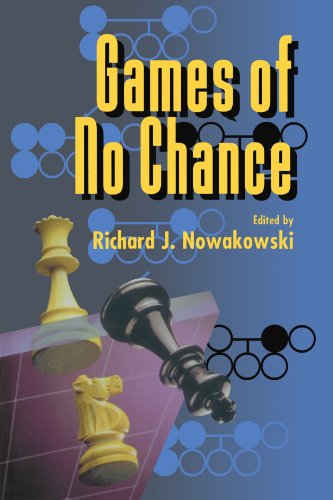
Richard J. Nowakowski
Cambridge University Press | 1998 | 549 páginas pdf | 3 Mb
on-line: msri.org (em capítulos)
link direto
djvu - link
Descrição: Is Nine-Men's Morris, in the hands of perfect players, a win for white or for black--or a draw? Can king, rook, and knight always defeat king and two knights in chess? What can Go players learn from economists? What are nimbers, tinies, switches, minies? This book deals with combinatorial games, that is, games not involving chance or hidden information. Their study is at once old and young: though some games, such as chess, have been analyzed for centuries, the first full analysis of a nontrivial combinatorial game (Nim) only appeared in 1902. This book deals with combinatorial games, that is, games not involving chance or hidden information. Their study is at once old and young: though some games, such as chess, have been analyzed for centuries, the first full anlaysis of a nontrivial combinatorial game (Nim) only appeared in 1902. The first part of this book will be accessible to anyone, regardless of background: it contains introductory expositions, reports of unusual contest between an angel and a devil. For those who want to delve more deeply, the book also contains combinatorial studies of chess and Go; reports on computer advances such as the solution of Nine-Men's Morris and Pentominoes; and new theoretical approaches to such problems as games with many players. If you have read and enjoyed Martin Gardner, or if you like to learn and analyze new games, this book is for you.
 More Games of no Chance
(Mathematical Sciences Research Institute Publications)
Richard J. Nowakowski
Cambridge University Press | 2002| 544 páginas
on-line: msri.org (pdf - em capítulos)
link direto
Descrição: This book is a state-of-the-art look at combinatorial games, that is, games not involving chance or hidden information. It contains a fascinating collection of articles by some of the top names in the field, such as Elwyn Berlekamp and John Conway, plus other researchers in mathematics and computer science, together with some top game players. The articles run the gamut from new theoretical approaches (infinite games, generalizations of game values, 2-player cellular automata, Alpha-Beta pruning under partial orders) to the very latest in some of the hottest games (Amazons, Chomp, Dot-and-Boxes, Go, Chess, Hex). Many of these advances reflect the interplay of the computer science and the mathematics. The book ends with an updated bibliography by A. Fraenkel and an updated and annotated list of combinatorial game theory problems by R. K. Guy.

Sem comentários:
Enviar um comentário