New Mathematical Library
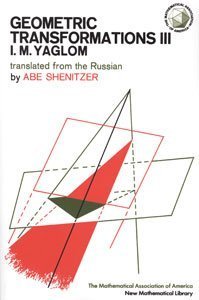
I. M. Yaglom
Mathematical Association of America | 1973 | 246 páginas | RAR - PDF | 7,29 Mb
uploading.com (password : matav)
This book is the sequel to Geometric Transformations I and II, volumes 8 and 21 in this series, but can be studies independently. It is devoted to the treatment of affine and projective transformations of the plane these transformations include the congruencies and similarities investigated in the previous volumes. The simple text and the many problems are designed mainly to show how the principles of affine and projective geometry may be used to furnish relatively simple solutions of large classes of problems in elementary geometry, including some straight edge construction problems. In the Supplement, the reader is introduced to hyperbolic geometry. The latter part of the book consists of detailed solutions of the problems posed throughout the text.
Contents
Translator’s Preface
From the Author’s Preface
Introduction - What is Geometry? (Final Essay)
Chapter 1- Affinitie and Projective Transformations
(Affinities and Projectivities) 10
Parallel projection of a plane onto a plane. Affine transformations of the plane 10
Central projection of a plane onto a plane. Projective transformations of a plane
Central projections which carry a circle into a circle. Stereographic projections 54
Reciprocation (polarity) of the plane. Principle of duality 66
Projective transformation of a line and a circle. Straightedge construction 87
Non-Euclidean Geometry of Lobachevsky-Bolyai (Hyperbolic Geometry) 103
Supplement. Non-Euclidean Geometry of Lobachevsky-Bolyai
(Hyperbolic Geometry)Livros da mesma série, disponíveis no blog: