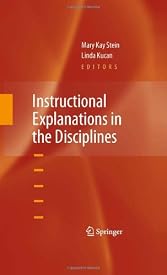
Mary Kay Stein, Linda Kucan
Springer | 2009 | 229 páginas | PDF | 5 Mb
link
link1
link2
Descrição: In today’s climate of accountability and standards, increasing attention is focused on teacher "quality," with less emphasis on what teachers actually do to interest and engage students in learning. This path-breaking volume addresses this research problem with a clear definition and a content-specific analysis of the most essential teaching moment—the instructional explanation—for vital new perspectives on educational method and process.Rich in examples from science, mathematics, and the humanities (and touching on areas of course development and pre-service training), Instructional Explanations in the Disciplines explores a variety of interactive contexts for teaching and learning, which may be collaborative between teachers, students, and others, performed in non-classroom settings, or assisted by technology. The book’s subject-matter-specific framework reveals key elements in the process, such as carefully examining the question to be answered, making connections with what is already known, and developing examples conducive to further understanding.Among the topics covered:The model as a method of explanation in scienceHow—and why—teachers explain things as they do"Let us explain with you": introducing instructional explanationsHow families talk about art in museum settings, and what we can learn from itDeveloping writing skills through students’ giving instructional explanationsInstructional explanation in the context of learning and identityInstructional Explanations in the Disciplines is a valuable addition to the education library, giving researchers new methods of unpacking educational process as few books before it.
Índice1 Introduction: Explaining Instructional Explanations . . 1Gaea LeinhardtPart I Instructional Explanations in the Teaching and Learning of Science2What Kind of Explanation is a Model? . . 9Richard Lehrer e Leona Schauble3 Learning, Identity, and Instructional Explanations. . 23Jorge Larreamendy-Joerns e Tatiana Muñoz4 Learning Chemistry: What, When, and How? . . 41David Yaron, Michael Karabinos, Karen Evans, Jodi Davenport, Jordi Cuadros, e James Greeno5 Negotiating the Goal of Museum Inquiry:How Families Engineer and Experiment . . 51Kyung Youn Kim e Kevin CrowleyPart II Instructional Explanations in the Teaching and Learning of Mathematics6 A Framing of Instructional Explanations: Let Us Explain With You . . 69Carla van de Sande e James G. Greeno7 How and Why Do Teachers Explain Things theWay They Do? . . 83Alan H. Schoenfeld8 The Explanatory Power of Examples in Mathematics: Challenges for Teaching . . 107Orit Zaslavsky9 Using Designed Instructional Activities to Enable Novices to Manage Ambitious Mathematics Teaching . 129Magdalene Lampert, Heather Beasley, Hala Ghousseini, Elham Kazemi, e Megan FrankePart III Instructional Explanations in the Teaching and Learning of the Humanities10 Learning History and Learning Language: Focusing on Language in Historical Explanations to Support English Language Learners . . . . 145Mariana Achugar e Catherine Stainton11 Instructional Explanations in a Legal Classroom: Are Students’ Argument Diagrams of Hypothetical Reasoning Diagnostic? . . . . . . 171Kevin D. Ashley e Collin Lynch12 Connecting with Art: How Families Talk About Art in a Museum Setting . . 189Karen Knutson e Kevin Crowley13 Developing Writing Skills Through Students Giving Instructional Explanations . 207Kwangsu Cho e Christian SchunnIndex . . 223

Sem comentários:
Enviar um comentário