sábado, 23 de junho de 2012

California Math Triumphs: Fractions and Decimals, Volume 2A

Basich Whintey

Mcgraw-hill | 2008 | 87 páginas | PDF | 8,97 Mb

link
link1

Site do Manual

glencoe.mcgraw-hill.com

California Math Triumphs is an intensive intervention resource for students who are two or more years below grade level. The series provides step-by-step intervention, vocabulary support, and data-driven decision making to help students succeed in high school mathematics.

Designed to support students needing the most intensive intervention, Math Triumphs: Fractions and Decimals helps build mastery of the foundational skills and concepts from prior grades that are prerequisites to the current grade level. Uniquely scaffolded practice problems provide support by breaking down each skill into the simplest understanding.

CONTENTS

Volume 2A - Chapter 1: Parts of a Whole
Volume 2A - Chapter 2: Equivalence of Fractions

Masculinities in Mathematics


(Educating Boys, Learning Gender)

Heather Mendick

Open University Press | 2006 | 192 Páginas| PDF | 1,57 Mb

link
link1

"We desperately need more people with good mathematical qualifications to fill many posts in numerate occupations, yet the numbers choosing to continue studying mathematics have fallen over the last 10 years. This book is important as it investigates how mathematics is aligned with masculinity and hence is not attractive to a significant part of the population. It is also challenging, scholarly, and a thoroughly good read. It reports the results of carefully designed research on gender and choice, and includes some fascinating individual case-studies. It should make us all reflect on what we are doing and how we can repair the damage." Margaret Brown, Professor of Mathematical Education, King's College London

"The book speaks to me as one of those texts that will become seminal in mathematics education. It is original, refreshing, and despite a complicated plot, points to some ways forward. It is engagingly written, if at times perhaps a little bit no-nonsense in tone. It will be of interest to teachers and teacher educators, as well as providing a theoretical stance that should inform future research." British Educational Research Journal

The study of mathematics, together with other 'gendered' subjects such as science and engineering, usually attracts more male than female pupils, particularly at more advanced levels. In this book Heather Mendick explores this phenomenon, addressing the important question of why more boys than girls choose to study mathematics. She combines new research with an original theoretical approach to argue that 'doing mathematics is doing masculinity'. The book illuminates what studying mathematics means for both students and teachers and offers a broad range of insights into students' views and practices. In addition to the words of young people learning mathematics, the masculinity of mathematics is explored through historical material and cinematic representations. Heather Mendick discusses the ways in which the alignment of mathematics with masculinity creates tensions for girls and women doing the subject. These tensions are sensitively explored through interviews with young men and women, to show how doing mathematics fits or conflicts with their gender identities. Finally, the book explores the implications for teachers, including ways to promote gender equity in mathematics education. This is key reading for students on courses in gender and education, mathematics education, gender and curriculum, and social justice.

This book illuminates what studying mathematics means for both students and teachers and offers a broad range of insights into students' views and practices. In addition to the words of young people learning mathematics, the masculinity of mathematics is explored through historical material and cinematic representations. The author discusses the ways in which the alignment of mathematics with masculinity creates tensions for girls and women doing the subject. These tensions are sensitively explored through interviews with young men and women, to show how doing mathematics fits or conflicts with their gender identities. Finally, the book explores the implications for teachers, including ways to promote gender equity in mathematics education. Following an introduction, this book is divided into three parts. Part 1, Scene Setting, presents the first chapters of the book: (1) Engendering Mathematics; and (2) Introducing the Study. Part 2, Sex by Numbers, continues with chapters: (3) Being/Doing "Good at Maths"; (4) Proving Something to Others; (5) Proving Something to Themselves; and (6) Changing Directions. Finally, Part 3, Queering Gender and Maths, concludes the book with the remaining chapters: (7) Making Choices Social: Refusing Essences in the Classroom; (8) Supporting Gender Transgression: Being and Acting Different in Maths; and (9) Opening Up Mathematics: Living with Uncertainty.

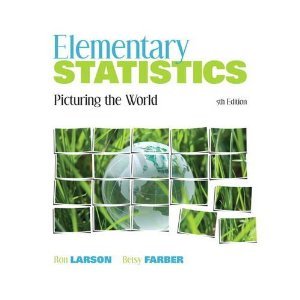
Elementary Statistics: Picturing the World

Ron Larson
5.ª Edição

Addison Wesley | 2012 | PDF | 786 páginas | 12,8 Mb


Elementary Statistics: Picturing the World, Fifth Edition, offers our most accessible approach to statistics–more than 750 graphical displays that illustrate data, readers are able to visualize key statistical concepts immediately. Adhering to the philosophy that students learn best by doing, this book relies heavily on examples–25% of the examples and exercises are new for this edition. Larson and Farber continue to demonstrate that statistics is all around us and that it’s easy to understand.

Table of Contents

Part One. Descriptive Statistics

1. Introduction to Statistics
1.1. An Overview of Statistics
1.2. Data Classification
1.3. Data Collection and Experimental Design

2. Descriptive Statistics
2.1. Frequency Distributions and Their Graphs
2.2. More Graphs and Displays
2.3. Measures of Central Tendency
2.4. Measures of Variation
2.5. Measures of Position

Part Two. Probability & Probability Distributions

3. Probability
3.1. Basic Concepts of Probability and Counting
3.2. Conditional Probability and the Multiplication Rule
3.3. The Addition Rule
3.4. Additional Topics in Probability and Counting

4. Discrete Probability Distributions
4.1. Probability Distributions
4.2. Binomial Distributions
4.3. More Discrete Probability Distributions

5. Normal Probability Distributions
5.1. Introduction to Normal Distributions and the Standard Normal Distribution
5.2. Normal Distributions: Finding Probabilities
5.3. Normal Distributions: Finding Values
5.4. Sampling Distributions and the Central Limit Theorem
5.5. Normal Approximations to Binomial Distributions

Part Three. Statistical Inference

6. Confidence Intervals
6.1. Confidence Intervals for the Mean (Large Samples)
6.2. Confidence Intervals for the Mean (Small Samples)
6.3. Confidence Intervals for Population Proportions
6.4. Confidence Intervals for Variance and Standard Deviation

7. Hypothesis Testing with One Sample
7.1. Introduction to Hypothesis Testing
7.2. Hypothesis Testing for the Mean (Large Samples)
7.3. Hypothesis Testing for the Mean (Small Samples)
7.4. Hypothesis Testing for Proportions
7.5. Hypothesis Testing for Variance and Standard Deviation

8. Hypothesis Testing with Two Samples
8.1. Testing the Difference Between Means (Large Independent Samples)
8.2. Testing the Difference Between Means (Small Independent Samples)
8.3. Testing the Difference Between Means (Dependent Samples)
8.4. Testing the Difference Between Proportions

Part Four. More Statistical Inference

9. Correlation and Regression
9.1 Correlation
9.2. Linear Regression
9.3. Measures of Regression and Prediction Intervals
9.4. Multiple Regression

10. Chi-Square Tests and the F-Distribution
10.1. Goodness-of-Fit Test
10.2. Independence
10.3. Comparing Two Variances
10.4. Analysis of Variance

11. Nonparametric Tests
11.1. The Sign Test
11.2. The Wilcoxon Tests
11.3. The Kruskal-Wallis Test
11.4. Rank Correlation
11.5. The Runs Test

Appendix A. Alternative Presentation of the Standard Normal Distribution
            Standard Normal Distribution Table (0-to-z)
            Alternative Presentation of the Standard Normal Distribution
Appendix B. Tables
            Table 1 Random Numbers
            Table 2 Binomial Distribution
            Table 3 Poisson Distribution
            Table 4 Standard Normal Distribution
            Table 5 t-Distribution
            Table 6 Chi-Square Distribution
            Table 7 F-Distribution
            Table 8 Critical Values for the Sign Test
            Table 9 Critical Values for the Wilcoxon Signed-Rank Test
            Table 10 Critical Values for the Spearman Rank Correlation
            Table 11 Critical Values for the Pearson Correlation Coefficient
            Table 12 Critical Values for the Number of Runs
Appendix C. Normal Probability Plots and Their Graphs

Answers to the Try It Yourself Exercises
Odd Answers
Index
Photo Credits

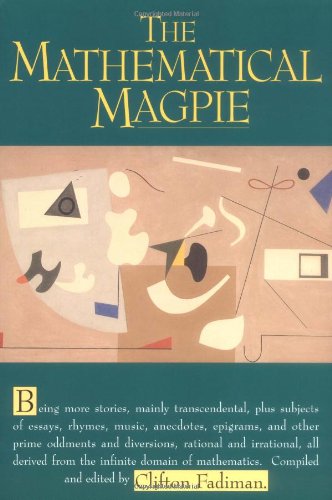
The Mathematical Magpie


Clifton Fadiman

Springer | 1997 | 303 páginas | djvu | 3,9 Mb


The companion volume to Fantasia Mathematica, first published in 1962, this second anthology of mathematical writings is even more varied and contains stories, cartoons, essays, rhymes, music, anecdotes, aphorisms, and other oddments. Authors include Arthur C. Clarke, Isaac Asimov, Mark Twain, and Lewis Carroll. 19 illus.

terça-feira, 19 de junho de 2012

Obstacles épistémologiques relatifs à la notion de limite

Anka Sierpinska

Recherches en Didactique des Mathematiques, Vol. 6, n°1, pp. 5-67, 1985

PDF - 2,4 Mb


Nenhum link disponível

Résumé
La recherche dont il est question dans le présent article se place dans la voie des recherches indiquée par Guy Brousseau dans son article (1983). Découvrir les obstacles épistémologiques lié aux mathématiques à enseigner à l’école et trouver les moyens didactiques pour aider les élèves à les surmonter - voilà, brièvement, deux principaux problèmes de ce programme de recherche. Ici, il s’agit du cas particulier de la notion de limite et l’article ne touche qu’au premier de ces problèmes : on propose une liste d’obstacles épistémologiques relatifs à la notion de limite présents encore chez des élèves d’aujourd’hui ; on ne propose pas les situations didactiques qui permettraient aux élèves de franchir ces obstacles.
Abstract
The present paper is concerned with a research the direction of which was indicated by Guy Brousseau in his 1983. To discover the epistemological obstacles connected with mathematics to be taught at school and to.elaborate didactical means to help the students to overcome them- these are, briefly, two main problems of this research programme. In this paper, the particular case of the notion of limit is considered and only the first of the two above mentionned problems is dealt with : a list of epistemological obstacles relative to the notion of limit is proposed ; there are no proposals of didactical situations enabling the students to overcome these.
Resumen
La investigación que trata este artículo se situa dentro de la línea de investigaciones indicadas por Guy Brousseau (1983). Descubrir los obstáculos epistemológicos ligados a las matemáticas que se enseñan en la escuela y encontrar los medios didácticos para ayudar los alumnos a superarlos. Brevemente presentamos aqui dos problemas principales de ese programa de investigación. Se trata del caso particular de la noción de limite y el artículo toca solamente el primero de esos problemas : se propone una lista de obstáculos epistemológicos relativos a la noción de límite presentes todavía en los alumnos de hoy en dia ; no se proponen situaciones didácticas que permitirian a los alumnos de superar esos obstáculos.

Artigo digitalizado por William (Obrigado!)

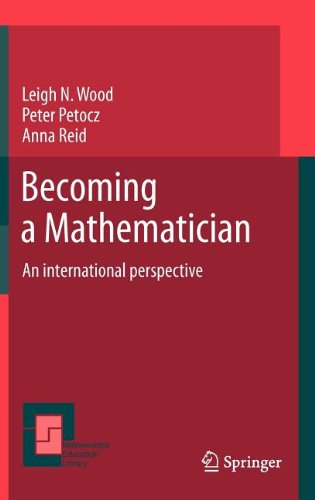
Becoming a Mathematician: An international perspective


Leigh Wood, Peter Petocz, Anna Reid

Springer | 2012 | 196 páginas | PDF | 1,75 Mb

link
link1

  • Presents research carried out over a decade in five universities spread over five continents using qualitative and quantitative methods
  • Presents implications for curriculum design and the professional development of mathematics lecturers
  • Investigates learning from the perspective of the learners
Mathematicians are everywhere and nowhere: although they play key roles in industry and research, business and science, the people who use the ideas and tools of the mathematics are often invisible and difficult to identify. This leads to a lack of clarity for students who are studying the mathematical sciences in their transition to professional life. Becoming a Mathematician considers the process of developing a mathematical identity and becoming a mathematician from the point of view of the participants in the process – students and recent graduates. It focuses on the people who do mathematics rather than on the topics of mathematics. It investigates the development of mathematical scientists for a variety of workplaces, and incorporates the experiences of those who were unsuccessful as well as those who were successful in the transition to the profession. The research presented is based on interviews, observations and surveys of students and graduates as they develop their identity as mathematicians, carried out over a decade in Australia and a diverse range of countries.
Índice
Chapter 1: Introduction: How does a person become a mathematician?.- Chapter 2: How do mathematics students think of mathematics? – a first look.- Chapter 3: How do mathematics students go about learning mathematics? – a first look.- Chapter 4: What do mathematics students say about mathematics internationally?.- Chapter 5: How can we track our students’ progress towards becoming mathematicians?.- Chapter 6: What is the contribution of mathematics to graduates’ professional working life?.- Chapter 7: What is the role of communication in mathematics graduates’ transition to professional work?.- Chapter 8: What university curriculum best helps students to become mathematicians?.- Chapter 9: How can professional development contribute to university mathematics teaching?.- Chapter 10: Conclusion: Becoming a mathematician – revisited.- References.- Appendix 1. Short form of conceptions of mathematics survey.- Appendix 2. Mathematical communication outcomes.-Appendix 3. Australian professional development framework.            

"From Text to 'Lived' Resources: Mathematics Curriculum Materials and Teacher Development


Ghislaine Gueudet, Birgit Pepin, Luc Trouche

Springer | 2011 | 369 páginas | PDF | 10 Mb

link

  • The book addresses both secondary and primary teachers and curricula
  • Draws from research in several countries, and authors with diverse expertise
  • Connects the design of curricula and the use of curricula by teachers
Curriculum materials and the interaction with these materials and resources is central in teacher education and professional development. How teachers use and learn from materials fundamentally depends on the interactions between three components: the reader, the material and the context. Teachers’ use and learning from text-based materials depends to a large extent on the characteristics of the materials, on the teaching activity in which the teacher is engaged, teachers’ beliefs and knowledge, and how these are aligned with the curriculum. What kinds of curriculum materials do teachers select and use, and how? How do teachers learn from these materials, and in which ways do they ‘tailor’ them for their use and pupil learning? These factors interact in complex ways, as teachers select, interpret and shape the materials, individually and collaboratively with groups of colleagues. The characteristics of the resources shape the teacher’s activity; analysing these characteristics enlightens the mathematics presented to the students, and more generally the classroom practice and the development of teacher professional knowledge. 
The purpose of this book is to provide a wider perspective on this issue in the field of mathematics education. It studies curriculum materials and their uses, in addition to investigations of teacher adaptation and use of those materials, and pays particular attention to digital resources. Teacher’s professional activity is studied as a whole, at different moments and in different contexts, in-class and out-of-class, with a variety of agents. The collective dimensions of this activity, the role of a variety of collectives for teachers professional development, constitute a major focus of the work presented here.

Índice
Foreword: R. Sträßer, Professor of Mathematics Education, Giessen, Germany.- Introduction:G. Gueudet, B. Pepin & L. Trouche.- Section 1: Teacher resources.- Chap. 1 (J. Adler): Knowledge resources in and for school mathematics teaching.- Chap. 2 (G. Gueudet & L. Trouche): Teachers’ work with resources: documentational geneses and professional geneses.- Chap. 3 (G. Sensevy): Patterns of didactic intentions, thought collective and documentation work.- Chap. 4 (M. A. Mariotti & M. Maracci): Resources for the teacher from a semiotic mediation perspective.- Reaction to section 1: B. Barton, President of ICMI, University of Auckland, New Zealand.- Section 2: Text and Curriculum resources.- Chap. 5 (K. Ruthven): Constituting Digital Tools and Materials as Classroom Resources.- Chap. 6 (J. Remillard): Modes of Engagement: Understanding Teachers’ Transactions with Mathematics Curriculum Resources.- Chap. 7 (B. Pepin): Task analysis as ‘Catalytic Tool’ for feedback and teacher learning: Working with teachers on mathematics curriculum materials.- Chap. 8 (W. Schmidt): The Cumulative Effects of Middle School Tracking: How Content Coverage Varies.- Chap. 9 (C. Proust): Teachers’ writings and students’ writings’: school material in Mesopotamia.- Reaction to section 2: M. Swan, Professor of Mathematics Education, Shell Centre, The University of Nottingham, UK.- Section 3: Use of resources.- Chap. 10 (C. Kieran, D. Tanguay & A. Solares): Researcher-designed resources and their adaptation within classroom teaching practice.- Chap. 11 (D. Forest & A Mercier): Classroom's video data and teaching resources: Some thoughts on teacher education.- Chap. 12 (S. Rezat): Interactions of teachers' and students' use of mathematics textbooks: A study of documentational genesis.- Chap. 13 (M. Trigueros & D. Lozano): Teachers teaching mathematics with Enciclomedia.- Chap. 14 (P. Drijvers): Teachers transforming resources into orchestrations.- Reaction to section 3: L. Radford, Professor of Mathematics Education, Laurentian University in Ontario, Canada.- Section 4: Collaborative use.- Chap. 15 (C. Winsløw): A comparative perspective on teacher collaboration: the cases of lesson study in Japan and of multidisciplinary teaching in Denmark.- Chap. 16 (G. Gueudet & L. Trouche): Communities, documents and professional geneses: interrelated stories.- Chap. 17 (J. Visnovska, P. Cobb & C. Dean): Mathematics teachers as instructional designers: what does it take?.- Reaction to section 4: B. Jaworski, Chair in Mathematics Education, Loughborough University, UK.-Closing reaction: D. Lowenberg Ball, Professor in Education, Dean, School of Education, University of Michigan, USA.- Conclusion: the editors.