domingo, 2 de fevereiro de 2014

Math for Life: Crucial Ideas You Didn't Learn in School


Jeffrey Bennett


Roberts and Company Publishers | 2011 | 189 páginas 

pdf - 1,8 Mb - link direto
scribd
mobi - link; link1
epub - link; link1
  • How can we solve the national debt crisis? 
  • Should you or your child take on a student loan? 
  • Is it safe to talk on a cell phone while driving? 
  • Are there viable energy alternatives to fossil fuels? 
  • Could simple policy changes reduce political polarization? 
These questions may all seem very different, but they share two things in common. First, they are all questions with important implications for either personal success or our success as a nation. Second, they all concern topics that we can fully understand only with the aid of clear quantitative or mathematical thinking. In other words, they are topics for which we need math for life--a kind of math that looks quite different from most of the math that we learn in school, but that is just as (and often more) important.
     In Math for Life, award-winning author Jeffrey Bennett simply and clearly explains the key ideas of quantitative reasoning and applies them to all the above questions and many more. He also uses these questions to analyze our current education system, identifying both shortfalls in the teaching of mathematics and solutions for our educational future.
     No matter what your own level of mathematical ability, and no matter whether you approach the book as an educator, student, or interested adult, you are sure to find something new and thought-provoking in Math for Life.
Table of Contents
Preface
1 (Don’t Be) “Bad at Math”
2 Thinking with Numbers
3 Statistical Thinking
4 Managing Your Money
5 Understanding Taxes
6 The U.S. Deficit and Debt
7 Energy Math
8 The Math of Political Polarization
9 The Mathematics of Growth
Epilogue: Getting “Good at Math”
To Learn More
Acknowledgments
Also by Jeffrey Bennett
Index
Index of Examples


sábado, 1 de fevereiro de 2014

Manifold Mirrors: The Crossing Paths of the Arts and Mathematics


 Felipe Cucker

Cambridge University Press | 2013 | 424 páginas | pdf | 31 Mb

link

Most works of art, whether illustrative, musical or literary, are created subject to a set of constraints. In many (but not all) cases, these constraints have a mathematical nature, for example, the geometric transformations governing the canons of J. S. Bach, the various projection systems used in classical painting, the catalog of symmetries found in Islamic art, or the rules concerning poetic structure. This fascinating book describes geometric frameworks underlying this constraint-based creation. The author provides both a development in geometry and a description of how these frameworks fit the creative process within several art practices. He furthermore discusses the perceptual effects derived from the presence of particular geometric characteristics. The book began life as a liberal arts course and it is certainly suitable as a textbook. However, anyone interested in the power and ubiquity of mathematics will enjoy this revealing insight into the relationship between mathematics and the arts.


The Mathematics Teacher in the Digital Era: An International Perspective on Technology Focused Professional Development


(Mathematics Education in the Digital Era, 2)

Alison Clark-Wilson, Ornella Robutti e Nathalie Sinclair

 Springer | 2014 | 419 páginas | rar - pdf | 4,5 Mb


link

password: matav


This volume addresses the key issue of the initial education and lifelong professional learning of teachers of mathematics to enable them to realize the affordances of educational technology for mathematics. With invited contributions from leading scholars in the field, this volume contains a blend of research articles and descriptive texts.
In the opening chapter John Mason invites the reader to engage in a number of mathematics tasks that highlight important features of technology-mediated mathematical activity.
This is followed by three main sections
·        an overview of current practices in teachers’ use of digital technologies in the classroom and explorations of the possibilities for developing more effective practices drawing on a range of research perspectives (including grounded theory, enactivism and Valsiner’s zone theory).
·        a set of chapters that share many common constructs (such as instrumental orchestration, instrumental distance and double instrumental genesis) and research settings that have emerged from the French research community, but have also been taken up by other colleagues.
·        meta-level considerations of research in the domain by contrasting different approaches and proposing connecting or uniting elements

Contents
Introduction .... 1
Alison Clark-Wilson , Ornella Robutti , and Nathalie Sinclair
Interactions Between Teacher, Student, Software and Mathematics: Getting a Purchase on Learning with Technology .... 11
John Mason
Part I Current Practices and Opportunities for Professional Development
Exploring the Quantitative and Qualitative Gap Between Expectation and Implementation: A Survey of English Mathematics Teachers’ Uses of ICT ....... 43
Nicola Bretscher
Teaching with Digital Technology: Obstacles and Opportunities .............. 71
Michael O.J. Thomas and Joann M. Palmer
A Developmental Model for Adaptive and Differentiated Instruction Using Classroom Networking Technology ... 91
Allan Bellman , Wellesley R. Foshay , and Danny Gremillion
Integrating Technology in the Primary School Mathematics Classroom: The Role of the Teacher ..... 111
María Trigueros , María-Dolores Lozano , and Ivonne Sandoval
Technology Integration in Secondary School Mathematics: The Development of Teachers’ Professional Identities .... 139
Merrilyn Goos
Teaching Roles in a Technology Intensive Core Undergraduate Mathematics Course .... 163
Chantal Buteau and Eric Mulle
Part II Instrumentation of Digital Resources in the Classroom
Digital Technology and Mid-Adopting Teachers’ Professional Development: A Case Study .. 189
Paul Drijvers , Sietske Tacoma , Amy Besamusca , Cora van den Heuvel , Michiel Doorman , and Peter Boon
Teaching Mathematics with Technology at the Kindergarten Level: Resources and Orchestrations ..... 213
Ghislaine Gueudet , Laetitia Bueno-Ravel , and Caroline Poisard
Teachers’ Instrumental Geneses When Integrating Spreadsheet Software........ 241
Mariam Haspekian
A Methodological Approach to Researching the Development of Teachers’ Knowledge in a Multi-Representational Technological Setting .... 277
Alison Clark-Wilson
Teachers and Technologies: Shared Constraints, Common Responses ..... 297
Maha Abboud-Blanchard
Didactic Incidents: A Way to Improve the Professional Development of Mathematics Teachers ..... 319
Gilles Aldon
Part III Theories on Theories
Meta-Didactical Transposition: A Theoretical Model for Teacher Education Programmes ...... 347
Ferdinando Arzarello, Ornella Robutti, Cristina Sabena, Annalisa Cusi,
Rossella Garuti, Nicolina Malara, and Francesca Martignone
Frameworks for Analysing the Expertise That Underpins Successful Integration of Digital Technologies into Everyday Teaching Practice ....... 373
Kenneth Ruthven
Summary and Suggested Uses for the Book ...... 395
Alison Clark-Wilson , Ornella Robutti , and Nathalie Sinclair
Glossary ....... 403
Index ........ 407

50 mathematical ideas you really need to know


Quercus | 2008 | 320 páginas

epub - link

pdf - link direto

Tony Crilly is Reader in Mathematical Sciences at Middlesex University, having previously taught at the University of Michigan, the City University in Hong Kong, and the Open University. His principal research interest is the history of mathematics, and he has written and edited many works on fractals, chaos and computing. He is the author of the acclaimed biography of the English mathematician Arthur Cayley

Contents
Introduction
01 Zero
02 Number systems
03 Fractions
04 Squares and square roots
05 π
06 e
07 Infinity
08 Imaginary numbers
09 Primes
10 Perfect numbers
11 Fibonacci numbers
12 Golden rectangles
13 Pascal’s triangle
14 Algebra
15 Euclid’s algorithm
16 Logic
17 Proof
318 Sets
19 Calculus
20 Constructions
21 Triangles
22 Curves
23 Topology
24 Dimension
25 Fractals
26 Chaos
27 The parallel postulate
28 Discrete geometry
29 Graphs
30 The four-colour problem
31 Probability
32 Bayes’s theory
33 The birthday problem
34 Distributions
35 The normal curve
36 Connecting data
37 Genetics
38 Groups
439 Matrices
40 Codes
41 Advanced counting
42 Magic squares
43 Latin squares
44 Money mathematics
45 The diet problem
46 The travelling salesperson
47 Game theory
48 Relativity
49 Fermat’s last theorem
50 The Riemann hypothesis

sexta-feira, 31 de janeiro de 2014

APOS Theory: A Framework for Research and Curriculum Development in Mathematics Education


Springer | 2014 | 270 páginas | pdf | 1,7 Mb


In spite of the fact that APOS Theory has been used extensively in numerous scholarly publications, in the design of textbooks, and in teaching practice, there is no single references that contains all the relevant information about its components, and provides guidance about its application. The goal of this book is to present the main elements of APOS theory. It should be useful for researchers who work with, or would like to learn more about, this theoretical approach, people who are interested in the way which mathematical conceptions are constructed according to this theory, Mathematics Education researchers, graduate students in Mathematics Education, and Mathematics instructors.

Chapter 1 Introduction.- Chapter 2 From Piaget’s Theory to APOS Theory: Reflective Abstraction in Learning Mathematics and the Historical Development of APOS Theory.- Chapter 3 Mental Structures and Mechanisms: APOS Theory and the Construction of Mathematical Knowledge.- Chapter 4 Genetic Decomposition.- Chapter 5 The Teaching of Mathematics Using APOS Theory.- Chapter 6 The APOS Paradigm for Research and Curriculum Development.- Chapter 7 Schemas, Their Development and Interaction.- Chapter 8 Totality as a Possible New Stage and Levels in APOS Theory.- Chapter 9 Use of APOS Theory to Teach Mathematics at Elementary School.- Chapter 10 Frequently Asked Questions.- Chapter 11 Conclusions.- Chapter 12 Annotated Bibliography.- References.- Index.

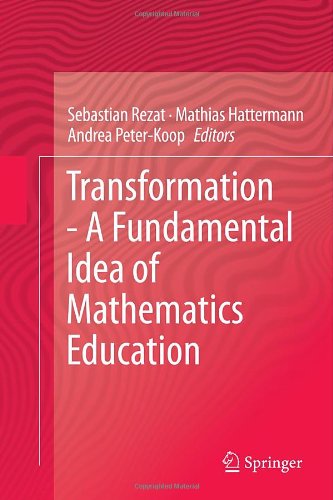
Transformation - A Fundamental Idea of Mathematics Education


Sebastian Rezat, Mathias Hattermann e Andrea Peter-Koop


Springer | 2014 | 417 páginas | rar -pdf |3,6 Mb

Password: matav

The diversity of research domains and theories in the field of mathematics education has been a permanent subject of discussions from the origins of the discipline up to the present. On the one hand the diversity is regarded as a resource for rich scientific development on the other hand it gives rise to the often repeated criticism of the discipline’s lack of focus and identity. As one way of focusing on core issues of the discipline the book seeks to open up a discussion about fundamental ideas in the field of mathematics education that permeate different research domains and perspectives. The book addresses transformation as one fundamental idea in mathematics education and examines it from different perspectives. Transformations are related to knowledge, related to signs and representations of mathematics, related to concepts and ideas, and related to instruments for the learning of mathematics. The book seeks to answer the following questions: What do we know about transformations in the different domains? What kinds of transformations are crucial? How is transformation in each case conceptualized?


Contents
Introduction
Sebastian Rezat, Mathias Hattermann
Part I
Introduction to Part I
Sebastian Rezat, Mathias Hattermann
1 How 18th Century Mathematics was Transformed into 19th Century School Curricula
                Heike Renate Biermann, Hans Niels Jahnke
2 A Framework for Examining the Transfor­mation of Mathematics and Mathematics Learning in the Transition from School to University: An Analysis of German Textbooks from Upper Secondary School and the First Semester
Maike Vollstedt, Aiso Heinze, Kristin Gojdka and Stefanie Rach
3 Knowledge Transformation between Secondary School and University Mathematics
                Oliver Deiser, Kristina Reiss
4 Student Transition to University Mathematics Education: Transformations of People, Tools and Practices
                Birgit Pepin
5 Overcoming the Gap between University and School Mathematics: The Impact of an Innovative Programme in Mathematics Teacher Education at the Justus-Liebig-University in Giessen
                Gabriele Kaiser, Nils Buchholtz
6 Mathematical Moments in a Human Life: Narratives on Transformation
                Barbro Grevholm
Discussion to Part I
Transitions in Learning Mathematics as a Challenge for People and Institutions
Rolf Biehler

Part II
Introduction to Part II
Sebastian Rezat, Mathias Hattermann
 7 Constructing Knowledge by Transformation: Diagrammatic Reasoning in Practice
                Gert Kadunz
8 Transforming Images in a DGS: The Semiotic Potential of the Dragging Tool for Introducing        the Notion of Conditional Statement
                Maria Alessandra Mariotti
9 Dynamic Representations of Complex Numbers: Opportunities to Learn in Teacher Training
                Reinhard Hölzl
10 Dynamic and Tangible Representations in Mathematics Education
                Colette Laborde, Jean-Marie Laborde
11 The Role of Social Aspects of Teaching and Learning in Transforming Mathematical Activity:      Tools, Tasks, Individuals and Learning Communities
                Vince Geiger
12 Designing a Simulator in Building Trades to Transform Vocational Education
                Annie Bessot
Discussion to Part II
Discussion I from an Epistemological Point of View: Representing and Meaning-making: The Transformation of Transformation
Falk Seeger
Discussion II from a Technological Point of View: Digital Technologies and Transformation in Mathematics Education
Rosamund Sutherland
Part III
Introduction to Part III
Sebastian Rezat, Mathias Hattermann
13 From Proof Image to Formal Proof – a Transformation
Tommy Dreyfus, Ivy Kidron
14 Elementary Stochastic Seeing in Primary Mathematics Classrooms – Epistemological Foundation and Empirical Evaluation of a Theoretical Construct
Judith Stanja, Heinz Steinbring
15 Understanding Geometric Work through its Development and its Transformations
                Alain Kuzniak
16 Small Steps to Promote “Mathematical Literacy”
                Lothar Profke
17 Transformation as a Fundamental Concept in Arithmetical Competence Modelling: An Example of Informatical Educational Science
                Josephus Klep
               
Discussion to Part III
Fundamental Ideas of Didactics – Reactions to the Suggested Meta-Theoretical Construct for Reflecting and Connecting Theories
Susanne Prediger

Epilogue

Rudolf Sträßer

As maravilhas da Matemática

Malba Tahan

BLOCH EDITORES | 1973 | 249 páginas| PDF

link direto

link

Sumário
1 — Estranho Vocabulário de Termos Incompreensíveis 13
2 — Os Mártires da Matemática 19
3 — O Papa que Foi Esquartejado 25
4 — Como Surgiram o + e o —? 29
5 — Numeração Pré-Colombiana 37
6 — Definições Euclidianas 41
7 — O Número Quatro na Mística Oriental e o Número Três Entre os Romanos 51
8 — As Aparências que Enganam 55
9 — A Curva Predileta dos Poetas 59
10 — O Heptágono Regular e Seu Peifume 65
11 — Um Repouso de Dezoito Séculos 69
12 — Os Ternos Pitagóricos e o Amor Sincero 73
13 — As Curvas Matemáticas nos Animais e nas Plantas 83
14 — O Problema das Bolas Misturadas 85
15 — A Geometria Ideal e a Realidade 89
16 — O Quadrado Mágico e o Jogo de Xadrez 91
17 — "Seu" Venâncio e as Dez Pontas de Cigarro 97
18 — Patas e Chifres no Palácio do Rei 101
19 — A Alta Matemática das Abelhas Geómetras 105
20 — O Número "Pi" Numa Trova Bem Rimada
21 — Círculos que se Tocam com Harmonia e Beleza 115
22 — O Milhão, Seu Retrato e Seu Prestígio 119
23 — A Estranha Numeração dos Maias 125
24 — Homens e Mulheres Numa Festa Mal Organizada 129
25 — Curiosidades Numéricas que Assombram os Calculistas 131
2 6 — 0 Problema dos Anjos de Efraim 133
27 — A Unidade Caçula: o Micrômetro 137
28 — A Pirâmide Humana de Newton 141
29 — A Curva Perfeita do Laço de Fita 145
30 — O Problema das Quinze Laranjeiras Bem Plantadas 151
31 — Filhos, Netos e Perucas em Equação 153
32 — Gato e Rato aos Pulos Uniformes 157
33 — A Idade Fantasiosa de Um Poeta 159
34 — O Palmo, o Palminho e Outras Medidas 163
35 — Goethe e a Tabuada da Feiticeira 169
36 — Problemas, Charadas e Enigmas 173
37 — Curva Patológica com Ponto Isolado 179
38 — Ao Reflorir Suave das Rosáceas 183
39 — O Simples Complicadíssimo e o Não-Simples Corriqueiro 189
40 — O Problema da Besta e a Solução do Sábio 193
41 — O Estranho Mistério dos Calculistas Famosos 195
42 — Circunferência Feita com Retas 197
43 — A Paixão e a Vez de Sofia Kovalevskaia 199
44 — Um Paradoxo Incrível no Infinito 203
45 — Quatro Símbolos Universais Famosos 207
46 — As Barricas Passam a Fronteira 215
47 — O Método Experimental em Matemática 219
48 — O Último e Famoso Teorema de Fermat 221
49 — O Ponto de Ouro, Sua Beleza e Seu Mistério 227
Índice das Curiosidades 251

Índice Alfabético de Nomes Citados 253

Sugestão de Jocélio Silveira