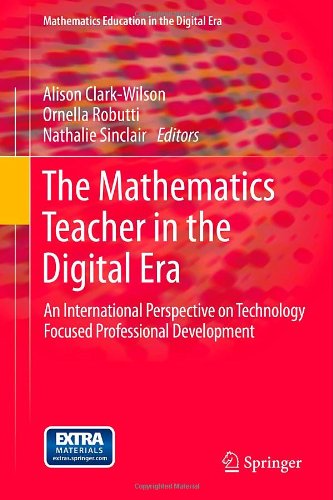
(Mathematics Education in the Digital Era, 2)
Alison Clark-Wilson, Ornella Robutti e Nathalie Sinclair
Springer | 2014 | 419 páginas | rar - pdf | 4,5 Mb
link
password: matav
This volume addresses the key issue of the initial education and lifelong professional learning of teachers of mathematics to enable them to realize the affordances of educational technology for mathematics. With invited contributions from leading scholars in the field, this volume contains a blend of research articles and descriptive texts.
In the opening chapter John Mason invites the reader to engage in a number of mathematics tasks that highlight important features of technology-mediated mathematical activity.
This is followed by three main sections
· an overview of current practices in teachers’ use of digital technologies in the classroom and explorations of the possibilities for developing more effective practices drawing on a range of research perspectives (including grounded theory, enactivism and Valsiner’s zone theory).
· a set of chapters that share many common constructs (such as instrumental orchestration, instrumental distance and double instrumental genesis) and research settings that have emerged from the French research community, but have also been taken up by other colleagues.
· meta-level considerations of research in the domain by contrasting different approaches and proposing connecting or uniting elements
Contents
Introduction .... 1
Alison Clark-Wilson , Ornella Robutti , and Nathalie Sinclair
Interactions Between Teacher, Student, Software and Mathematics: Getting a Purchase on Learning with Technology .... 11
John Mason
Part I Current Practices and Opportunities for Professional Development
Exploring the Quantitative and Qualitative Gap Between Expectation and Implementation: A Survey of English Mathematics Teachers’ Uses of ICT ....... 43
Nicola Bretscher
Teaching with Digital Technology: Obstacles and Opportunities .............. 71
Michael O.J. Thomas and Joann M. Palmer
A Developmental Model for Adaptive and Differentiated Instruction Using Classroom Networking Technology ... 91
Allan Bellman , Wellesley R. Foshay , and Danny Gremillion
Integrating Technology in the Primary School Mathematics Classroom: The Role of the Teacher ..... 111
María Trigueros , María-Dolores Lozano , and Ivonne Sandoval
Technology Integration in Secondary School Mathematics: The Development of Teachers’ Professional Identities .... 139
Merrilyn Goos
Teaching Roles in a Technology Intensive Core Undergraduate Mathematics Course .... 163
Chantal Buteau and Eric Mulle
Part II Instrumentation of Digital Resources in the Classroom
Digital Technology and Mid-Adopting Teachers’ Professional Development: A Case Study .. 189
Paul Drijvers , Sietske Tacoma , Amy Besamusca , Cora van den Heuvel , Michiel Doorman , and Peter Boon
Teaching Mathematics with Technology at the Kindergarten Level: Resources and Orchestrations ..... 213
Ghislaine Gueudet , Laetitia Bueno-Ravel , and Caroline Poisard
Teachers’ Instrumental Geneses When Integrating Spreadsheet Software........ 241
Mariam Haspekian
A Methodological Approach to Researching the Development of Teachers’ Knowledge in a Multi-Representational Technological Setting .... 277
Alison Clark-Wilson
Teachers and Technologies: Shared Constraints, Common Responses ..... 297
Maha Abboud-Blanchard
Didactic Incidents: A Way to Improve the Professional Development of Mathematics Teachers ..... 319
Gilles Aldon
Part III Theories on Theories
Meta-Didactical Transposition: A Theoretical Model for Teacher Education Programmes ...... 347
Ferdinando Arzarello, Ornella Robutti, Cristina Sabena, Annalisa Cusi,
Rossella Garuti, Nicolina Malara, and Francesca Martignone
Frameworks for Analysing the Expertise That Underpins Successful Integration of Digital Technologies into Everyday Teaching Practice ....... 373
Kenneth Ruthven
Summary and Suggested Uses for the Book ...... 395
Alison Clark-Wilson , Ornella Robutti , and Nathalie Sinclair
Glossary ....... 403
Index ........ 407

Sem comentários:
Enviar um comentário