segunda-feira, 27 de janeiro de 2014
Magic Squares: Learning the Inverse Relationships Between Addition and Subtraction
(Math for the Real World)
Colleen Adams
Rosen Publishing Group | 2003 | 19 páginas | pdf |
link (password: matav)
Contents
What Is a Magic Square? 4
An Ancient Magic Square 6
An Artist’s Magic Square 8
Changing the Numbers Around 11
Subtracting Numbers in a Magic Square 12
Benjamin Franklin’s Magic Square 14
Glossary 15
Index 16
In Eves' Circles
(Mathematical Association of America Notes and Reports, No. 34)
Joby Milo Anthony (Editor)
Mathematical Association of America (MAA) | 1994 | 209 páginas | DjVu (3.6 mb)
link
Howard Eves celebrated his eightieth birthday in 1991. To honor that occasion, the University of Central Florida sponsored a conference that focused on the life-long interests of this prominent American mathematician namely, the history of mathematics, the teaching of mathematics, and geometry. Howard is well-known for his contributions to all three areas. He is author of one of the best known books that has ever been writen on the history of mathematics, has a long association with the Mathematical Association of America, and has published extensive research in geometry.
The conference was unique. Conference participants included pre-college mathematics teachers, community college and university teachers, and research mathematicians. Papers were delivered in sessions devoted to the classroom teacher, to the history of mathematics,and to pedagogical and research interests in geometry. Many lectures combined these subjects. This book presents some of those lectures. anyone involved with teaching or producing mathematics can find something in this volume that will be interesting to them.
Some of these papers are speciically for the classroom teacher. They discuss a use of technology, or the organization of a class for some specific purpose. Other articles will provide teachers with examples of mathematical problems or historical episodes that can be used as part of a mathematics class. Still other papers deal with the philosophy of mathematics education. There are articles in this volume that present new insights into some of the history of mathematics, and there are other articles that deal with some new results in geometry. This is really the legacy of Howard Eves. He has been both a mentor for teachers at every level, and a colleague of research mathematicians. And so some part of this volume wil be appropriate for anyone interested in mathematics.
Contents
Howard Eves by Joby Anthony vii
Howard Eves—The High Elf by Donald J. Albers xv
Geometry, History, and Pedagogy
1. Geometry—an Innate Part of Mathematics Page 1
by Bruce Meserve
Professor Meserve begins this article with a short survey of the thirteen books of Euclid's Elements. He then uses Euclid to discuss the geometric representation of numbers and of algebraic concepts leading to the use of geometry to model the physical universe. He concludes with the roles of geometries in mathematics and science, and some objectives for the inclusion of geometry in the undergraduate mathematics curriculum.
2. Connecting Geometry and Number Theory Page 17
by Peter Hilton and Jean Pedersen
In this paper Professors Hilton and Pedersen show how an approximation with any desired degree of accuracy to any regular convex Af-gon (for example a regular pentagon) may be constructed from folding a straight strip of paper in a specific, repetitive pattern. In addition they show how the folding process for the regular convex Af-gons may be modified to construct approximations to all of the regular star polygons. The paper-folding process leads to some surprising results in number theory.
History and Pedagogy
3. The Meanings of Mathematical Proof: On Relations Between History and Mathematical Education Page 41
by Evelyne Barbin
Professor Barbin has been deeply involved with the development of mathematics education programs in France for some time. In this paper she examines carefully the historical notion of "proof" in mathematics, and draws some conclusions about the role of proof for mathematics teachers. She addresses the question "Is proving a means to convince or to enlighten?" She concludes that when teaching "proof" the question "How do you prove this result?" should be replaced with "How have you obtained this result?"
4. Some Mathematical Applications from the History of Cryptology for the Mathematics Classroom Page 53
by Helen Skala
This paper contains a brief history of some simple enciphering and deciphering techniques along with a collection of intriguing little "coding" problems. These problems could be used in a typical high school classroom as "enrichment" exercises that will absorb the attention of bright and inquisitive students.
Problem Solving
5. Reflections of a Problems Editor Page 63
by Clayton Dodge
For many years Professor Dodge was a colleague of Howard Eves at the University of Maine where he assisted Howard with the Elementary Problem Department of the American Mathematical Monthly. Presently he is the editor of the problem section of the Pi Mu Epsilon Journal. This paper contains a collection of problems, mostly in geometry, that have challenged Professor Dodge over the years.
6. Mathematical Creativity in Problem Solving and Problem Proposing II Page 73
by Murray Klamkin
Professor Klamkin is the former coach of the American Mathematical Olympiad team. He presents a very well organized list of problem-solving strategies, and then applies them to a collection of fascinating problems that have appeared in various contests, books, and papers.
Geometry
7. Bi-centric Quadrilaterals and the Pedal n-gon Page 97
by Gordon Bennett
A "pedal triangle" is formed in the following way. From a point P in the interior of a triangle, drop perpendicular line segments to the three sides of the triangle. The triangle whose vertices are the points of intersection of these line segments with the sides of the original triangle is called a "pedal" triangle. (A generalization of this concept produces the definition of a "pedal" n-gon.) A "bi-centric quadrilateral" is a quadrilateral with both a circumscribed and inscribed circle. Both bi-centric quadrilaterals and pedal n-gons have an extensive history. This paper uses advanced euclidean geometry to give some surprising results in both subject areas along with an interesting pedal n-gon conjecture and a new euclidean construction for the bi-centric quadrilateral.
The Fundamental Group as a Beautiful Functor Page 107
by Peter Hilton
Professor Peter Hilton is one of the best known of contemporary American mathematicians. This paper shows how techniques in algebraic topology can establish deep and beautiful links between geometry and algebra. Here are some comments by one of the referees. "It is not very difficult to learn a certain theory so that we are familiar with basic definitions and results and possibly aware of some applications. It is much more difficult to acquire a sufficient understanding of a theory so that we can effectively use its tools in new situations. The third stage is understanding how the studied theory fits within mathematics as a whole. This usually takes years of serious and devoted research and possibly some special qualities of mind. Most of us never really get there. Fortunately, it is possible to get glimpses of that world from mathematicians who have achieved that stage. This paper is in that category."
Calendars, Pacemakers, and Quasicrystals Page 117
by Marjorie Senechal
What is a "blue moon?" The answer may surprise you, and the mathematical connections between "blue" moons, pacemakers, and the study of crystals that don't quite have the symmetry that crystals are supposed to have (quasicrystals) will certainly surprise you. Professor Senechal shows how "circle" maps can be used to unify some aspects of the study of these apparantly disparate phenomena.
Two Families of Cubics Associated with a Triangle Page 127
by Peter Yff
A cubic curve is the locus of points in the plane that satisfy a third-degree polynomial equation. This paper in advanced euclidean geometry establishes some remarkable connections between ordinary triangles and families of cubic curves that are associated with that triangle.
History
11. Symmetry Through the Ages - Highlights from the Page 139
History of Regular Polyhedra
by Benno Artmann
There are only five "regular" solids; the tetrahedron, the cube, the octahedron, the dodecahedron, and the icosahedron. Three of these, the tetrahedron, the octahedron, and the icosahedron, have faces that are equilateral triangles. One, the cube, has faces that are squares; and one, the dodecahedron, has faces that are regular pentagons. In this paper Professor Artmann discusses the history of these regular polyhedra from the time when they first appear in the writings of Greek mathematicians in antiquity to their modern connections with abstract algebra.
12. G. A. Miller: Mathematician, Historian of Mathematics, and Mathematics Educator Extraordinaire Page 149
by Richard Davitt
Certainly one of the most prolific and influential mathematicians of the first part of the twentieth century was Professor G. A. Miller. This paper concentrates on Professor Miller's 44-year career at the University of Illinois. Along with some anecdotes about the Professor, is a compendium of his contributions to the founding of the American Mathematical Society and the Mathematical Association of America. This is an excellent summary of the life and work of a brilliant researcher, a dedicated teacher, and an active, responsible member of the community of scholars.
13. The History of the Mathematical Representation of Electromagnetic Theory Page 159
by Domina Spencer and Uma Shama
Much of the mathematical representation of electromagnetic theory began in the last half of the nineteenth century. This paper traces the development of that theory from the early work of Oersted, Ampere, Gauss, and others through the publication of Maxwell's Treatise on Electricity and Magnetism in 1873. It is shown that current formulations of electromagnetic theory depend on the interplay of two distinct traditions. Gauss suggested the idea of developing the entire subject from a single retarded equation for the force between moving charges which depends on the relative velocity of source and receiver. Maxwell developed the mathematical formulation of the field concepts of Faraday. These mathematical representations are now a fundamental tool of contemporary physics.
14. From Howard Eves to Africa Counts to Multicultural Mathematics Education Page 171
by Claudia Zaslavsky
Before there was much attention being paid to multicultural education there was Africa Counts. This paper gives a brief description of how Professor Zaslavsky came to write one of the earliest and best known of the books now used as references for multicultural mathematics education. Pedagogy
15. An Alternative to the Conventional Wisdom of a Term Paper in History of Mathematics Survey Courses Page 175
by Joe Albree
We certainly want our mathematics students to be literate, to be able to use language to communicate accurately and correctly. And they must have something to say. How do they attain such knowledge and skill? Professor Albree lists a number of problems with conventional term papers that he has encountered. Then he states some of his goals for students in a history of mathematics course: (1) confidence with basic library research skills, (2) organizational and writing skills, and (3) succesful completion of a major piece of
writing. This paper then explains how these goals are met with a "progression of literature reports."
16. DERIVEing a New Approach to Calculus Page 183
by Steven Amgott and Jane Friedman
There is much discussion today about the use of computers in mathematics classes. This paper explains how computer laboratories and the DERIVE software can be used to teach the beginning calculus courses.
17. Alternatives to the Lecture in Teaching Page 191
by William Bonnice
Teachers usually teach the way that they were taught. Lectures have been the mainstay of mathematics teaching for many years. In this paper Professor Bonnice discusses a variety of teaching techniques that can supplement or replace lectures. Included are cooperative groups, journals, and "writing to learn."
Calculus in Context: Integrating Calculus Concepts and Finite Mathematics in a First College Course Page 201
by Stephen Turner
This paper discusses ways to introduce the concepts of finite mathematics and calculus in a mathematics course designed for business majors. The use of computer systems utilizing computer algebra software, graphics programs, and spreadsheets is a key element in the course design. A very nice example of building a mathematical model of a simple business decision situation illustrates most of the methodology. Professor Turner was a student of Howard Eves at the University of Maine. He concludes this paper with some recollections of Howard as a teacher.
Vita Mathematica: Historical Research and Integration with Teaching
(Mathematical Association of America Notes and Reports, No. 40)
Ronald Calinger (Editor)
Mathematical Association of America (MAA) | 1996 | 364 páginas | DjVu (10 mb)
link
Vita Mathematica will enable teachers to learn the relevant history of
various topics in the undergraduate curriculum and help them incorporate
this history in their teaching. It contains articles dealing not only
with calculus, but also with algebra, combinatorics, graph theory, and
geometry, as well as more general articles on teaching courses for
prospective teachers, and describes courses taught entirely using
original sources. Judith Grabiner shows us how two important eighteenth
century mathematicians, Colin Maclaurin and Joseph-Louis Lagrange,
understood the calculus from these different standpoints and how their
legacy is still important in teaching calculus today. We learn from Hans
Nils Jahnke why Lagrange's algebraic approach dominated teaching in
Germany in the nineteenth century. Wilbur Knorr traces the ancient
history of one of the possible foundations, the concept of indivisibles.
This volume demonstrates that the history of mathematics is no longer
tangential to the mathematics curriculum, but in fact deserves a central
role.
Contents
Foreword VB
I. Historiography and Sources
New Trends and Old Images in The History of Mathematics, David E. Rowe 3
The Role of Problems in the History and Teaching of Mathematics, Evelyne Barbin 17
Dramatizing the Birth and Adventures of Mathematical Concepts:
Two Dialogues, Gavin Hitchcock 27
II. Historical Studies:
From Antiquity to the Scientific Revolution
The Four Sides and The Area: Oblique Light on the Prehistory of Algebra, Jens HrjJyrup 45
The Method of Indivisibles in Ancient Geometry, Wilbur Knorr 67
Enigmas of Chinese Mathematics, Frank Swetz 87
Combinatorics and Induction in Medieval Hebrew and Islamic Mathematics, Victor Katz 99
The Earliest Correct Algebraic Solutions of Cubic Equations, Barnabus Hughes 107
From the Scientific Revolution to the Present
The Early Geometrical Works of Marin Getaldic, Zarko Dadic 115
Empowerment through Modelling: the Abolition of the Slave Trade, John Fauvel 125
The Calculus as Algebra, the Calculus as Geometry: Lagrange, Maclaurin, and their Legacy, Judith Grabiner 131
The Development of Algebraic Analysis from Euler to Klein and Its Impact on School Mathematics in the Nineteenth Century, Hans Niels Jahnke 145
The Mathematics Seminar at the University of Berlin: Origins, Founding, and the Kummer-Weierstrass Years, Ronald Calinger 153
S. V. Kovalevskaya's Mathematical Legacy: The Rotation of a Rigid Body, Roger Cooke 177
Aspects and Problems of the Development of Mathematical Education at Technical Colleges in Germany during the Nineteenth Century, Susann Hensel 191
American Mathematics Viewed Objectively: The Case of Geometric Models, Peggy Kidwell 197
The Social and Intellectual Shaping of a New Mathematical Discipline:
The Role of the National Science Foundation in the Rise of Theoretical Computer
Science and Engineering, William Aspray, Andrew Goldstein, and Bernard Williams 209
III. Integration of History with Mathematics Teaching:
Fundamentals and Selected Cases
History of Mathematics and the Teacher, Torkil Heiede 231
Ethnomathematics: An Explanation, Ubiratan D'Ambrosio 245
The Necessity of History in Teaching Mathematics, \.t:' Frederick Rickey 251
Mathematical Masterpieces: Teaching with Original Sources, Reinhard C. Laubenbacher and David J. Pengelley 257
A History-of-Mathematics Course For Teachers, Based on Great Quotations, Israel Kleiner 261
Measuring an Arc of Meridian, Marie Franroise Jozeau and Michele Gregoire 269
From Egypt to Benjamin Banneker: African Origins of False Position Solutions, Beatrice Lumpkin 279
Mary Everest Boole (1832-1916):
An Erstwhile Pedagogist for Contemporary Times, Karen Dee Michalowicz 291
Origins and Teaching of Calculus
Pupils' Perception of the Continuum, Peter Bero 303
Historical Motivation for a Calculus Course: Barrow's Theorem, Martin Flashman 309
The History of the Concept of Function and Some Implications for Classroom Teaching,
Manfred Kronfellner 317
Integration in Finite Terms: From Liouville's Work to the Calculus Classroom of Today, SIU Man-Keung 321
How Many People Ever Lived? James Tattersall 331
Notes on Contributors 339
Index 345
The Geometric supposer: what is it a case of?

Judah L. Schwartz, Michal Yerushalmy, Beth Wilson
Lawrence Erlbaum Associates | 1993 | 254 páginas | rar - pdf | 89 Mb
link
password: matav
Capítulos:
Introduction: The Many Faces of Educational Innovation
I-Introducing the Reader to the Supposer
1-A Personal View of the Supposer: Reflections on Particularities and Generalities in Educational Reform 3
Judah L. Schwartz
2 - The Geometric Supposer in the Classroom 17
Beth Wilson
II-Problems of Learning
3 - Overcoming Visual Obstacles With the Aid of the Supposer 25
Michal Yerushalmy e Daniel Chazan
4 - Generalization in Geometry 57
Michal Yerushalmy
5 - Discovery Courses Are Great in Theory, But... 85
Christopher C. Heady
III-Problems of Teaching
6- Instructional Implications of Students' Understandings of the Differences Between Empirical Verification and Mathematical Proof 107
Daniel Chazan
7 - Posing Problems: One Aspect of Bringing Inquiry into Classrooms 117
Michal Yerushalmly, Daniel Chazan, Myles Gordon
8 -Teachers' Thinking About Students' Thinking About Geometry: The Effects of New Teaching Tools 143
Magdalene Lampert
9 - How the Supposer Changed My Life: An Autobiography 179
Richard Houde
IV-Problems of Implementation
10 -From Recitation to Construction: Teachers Change With New Technologies 193
Martha Stone Wiske e Richard Houde
11 - Geometric Supposer Urban Network 217
Grace Kelemanik e Mark Driscoll
12-What is the Supposer a Case Of? 227
Myles Gordon
Appendix A: A Guide to the Geometric Supposer 243
Author Index 249
Subject Index 253
domingo, 26 de janeiro de 2014
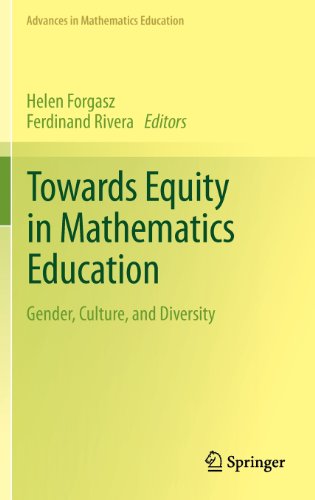
Towards Equity in Mathematics Education: Gender, Culture, and Diversity
(Advances in Mathematics Education)
Helen Forgasz e Ferdinand Rivera
Springer | 2012 | 586 páginas | pdf | 5,5 Mb
link
This volume gathers together twenty major chapters that tackle a variety of issues associated with equity in mathematics education along the dimensions of gender, culture, curriculum diversity, and matters of a biological nature. The pursuit of equity in mathematics education is an important concern in the history of the present. Since there is no doubt about the significant role of mathematics in almost every aspect of life, it means that all individuals regardless of sex, in any age range, and in whatever context need to be provided with an opportunity to become mathematically able. The publication of this Springer volume on equity in mathematics education is situated at a time when there is strong and sustained research evidence indicating the persistence of an equity gap in mathematics, which has now enabled the mathematics education community to engage in a discourse of access for all.
The research studies that are reported and discussed in the volume have been drawn from an international group of distinguished scholars whose impressive, forward-looking, and thought-provoking perspectives on relevant issues incite, broaden, and expand complicated conversations on how we might effectively achieve equity in mathematics education at the local, institutional, and systemic levels. Further, the up-to-date research knowledge in the field that is reflected in this volume provides conceptual and practical outlines for mechanisms of change, including models, examples, and usable theories that can inform the development of powerful equitable practices and the mobilization of meaningful equity interventions in different contexts of mathematics education.
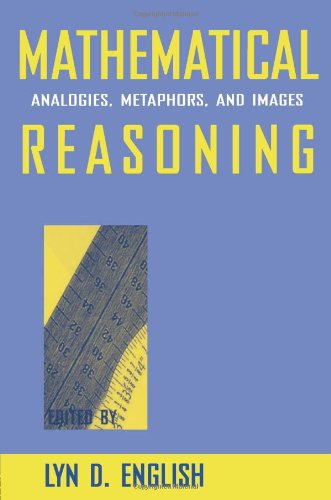
Mathematical Reasoning: Analogies, Metaphors, and Images
Lyn D. English
Routledge |1997 | 392 páginas | rar - epub | 2,3 Mb
link (password: matav)
How we reason with mathematical ideas continues to be a fascinating and challenging topic of research--particularly with the rapid and diverse developments in the field of cognitive science that have taken place in recent years. Because it draws on multiple disciplines, including psychology, philosophy, computer science, linguistics, and anthropology, cognitive science provides rich scope for addressing issues that are at the core of mathematical learning.
Drawing upon the interdisciplinary nature of cognitive science, this book presents a broadened perspective on mathematics and mathematical reasoning. It represents a move away from the traditional notion of reasoning as "abstract" and "disembodied", to the contemporary view that it is "embodied" and "imaginative." From this perspective, mathematical reasoning involves reasoning with structures that emerge from our bodily experiences as we interact with the environment; these structures extend beyond finitary propositional representations. Mathematical reasoning is imaginative in the sense that it utilizes a number of powerful, illuminating devices that structure these concrete experiences and transform them into models for abstract thought. These "thinking tools"--analogy, metaphor, metonymy, and imagery--play an important role in mathematical reasoning, as the chapters in this book demonstrate, yet their potential for enhancing learning in the domain has received little recognition.
This book is an attempt to fill this void. Drawing upon backgrounds in mathematics education, educational psychology, philosophy, linguistics, and cognitive science, the chapter authors provide a rich and comprehensive analysis of mathematical reasoning. New and exciting perspectives are presented on the nature of mathematics (e.g., "mind-based mathematics"), on the array of powerful cognitive tools for reasoning (e.g., "analogy and metaphor"), and on the different ways these tools can facilitate mathematical reasoning. Examples are drawn from the reasoning of the preschool child to that of the adult learner.
Contents:
Preface. Part I: Introduction.
L.D. English, Analogies, Metaphors, and Images: Vehicles for Mathematical Reasoning.
Part II: Cognitive Foundations for a Mind-Based Mathematics.
G. Lakoff, R.E. Núñez, The Metaphorical Structure of Mathematics: Sketching Out Cognitive Foundations for a Mind-Based Mathematics.
Part III: Mathematical Reasoning: Analogies.
R.B. Davis, C.A. Maher, How Students Think: The Role of Representations.
P.A. Alexander, C.S. White, M. Daugherty, Analogical Reasoning and Early Mathematics Learning.
B. Gholson, D. Smither, A. Buhrman, M.K. Duncan, K.A. Pierce, Children's Development of Analogical Problem-Solving Skill.
L.D. English, Children's Reasoning Processes in Classifying and Solving Computational Word Problems.
M. Bassok, Two Types of Reliance on Correlations Between Content and Structure in Reasoning About Word Problems.
M.J. Rattermann, Commentary: Mathematical Reasoning and Analogy.
Part IV: Mathematical Reasoning: Metaphors, Metonymies, and Images.
N.C. Presmeg, Reasoning With Metaphors and Metonymies in Mathematics Learning.
G.H. Wheatley, Reasoning With Images in Mathematical Activity.
N.C. Presmeg, Generalization Using Imagery in Mathematics.
D.H. Clements, J. Sarama, Children's Mathematical Reasoning With the Turtle Programming Metaphor.
A. Sfard, Commentary: On Metaphorical Roots of Conceptual Growth.
The Universal Computer: The Road from Leibniz to Turing
Martin Davis
|
A K Peters/CRC Press | 2011 | 240 páginas | pdf
link
The breathtakingly rapid pace of change in computing makes it easy to overlook the pioneers who began it all. Written by Martin Davis, respected logician and researcher in the theory of computation, The Universal Computer: The Road from Leibniz to Turing explores the fascinating lives, ideas, and discoveries of seven remarkable mathematicians. It tells the stories of the unsung heroes of the computer age – the logicians.
The story begins with Leibniz in the 17th century and then focuses on Boole, Frege, Cantor, Hilbert, and Gödel, before turning to Turing. Turing’s analysis of algorithmic processes led to a single, all-purpose machine that could be programmed to carry out such processes—the computer. Davis describes how this incredible group, with lives as extraordinary as their accomplishments, grappled with logical reasoning and its mechanization. By investigating their achievements and failures, he shows how these pioneers paved the way for modern computing.
Bringing the material up to date, in this revised edition Davis discusses the success of the IBM Watson on Jeopardy, reorganizes the information on incompleteness, and adds information on Konrad Zuse. A distinguished prize-winning logician, Martin Davis has had a career of more than six decades devoted to the important interface between logic and computer science. His expertise, combined with his genuine love of the subject and excellent storytelling, make him the perfect person to tell this story.
Subscrever:
Mensagens (Atom)