domingo, 26 de janeiro de 2014

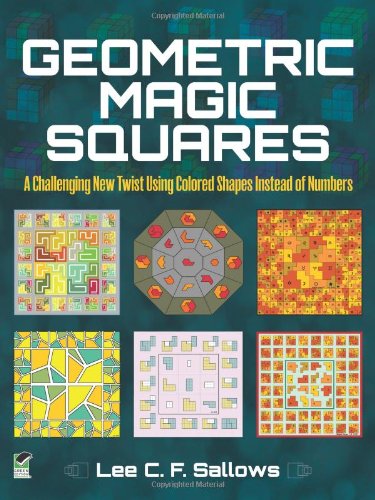
Geometric Magic Squares: A Challenging New Twist Using Colored Shapes Instead of Numbers


Lee Sallows

Dover Publications Inc. | 2013 | 160 páginas | epub | 15 Mb

link

Traditional magic squares employ a chessboard-like arrangement of numbers in which the total of all rows, columns, and diagonals add up to the same number. This innovative approach by a Dutch engineer challenges puzzlists to think two dimensionally by replacing numbers with colorful geometric shapes. Dozens of creative puzzles, suitable for ages 12 and up.

Contents
Part I: Geomagic Squares of 3×3 
1. Introduction
2. Geometric Magic Squares
3. The Five Types of 3×3 Area Square
4. Construction by Formula
5. Construction by Computer
6. 3×3 Squares
7. 3×3 Nasiks and Semi-Nasiks
8. Special Examples of 3×3 Squares
Part II: Geomagic Squares of 4×4 
9. Geo-Latin Squares
10. 4×4 Nasiks
11. Graeco-Latin Templates
12. Uniform Square Substrates
13. Dudeney’s 12 Graphic Types
14. The 12 Formulae
15. A Type I Geomagic Square
16. Self-Interlocking Geomagics
17. Form and Emptiness
18. Further Variations
Part III: Special Categories 
19. 2×2 Squares
20. Picture-Preserving Geomagics
21. 3-Dimensional Geomagics
22. Alpha-Geomagic Squares
23. Normal Squares of Order-4
24. Eccentric Squares
25. Collinear Collations
26. Concluding Remarks
Appendix I. A Formal Definition of Geomagic Squares
Appendix II. Magic Formulae
Appendix III. New Advances with 4×4 Magic Squares
Appendix IV. The Dual of the Lo shu
Appendix V. The Lost Theorem
Glossary 
References

An Introduction to Probability and Inductive Logic


Ian Hacking | Cambridge University Press | 2001 | 322 páginas | DjVu (2.8 mb)


link

This is an introductory textbook on probability and induction written by one of the world's foremost philosophers of science. The book has been designed to offer maximal accessibility to the widest range of students (not only those majoring in philosophy) and assumes no formal training in elementary symbolic logic. It offers a comprehensive course covering all basic definitions of induction and probability, and considers such topics as decision theory, Bayesianism, frequency ideas, and the philosophical problem of induction. 
 Contents
A Note on the Cover Illustration page ix
Foreword xi
Odd Questions xv
LOGIC
1 Logic 1
2 What Is Inductive Logic? 11
HOW TO CALCULATE PROBABILITIES
3 The Gambler's Fallacy 23
4 Elementary Probability Ideas 37
5 Conditional Probability 47
6 The Basic Rules of Probability 58
7 Bayes' Rule 69
HOW TO COMBINE PROBABILITIES AND UTILITIES
8 Expected Value 79
9 Maximizing Expected Value 98
10 Decision under Uncertainty 114
KINDS OF PROBABILITY
11 What Do You Mean? 127
12 Theories about Probability 140
PROBABILITY AS A MEASURE OF BELIEF
13 Personal Probabilities 151
14 Coherence 163
15 Learning from Experience 171 
PROBABILITY AS FREQUENCY
16 Stability 189
17 Normal Approximations 201
18 Significance and Power 209
19 Confidence and Inductive Behavior 229
PROBABILITY APPLIED TO PHILOSOPHY
20 The Philosophical Problem of Induction 247
21 Learning from Experience as an Evasion of the Problem
of Induction 256
22 Inductive Behavior as an Evasion of the Problem of
Induction 261
Answers to the Exercises 269
Further Reading 293
Index 300

The Emergence of Probability: A Philosophical Study of Early Ideas about Probability, Induction and Statistical Inference


(Cambridge Series on Statistical & Probabilistic Mathematics)

Ian Hacking | 2006 | 246 páginas | DjVu (3 mb)

link

 rar - epub | 664 kb - link (password: matav)

Historical records show that there was no real concept of probability in Europe before the mid-seventeenth century, although the use of dice and other randomizing objects was commonplace. Ian Hacking presents a philosophical critique of early ideas about probability, induction, and statistical inference and the growth of this new family of ideas in the fifteenth, sixteenth, and seventeenth centuries. Hacking invokes a wide intellectual framework involving the growth of science, economics, and the theology of the period. He argues that the transformations that made it possible for probability concepts to emerge have constrained all subsequent development of probability theory and determine the space within which philosophical debate on the subject is still conducted. First published in 1975, this edition includes an introduction that contextualizes his book in light of developing philosophical trends. Ian Hacking is the winner of the Holberg International Memorial Prize 2009.

CONTENTS
Introduction 2006 page xi
1 An absent family of ideas 1
Although dicing is one of the oldest of human pastimes, there is no known
mathematics of randomness until the Renaissance. None of the explanations
of this fact is compelling.
2 Duality 11
Probability, as we now conceive it, came into being about 1660. It was
essentially dual, on the one hand having to do with degrees of belief, on the
other, with devices tending to produce stable long-run frequencies.
3 Opinion 18
In the Renaissance, what was then called 'probability' was an attribute of
opinion, in contrast to knowledge, which could only be obtained by
demonstration. A probable opinion was not one supported by evidence, but
one which was approved by some authority, or by the testimony of respected
judges.
4 Evidence
31
Until the end of the Renaissance, one of our concepts of evidence was lacking:
that by which one thing can indicate, contingently, the state of something else.
Demonstration, versimilitude and testimony were all familiar concepts, but
not this further idea of the inductive evidence of things,
5 Signs 39
Probability is a child of the low sciences, such as alchemy or medicine, which
had to deal in opinion, whereas the high sciences, such as astronomy or
mechanics, aimed at demonstrable knowledge. A chief concept of the low
sciences was, that of the sign, here described in some detail. Observation of
signs was conceived of as reading testimony. Signs were more or less reliable.
Thus on the one hand a sign made an opinion probable (in the old sense of
Chapter 3) because it was furnished by the best testimony of all. On the other
hand, signs could be assessed by the frequency with which they spoke truly. At
the end of the Renaissance, the sign was transformed into the concept of
evidence described in Chapter 4. This new kind of evidence conferred
Contents
probability on propositions, namely made them worthy of approval. But it did
so in virtue of the frequency with which it made correct predictions. This
transformation from sign into evidence is the key to the emergence of a
concept of probability that is dual in the sense of Chapter 2.
6 The first calculations 49
Some isolated calculations on chances, made before 1660, are briefly
described.
7 The Roannez circle (1654) 57
Some problems solved by Pascal set probability rolling. From here until
Chapter 17 Leibniz is used as a witness to the early days of probability theory.
8 The great decision (1658?)
63
'Pascal's wager' for acting as if one believed in God is the first well-understood
contribution to decision theory.
9 The art of thinking (1662) 73
Something actually called 'probability' is first measured in the Port Royal
Logic, which is also one of the first works to distinguish evidence, in the sense
of Chapter 4, from testimony. The new awareness of probability, evidence
and conventional (as opposed to natural) sign, is illustrated by work of
Wilkins, first in 1640, before the emergence of probability, and then in 1668,
after the emergence.
10 Probability and the law (1665) 85
While young and ignorant of the Paris developments Leibniz proposed to
measure degrees of proof and right in law on a scale between 0 and 1, subject
to a crude calculation of what he called 'probability'.
11 Expectation (1657)
92
Huygens wrote the first printed textbook of probability using expectation as
the central concept. His justification of this concept is still of interest.
12 Political arithmetic (1662) 102
Graunt drew the first detailed statistical inferences from the bills of mortality
for the city of London, and Petty urged the need for a central statistical office.
13 Annuities (1671) 111
Hudde and de Witt used Dutch annuity records to infer a mortality curve on
which to work out the fair price for an annuity.
14 Equipossibility (1678) 122
The definition of probability as a ratio among 'equally possible cases1
originates with Leibniz. The definition, unintelligible to us, was natural at the
time, for possibility was either de re (about things) or de dicto (about
propositions). Probability was likewise either about things, in the frequency
sense, or about propositions, in the epistemic sense. Thus the duality of
probability was preserved by the duality of possibility.
15 Inductive logic 134
Leibniz anticipated Carnap's notion of inductive logic. He could do so
because of the central place occupied by the concept of possibility in his
scheme of metaphysics. Within that scheme, a global system of inductive logic
makes more sense than Carnap's does in our modern metaphysics.
16 The art of conjecturing (1692[?] published 1713) 143
The emergence of probability is completed with Jacques Bernoulli's book,
which both undertakes a self-conscious analysis of the concept of probability,
and proves the first limit theorem.
17 The first limit theorem 154
The possible interpretations of Bernoulli's theorem are described.
18 Design 166
The English conception of probability in the early eighteenth century, guided
by the Newtonian philosophy espoused by members of the Royal Society,
interprets the stability of stochastic processes proven by the limit theorems as
evidence of divine design.
19 Induction (1737) 176
Hume's sceptical problem of induction could not have arisen much before
1660, for there was no concept of inductive evidence in terms of which to raise
it. Why did it have to wait until 1737? So long as it was still believed that
demonstrative knowledge was possible, a knowledge in which causes were
proved from first principles, then Hume's argument could always be stopped.
It was necessary that the distinction between opinion and knowledge should
become a matter of degree. That means that high and low science had to
collapse into one another. This had been an ongoing process throughout the
seventeenth century. It was formalized by Berkeley who said that all causes
were merely signs. Causes had been the prerogative of high science, and signs
the tool of the low. Berkeley identified them and Hume thereby became
possible.
Bibliography 186
Index 203
sábado, 25 de janeiro de 2014

International Perspectives on Teacher Knowledge, Beliefs and Opportunities to Learn: TEDS-M Results


(Advances in Mathematics Education)

Sigrid Blömeke, Feng-Jui Hsieh, Gabriele Kaiser e William H Schmidt 

Springer | 2014 | 581 páginas | pdf | 10,1 Mb

link


This book presents a collection of papers that examine the TEDS-M data results in terms of knowledge and beliefs, the relationship between opportunities to learn during teacher education and outcomes, as well as the relationship between the future teachers’ background and teacher education outcomes. TEDS-M, under the auspices of the International Association for the Evaluation of Educational Achievement (IEA), carried out the first-ever study to examine primary and lower secondary mathematics teachers’ competence in their last year of teacher education. In particular, it analyses the relationship between teacher education policies, practices and outcomes. Analysis of these complex relationships indicates both global and regional patterns of similarity and difference and identifies country-specific strengths and weaknesses, thus enabling national policy makers to improve the effectiveness of their systems within their own cultural norms and values.
 Specifically, through examination and analysis of the TEDS-M data, the papers in this book:
•     add to the body of theory through reflecting on teacher knowledge conceptions, the relationship between teacher knowledge and beliefs, and cultural influences on the assessment and development of teacher knowledge and beliefs;
•     illustrate the potential and ways of exploring possible connections between teacher preparation and student achievement; and
•     discuss policy implications for evaluating teacher preparation and program quality.
 The book therefore provides a unique insight into teacher training systems and competences around the world and will be an invaluable resource for researchers, government policy makers and teacher trainers everywhere.


Contents
Part I Introduction
Framing the Enterprise: Benefits and Challenges of InternationalStudies on Teacher Knowledge and Teacher Beliefs—Modeling Missing Links  . . 3
Sigrid Blömeke
Theoretical Framework, Study Design and Main Results of TEDS-M . . 19
S. Blömeke and G. Kaiser
Learning About and Improving Teacher Preparation for Teaching Mathematics from an International Perspective . . 49
Yeping Li
Part II Knowledge at the End of Teacher Education: International Perspectives
Knowledge of Future Primary Teachers for Teaching Mathematics: An International Comparative Study . . 61
Sharon L. Senk, Maria Teresa Tatto, Mark Reckase, Glenn Rowley, Ray Peck, and Kiril Bankov
Teacher Education Effectiveness: Quality and Equity of Future Primary Teachers’ Mathematics and Mathematics Pedagogical Content Knowledge  . . 91
Sigrid Blömeke, Ute Suhl, and Gabriele Kaiser
In-depth Analyses of Different Countries’ Responses to MCK Items: A View on the DifferencesWithin and Between East andWest  . . 115
Feng-Jui Hsieh, Chi-Tai Chu, Chia-Jui Hsieh, and Pi-Jen Lin
Why Did Taiwan Excel: Hot Topics and Pressing Issues . . 141
Feng-Jui Hsieh, Pei-Chen Wu, and Ting-Ying Wang
The Preparation of Primary Mathematics Teachers in Singapore: Programs and Outcomes from the TEDS-M Study  . . 163
Khoon Yoong Wong, Kok Leong Boey, Suat Khoh Lim-Teo, and Jaguthsing Dindyal
Teacher Education Effectiveness: Quality and Equity of Future Primary and Future Lower Secondary Teachers’ General Pedagogical Knowledge . . . . 187
J. König, S. Blömeke, L. Paine, W.H. Schmidt, and F.-J. Hsieh
Part III Beliefs at the End of Teacher Education: International Perspectives
The Cultural Dimension of Beliefs: An Investigation of Future Primary Teachers’ Epistemological Beliefs Concerning the Nature of Mathematics in 15 Countries . . 209
Anja Felbrich, Gabriele Kaiser, and Christiane Schmotz
The Cultural Notion of Teacher Education: Future Lower Secondary Teachers’ Beliefs on the Nature of Mathematics, the Learning of Mathematics and Mathematics Achievement . . 231
Shu-Jyh Tang and Feng-Jui Hsieh
The Cultural Notion of Teacher Education: Comparison of Lower-Secondary Future Teachers’ and Teacher Educators’ Beliefs  . . 255
Ting-Ying Wang and Feng-Jui Hsieh
An Examination of Future Primary Teachers Attitudes About the Teaching of Mathematics: An International Perspective . . 279
Nathan Burroughs and William Schmidt
Part IV Does Teacher Education Matter?
Homogeneity or Heterogeneity? Profiles of Opportunities to Learn in Primary Teacher Education and Their Relationship to Cultural Context and Outcomes . . 299
Sigrid Blömeke and Gabriele Kaiser
Family Background, Entry Selectivity and Opportunities to Learn: What Matters in Primary Teacher Education? An International Comparison of Fifteen Countries  . . . 327
Sigrid Blömeke, Ute Suhl, Gabriele Kaiser, and Martina Döhrmann
Primary Teacher Preparation in the United States: What We Have Learned  . . 355
Leland Cogan, William H. Schmidt, and Richard Houang
Emphasis and Balance among the Components of Teacher Preparation: The Case of Lower Secondary Mathematics Teacher Education  . . 371
William H. Schmidt, Leland Cogan, and Richard Houang
Greater Expectations in Lower Secondary Mathematics Teacher Preparation: An Examination of Future Teachers’ Opportunity to Learn Profiles  . . 393
William Schmidt and Leland Cogan
Does School Experience Matter for Future Teachers’ General Pedagogical Knowledge? . . 415
Johannes König and S. Blömeke
Part V Assessment Challenges with Respect to Teacher Knowledge 
The Conceptualisation of Mathematics Competencies in the International Teacher Education Study TEDS-M . . 431
Martina Döhrmann, Gabriele Kaiser, and Sigrid Blömeke
A Conceptualization of Indicators for Mathematics Teacher Education Quality for International Studies. . 457
Feng-Jui Hsieh, Chiu-Keung Law, Haw-Yaw Shy, Ting-Ying Wang,
Chia-Jui Hsieh, and Shu-Jyh Tang
Diagnosing Teacher Knowledge by Applying Multidimensional Item Response Theory and Multiple-Group Models . . 483
Sigrid Blömeke, Richard T. Houang, and Ute Suhl
Are College Rankings an Indicator of Quality Education? Comparing Barron’s and TEDS-M  . . 503
William Schmidt, Nathan Burroughs, Lee Cogan, and Richard Houang
Part VI Conclusions:WhatWe Have Learned and Future Challenges
Learning from the Eastern and the Western Debate—The Case of Mathematics Teacher Education . . 517
Gabriele Kaiser and Sigrid Blömeke
Assessment of Teacher Knowledge Across Countries: A Review of the State of Research  . . 541
Sigrid Blömeke and Séan Delaney

Transnational and Borderland Studies in Mathematics Education


(Studies in Mathematical Thinking and Learning Series)

Richard S. Kitchen e Marta Civil

Routledge | 2010 | 233 páginas | rar - pdf | 1,4 Mb


link (password: matav)

Every year, significant numbers of immigrant children from Mexico enter classrooms in the United States. These immigrants comprise a heterogeneous group of students with diverse needs, abilities, and experiences. Transnational and Borderland Studies in Mathematics Educationis the first collection to offer research studies across these communities. Providing invaluable research on both sending and receiving communities in Mexico and the US, this collection considers the multiple aspects of children’s experiences with mathematics, including curriculum, classroom participation structures, mathematical reasoning and discourse – both in and out of school – and parents’ perceptions and beliefs about mathematics instruction. An important treatment of an insufficiently documented subject, this collection brings together researchers on both sides of the border to foster and support an interest in documenting evidence that will set the stage for future studies in mathematics education.


Contents
Preface by Richard S. Kitchen and Marta Civil
1. Ecological Approaches to Transnational Research on Mathematical Reasoning: A Focus on Latino/a Mathematics Learners in the Borderlands by Judit Moschkovich
2. Crossing the Border between Home and School: Dominican Parents' Perspectives on the Teaching and Learning of Mathematics by Mary Q. Foote
3. Impressions of Mexican Immigrant Families on their Early Experiences with School Mathematics in Arizona by Marta Civil & José María Menéndez
4. Becoming a "Liberal" Math Learner: Expanding Secondary School Mathematics to Support Cultural Connections, Multiple Mathematical Identities and Engagement by Lisa M. Jilk
5. Engaging Underprivileged Mexican students in Reform-Oriented Mathematics Instruction by José Luis Cortina
6. Considering Mexican and U.S. Teachers’ Views on the Teaching and Learning of Mathematics Through a Teaching for Diversity Lens by Richard S. Kitchen
7. Teachers’ Task Management Practices in the Context of Routine and Non-Routine Mathematics Problems: A Descriptive Analysis by Guadalupe I. Lozano Terán
8. Teachers’ Conceptions of Mathematics and Mathematics Teaching and Learning: The Case of Two Elementary Teachers in Northern Mexico by Jesús Acosta-Iriqui
9. Looking Forward: Establishing a Research Agenda for Transnational and Borderland Studies in Mathematics Education by Richard S. Kitchen & Marta Civil
Epilogue by Olimpia Figueras

Math Talk: Mathematical Ideas in Poems for Two Voices

Theoni Pappas


Wide World Publishing/Tetra | 1993 | 73 páginas | rar - pdf | 924 kb

password: matav

Presents mathematical ideas through poetic dialogues intended to be read by two people.

Contents
Forward 7
Mathematics 9
We are numbers 13
Circles 15
One 18
Fractals 21
Zero 23
Fibonacci numbers 26
Squares 29
Operations 30
Imaginary numbers 32
Variables 35
Radicals 37
The Möbius strip 39
Triangles 41
π 43
Prime numbers 46
The 2nd-dimension 48
e, π and i 51
Integers 52
Tessellations 55
The even numbers 58
Proper fractions 60
Googols 63
Infinity 66
The golden mean 68

Becoming a Reflective Mathematics Teacher


(Studies in Mathematical Thinking and Learning Series)

Alice F. Artzt, Eleanor Armour-Thomas e Frances R. Curcio

Routledge| 2007 - 2ª edição | 240 páginas | rar - pdf | 1 Mb

link (password: matav)


1ª edição - 2001

Becoming a Reflective Mathematics Teacher: A Guide for Observations and Self-Assessment offers what every mathematics teacher educator or supervisor has been looking for. Ideally suited for use with students who are taking a methods course or who are student teaching, this activity-oriented, research-based text: 
*supplies detailed observation instruments that preservice teachers can use when they observe other teachers. Each instrument focuses on a critical aspect of instructional practice in mathematics (e.g., tasks, learning environment, discourse). In addition, it requires the observer to make conjectures regarding the teachers' underlying cognitions (e.g., knowledge, beliefs, goals) that might account for the instructional practice they observe. 
*offers reflective activities that provide a structure through which beginning teachers can think about their teaching in an insightful, thorough, and productive manner. Students can work through the activities over the period of a year. The structured observations and reflective activities are modular, and the framework applies to all observations of teaching, no matter what the instructional content. 
*includes guidelines and instruments for supervisors to use when observing, conferencing with, and assessing beginning or student teachers. The unique aspect of these guidelines and instruments is the link they make between teachers' cognitions and their instructional practice. 
All instruments and suggested activities are couched within a highly effective framework for teacher reflection and self-assessment that was developed in the spirit of the NCTM professional teaching standards. This framework is grounded in a cognitive perspective on learner-centered teaching. In Part I, the framework is explained and its validity is documented. Part II shows how teachers can use the framework to observe other teachers' classroom work, and to reflect on their own teaching. Part III offers case studies to help readers see how the method works.


Contents
Part I: Philosophical Basis for the Model
1. Toward an Understanding of Student-Centered Teaching
2. A Framework for the Examination of Instructional Practice
3. A Framework for the Examination of Teacher Cognitions
4. Putting It All Together
Part II: How to Use the Model
5. Using the Model to Examine Teachers’ Instructional Practice and Cognitions
6. Using the Model to Examine Your Own Instructional Practice and Cognitions
7. Using a Portfolio to Document How You Engage in Self-Assessment and Reflection
Part III: Evidence: The Model in Action
8. Case Studies of the Model in Action: Five Cases
Appendix A: Research Results of Exploratory Study
Appendix B: Observation Guidelines
Appendix C: Observation Charts Made by Preservice Teachers
Appendix D: Guides and Forms for Supervised Observations
Appendix E: Portfolio Assignment and Rubrics