quarta-feira, 22 de julho de 2009

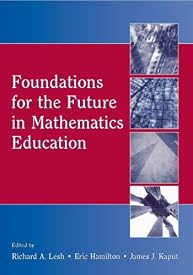
Foundations for the Future in Mathematics Education


Richard A. Lesh, Eric Hamilton, James J. Kaput (Editores)

Taylor & Francis | 2007 | 528 páginas |  pdf | 45,7 Mb

link
link1

Conteúdos
Preface: Foundations for the Future in Engineering and other Fields That Are Heavy Users of Mathematics, Science and Technology
Richard Lesh

Part 1
What Changes are Occurring in the Kind of Problem-Solving Situations Where Mathematical Thinking Is Needed Beyond School? (on-line: faculty.pepperdine.edu)
Eric Hamilton
1- The Meanings of Statistical Variation in the Context of Work
(on-line: faculty.pepperdine.edu)
Celia Hoyles e Richard Noss
2- Problem-Solving and Learning in Everyday Structural Engineering Work
Julie Gainsburg
3- Modeling Without End: Conflict Across Organizational and Disciplinary Boundaries in Habitat Conservation Planning (on-line: peabody.vanderbilt.edu)
Bruce Evan Goldstein e Rogers Hall
4- Mathematical Modeling 'in the Wild': A Case of Hot Cognition
Wolff-Michael Roth
5- Learning in Design (on-line: epistemicgames.org)
David Williamson Shaffer
6- The Cognitive Science of Mathematics: Why Is It Relevant for Mathematics Education?
Rafael Nunez

Part 2
What Changes Are Occurring in the Kind of Elementary-but-Powerful Mathematics Concepts That Provide New Foundations for the Future?
Richard Lesh
7- Models, Simulations, and Exploratory Environments: A Tentative Taxonomy
(on-line: gse.harvard.edu)
Judah L. Schwartz
8- Technology Becoming Infrastructural in Mathematics Education
Jim Kaput, Richard Lesh e Steve Hegedus
9- Why Build a Mathematical Model? Taxonomy of Situations That Create the Need for a Model to Be Developed
Maynard Thompson e Caroline Yoon
10- Cultivating Modeling Abilities
Caroline Yoon e Maynard Thompson
11- Discrete Mathematics in 21st Century Education: An Opportunity to Retreat from the Rush to Calculus
Joseph G. Rosenstein
12- Formalizing Learning as a Complex System: Scale Invariant Power Law Distributions in Group and Individual Decision Making
(on-line: generative.edb.utexas.edu)
Thomas Hills, Andrew C. Huford, Walter M. Stroup e Richard Lesh
13- Systemics of Learning for a Revised Pedagogical Agenda
Andrea A. diSessa
14- The DNR System as a Conceptual Framework for Curriculum Development and Instruction (on-line: math.ucsd.edu)
Guershon Harel
15- Aspects of Affect and Mathematical Modeling Processes
Gerald A. Goldin

Part 3
What Kind of Instructional Activities are Are Needed to Develop New Levels and Types of Understanding and Ability?
Richard Lesh e Jim Kaput
16- Beyond Efficiency: A Critical Perspective of Singapore's Educational Reforms
Mani Le Vasan, Richard Lesh e Mardiana Abu Bakar
17- John Dewey Revisited-Making Mathematics Practical versus Making Practice Mathematical
Richard Lesh, Caroline Yoon e Judi Zawojewski
18- The Use of Reflection Tools in Building Personal Models of Problem-Solving
(on-line: faculty.pepperdine.edu)
Eric Hamilton, Richard Lesh, Frank Lester e Caroline Yoon
19- Diversity-by-Design: The What, Why, and How of Generativity in Next-Generation Classroom Networks
(on-line: generative.edb.utexas.edu)
Walter M. Stroup, Nancy Ares, Andrew C. Hurford e Richard Lesh
20- When the Model Is a Program
Fred G. Martin, Margret A. Hjalmarson e Phillip C. Wankat
21- Uncertainty and Iteration in Design Tasks for Engineering Students
Margret A. Hjalmarson, Monica Cardella e Phillip C. Wankat
22- Teacher Development in a Large Urban District and the Impact on Students
Roberta Y. Schorr, Lisa Warner, Darleen Gearhar e May Samuels
23- Directions for Future Research (on-line: faculty.pepperdine.edu)
Richard Lesh, Eric Hamilton e Jim Kaput

Second International Handbook of Mathematics Education

Second International Handbook of Mathematics EducationA.J. Bishop; M.A. Clements; C. Keitel; J. Kilpatrick; FY.S. Leung (Eds.)


Só estão disponíveis alguns textos

PART ONE

Introduction
(on-line: pdf)
Alan J. Bishop

SECTION 1: POLICY DIMENSIONS OF MATHEMATICS EDUCATION

Introduction

Christine Keitel

1- Mathematics, mathematics education and economic conditions
(on-line: pdf)
Derek Woodrow

2- Is mathematics for all?
(on-line: pdf)
Peter Gates e Catherine Vistro- Yu

3- Mathematical literacy
(on-line: pdf)
Eva Jablonka

4- Lifelong mathematics education

Gail FitzSimons, Diana Coben e John O'Donoghue

5- International comparative research in mathematics education

David Clarke

6- Mathematics education in international and global contexts
(falta)
Bill Atweh, Phil Clarkson e Benvenido Nebres

SECTION 2: RESPONSES IN MATHEMATICS EDUCATION TO TECHNOLOGICAL DEVELOPMENTS

Introduction

Frederick Leung

7- Technology and mathematics education: a multidimensional overview of recent research and innovation
(falta)
Jean-Baptiste Lagrange, Michele Artigue, Colette Laborde e Luc Trouche

8- Influence of technology on the mathematics curriculum
(falta)
Ngai- Ying Wong

9- What can digital technologies take from and bring to research in mathematics education
(on-line: pdf)
Celia Hoyles e Richard Noss

10- Technology as a tool for teaching undergraduate mathematics
(falta)
Mike Thomas e Derek Holton

11- Mathematics teacher education and technology
(falta)
Judith Mousley, Diana Lambdin e Yusuf Koc
PART TWO

SECTION 3: ISSUES IN RESEARCH IN MATHEMATICS EDUCATION

Introduction

Jeremy Kilpatrick

12- Getting the description right and making it count
Jill Adler e Steve Lerman

13- The impact of educational research on mathematics education
Dylan Wiliam

14- Preparing mathematics education researchers for disciplined inquiry
Jo Boaler, Deborah Ball e Ruhama Even

15- Mathematics teachers as researchers
Chris Breen

16- Researching mathematics education in situations of social and political conflict
Renuka Vithal e Paola Valero

17- Obstacles to the dissemination of mathematics education research
Andy Begg

SECTION 4: PROFESSIONAL PRACTICE IN MATHEMATICS EDUCATION

Introduction (falta)
Ken Clements

18- Challenging and changing mathematics teaching classroom practices
Dina Tirosh e Anna Graeber

19- Towards a didactic model for assessment design in mathematics education (on-line: fi.uu.nl)
Marja van den Heuvel-Panhuizen e Jerry Becker

20- Values in mathematics teaching - The hidden persuaders? (falta)
Alan Bishop, Wee Tiong Seah e Chien Chin

21- Regulating the entry of teachers of mathematics into the profession: Challenges, new models, and glimpses into the future 

Max Stephens

22- Examining the mathematics in mathematics teacher education (falta)
Thomas Cooney e Heide Wiegel

23- Educating new mathematics teachers: Integrating theory and practice, and the roles of practising teachers (falta)
Barbara Jaworski e Uwe Gellert

24- Professional development in mathematics education: Trends and tasks (falta)
Orit Zaslavsky, Olive Chapman e Roza Leikin

A Philosophical Essay on Probabilities


Marquis de Laplace

Chapman & Hall | 1902 |

on-line: archive.org


Descrição: This classic introduces the concepts and uses of probability theory. It demonstrates, without the use of higher mathematics, the application of probability to games of chance, physics, reliability of witnesses, astronomy, insurance, democratic government, and many other areas. It also shows how scientists can express complex ideas in simple terms.


The 15 Puzzle book


Jerry Slocum, Dic Sonneveld

Slocum Puzzle Foundation | 2006 | 144 páginas | 6 Mb

djvu - link; link1

Descrição: This book contains the definitive, illustrated history of one of the most popular and important mechanical puzzles of all time. It can be argued that the Fifteen Puzzle in 1880 had the greatest impact on American and European society during of any mechanical puzzle the world has ever known. Books by famous mathematicians tell that a deaf mute invented the 15 puzzle, but encyclopedias, other books and web sites say it was invented by Sam Loyd who Martin Gardner called "America’s greatest puzzle designer". Or has Sam Loyd, who said he invented the puzzle, continued to fool the world for more than 100 years? The true story of the puzzle is told here for the first time.
• The real inventor and his patent application records were found.
• The story of how the puzzle came to be manufactured.
• Proof that the 15 puzzle is mathematically impossible to solve.
• How a young New Yorker solved it.
• The worldwide puzzle craze that it created

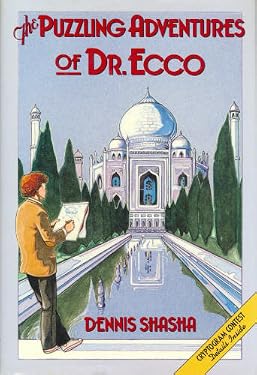
The Puzzling Adventures of Dr. Ecco


Dennis Elliott Shasha

W.H. Freeman & Company | 1988 | 183 páginas | djvu | 1,25 Mb

link direto
link
link1

Descrição: Dr. Ecco is a mathematical detective and puzzle solver. In this book readers are invited to join him in solving nearly 40 puzzles inspired by methods in computer science and mathematics, including The Tower of Lego, the Odd Doors Problem, Spies and Double Agents, Gossiping Defenders, Code Breaking, and many more.


Diamond: A Paradox Logic


(Series on Knots and Everything, Vol 14)
N. S. Hellerstein

World Scientific Publishing Company | 1997 | 257 páginas |
djvu - link
pdf - link
depositfiles.com


Descrição:
This book is about "diamond", a logic of paradox. In diamond, a statement can be true yet false; an "imaginary" state, midway between being and non-being. Diamond's imaginary values solve many logical paradoxes unsolvable in two-valued boolean logic. Diamond is a new way to solve the dilemmas of higher mathematics. In this volume, paradoxes by Russell, Cantor, Berry and Zeno are all resolved. This book consists of two sections: Elementary; which covers the classic paradoxes of mathematical logic and shows how they can be resolved in this new system; and Advanced, which relates diamond to Boolean logic, three-valued logic, Gödelian meta-mathematics and dilemma games.

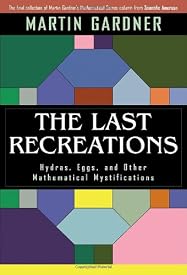
The Last Recreations: Hydras, Eggs, and Other Mathematical Mystifications

Martin Gardner

Springer | 1997 | 404 páginas | pdf | 20 Mb

link
link1

djvu - 6 Mb
link
link1

Descrição: Of all of Martin Gardner's writings, none gained him a wider audience or was more central to his reputation than his Mathematical Recreations column in "Scientific American", which virtually defined the genre of popular mathematics writing for a generation. Flatland, Hydras and Eggs: Mathematical Mystifications will be the final collection of these columns, covering a period roughly from 1979 to Gardner's retirement as a regular columnist in 1986. The notable trend over Gardner's career is the increasing sophistication of the mathematics he has been able to translate into his famously lucid prose. These columns show him at the top of his form and are not to be missed by anyone with an interest in mathematics. As always in his published collections, Gardner includes letters received from mathematicians and other commenting on the ideas presented in the columns.