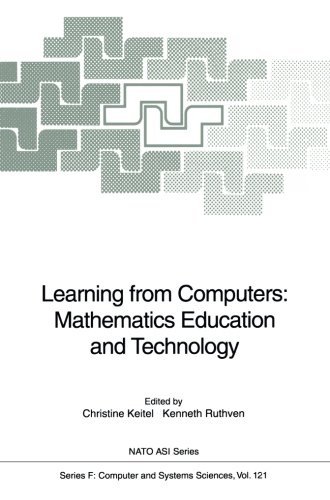
Christine Keitel-Kreidt e Kenneth Ruthven
Springer | 2011 - reprint of the original 1st ed. 1993 edition | páginas | rar - pdf |10,3 Mb
link (password : matav)
This study offers a re-examination of the mathematics curriculum and the teaching of mathematics in the light of changing technological possibilities. Recent developments in cognitive technologies and the impact of technology on mathematics teaching are amongst the topics explored.
Contents
1. Microworlds/Schoolworlds: The Transformation of an Innovation.
1.1 The story of microworlds.
1.2 The genesis.
1.3 From designers to mathematics educators.
1.4 Generating mathematics through microworlds: some illustrations.
1.5 Evocative computational objects and situated abstractions.
1.6 Microworlds in school mathematics.
1.7 Microworlds in the curriculum.
1.8 Reflections and implications.
2. Computer Algebra Systems as Cognitive Technologies: Implication for the Practice of Mathematics Education.
2.1 CAS: Some examples of symbol manipulations.
2.2 Computers and computer algebras in relation to pure mathematics.
2.3 Computer Algebra Systems in relation to mathematics education.
2.4 Opposition to instructional uses of Computer Algebra Systems.
2.5 Strengths of Computer Algebra Systems as learning tools.
2.6 Computer algebra in an educational context: One example.
2.7 CAS: From amplifiers to reorganisers.
3. The Computer as Part of the Learning Environment: The Case of Geometry.
3.1 The dual nature of geometrical figures.
3.2 Difficulties of students.
3.3 The notion of geometric figure as mediated by the computer.
3.4 Changes brought by computers to the relationship to the figure.
3.5 Interactions between student and software.
4. Software Tools and Mathematics Education: The Case of Statistics.
4.1 Didactical transposition and software tools.
4.2 The revolution in statistics.
4.3 Graphical and interactive data analysis: an example.
4.4 Making sense of statistical software tools.
4.5 Statistics education.
4.6 Statistics and a re-defined school mathematics
5. Didactic Design of Computer-based Learning Environments.
5.1 Understanding mathematics and the use of computers.
5.2 Designing QuadFun - A case description.
5.3 Interlude: Experimental aspects of mathematics.
5.4 Design issues.
5.5 A systemic view of didactic design.
6. Artificial Intelligence and Real Teaching.
6.1 Didactical interaction revisited.
6.2 The input of artificial intelligence.
6.3 Student-computer interaction, an overview.
6.4 Educational software in the classroom, a new complexity.
6.5 Open questions for future practice.
7. Computer Use and Views of the Mind.
7.1 The notion of cognition.
7.2 Cognitive reorganization by using tools.
7.3 Cognitive models and concreteness of thinking.- 7.4 Situated thinking and distributed cognition
7.5 The computer as a medium for prototypes.
7.6 Modularity of thought.
7.7 Conclusion.
8. Technology and the Rationalisation of Teaching.
8.1 The rationalisation of social practice.
8.2 The elusive rationality of teaching.
8.3 The marginal impact of machines on teaching.
8.4 The dynamics of pedagogical change.
8.5 The programming microworld.
8.6 The tutoring system.
8.7 The computer and the rationalisation of teaching.
9. Computers and Curriculum Change in Mathematics.
9.1 Locating the curriculum.-
9.2 Curriculum change as institutional change.
9.3 Redefining school mathematics.
9.4 Planning curriculum change.
9.5 Alternative scenarios.
10. On Determining New Goals for Mathematical Education.
10.1 Goals for mathematics education.
10.2 Goals for mathematics learners.
10.3 Role of the teacher and the educational institution.
10.4 Needed research on goals in mathematics education.
11. Beyond the Tunnel Vision: Analysing the Relationship Between Mathematics, Society and Technology.
11.1 Setting the stage.
11.2 Technology in society.
11.3 Mathematics shaping society?.
11.4 Living (together) with abstractions.
11.5 Mathematical technology as social structures.
11.6 Structural problems in an abstraction society.
11.7 Mathematics education as a social enterprise.
11.8 Mathematics education as a democratic forum.
11.9 Reflecting on computers in the classroom: Hardware-software-be(a)ware.
12. Towards a Social Theory of Mathematical Knowledge.
12.1 The Mechanistic Age - a historical introduction.
12.2 Mathematical and social individuation.
12.3 How can we master technology?.
12.4 Engineers versus mathematicians since the turn of the century.
References
Software.

Sem comentários:
Enviar um comentário