quarta-feira, 9 de abril de 2014

The code book : the evolution of secrecy from Mary Queen of Scots to quantum cryptography


Simon Singh

Anchor Books | 1999 | 411 páginas | epub | 5,3 Mb

link
link1

People love secrets. Ever since the first word was written, humans have sent coded messages to each other. In The Code Book, Simon Singh, author of the bestselling Fermat's Enigma, offers a peek into the world of cryptography and codes, from ancient texts through computer encryption. Singh's compelling history is woven through with stories of how codes and ciphers have played a vital role in warfare, politics, and royal intrigue. The major theme of The Code Book is what Singh calls "the ongoing evolutionary battle between codemakers and codebreakers," never more clear than in the chapters devoted to World War II. Cryptography came of age during that conflict, as secret communications became critical to both sides' success.
Confronted with the prospect of defeat, the Allied cryptanalysts had worked night and day to penetrate German ciphers. It would appear that fear was the main driving force, and that adversity is one of the foundations of successful codebreaking.
In the information age, the fear that drives cryptographic improvements is both capitalistic and libertarian--corporations need encryption to ensure that their secrets don't fall into the hands of competitors and regulators, and ordinary people need encryption to keep their everyday communications private in a free society. Similarly, the battles for greater decryption power come from said competitors and governments wary of insurrection.
The Code Book is an excellent primer for those wishing to understand how the human need for privacy has manifested itself through cryptography. Singh's accessible style and clear explanations of complex algorithms cut through the arcane mathematical details without oversimplifying. --Therese Littleton
Contents
Epigraph
Introduction
1 The Cipher of Mary Queen of Scots
2 Le Chiffre Indéchiffrable
3 The Mechanization of Secrecy
4 Cracking the Enigma
5 The Language Barrier
6 Alice and Bob Go Public
7 Pretty Good Privacy
8 A Quantum Leap into the Future
The Cipher Challenge
Appendices
Glossary
Acknowledgments
Further Reading

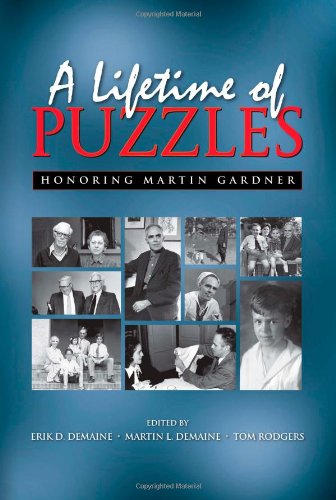
A lifetime of puzzles : a collection of puzzles in honor of Martin Gardner's 90th birthday


Erik D. Demaine, Martin L. Demaine e Tom Rodgers

A K Peters/CRC Press | 2008 | 338 páginas | rar - pdf | 6,2 Mb


link (password: matav)

Martin Gardner has entertained the world with his puzzles for decades and inspired countless mathematicians and scientists. As he rounds out another decade, his colleagues are paying him tribute with this special collection that contains contributions from some of the most respected puzzlemasters, magicians and mathematicians, including: - John H. Conway - William R. Gosper - Ed Pegg, Jr. - Roger Penrose - Raymond Smullyan - Peter Winkler And of course there is something from the orignal puzzlemaster himself, Martin Gardner.


ContentsPreface ix
I CastaSpell 1
Martin Gardner and His Influence on Magic 3
Christopher Morgan
Martin Gardner—Encore! 15
Prof. M. O’Snart
Low-Down Triple Dealing 29
Colm Mulcahy
Products of Universal Cycles 35
Persi Diaconis and Ron Graham
II In Hindsight 57
Tangram: TheWorld’s First Puzzle Craze 59
Jerry Slocum
De Viribus Quantitatis by Luca Pacioli: The First Recreational Mathematics Book 77
David Singmaster
Magic and Card Tricks in Luca Paciolo’s De Viribus Quantitatis 123
Vanni Bossi
III Move It 131
Railway Mazes 133
Roger Penrose
Mechanical Mazes 149
M. Oskar van Deventer
Insanity Puzzles: Instant and On-the-Spot 157
Rik van Grol
The Adventures of Ant Alice 177
Peter Winkler
IV Fitting In 187
Simplicity 189
Stewart Coffin
Extreme Puzzles 195
Frans de Vreugd
Satterfield’s Tomb 221
David A. Klarner and Wade Satterfield,
edited by Thane E. Plambeck
Computer-Assisted Seashell Mosaics 233
Ken Knowlton
V Speak to Me 243
Memories and Inconsistencies 245
Raymond Smullyan
A Bouquet for Gardner 253
Jeremiah Farrell and Thomas Rodgers
NetWords: A Fascinating New Pencil-Paper Game 265
Mamikon Mnatsakanian, Gwen Roberts, and Martin Gardner
TheWizard Is Always In 273
James Randi
VI Making Arrangements 277
Symmetric Graphs in Mathematical Puzzles 279
Ed Pegg Jr
Martin Gardner and Ticktacktoe 293
Solomon W. Golomb
Scheduling Tennis Doubles Competitions 303
Dick Hess
When MultiplicationMixes Up Digits 313
David Wolfe
Magic, Antimagic, and Talisman Squares 319
Rodolfo Kurchan
Rectangle Arithmetic: Another Slant on Fractions 327
Bill Gosper
About the Authors 345

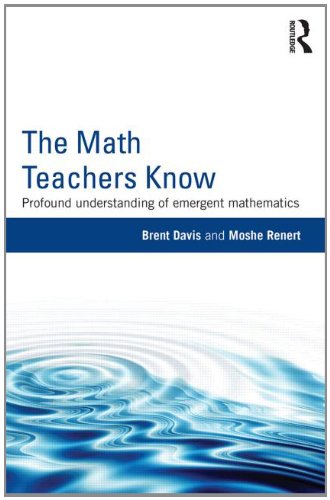
The Math Teachers Know: Profound Understanding of Emergent Mathematics

Brent Davis e Moshe Renert 

Routledge | 2013 | 150 páginas | rar - pdf | Mb


link (password: matav)


What sorts of mathematics competencies must teachers have in order to teach the discipline well? This book offers a novel take on the question. Most research is focused on explicit knowledge–that is, on the sorts of insights that might be specified, catalogued, taught, and tested. In contrast, this book focuses on the tacit dimensions of teachers’ mathematics knowledge that precede and enable their competencies with formal mathematics. It highlights the complexity of this knowledge and offers strategies to uncover it, analyze it, and re-synthesize it in ways that will make it more available for teaching. Emerging from 10 years of collaborative inquiry with practicing teachers, it is simultaneously informed by the most recent research and anchored to the realities of teachers’ lives in classrooms.


CONTENTSAcknowledgments | vii
1. teachers’ mathematics: framing the question | 1
1 Mathematics-for-Teaching: A Working Definition
5 What’s the Question? Three Framings of Mathematics-for-Teaching
12 The Bigger Picture: Making Sense of M4T by Grappling with Why Math Matters
15 Where Are We Going with This?
2. knowing and learning (mathematics): some game-changing insights | 17
17 “Thou Shalt Not” – A Teacher Dares to Divide by Zero
20 Complexity Science
23 Knowing
27 Learning
33 Where Are We Going with This?
3. substructing emergent mathematics: cultivating an open disposition | 35
35 Is 1 Prime?
39 Concept Study
42 Substructing
44 Emergent Mathematics
47 Open Dispositions
48 Where Are We Going with This?
4. concept study: teachers co-constructing mathematics | 49
49 Pulling Together, Not Just Pulling Apart
53 Collective Cognition
56 Structures of Concept Study
58 Emphasis 1: Realizations
61 Emphasis 2: Landcapes
66 Emphasis 3: Entailments
70 Emphasis 4: Blends
75 Where Are We Going with This?
5. pedagogical problem solving: the emergence of a community of experts | 77
77 Pedagogical Problem Solving
80 A Community of Experts
83 Mathematics Teaching and Listening
87 A Depth and Breadth of Mathematical Knowledge
90 Knowledge of How Mathematics is Produced
93 Where Are We Going with This?
6. concept study in the classroom: enacting an open way of being | 95
95 A Concept Study of Circles
96 Four Quadrants of M4T
99 What’s Interesting about Circles? Emergent Problem Solving
102 Do Circles Exist? Student Agency in Mathematical Knowledge Production
104 Rope around the Equator: Cultural Mathematics
106 Are Circles Efficient? An Open Way of Being
110 Where Are We Going with This?
7. the mathematics teachers (need to) know: profound understanding of emergent mathematics | 111
111 Zero and Function
117 Profound Understanding of Emergent Mathematics
120 All That and More ...
125 Where Are We Going with This?
References | 129
Index | 137

Ratio and Proportion: Research and Teaching in Mathematics Teachers’ Education


(Pre- and In-Service Mathematics Teachers of Elementary and Middle School Classes)

David Ben-Chaim (The Technion-Israel Institute of Technology, Israel), 
Yaffa Keret (The Open University of Israel, Israel) 
Bat-Sheva Ilany (Beit Berl Academic College, Israel)

Sense Publishers | 2012 | 283 páginas | pdf | 4,7 Mb

link

Ratio and Proportion-Research and Teaching in Mathematics Teachers' Education offers its readers an intellectual adventure where they can acquire invaluable tools to turn teaching ratio and proportion to professionals and school children into an enjoyable experience. Based on in-depth research, it presents a deep, comprehensive view of the topic, focusing on both the mathematical and psychological-didactical aspects of teaching it. The unique teaching model incorporates both theoretical and practical knowledge, allowing instructors to custom-design teacher courses according to their specific needs. The book reports on hands-on experience in the college classes plus teachers' experience in the actual classroom setting. An important feature is the extensive variety of interesting, meaningful authentic activities. While these activities are on a level that will engage pre- and in-service mathematics teachers in training, most can also be utilized in upper elementary and middle school classes. Accompanying the majority of these activities are detailed remarks, explanations, and solutions, along with creative ideas on how to conduct and expand the learning adventure. While primarily written for educators of mathematics teachers, this book can be an invaluable source of information for mathematics teachers of elementary and middle school classes, pre-service teachers, and mathematics education researchers.

TABLE OF CONTENTS
Chapter 1: Introduction ... 1
PART I: STRUCTURE OF BOOK AND TEACHING MODEL 5
Chapter 2: Structure of Book... 7
Chapter 3: A Model for Teaching Ratio and Proportion Using Authentic Investigative Activities .... 13
PART II: THEORETICAL BACKGROUND 21
Chapter 4: A Mathematical Perspective of Ratio and Proportion ... 23
Chapter 5: Proportional reasoning—A psychological-didactical view ... 49
Chapter 6: Research and new approaches in pre- and
in-service mathematics teacher education ... 61
PART III: AUTHENTIC INVESTIGATIVE ACTIVITIES, INCLUDING DIDACTIC COMMENTS AND EXPLANATIONS 71
Chapter 7: Authentic investigative activities— Introduction .. 73
Chapter 8: Group 1: Introductory activities .. 83
Chapter 9: Group 2: Rate activities . 95
Chapter 10: Group 3: Ratio activities .. 125
Chapter 11: Group 4: Stretching and Shrinking: Scaling Activities .. 145
Chapter 12: Group 5: Indirect Proportion Activities ... 181
Chapter 13: Group 6: Additional Activities
for Practice and Enrichment (All topics). 195
PART IV: ASSESSMENT TOOLS 219
Chapter 14: Introduction to Assessment Tools .. 221
Chapter 15: Questionnaire: Attitude Toward Ratio and Proportion .. 225
Chapter 16: Diagnostic Questionnaire in Ratio and Proportion ... 233
Chapter 17: Assessing Research Reports and Building a Student Portfolio . 245
PART V: ANNOTATED RESOURCES AND BIBLIOGRAPHY 253
Chapter 18: Annotated Resources .... 255

Chapter 19: Bibliography ... 269

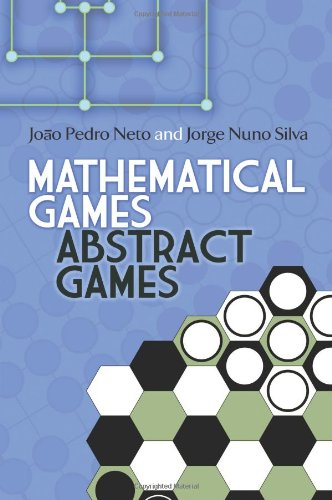
Mathematical Games, Abstract Games


João Pedro Neto e Jorge Nuno Silva

Dover Publications | 2013 | 208 páginas | rar - epub | 11,85 Mb

link (password : matav)


This user-friendly and visually appealing book offers a collection of board games of strategy — some old, most very recent. None involve chance or hidden information. Perfect for anyone who enjoys an intellectual challenge, these are chiefly new diversions that were chosen by the authors for their strategic and tactical qualities.
Contents include sections on games for two and three players, plus a chapter dedicated to mathematical games (including Nim and games on graphs). Additional chapters discuss the theory and history of board games. Numerous diagrams throughout the book clarify the text, and a helpful glossary offers clarifications of rules.

Contents1.The World of Games
2.Games for Two
Aboyne, Amazons, Anchor, Annuvin, Campaign, Dispatch, Epaminondas, Go, Gogol, Gomoku, Gonnect, Havannah, Hex, Hobbes, Intersections, Iqishiqi, Jade, Lines of Action, Nex, Nosferatu, Pawnographic Chess, SanQi, Semaphore, Slimetrail, Stooges, UN, Y
3.Nim Games
White Knight, Wyt Queen, Whitoff, JIL, LIM, Nim, Plainim, Nimble, Turning Turtles, Silver, Dollar, Stairs, Northcott, Nimk, Blocking Nim, Games on Graphs, Sums of Impartial Games, Wyt Queens, Green Hackenbush
4.Games for Three
Triskelion, Iqishiqi for Three, Porus Torus, Hex for Three, Reversi for Three, Triad, Gomoku for Three, Gonnect for Three

Glossary

The Gödelian Puzzle Book: Puzzles, Paradoxes and Proofs by Raymond M. Smullyan


Raymond M. Smullyan

Dover Publications | 2013 | 288 páginas | rar - epub | 557 kb

link (password: matav)

These brand-new recreational logic puzzles provide entertaining variations on Gödel's incompleteness theorems, offering ingenious challenges related to infinity, truth and provability, undecidability, and other concepts. Created by the celebrated logician Raymond Smullyan, the puzzles require no background in formal logic and will delight readers of all ages.
The two-part selection of puzzles and paradoxes begins with examinations of the nature of infinity and some curious systems related to Gödel's theorem. The first three chapters of Part II contain generalized Gödel theorems. Symbolic logic is deferred until the last three chapters, which give explanations and examples of first-order arithmetic, Peano arithmetic, and a complete proof of Gödel's celebrated result involving statements that cannot be proved or disproved. The book also includes a lively look at decision theory, better known as recursion theory, which plays a vital role in computer science.

TABLE OF CONTENTS
Part I—Puzzles, Paradoxes, Infinity and other Curiosities
Chapter I A Chatty Personal Introduction
Chapter II Some Curious Adventures
Chapter III The Strange Island of Musica
Chapter IV Four Metapuzzles
Chapter V Certified Knights and Knaves
Chapter VI Paradoxical?
Chapter VII Infinity and Induction
Chapter VIII Introducing Self-Reference
Chapter IX Fixed Point Puzzles
Chapter X Some Curious Systems
Chapter XI How to Stump a Decision Machine
Chapter XII Some Additional Gödelian Puzzles
Part II—Provability, Truth and the Undecidable
Chapter XIII Truth and Provability
Chapter XIV Syntactic Incompleteness Theorems
Chapter XV Provability in Stages
Chapter XVI Formal Systems and Recursion
Chapter XVII Incompleteness and Undecidability
Chapter XVIII First-Order Arithmetic
Chapter XIX Arithmetic Truth Is Not Formalizable
Chapter XX The Incompleteness of Peano Arithmetic

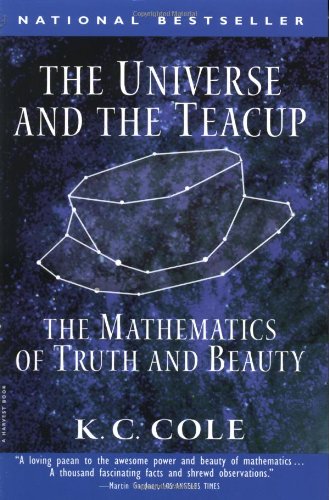
The Universe and the Teacup: The Mathematics of Truth and Beauty


K. C. Cole

Mariner Books | 1999 | 224 páginas | rar - epub | 250 kb

link (password: matav)

Mathematics, that breathtaking invention of ours that reveals the tiniest particles of matter and takes us to the outermost reaches of the cosmos, is found by many people to be intimidating. In The Universe and the Teacup, K. C. Cole demystifies mathematics and shows us-with humor and wonderfully accessible stories-why math need not be frightening. Using the O. J. Simpson trial, the bell curve, and Emmy Noether, the nineteenth-century woman scientist whose work was essential for Einstein's theory of relativity, Cole helps us see that more than just being a tool, math is a key to understanding the beauty of everything from rainbows to relativity.

Contents
ch. 1. What's math got to do with it
pt 1. Where mind meets math
ch. 2. Exponential amplification
ch. 3. Calculated risks
pt. 2. Interpreting the physical world
ch. 4. Measure of man, woman, and thing
ch. 5. Matter of scale
ch. 6. Emerging properties: more is different
ch. 7. Mathematics of prediction
ch. 8. Signal in the haystack
pt. 3. Interpreting the social world
ch. 9. Voting: Lani Guinier was right
ch. 10. Fair division: the wisdom of Solomon
ch. 11. Mathematics of kindness: math proves the golden rule
pt. 4. Mathematics of truth
ch. 12. Truth about why things happen
ch. 13. Burden of proof
ch. 14. Emmy and Albert: the unvarying nature of truth.