quinta-feira, 3 de abril de 2014

Math Stuff

Theoni Pappas 

 Wide World Publishing, Tetra | 2002 | 225 páginas | rar - pdf | 6,7 Mb

link (password: matav)

Whether one is adjusting the settings of a camera, doing financial planning, or just talking about the weather, everyone is involved in mathematics every day. Theoni Pappas explores some of the many areas in which one least expects to find "math stuff." Readers learn how computers get stressed out, how epaper works, and how codes and numbers affect the body.

TABLE OF CONTENTS
Introduction ix
The pea counts 2
mathematics behind your genes
The mathematics of peace 12
The millennium clock 16
Chaos theory 21
Cricket math 26
Mathematical private eyes 27
ratios hold the clues
Holyhedrons 30
Fractals, fractals everywhere 32
Smart dust, MEMS 40
What’s it all about?
Starcage 44
the works of Akio Hizume
In search of AI 50
mathematics & artificial intelligence
Art in nature/nature in art 60
Andy Goldsworthy
Do bees count? 64
e-paper & mathematics 65
Mathematics mints a coin 70
The sound of mathematics 72
music & mathematics
Mathematics engineers your finances 82
Numbers, numbers everywhere 85
You’ve come a long way ! 89
Icosa shelters 95
mathematically designed shelters
Computers get stressed out too! 98
lock-up, crash, freeze
mathematics & the pomegranate 101
rhombic dodecahedron & sphere packing

Differential Equations of My Young Years


Vladimir Maz'ya e Arkady Alexeev

Birkhäuser | 2014 | 204 páginas | rar - pdf | 7,7 Mb

link (password: matav)

Vladimir Maz'ya (born 1937) is an outstanding mathematician who systematically made fundamental contributions to a wide array of areas in mathematical analysis and in the theory of partial differential equations. In this fascinating book he describes the first thirty years of his life. He starts with the story of his family, speaks about his childhood, high school and university years, describe his formative years as a mathematician. Behind the author's personal recollections, with his own joys, sorrows and hopes, one sees a vivid picture of the time. He speaks warmly about his friends, both outside and inside mathematics. The author describes the awakening of his passion for mathematics and his early achievements. He mentions a number of mathematicians who influenced his professional life. The book is written in a readable and inviting way sometimes with a touch of humor. It can be of interest for a very broad readership.

Contents
1. Family and Early Childhood .. 1
1.1 The Beginning . . 1
1.2 The Time of Peace Is Over . . 5
1.3 My Mother’s Story . . 6
1.4 My Father’s Story .. 10
1.5 In Sverdlovsk . .. 15
1.6 Back to Leningrad .  20
1.7 Postage Stamps .. 21
1.8 Crime Without Punishment . 23
1.9 From the Kiosk to House No. 19/18  . 23
1.10 Life in the “Small Room” on Marat Street . . 26
1.11 Aunt Rita and Lusya .. 30
1.12 Lusya, Ella and the Sinclairs  . 31
1.13 Uncle Aron, Bathhouse and Chess  . 32
1.14 Mother and My First Library . 33
1.15 Durian  . 35
1.16 Our Room . . 35
1.17 The Kitchen and the Toilet . . 39
1.18 Life Has Become Better . . 40
1.19 Even the Sun Has Spots .. 42
2 Boyhood . . 45
2.1 It Is So Difficult to Become an “A” Student . . 45
2.2 The Importance of Being an “A” Student . . 50
2.3 Slingshots  . 52
2.4 Illnesses . . 53
2.5 “Physcult” and Sports . 56
2.6 To Me the Most Important Art Was the Movies  . 59
2.7 A Sharp Kid . . 59
2.8 Foreign Languages  . 63
2.9 My Interests . 64
2.10 Poetry . . 66
2.11 Fimka. 67
2.12 The First Place in the District!  . 69
3 High School Life . . . . 73
3.1 In the Sixth Grade . . 73
3.2 In the Seventh Grade  . 75
3.3 The Indecent Topic  . 75
3.4 My Circle of Reading . 77
3.5 I Chose Mathematics .  . 78
3.6 A Circle at the Palace of Pioneers .  . 79
3.7 Two Lectures for School Children .  . 82
3.8 Murderers in Doctors’ Smocks . . 83
3.9 The English Teacher .  . 84
3.10 Arkady Alexeev .. 87
3.11 Alexeev’s Story . . . 88
4 Mathematics and Other Activities . . 91
4.1 Vanity of Vanities, All Is Vanity .  91
4.2 You Cannot Live Without Women. No! . . 95
4.3 Phase Transition . 97
4.4 My First Mathmech Year .  97
4.5 Student Contests . . 99
4.6 We Lead Our Life in Major Key . . 101
4.7 A Mysterious ID  . 103
4.8 Musical Moments (Leonid Druz)  . 105
4.9 Valery Maisky . .  . 117
4.10 The Authorities Did Not Like Me .  . 120
4.11 How I Did Not Become a Dissident .  122
4.12 Misha Danilov . . 123
5 Mathmech Life .. 129
5.1 The Mathmech Cafeteria .. 129
5.2 Fractional Derivatives . . 130
5.3 Something New at Last! . .. . 130
5.4 Student Scientific Society (SSS) and Tseitin .. 132
5.5 “Quasi-publication” and S. M. Lozinsky . 133
5.6 The Mathmech Choir . 139
5.7 My Doubts and S. G. Mikhlin’s Advice  . 139
5.8 A Few Words About Mikhlin .  . 142
5.9 In the Fourth Year . . 144
5.10 The Virgin Soil . . 147
5.11 In My Fifth Year .  . 148
5.12 Bakelman’s Special Course . . 149
5.13 Job Placement . . 152
5.14 Siegfried . . 154
6. Dissertations and the Years After .. 157
6.1 Steel Sheets and YMS . . . 157
6.2 Possibility and Reality .  . 158
6.3 Defense at the Moscow State University . . 159
6.4 Defense at the Leningrad University . 163
6.5 About V. I. Smirnov . . . 166
6.6 An Order: Scatter the Composed Type .  . 167
6.7 About the “Big Seminar” .. 168
6.8 After the Defense of the Doctor’s Degree Dissertation .  170
6.9 One Hour Late, Lose the Whole Year . .. 175
6.10 A Similar Topic . 176
6.11 Non-Travels to Foreign Countries . . 176
6.12 Counterexamples to a Hilbert Problem  . 178
6.13 Talent .. 181
6.14 Farewell, My Young Years! . . 182
6.15 How Many Medium Range Rockets Were There? . 185
6.16 Under Close Surveillance? . . 186
Index .  . 189

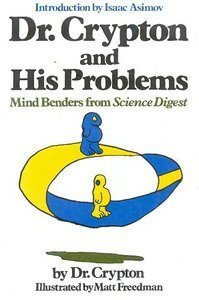
Dr. Crypton and His Problems: Mind Benders from Science Digest

 Dr. Crypton
 St Martins Pr | 1982 | 191 páginas | djvu | 1,7 Mb
link

link1

" The mysterious Dr. Crypton (presumably a friend  of Superman except that he has a superbrain instead  of a superbody) has assembled a super collection of puzzles and curiosities involving mathematics, words, and anything at all that lends itself to logical  and creative thinking. A delightful book to read and ponder. " 
-Martin Gardner

Contents 
Acknowledgments vii
Questions by Isaac Asimov ix
1. An Enigmatic Evening with Microwave Cornbread 1
2. The Intragalactic Cabaret 14
3. The Case of the Fatal Forfex 23
4. Palindromes: No Lemons! No Melon! 31
5. Sleight of Mind in Katmandu 42
6. Shockley: Sperm Hustler Offers Compatible  Kinky Ladies Einsteinish Young 50
7. Zeno of Elea: The First Paradoxologist 57
8. The Well-Hung Natives and Twenty-three  Other Conundrums 67
9. The Logistics of Armchair Ornithology 115
10. Lora Does a Mobius Strip 121
11. The BANG and Other Phrenetic Phrases 143
12. How's Your Resistance? (There's No Place like Ohm) 148
14. Triskaidekaphobia 151
15. Freud and the Number 23 158
16. The Puzzles of Nympholepts: Lewis Carroll and
Vladimir Nabokov 165
17. The Talk of the Town 178 


Mathematical Connections: A Companion for Teachers

(Classroom Resource Material) 

Al Cuoco

The Mathematical Association of America | 2005 | 261 páginas | pdf | 6,3 Mb

link
link1

This book is about some of the topics that form the foundations for high school mathematics. It focuses on a closely-knit collection of ideas that are at the intersection of algebra, arithmetic, combinatorics, geometry, and calculus. Most of the ideas are classical: methods for fitting polynomial functions to data, for summing powers of integers, for visualizing the iterates of a function defined on the complex plane, or for obtaining identities among entries in Pascal's triangle. Some of these ideas, previously considered quite advanced, have become tractable because of advances in computational technology. Others are just beautiful classical mathematics, topics that have fallen out of fashion and that deserve to be resurrected While the book will appeal to many audiences, one of the primary audiences is high school teachers, both practicing and prospective. It can be used as a text for undergraduate or professional courses, and the design lends itself to self-study. Of course, good mathematics for teaching is also good for many other uses, so readers of all persuasions can enjoy exploring some of the beautiful ideas presented in the pages of this book.

Contents
1. Difference tables and polynomial fits. Doing it with sums
Doing it with differences
Finding a formula: combinatorial polynomials
Making it formal: the [delta] operator
Going the other way: polynomials to tables
Conversions
From Newton to Lagrange
Agreeing to disagree
2. Form and function: the algebra of polynomials. Polynomials
The basic theorems
Coefficients and values
Up a level
Transformations
Coefficients and zeros.
3. Complex numbers, complex maps, and trigonometry. Complex numbers
The complex plane
The geometry behind multiplying
Trigonometric identities
Complex maps
Julia sets and the Mandelbrot set.
4. Combinations and locks. Combinatorial proofs and identities
The simplex lock
Some approaches to the simplex lock problem
Connections to the Mahler basis.
5. Sums of powers. Summatory polynomials
Bernoulli's method.

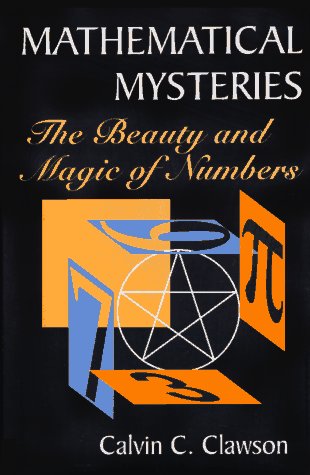
Mathematical Mysteries: the beauty and magic of numbers

 Calvin C. Clawson

Plenum Press | 1996 | 322 páginas | rar - pdf | 7,7 Mb

link (password: matav)

Why seemingly unrelated mathematical truths are connected in simple and beautiful equations continues to stump even mathematicians. This recreational math book takes the reader on a fantastic voyage into the world of natural numbers. From the earliest discoveries of the ancient Greeks to various fundamental characteristics of the natural number sequence, Clawson explains fascinating mathematical mysteries in clear and easy prose. He delves into the heart of number theory to see and understand the exquisite relationships among natural numbers, and ends by exploring the ultimate mystery of mathematics: the Riemann hypothesis, which says that through a point in a plane, no line can be drawn parallel to a given line.While a professional mathematician’s treatment of number theory involves the most sophisticated analytical tools, its basic ideas are surprisingly easy to comprehend. By concentrating on the meaning behind various equations and proofs and avoiding technical refinements,Mathematical Mysteries lets the common reader catch a glimpse of this wonderful and exotic world.

CONTENTS

Introduction 1
CHAPTER 1 Discovery of the Number Sequence 8
CHAPTER 2 Numbers and the Occult 39
CHAPTER 3 Sequences and Series 53
CHAPTER 4 The Family of Numbers 77
CHAPTERS Story for a Rich Man 95
CHAPTER 6 Exotic Connections 116
CHAPTER 7 Closing in on the Primes 145
CHAPTER 8 Primes in Depth 164
CHAPTER 9 Primes and Secret Codes 184
CHAPTER 10 The Remarkable Ramanujan
CHAPTER 11 Ramanujan's Equations
CHAPTER 12 Goldbach's Conjecture
CHAPTER 13 Deepest Mysteries
CHAPTER 14 Into the Stratosphere
EndNotes
Suggested Reading
Index


Outros livros do mesmos autor:

quarta-feira, 2 de abril de 2014

Child's Construction of Quantities


Jean Piaget 

Routledge | 1998 | 292 páginas | rar - pdf |4,8 Mb


link (password: matav)


Contents
PART I CONSERVATION

The Conservation of Matter and Deformations of a Ball of Modelling Clay 3
2 The Conservation of Weight upon Deformations ofa Clay Ball 22
3 The Conservation of Volume at Equal Concentrations of Matter 47
PART II FROM CONSERVATION TO ATOMISM
4 The Destruction of Matter and the Dissolution of Sugar 67
5 The Conservation of the Sugar and the Beginning of Atomism 81
6 The Conservation of the Weight and Volume of the Dissolved Sugar and the Completion of Atomism 98
PART III COMPRESSION, DECOMPRESSION AND DENSITY
7 The Expansion of a Maize Seed and of a Column of Mercury 119
8 Differences in Density 137
9 Special Problems Posed by the Relationship between Weight and Quantity of Matter 154
PART IV FORMAL COMPOSITIONS
10 The Composition of Asymmetrical Relations and Differences in Weight 183
11 Simple and Additive Compositions of Equivalent Weights 203
12 Simple and Additive Compositions of Equivalent Volumes and the Discovery of the Displacement Law 232
Conclusion 269
Index 281

Basic Engineering Mathematics

John Bird

Routledge | 2014 - 6ª edição | 457 páginas | rar - pdf | 3,7 Mb

link (password: matav)

Now in its sixth edition, Basic Engineering Mathematics is an established textbook that has helped thousands of students to succeed in their exams.
John Bird's approach is based on worked examples and interactive problems. This makes it ideal for students from a wide range of academic backgrounds as the student can work through the material at their own pace. Mathematical theories are explained in a straightforward manner, being supported by practical engineering examples and applications in order to ensure that readers can relate theory to practice. The extensive and thorough topic coverage makes this an ideal text for introductory level engineering courses.
This title is supported by a companion website with resources for both students and lecturers, including lists of essential formulae, multiple choice tests, full solutions for all 1,600 further questions contained within the practice exercises, and biographical information on the 25 famous mathematicians and engineers referenced throughout the book.