sábado, 25 de janeiro de 2014

International Perspectives on Teacher Knowledge, Beliefs and Opportunities to Learn: TEDS-M Results


(Advances in Mathematics Education)

Sigrid Blömeke, Feng-Jui Hsieh, Gabriele Kaiser e William H Schmidt 

Springer | 2014 | 581 páginas | pdf | 10,1 Mb

link


This book presents a collection of papers that examine the TEDS-M data results in terms of knowledge and beliefs, the relationship between opportunities to learn during teacher education and outcomes, as well as the relationship between the future teachers’ background and teacher education outcomes. TEDS-M, under the auspices of the International Association for the Evaluation of Educational Achievement (IEA), carried out the first-ever study to examine primary and lower secondary mathematics teachers’ competence in their last year of teacher education. In particular, it analyses the relationship between teacher education policies, practices and outcomes. Analysis of these complex relationships indicates both global and regional patterns of similarity and difference and identifies country-specific strengths and weaknesses, thus enabling national policy makers to improve the effectiveness of their systems within their own cultural norms and values.
 Specifically, through examination and analysis of the TEDS-M data, the papers in this book:
•     add to the body of theory through reflecting on teacher knowledge conceptions, the relationship between teacher knowledge and beliefs, and cultural influences on the assessment and development of teacher knowledge and beliefs;
•     illustrate the potential and ways of exploring possible connections between teacher preparation and student achievement; and
•     discuss policy implications for evaluating teacher preparation and program quality.
 The book therefore provides a unique insight into teacher training systems and competences around the world and will be an invaluable resource for researchers, government policy makers and teacher trainers everywhere.


Contents
Part I Introduction
Framing the Enterprise: Benefits and Challenges of InternationalStudies on Teacher Knowledge and Teacher Beliefs—Modeling Missing Links  . . 3
Sigrid Blömeke
Theoretical Framework, Study Design and Main Results of TEDS-M . . 19
S. Blömeke and G. Kaiser
Learning About and Improving Teacher Preparation for Teaching Mathematics from an International Perspective . . 49
Yeping Li
Part II Knowledge at the End of Teacher Education: International Perspectives
Knowledge of Future Primary Teachers for Teaching Mathematics: An International Comparative Study . . 61
Sharon L. Senk, Maria Teresa Tatto, Mark Reckase, Glenn Rowley, Ray Peck, and Kiril Bankov
Teacher Education Effectiveness: Quality and Equity of Future Primary Teachers’ Mathematics and Mathematics Pedagogical Content Knowledge  . . 91
Sigrid Blömeke, Ute Suhl, and Gabriele Kaiser
In-depth Analyses of Different Countries’ Responses to MCK Items: A View on the DifferencesWithin and Between East andWest  . . 115
Feng-Jui Hsieh, Chi-Tai Chu, Chia-Jui Hsieh, and Pi-Jen Lin
Why Did Taiwan Excel: Hot Topics and Pressing Issues . . 141
Feng-Jui Hsieh, Pei-Chen Wu, and Ting-Ying Wang
The Preparation of Primary Mathematics Teachers in Singapore: Programs and Outcomes from the TEDS-M Study  . . 163
Khoon Yoong Wong, Kok Leong Boey, Suat Khoh Lim-Teo, and Jaguthsing Dindyal
Teacher Education Effectiveness: Quality and Equity of Future Primary and Future Lower Secondary Teachers’ General Pedagogical Knowledge . . . . 187
J. König, S. Blömeke, L. Paine, W.H. Schmidt, and F.-J. Hsieh
Part III Beliefs at the End of Teacher Education: International Perspectives
The Cultural Dimension of Beliefs: An Investigation of Future Primary Teachers’ Epistemological Beliefs Concerning the Nature of Mathematics in 15 Countries . . 209
Anja Felbrich, Gabriele Kaiser, and Christiane Schmotz
The Cultural Notion of Teacher Education: Future Lower Secondary Teachers’ Beliefs on the Nature of Mathematics, the Learning of Mathematics and Mathematics Achievement . . 231
Shu-Jyh Tang and Feng-Jui Hsieh
The Cultural Notion of Teacher Education: Comparison of Lower-Secondary Future Teachers’ and Teacher Educators’ Beliefs  . . 255
Ting-Ying Wang and Feng-Jui Hsieh
An Examination of Future Primary Teachers Attitudes About the Teaching of Mathematics: An International Perspective . . 279
Nathan Burroughs and William Schmidt
Part IV Does Teacher Education Matter?
Homogeneity or Heterogeneity? Profiles of Opportunities to Learn in Primary Teacher Education and Their Relationship to Cultural Context and Outcomes . . 299
Sigrid Blömeke and Gabriele Kaiser
Family Background, Entry Selectivity and Opportunities to Learn: What Matters in Primary Teacher Education? An International Comparison of Fifteen Countries  . . . 327
Sigrid Blömeke, Ute Suhl, Gabriele Kaiser, and Martina Döhrmann
Primary Teacher Preparation in the United States: What We Have Learned  . . 355
Leland Cogan, William H. Schmidt, and Richard Houang
Emphasis and Balance among the Components of Teacher Preparation: The Case of Lower Secondary Mathematics Teacher Education  . . 371
William H. Schmidt, Leland Cogan, and Richard Houang
Greater Expectations in Lower Secondary Mathematics Teacher Preparation: An Examination of Future Teachers’ Opportunity to Learn Profiles  . . 393
William Schmidt and Leland Cogan
Does School Experience Matter for Future Teachers’ General Pedagogical Knowledge? . . 415
Johannes König and S. Blömeke
Part V Assessment Challenges with Respect to Teacher Knowledge 
The Conceptualisation of Mathematics Competencies in the International Teacher Education Study TEDS-M . . 431
Martina Döhrmann, Gabriele Kaiser, and Sigrid Blömeke
A Conceptualization of Indicators for Mathematics Teacher Education Quality for International Studies. . 457
Feng-Jui Hsieh, Chiu-Keung Law, Haw-Yaw Shy, Ting-Ying Wang,
Chia-Jui Hsieh, and Shu-Jyh Tang
Diagnosing Teacher Knowledge by Applying Multidimensional Item Response Theory and Multiple-Group Models . . 483
Sigrid Blömeke, Richard T. Houang, and Ute Suhl
Are College Rankings an Indicator of Quality Education? Comparing Barron’s and TEDS-M  . . 503
William Schmidt, Nathan Burroughs, Lee Cogan, and Richard Houang
Part VI Conclusions:WhatWe Have Learned and Future Challenges
Learning from the Eastern and the Western Debate—The Case of Mathematics Teacher Education . . 517
Gabriele Kaiser and Sigrid Blömeke
Assessment of Teacher Knowledge Across Countries: A Review of the State of Research  . . 541
Sigrid Blömeke and Séan Delaney

Transnational and Borderland Studies in Mathematics Education


(Studies in Mathematical Thinking and Learning Series)

Richard S. Kitchen e Marta Civil

Routledge | 2010 | 233 páginas | rar - pdf | 1,4 Mb


link (password: matav)

Every year, significant numbers of immigrant children from Mexico enter classrooms in the United States. These immigrants comprise a heterogeneous group of students with diverse needs, abilities, and experiences. Transnational and Borderland Studies in Mathematics Educationis the first collection to offer research studies across these communities. Providing invaluable research on both sending and receiving communities in Mexico and the US, this collection considers the multiple aspects of children’s experiences with mathematics, including curriculum, classroom participation structures, mathematical reasoning and discourse – both in and out of school – and parents’ perceptions and beliefs about mathematics instruction. An important treatment of an insufficiently documented subject, this collection brings together researchers on both sides of the border to foster and support an interest in documenting evidence that will set the stage for future studies in mathematics education.


Contents
Preface by Richard S. Kitchen and Marta Civil
1. Ecological Approaches to Transnational Research on Mathematical Reasoning: A Focus on Latino/a Mathematics Learners in the Borderlands by Judit Moschkovich
2. Crossing the Border between Home and School: Dominican Parents' Perspectives on the Teaching and Learning of Mathematics by Mary Q. Foote
3. Impressions of Mexican Immigrant Families on their Early Experiences with School Mathematics in Arizona by Marta Civil & José María Menéndez
4. Becoming a "Liberal" Math Learner: Expanding Secondary School Mathematics to Support Cultural Connections, Multiple Mathematical Identities and Engagement by Lisa M. Jilk
5. Engaging Underprivileged Mexican students in Reform-Oriented Mathematics Instruction by José Luis Cortina
6. Considering Mexican and U.S. Teachers’ Views on the Teaching and Learning of Mathematics Through a Teaching for Diversity Lens by Richard S. Kitchen
7. Teachers’ Task Management Practices in the Context of Routine and Non-Routine Mathematics Problems: A Descriptive Analysis by Guadalupe I. Lozano Terán
8. Teachers’ Conceptions of Mathematics and Mathematics Teaching and Learning: The Case of Two Elementary Teachers in Northern Mexico by Jesús Acosta-Iriqui
9. Looking Forward: Establishing a Research Agenda for Transnational and Borderland Studies in Mathematics Education by Richard S. Kitchen & Marta Civil
Epilogue by Olimpia Figueras

Math Talk: Mathematical Ideas in Poems for Two Voices

Theoni Pappas


Wide World Publishing/Tetra | 1993 | 73 páginas | rar - pdf | 924 kb

password: matav

Presents mathematical ideas through poetic dialogues intended to be read by two people.

Contents
Forward 7
Mathematics 9
We are numbers 13
Circles 15
One 18
Fractals 21
Zero 23
Fibonacci numbers 26
Squares 29
Operations 30
Imaginary numbers 32
Variables 35
Radicals 37
The Möbius strip 39
Triangles 41
π 43
Prime numbers 46
The 2nd-dimension 48
e, π and i 51
Integers 52
Tessellations 55
The even numbers 58
Proper fractions 60
Googols 63
Infinity 66
The golden mean 68

Becoming a Reflective Mathematics Teacher


(Studies in Mathematical Thinking and Learning Series)

Alice F. Artzt, Eleanor Armour-Thomas e Frances R. Curcio

Routledge| 2007 - 2ª edição | 240 páginas | rar - pdf | 1 Mb

link (password: matav)


1ª edição - 2001

Becoming a Reflective Mathematics Teacher: A Guide for Observations and Self-Assessment offers what every mathematics teacher educator or supervisor has been looking for. Ideally suited for use with students who are taking a methods course or who are student teaching, this activity-oriented, research-based text: 
*supplies detailed observation instruments that preservice teachers can use when they observe other teachers. Each instrument focuses on a critical aspect of instructional practice in mathematics (e.g., tasks, learning environment, discourse). In addition, it requires the observer to make conjectures regarding the teachers' underlying cognitions (e.g., knowledge, beliefs, goals) that might account for the instructional practice they observe. 
*offers reflective activities that provide a structure through which beginning teachers can think about their teaching in an insightful, thorough, and productive manner. Students can work through the activities over the period of a year. The structured observations and reflective activities are modular, and the framework applies to all observations of teaching, no matter what the instructional content. 
*includes guidelines and instruments for supervisors to use when observing, conferencing with, and assessing beginning or student teachers. The unique aspect of these guidelines and instruments is the link they make between teachers' cognitions and their instructional practice. 
All instruments and suggested activities are couched within a highly effective framework for teacher reflection and self-assessment that was developed in the spirit of the NCTM professional teaching standards. This framework is grounded in a cognitive perspective on learner-centered teaching. In Part I, the framework is explained and its validity is documented. Part II shows how teachers can use the framework to observe other teachers' classroom work, and to reflect on their own teaching. Part III offers case studies to help readers see how the method works.


Contents
Part I: Philosophical Basis for the Model
1. Toward an Understanding of Student-Centered Teaching
2. A Framework for the Examination of Instructional Practice
3. A Framework for the Examination of Teacher Cognitions
4. Putting It All Together
Part II: How to Use the Model
5. Using the Model to Examine Teachers’ Instructional Practice and Cognitions
6. Using the Model to Examine Your Own Instructional Practice and Cognitions
7. Using a Portfolio to Document How You Engage in Self-Assessment and Reflection
Part III: Evidence: The Model in Action
8. Case Studies of the Model in Action: Five Cases
Appendix A: Research Results of Exploratory Study
Appendix B: Observation Guidelines
Appendix C: Observation Charts Made by Preservice Teachers
Appendix D: Guides and Forms for Supervised Observations
Appendix E: Portfolio Assignment and Rubrics

sexta-feira, 24 de janeiro de 2014

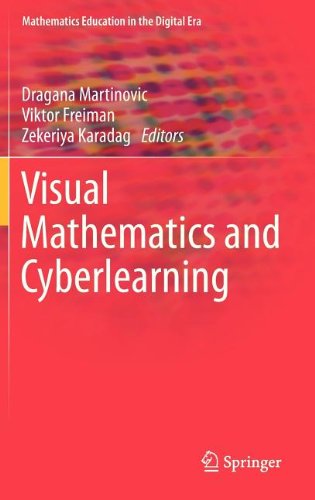
Visual Mathematics and Cyberlearning


(Mathematics Education in the Digital Era, 1)

Dragana Martinovic, Viktor Freiman e Zekeriya Karadag

Springer | 2013 | 255 páginas | pdf | 3,9 Mb


link


This first book in the series will describe the Net Generation as visual learners who thrive when surrounded with new technologies and whose needs can be met with the technological innovations. These new learners seek novel ways of studying, such as collaborating with peers, multitasking, as well as use of multimedia, the Internet, and other Information and Communication Technologies. Here we present mathematics as a contemporary subject that is engaging, exciting and enlightening in new ways. For example, in the distributed environment of cyber space, mathematics learners play games, watch presentations on YouTube, create Java applets of mathematics simulations and exchange thoughts over the Instant Messaging tool. How should mathematics education resonate with these learners and technological novelties that excite them?
Contents

Patterns of Collaboration: Towards Learning Mathematics in the Era of the SemanticWeb.  . . 1
Keith Jones, Eirini Geraniou, and Thanassis Tiropanis
Collaborative Mathematics Learning in Online Environments . . 23
Gorjan Alagic and Mara Alagic
The Integration of Mathematics Discourse, Graphical Reasoning and Symbolic Expression by a Virtual Math Team  . . 49
Murat Perit Cakir & Gerry StahlInvestigating the Mathematical Discourse of Young Learners Involved in Multi-Modal Mathematical Investigations: The Case of Haptic Technologies .. . 97
 Beste Güçler, Stephen Hegedus, Ryan Robidoux, & Nicholas JackiwEmbodied Interaction as Designed Mediation of Conceptual Performance. . 119
Dragan Trninic and Dor Abrahamson
Sensuous Cognition .. . . 141
Luis Radford
New Media and Online Mathematics Learning for Teachers  . . . . 163
George Gadanidis and Immaculate Kizito Namukasa
Web-Based Video Clips: A Supplemental Resource for Supporting Pre-service Elementary Mathematics Teachers
Ann LeSage
Visual Mathematics and Cyberlearning in View of Affordance and Activity Theories . . . 209
Dragana Martinovic, Viktor Freiman, and Zekeriya Karadag


The Tower of Hanoi – Myths and Maths


Andreas M. Hinz, Sandi Klavzar, Uros Milutinovic e Ciril Petr

Birkhäuser | 2013 | 353 páginas | pdf | 9 Mb

link
link1

This is the first comprehensive monograph on the mathematical theory of the solitaire game “The Tower of Hanoi” which was invented in the 19th century by the French number theorist Édouard Lucas. The book comprises a survey of the historical development from the game’s predecessors up to recent research in mathematics and applications in computer science and psychology. Apart from long-standing myths it contains a thorough, largely self-contained presentation of the essential mathematical facts with complete proofs, including also unpublished material. The main objects of research today are the so-called Hanoi graphs and the related Sierpiński graphs. Acknowledging the great popularity of the topic in computer science, algorithms and their correctness proofs form an essential part of the book. In view of the most important practical applications of the Tower of Hanoi and its variants, namely in physics, network theory, and cognitive (neuro)psychology, other related structures and puzzles like, e.g., the “Tower of London”, are addressed.
Numerous captivating integer sequences arise along the way, but also many open questions impose themselves. Central among these is the famed Frame-Stewart conjecture. Despite many attempts to decide it and large-scale numerical experiments supporting its truth, it remains unsettled after more than 70 years and thus demonstrates the timeliness of the topic.
Enriched with elaborate illustrations, connections to other puzzles and challenges for the reader in the form of (solved) exercises as well as problems for further exploration, this book is enjoyable reading for students, educators, game enthusiasts and researchers alike.

Contents
Foreword by Ian Stewart v
Preface vii
0 The Beginning of the World 1
0.1 The Legend of the Tower of Brahma . . 1
0.2 History of the Chinese Rings . . 3
0.3 History of the Tower of Hanoi. . 6
0.4 Puzzles and Graphs  . . 23
0.5 Quotient Sets. . 36
1 The Chinese Rings 53
1.1 Theory of the Chinese Rings . . 53
1.2 The Gros Sequence. . 60
1.3 Two Applications. . 65
1.4 Exercises  . 68
2 The Classical Tower of Hanoi 71
2.1 Perfect to Perfect . . 71
2.2 Regular to Perfect . . 82
2.3 Hanoi Graphs . . 94
2.4 Regular to Regular . . 105
2.5 Exercises . . 128
3 Lucas’s Second Problem 131
3.1 Irregular to Regular. . 131
3.2 Irregular to Perfect . . 136
3.3 Exercises. . 140
4 Sierpinski Graphs 141
4.1 Sierpinski Graphs With Base 3  . . 141
4.2 General Sierpinski Graphs  . . 149
4.3 Connections to Topology: Sierpinski Curve and Lipscomb Space . . 160
4.4 Exercises  . . 163
5 The Tower of Hanoi with More Pegs 165
5.1 The Reve’s Puzzle and the Frame-Stewart Conjecture. . 165
5.2 Frame-Stewart Numbers . . 170
5.3 Numerical Evidence for The Reve’s Puzzle . . 179
5.4 Even More Pegs. . 184
5.5 Hanoi Graphs. . 190
5.6 Numerical Results and Largest Disc Moves . . 200
5.7 Exercises . . 209
6 Variations of the Puzzle 211
6.1 What is a Tower of Hanoi Variant? . . 211
6.2 The Tower of Antwerpen .. . 218
6.3 The Bottleneck Tower of Hanoi . . 222
6.4 Exercises . . 226
7 The Tower of London 227
7.1 Shallice’s Tower of London . . 227
7.2 More London Towers . . 231
7.3 Exercises  . . 238
8 Tower of Hanoi Variants with Oriented Disc Moves 241
8.1 Solvability . . 241
8.2 An Algorithm for Three Pegs. . 245
8.3 More Than Three Pegs . . 251
8.4 Exponential and Sub-Exponential Variants. . 256
8.5 Exercises  . . 259
9 The End of the World 261
A Hints and Solutions to Exercises 265

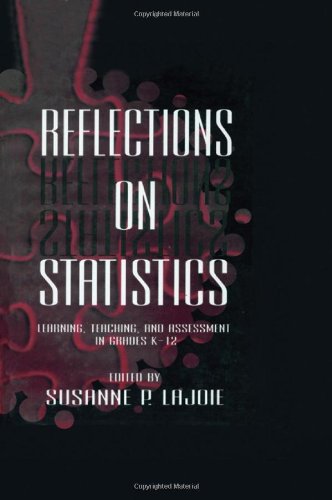
Reflections on Statistics: Learning, Teaching, and Assessment in Grades K-12


(Studies in Mathematical Thinking and Learning Series)

Susanne P. Lajoie 


Routledge | 1998 | 359 páginas | rar - pdf | 17,7 Mb


link (password: matav)

An issue in the current push for reform in mathematics education is the call to address statistics at the precollege level. This volume represents the emerging findings of an interdisciplinary collaboration among a group of mathematics educators, cognitive scientists, teachers, and statisticians to construct an understanding of how to introduce statistics education and assessment for students in elementary and secondary schools. A premise shared by the contributors to this volume is that when students are introduced to statistics at the K-12 level and provided with opportunities to do statistics that are related to actual life situations, they will be better prepared for decision making in the real world. 
The interdisciplinary nature of the group of researchers stimulated a lively interchange of ideas for enhancing the learning, teaching, and assessment of statistical understanding, which is reflected in this volume. Mathematics educators contribute their insights into how teachers teach mathematical ideas and heighten our awareness of the ecological needs of the current mathematics classroom. Cognitive scientists share their understanding of developmental differences in learning and present theoretical perspectives that contribute to the design of effective learning environments. Classroom teachers share their ideas about classroom activities and assessment of student learning, as well as their concerns for in-service training and workshops to help teachers acquire skills in this new content area. Statisticians offer their understanding of what is feasible to teach in the early grades, and what their view is of statistical literacy. 
The book is organized around four interdependent themes: content, teaching, learning, and assessment. By focusing their respective chapters on particular themes, the authors intend to cultivate a better understanding of how each relates to improvements in statistics education. This is the first book to: * address statistics learning in grades K-12, * address issues of statistical curriculum content in grades K-12, * address issues of assessment of statistics learning in grades K-12, * bring issues of technology instruction and assessment in statistics education in grades K-12, and * look at teacher education for statistics instruction in grades K-12. 
This is a must-read book for both practitioners and researchers involved in K-12 mathematics education.


Contents
Identifying an Agenda for Statistics Instruction and Assessment in Grades K-12
Susanne P. Lajoie and Thomas A. Romberg
PART I: STATISTICAL CONTENT
1 What Every High-School Graduate Should Know About Statistics
Richard L.Scheaffer, Ann E. Watkins, and james M. Landwehr
2 Statistics and Probability for the Middle Grades: Examples from Mathematics in Context
Gail Burrill and Thomas A. Romberg
PART II: TEACHING STATISTICS
3 Graphical Representations: Helping Students Interpret Data
George W. Bright and Susan N. Friel
4 Teach-Stat: A Model for Professional Development in Data Analysis and Statistics for Teachers K-6
Susan N. Friel and George W. Bright
PART III: LEARNING STATISTICS
5 A Model-Based Perspective on the Development of Children's Understanding of Chance and Uncertainty
Jeffrey K. Horvath and Richard Lehrer
6 Emergent Ideas of Chance and Probability in Primary-Grade Children
Kathleen E. Metz
7 Developing Middle-School Students' StatisticalReasoning Abilities Through Simulation Gaming
Sharon Derry, joel R. Levin, Helen P. Osana, and Melanie S. Jones
PART IV: ASSESSING STATISTICS
B Monitoring Student Progress in Statistics
Susanne P. Lajoie, Nancy C. Lavigne, Steven D. Munsie,
and Tara V. Wilkie
9 Aligning Everyday and Mathematical Reasoning:
The Case of Sampling Assumptions
Daniel L. Schwartz, Susan R. Goldman, Nancy Vye, Brigid Barron, and The Cognition and Technology Group at Vanderbilt
10 Assessing Statistical Knowledge as It Relates to Students' Interpretation of Data
Iddo Gal
PARTY: EPILOGUE
11 Reflections on a Statistics Agenda for K-12
Susanne P. Lajoie