sexta-feira, 24 de janeiro de 2014

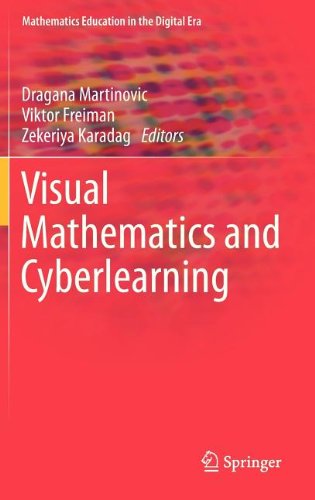
Visual Mathematics and Cyberlearning


(Mathematics Education in the Digital Era, 1)

Dragana Martinovic, Viktor Freiman e Zekeriya Karadag

Springer | 2013 | 255 páginas | pdf | 3,9 Mb


link


This first book in the series will describe the Net Generation as visual learners who thrive when surrounded with new technologies and whose needs can be met with the technological innovations. These new learners seek novel ways of studying, such as collaborating with peers, multitasking, as well as use of multimedia, the Internet, and other Information and Communication Technologies. Here we present mathematics as a contemporary subject that is engaging, exciting and enlightening in new ways. For example, in the distributed environment of cyber space, mathematics learners play games, watch presentations on YouTube, create Java applets of mathematics simulations and exchange thoughts over the Instant Messaging tool. How should mathematics education resonate with these learners and technological novelties that excite them?
Contents

Patterns of Collaboration: Towards Learning Mathematics in the Era of the SemanticWeb.  . . 1
Keith Jones, Eirini Geraniou, and Thanassis Tiropanis
Collaborative Mathematics Learning in Online Environments . . 23
Gorjan Alagic and Mara Alagic
The Integration of Mathematics Discourse, Graphical Reasoning and Symbolic Expression by a Virtual Math Team  . . 49
Murat Perit Cakir & Gerry StahlInvestigating the Mathematical Discourse of Young Learners Involved in Multi-Modal Mathematical Investigations: The Case of Haptic Technologies .. . 97
 Beste Güçler, Stephen Hegedus, Ryan Robidoux, & Nicholas JackiwEmbodied Interaction as Designed Mediation of Conceptual Performance. . 119
Dragan Trninic and Dor Abrahamson
Sensuous Cognition .. . . 141
Luis Radford
New Media and Online Mathematics Learning for Teachers  . . . . 163
George Gadanidis and Immaculate Kizito Namukasa
Web-Based Video Clips: A Supplemental Resource for Supporting Pre-service Elementary Mathematics Teachers
Ann LeSage
Visual Mathematics and Cyberlearning in View of Affordance and Activity Theories . . . 209
Dragana Martinovic, Viktor Freiman, and Zekeriya Karadag


The Tower of Hanoi – Myths and Maths


Andreas M. Hinz, Sandi Klavzar, Uros Milutinovic e Ciril Petr

Birkhäuser | 2013 | 353 páginas | pdf | 9 Mb

link
link1

This is the first comprehensive monograph on the mathematical theory of the solitaire game “The Tower of Hanoi” which was invented in the 19th century by the French number theorist Édouard Lucas. The book comprises a survey of the historical development from the game’s predecessors up to recent research in mathematics and applications in computer science and psychology. Apart from long-standing myths it contains a thorough, largely self-contained presentation of the essential mathematical facts with complete proofs, including also unpublished material. The main objects of research today are the so-called Hanoi graphs and the related Sierpiński graphs. Acknowledging the great popularity of the topic in computer science, algorithms and their correctness proofs form an essential part of the book. In view of the most important practical applications of the Tower of Hanoi and its variants, namely in physics, network theory, and cognitive (neuro)psychology, other related structures and puzzles like, e.g., the “Tower of London”, are addressed.
Numerous captivating integer sequences arise along the way, but also many open questions impose themselves. Central among these is the famed Frame-Stewart conjecture. Despite many attempts to decide it and large-scale numerical experiments supporting its truth, it remains unsettled after more than 70 years and thus demonstrates the timeliness of the topic.
Enriched with elaborate illustrations, connections to other puzzles and challenges for the reader in the form of (solved) exercises as well as problems for further exploration, this book is enjoyable reading for students, educators, game enthusiasts and researchers alike.

Contents
Foreword by Ian Stewart v
Preface vii
0 The Beginning of the World 1
0.1 The Legend of the Tower of Brahma . . 1
0.2 History of the Chinese Rings . . 3
0.3 History of the Tower of Hanoi. . 6
0.4 Puzzles and Graphs  . . 23
0.5 Quotient Sets. . 36
1 The Chinese Rings 53
1.1 Theory of the Chinese Rings . . 53
1.2 The Gros Sequence. . 60
1.3 Two Applications. . 65
1.4 Exercises  . 68
2 The Classical Tower of Hanoi 71
2.1 Perfect to Perfect . . 71
2.2 Regular to Perfect . . 82
2.3 Hanoi Graphs . . 94
2.4 Regular to Regular . . 105
2.5 Exercises . . 128
3 Lucas’s Second Problem 131
3.1 Irregular to Regular. . 131
3.2 Irregular to Perfect . . 136
3.3 Exercises. . 140
4 Sierpinski Graphs 141
4.1 Sierpinski Graphs With Base 3  . . 141
4.2 General Sierpinski Graphs  . . 149
4.3 Connections to Topology: Sierpinski Curve and Lipscomb Space . . 160
4.4 Exercises  . . 163
5 The Tower of Hanoi with More Pegs 165
5.1 The Reve’s Puzzle and the Frame-Stewart Conjecture. . 165
5.2 Frame-Stewart Numbers . . 170
5.3 Numerical Evidence for The Reve’s Puzzle . . 179
5.4 Even More Pegs. . 184
5.5 Hanoi Graphs. . 190
5.6 Numerical Results and Largest Disc Moves . . 200
5.7 Exercises . . 209
6 Variations of the Puzzle 211
6.1 What is a Tower of Hanoi Variant? . . 211
6.2 The Tower of Antwerpen .. . 218
6.3 The Bottleneck Tower of Hanoi . . 222
6.4 Exercises . . 226
7 The Tower of London 227
7.1 Shallice’s Tower of London . . 227
7.2 More London Towers . . 231
7.3 Exercises  . . 238
8 Tower of Hanoi Variants with Oriented Disc Moves 241
8.1 Solvability . . 241
8.2 An Algorithm for Three Pegs. . 245
8.3 More Than Three Pegs . . 251
8.4 Exponential and Sub-Exponential Variants. . 256
8.5 Exercises  . . 259
9 The End of the World 261
A Hints and Solutions to Exercises 265

Reflections on Statistics: Learning, Teaching, and Assessment in Grades K-12


(Studies in Mathematical Thinking and Learning Series)

Susanne P. Lajoie 


Routledge | 1998 | 359 páginas | rar - pdf | 17,7 Mb


link (password: matav)

An issue in the current push for reform in mathematics education is the call to address statistics at the precollege level. This volume represents the emerging findings of an interdisciplinary collaboration among a group of mathematics educators, cognitive scientists, teachers, and statisticians to construct an understanding of how to introduce statistics education and assessment for students in elementary and secondary schools. A premise shared by the contributors to this volume is that when students are introduced to statistics at the K-12 level and provided with opportunities to do statistics that are related to actual life situations, they will be better prepared for decision making in the real world. 
The interdisciplinary nature of the group of researchers stimulated a lively interchange of ideas for enhancing the learning, teaching, and assessment of statistical understanding, which is reflected in this volume. Mathematics educators contribute their insights into how teachers teach mathematical ideas and heighten our awareness of the ecological needs of the current mathematics classroom. Cognitive scientists share their understanding of developmental differences in learning and present theoretical perspectives that contribute to the design of effective learning environments. Classroom teachers share their ideas about classroom activities and assessment of student learning, as well as their concerns for in-service training and workshops to help teachers acquire skills in this new content area. Statisticians offer their understanding of what is feasible to teach in the early grades, and what their view is of statistical literacy. 
The book is organized around four interdependent themes: content, teaching, learning, and assessment. By focusing their respective chapters on particular themes, the authors intend to cultivate a better understanding of how each relates to improvements in statistics education. This is the first book to: * address statistics learning in grades K-12, * address issues of statistical curriculum content in grades K-12, * address issues of assessment of statistics learning in grades K-12, * bring issues of technology instruction and assessment in statistics education in grades K-12, and * look at teacher education for statistics instruction in grades K-12. 
This is a must-read book for both practitioners and researchers involved in K-12 mathematics education.


Contents
Identifying an Agenda for Statistics Instruction and Assessment in Grades K-12
Susanne P. Lajoie and Thomas A. Romberg
PART I: STATISTICAL CONTENT
1 What Every High-School Graduate Should Know About Statistics
Richard L.Scheaffer, Ann E. Watkins, and james M. Landwehr
2 Statistics and Probability for the Middle Grades: Examples from Mathematics in Context
Gail Burrill and Thomas A. Romberg
PART II: TEACHING STATISTICS
3 Graphical Representations: Helping Students Interpret Data
George W. Bright and Susan N. Friel
4 Teach-Stat: A Model for Professional Development in Data Analysis and Statistics for Teachers K-6
Susan N. Friel and George W. Bright
PART III: LEARNING STATISTICS
5 A Model-Based Perspective on the Development of Children's Understanding of Chance and Uncertainty
Jeffrey K. Horvath and Richard Lehrer
6 Emergent Ideas of Chance and Probability in Primary-Grade Children
Kathleen E. Metz
7 Developing Middle-School Students' StatisticalReasoning Abilities Through Simulation Gaming
Sharon Derry, joel R. Levin, Helen P. Osana, and Melanie S. Jones
PART IV: ASSESSING STATISTICS
B Monitoring Student Progress in Statistics
Susanne P. Lajoie, Nancy C. Lavigne, Steven D. Munsie,
and Tara V. Wilkie
9 Aligning Everyday and Mathematical Reasoning:
The Case of Sampling Assumptions
Daniel L. Schwartz, Susan R. Goldman, Nancy Vye, Brigid Barron, and The Cognition and Technology Group at Vanderbilt
10 Assessing Statistical Knowledge as It Relates to Students' Interpretation of Data
Iddo Gal
PARTY: EPILOGUE
11 Reflections on a Statistics Agenda for K-12
Susanne P. Lajoie


Mathematical Footprints


Theoni Pappas


Wide World Publishing, Tetra | 2000 | 241 páginas | rar - pdf |2Mb


link (password: matav)

This journey across the spectrum of human activities takes a creative look at the role mathematics has played since prehistoric times. From its many uses in medicine and its appearance in artwork to its patterns in nature and its central role in the development of computers, mathematics is presented in a fun-to-read, nonthreatening manner.


table of contents


Introduction Mathematics — the framework of architecture
early mathematics artifacts
the very pervasive golden ratio
seeing is not believing
mathematics & your money
mathematics —the framework of architecture
hyperspace & beyond
mathematics & cubism
le grande arche
the mathematical pandora’s box
mathematics & the body
will computers take the quatum leap?
mathematics, Guggenheim Bilbao & Frank Gehry
the Pythagorean theorem—the survivor.
rings, helices, & dolphins
the art of Claude Monet
how knots are tied to mathematics
Chinese remainder theorem—a problem fromthe past
solitons
mathematics of weather forecasting
mathematics & the architecture of Arata Isozaki
fuzzy numbers
mathematics & the art of Alexander Calder
wavelets
the longitude problem
mathematics is in the creases
mathematics & nature’s formations
mathematics & the architecture of the pyramids
cellular automata—pixels of life
art-manifeste
mathematics finds its way around mazes
meter is a meter, is a meter. or is it?
molecular computers
a mathematical looks at the art of Cezanne
where am i? — mathematics & the global positioning system
mathematics in literature
crime & complexity
a mathematical look at time
the universe—what’s with it anyway
numbers help nail errors
mathematics & the art of Tony Robbin
have we heard the last of Fermat’s last theorem?
mathematics & the game of life
mathematics & the architecture of SFMOMA
music, matter & mathematics
nanotechnology is big stuff!!
soft computing
it’s crystal clear, or is it?—quasicrystals & Penrose tiles
smart machines

quinta-feira, 23 de janeiro de 2014

The Simpsons and Their Mathematical Secrets


Bloomsbury USA | 2013 | 279 páginas | epub/mobi

link (epub)
link (mobi)

You may have watched hundreds of episodes of The Simpsons (and its sister show Futurama) without ever realizing that cleverly embedded in many plots are subtle references to mathematics, ranging from well-known equations to cutting-edge theorems and conjectures. That they exist, Simon Singh reveals, underscores the brilliance of the shows’ writers, many of whom have advanced degrees in mathematics in addition to their unparalleled sense of humor.
While recounting memorable episodes such as “Bart the Genius” and “Homer3,” Singh weaves in mathematical stories that explore everything from p to Mersenne primes, Euler’s equation to the unsolved riddle of P v. NP; from perfect numbers to narcissistic numbers, infinity to even bigger infinities, and much more. Along the way, Singh meets members of The Simpsons’ brilliant writing team—among them David X. Cohen, Al Jean, Jeff Westbrook, and Mike Reiss—whose love of arcane mathematics becomes clear as they reveal the stories behind the episodes.
With wit and clarity, displaying a true fan’s zeal, and replete with images from the shows, photographs of the writers, and diagrams and proofs, The Simpsons and Their Mathematical Secrets offers an entirely new insight into the most successful show in television history.

** 
Contents
CHAPTER 0 The Truth About The Simpsons
CHAPTER 1 Bart the Genius
CHAPTER 2 Are you π-Curious?
CHAPTER 3 Homer’s Last Theorem
CHAPTER 4 The Puzzle of Mathematical Humor
EXAMINATION I
CHAPTER 5 Six Degrees of Separation
CHAPTER 6 Lisa Simpson, Queen of Stats and Bats
CHAPTER 7 Galgebra and Galgorithms
EXAMINATION II
CHAPTER 8 A Prime-Time Show
CHAPTER 9 To Infinity and Beyond
CHAPTER 10 The Scarecrow Theorem
EXAMINATION III
CHAPTER 11 Freeze-Frame Mathematics
CHAPTER 12 Another Slice of π
CHAPTER 13 Homer3
EXAMINATION IV
CHAPTER 14 The Birth of Futurama
CHAPTER 15 1,729 and a Romantic Incident
CHAPTER 16 A One-Sided Story
CHAPTER 17 The Futurama Theorem
EXAMINATION V
EπLOGUE
APPENDIX 1 The Sabermetrics Approach in Soccer
APPENDIX 2 Making Sense of Euler’s Equation
APPENDIX 3 Dr. Keeler’s Recipe for the Sum of Squares
APPENDIX 4 Fractals and Fractional Dimensions
APPENDIX 5 Keeler’s Theorem
ACKNOWLEDGMENTS
ONLINE RESOURCES
PICTURE CREDITS
BY THE SAME AUTHOR

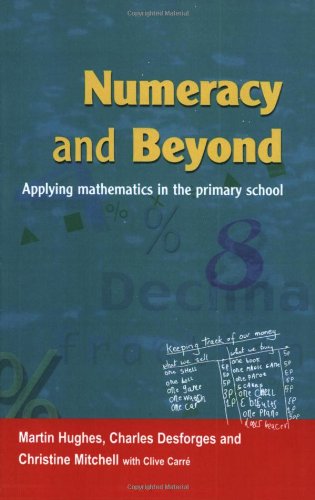
Numeracy and Beyond: Applying Mathematics in the Primary School


Martin Hughes, Charles Desforges, Christine Mitchell, Clive Carre

Open University Press | 2000 | 134 páginas | pdf |


link


One of the fundamental problems in education is that of applying skills and knowledge which learners have gained in one context to problems they encounter in another. This is particularly so in mathematics, where the problems encountered by learners in applying mathematical knowledge are well documented. Using and applying mathematics has been a central component of the National Curriculum in mathematics. However, the National Numeracy Strategy has adopted a new approach, in which 'using and applying' is integrated throughout the mathematics curriculum. This book aims to help teachers develop their understanding and practice in this crucial area. It is based on the findings of a major research study, funded by the Nuffield Foundation, in which a group of primary teachers worked closely with the research team to develop their thinking and practice. The book provides a clear conceptual analysis of the problem of application, together with extensive examples of ways in which teachers can address it in their classrooms at Key Stages 1 and 2. A novel feature of the book is that it includes first-hand accounts of practice in Japanese classrooms, and outlines what teachers in the UK and elsewhere may learn from Japanese methods.

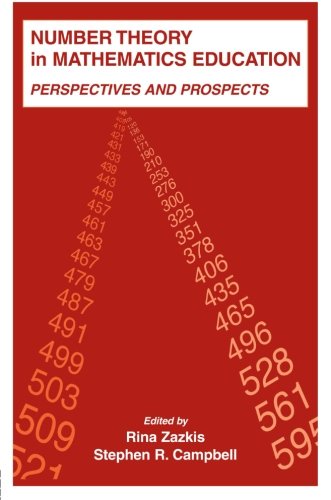
Number Theory in Mathematics Education: Perspectives and Prospects


(Studies in Mathematical Thinking and Learning)

Rina Zazkis, Stephen R. Campbell

Lawrence Erlbaum Associates | 2006 | 304 páginas | pdf | 2,8 Mb

link (password: matav)

This book offers multiple interconnected perspectives on the largely untapped potential of elementary number theory for mathematics education: its formal and cognitive nature, its relation to arithmetic and algebra, its accessibility, its utility and intrinsic merits, to name just a few. Its purpose is to promote explication and critical dialogue about these issues within the international mathematics education community. The studies comprise a variety of pedagogical and research orientations by an international group of researchers that, collectively, make a compelling case for the relevance and importance of number theory in mathematics education in both pre K-16 settings and mathematics teacher education. Topics variously engaged include: • understanding particular concepts related to numerical structure and number theory; • elaborating on the historical and psychological relevance of number theory in concept development; • attaining a smooth transition and extension from pattern recognition to formative principles; • appreciating the aesthetics of number structure; • exploring its suitability in terms of making connections leading to aha! insights and reaching toward the learner's affective domain; • reexamining previously constructed knowledge from a novel angle; • investigating connections between technique and theory; • utilizing computers and calculators as pedagogical tools; and • generally illuminating the role number theory concepts could play in developing mathematical knowledge and reasoning in students and teachers. Overall, the chapters of this book highlight number theory-related topics as a stepping-stone from arithmetic toward generalization and algebraic formalism, and as a means for providing intuitively grounded meanings of numbers, variables, functions, and proofs. Number Theory in Mathematics Education: Perspectives and Prospects is of interest to researchers, teacher educators, and students in the field of mathematics education, and is well suited as a text for upper-level mathematics education courses.

Contents
List of Contributors vii
Preface ix
1 Number Theory in Mathematics Education Research: Perspectives and Prospects
Rina Zazkis and Stephen R. Campbell
2 Understanding Elementary Number Theory in Relation to Arithmetic and Algebra
Stephen R. Campbell
3 What Makes an Example Exemplary: Pedagogical and Didactical Issues in Appreciating Multiplicative Structures
John Mason
4 For the Beauty of Number Theory 69
Nathalie Sinclair
5 On the Path to Number Theory: Repeating Patterns as a Gateway
Rina Zazkis and Peter Liljedahl
6 Learning by Teaching: The Case of Sieve of Eratosthenes and One Elementary School Teacher
Roza Leikin
7 Learning Elementary Number Theory Through a Chain of Discovery: Preservice Teachers’ Encounter with Pentominoes
Peter Liljedahl
8 The Number-Theoretic Experience of 12- to 15-Year-Olds in a Calculator Environment: The Intertwining Coemergence of Technique and Theory
Carolyn Kieran and José Guzmán
9 Learning Number Theory Concepts Via Geometrical Interactive Computerized Setting
Ilana Lavy
10 Overlooking Number Patterns in Algorithmic Problem Solving
David Ginat
11 Revisiting Algebra in a Number Theoretical Setting 249
Jennifer Christian Smith


Outros livros da mesma autora, disponíveis no blog:


- Campbell. S. R., & Zazkis, R. (Eds.) (2002). Learning and teaching number theory: Research in cognition and instruction. Westport, CT: Ablex Publishing 
- Leikin, R. & Zazkis, R. (Eds.) (2010). Learning through Teaching Mathematics:  Developing teachers’ knowledge and expertise in practice. Springer.

- Zazkis, R. (2011). Relearning mathematics: A challenge for prospective elementary school teachers. Information Age Publishing. Charlotte, NC.

Capítulos em livros, da mesma autora, disponíveis no blog:

- Zazkis, R. & Gadowsky, K. (2001). Attending to transparent features of opaque representations of natural numbers. In A. Cuoco (Ed.), NCTM 2001 Yearbook: The roles of representation in school mathematics (pp. 41-52). Reston, VA: NCTM. 
-  Zazkis, R. (2008). Divisibility and transparency of number representations. In M. P. Carlson & C. Rasmussen (Eds.), Making the Connection: Research and practice in undergraduate mathematics (pp. 81-92). MAA notes.