segunda-feira, 20 de janeiro de 2014

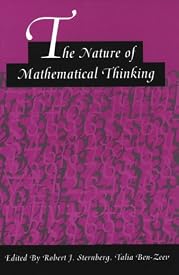
The Nature of Mathematical Thinking


(Studies in Mathematical Thinking and Reasoning)

Robert J. Sternberg, Talia Ben-Zeev

Lawrence Erlbaum | 1996 | 352 páginas | rar - pdf | 18 Mb

link (password: matav)

djvu - 3,72 Mb
link

link1

Why do some children seem to learn mathematics easily and others slave away at it, learning it only with great effort and apparent pain? Why are some people good at algebra but terrible at geometry? How can people who successfully run a business as adults have been failures at math in school? How come some professional mathematicians suffer terribly when trying to balance a checkbook? And why do school children in the United States perform so dismally in international comparisons? These are the kinds of real questions the editors set out to answer, or at least address, in editing this book on mathematical thinking. Their goal was to seek a diversity of contributors representing multiple viewpoints whose expertise might converge on the answers to these and other pressing and interesting questions regarding this subject.
The chapter authors were asked to focus on their own approach to mathematical thinking, but also to address a common core of issues such as the nature of mathematical thinking, how it is similar to and different from other kinds of thinking, what makes some people or some groups better than others in this subject area, and how mathematical thinking can be assessed and taught. Their work is directed to a diverse audience -- psychologists interested in the nature of mathematical thinking and abilities, computer scientists who want to simulate mathematical thinking, educators involved in teaching and testing mathematical thinking, philosophers who need to understand the qualitative aspects of logical thinking, anthropologists and others interested in how and why mathematical thinking seems to differ in quality across cultures, and laypeople and others who have to think mathematically and want to understand how they are going to accomplish that feat.


Contents
Preface
List of Contributors
I A Psychometric Approach 1
1 Mathematical Abilities: Some Results From Factor Analysis 3
II Cognitive/Information-Processing Approaches 27
2 The Process of Understanding Mathematical Problems 29
3 When Erroneous Mathematical Thinking Is Just as "Correct": The Oxymoron of Rational Errors 55
III Cognitive/Cultural Approaches 81
4 On the Shoulders of Giants: Cultural Tools and Mathematical Development 83
5 Culture and Children's Mathematical Thinking 119
6 Biology, Culture, and Cross-National Differences in Mathematical Ability 145
IV Cognitive/Educational Approaches 173
7 Toby's Math 175
8 Fostering Mathematical Thinking in Middle School Students: Lessons From Research 203
V Mathematical Approaches 251
9 On Different Facets of Mathematical Thinking 253
10 Structuralism and Mathematical Thinking 285
VI Conclusions 301
11 What is Mathematical Thinking? 303
Author Index 319
Subject Index 327

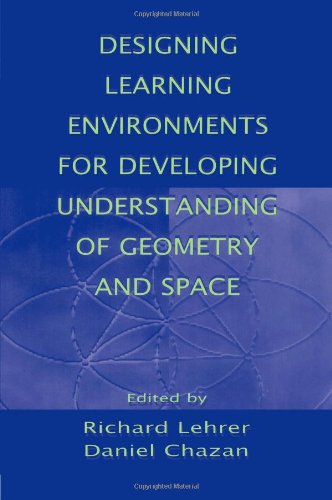
Designing Learning Environments for Developing Understanding of Geometry and Space


(Studies in Mathematical Thinking and Learning)

  Richard Lehrer, Daniel Chazan

Lawrence Erlbaum | 1998 | 520 páginas | rar -  pdf | 25 Mb

link (password: matav)

Conteúdos:

Prefácio ix
I - WHY TEACH GEOMETRY? 1
A Role for Geometry in General Education 3
E. Paul Goldenberg , Albert A. Cuoco , June Mark
From a Different Perspective: Building on Students' Informal Knowledge 45
Koeno P. Gravemeijer
Charting a Course for Secondary Geometry 67
Daniel Chazan e Michal Yerushalmy
Chaos in the Classroom 91
Robert L. Devaney
II - STUDIES OF CONCEPTUAL DEVELOPMENT 105
Interpreting Student Understanding in Geometry: A Synthesis of Two Models 109
John Pegg e Geoff Davey
Longitudinal Study of Children's Reasoning About Space and Geometry 137
Richard Lehrer, Michael Jenkins, Helen Osana
Developing Understanding of Geometry and Space in the Primary Grades 169
Richard Lehrer, Cathy Jacobson, Greg Thoyre, Vera Kemeny, Dolores Strom, Jeffrey Horvath, Stephen Gance, Matthew Koehler
Development of Geometric and Measurement Ideas 201
Douglas H. Clements, Michael T. Battista, Julie Sarama
Students' Understanding of Three-Dimensional Cube Arrays: Findings From a Research and Curriculum Development Project 227
Michael T. Battista e Douglas H. Clements
Sixth-Grade Students' Conceptions of Stability in Engineering Contexts 249
James A. Middleton e Robert Corbett
Interconnecting Science and Mathematics Concepts 267
Kalyani Raghavan, Mary L. Sartoris, Robert Glaser
Geometric Curve-Drawing Devices as an Alternative Approach to Analytic Geometry: An Analysis of the Methods, Voice, and Epistemology of a High-School Senior 297David Dennis e Jere Confrey
Conjecturing and Argumentation in High-School Geometry Students 319Kenneth R. Koedinger
III DEFINING A NEW SEMANTICS OF SPACE: COMPUTERS, SOFTWARE, AND THE ELECTRONIC WORLD 349
What Is Dynamic Geometry?
E. Paul Goldenberg e Albert A. Cuoco 351
An Alternative Approach to Proof in Dynamic Geometry 369
Michael de Villiers
Opportunities to Explore and Integrate Mathematics with the Geometer's Sketchpad 395
John Olive
Mapping the Classroom Using a CAD Program: Geometry as Applied Mathematics 419
Daniel Lynn Watt
An Introduction to Geometry Through Anchored Instruction 439
Linda Zech, Nancy J. Vye, John D. Bransford, Susan R. Goldman, Brigid. J. Barron, Dan L. Schwartz, Rachelle Kisst-Hackett, Cynthia Mayfield-Stewart e the Cognition and Technology Group
Teachers and Students Investigating and Communicating About Geometry: The Math Forum 465
K. Ann Renninger, Stephen A. Weimar e Eugene A. Klotz
EPILOGUE 489
Organization and Freedom in Geometry Learning and Teaching
Rina Hershkowitz

Mathematics Teaching, Learning, and Liberation in the Lives of Black Children


(Studies in Mathematical Thinking and Learning Series)

Danny Bernard Martin

Routledge | 2009 |375 páginas | pdf | 2 Mb


link

link1

With issues of equity at the forefront of mathematics education research and policy, Mathematics Teaching, Learning, and Liberation in the Lives of Black Children fills the need for authoritative, rigorous scholarship that sheds light on the ways that young black learners experience mathematics in schools and their communities. This timely collection significantly extends the knowledge base on mathematics teaching, learning, participation, and policy for black children and it provides new framings of relevant issues that researchers can use in future work. More importantly, this book helps move the field beyond analyses that continue to focus on and normalize failure by giving primacy to the stories that black learners tell about themselves and to the voices of mathematics educators whose work has demonstrated a commitment to the success of these children.

Calculus and its Origins


(Spectrum)
David Perkins

The Mathematical Association of America | 2012 | 180 páginas | pdf | 3,7 Mb

link direto

link

Calculus answers questions that had been explored for centuries before calculus was born. Calculus and Its Origins begins with these ancient questions and details the remarkable story of how subsequent scholars wove these inquiries into a unified theory. This book does not presuppose knowledge of calculus, it requires only a basic knowledge of geometry and algebra (similar triangles, polynomials, factoring). Inside you will find the accounts of how Archimedes discovered the area of a parabolic segment, ibn Al-Haytham calculated the volume of a revolved area, Jyesthadeva explained the infinite series for sine and cosine, Wallis deduced the link between hyperbolas and logarithms, Newton generalized the binomial theorem, Leibniz discovered integration by parts, and much more. Each chapter ends with further results, in the form of exercises, by such luminaries as Pascal, Maclaurin, Barrow, Cauchy and Euler.

Contents
Preface ix
1 The Ancients 1
1.1 Zeno holds a mirror to the infinite . . 2
1.2 The ‘infinitely small’  . . 4
1.3 Archimedes exhausts a parabolic segment . . 5
1.4 Patterns . . 7
1.5 The evolution of notation  . . 10
1.6 Furthermore  . . 10
2 East of Greece 15
2.1 Ibn al-Haytham sums the fourth powers . . 15
2.2 Ibn al-Haytham’s parabolic volume . . 17
2.3 Jyesthadeva expands 1/(1+x)  . . 20
2.4 Jyesthadeva expresses as a series . . 23
2.5 Furthermore. . 26
3 Curves 29
3.1 Oresme invents a precursor to a coordinate system . . 29
3.2 Fermat studies the maximums of curves. . 32
3.3 Fermat extends his method to tangent lines . . 33
3.4 Descartes proposes a geometric method . . 35
3.5 Furthermore . . 37
4 Indivisibles 43
4.1 Cavalieri’s quadrature of the parabola . . 43
4.2 Roberval’s quadrature of the cycloid  . . 47
4.3 Worry over indivisibles. . 50
4.4 Furthermore. . 51
5 Quadrature 57
5.1 Gregory studies hyperbolas . . 57
5.2 De Sarasa invokes logarithms . . 59
5.3 Brouncker finds a quadrature of a hyperbola. . 61
5.4 Mercator andWallis finish the task . . 63
5.5 Furthermore  . . 65
6 The Fundamental Theorem of Calculus 77
6.1 Newton links quadrature to rate of change  . . 77
6.2 Newton reverses the link  . . 79
6.3 Leibniz discovers the transmutation theorem  . . 81
6.4 Leibniz attains Jyesthadeva’s series for  pi. . 83
6.5 Furthermore  . . 85
7 Notation 95
7.1 Leibniz describes differentials. . 95
7.2 The fundamental theorem with new notation  . . 98
7.3 Leibniz integrates the cycloid . . 100
7.4 Furthermore . . 102
8 Chords 109
8.1 Preliminary results known to the Greeks. . 109
8.2 Jyesthadeva finds series for sine and cosine. . 110
8.3 Newton derives a series for arcsine . . 116
8.4 Furthermore . . 118
9 Zero over zero 123
9.1 D’Alembert and the convergence of series  . . 123
9.2 Lagrange defines the ‘derived function’. . 126
9.3 Taylor approximates functions. . 128
9.4 Bolzano and Cauchy define convergence  . . 130
9.5 Furthermore . . 133
10 Rigor 137
10.1 Cauchy defines continuity . . 137
10.2 Bolzano invents a peculiar function . . 140
10.3 Weierstrass investigates the convergence of functions. . 145
10.4 Dirichlet’s nowhere-continuous function . . 147
10.5 A few final words about the infinite. . 149
10.6 Furthermore . . 150

Sugestão de tibu


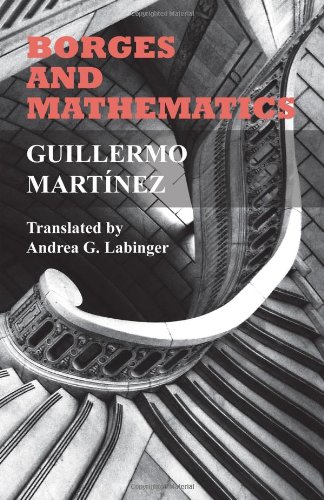
Borges and Mathematics


Guillermo Martinez e Andrea G. Labinger

Purdue University Press | 2012 | 153 páginas | pdf | 1 Mb

link direto

link


Borges and Mathematics is a short book of essays that explores the scientific thinking of the Argentine writer Jorge Luis Borges (1899-1986). Around half of the book consists of two "lectures" focused on mathematics. The rest of the book reflects on the relationship between literature, artistic creation, physics, and mathematics more generally. Written in a way that will be accessible even to those "who can only count to ten," the book presents a bravura demonstration of the intricate links between the worlds of sciences and arts, and it is a thought provoking call to dialog for readers from both traditions. The author, Guillermo Martinez, is both a recognized writer, whose murder mystery The Oxford Murders has been translated into thirty-five languages, and a PhD in mathematics. Contents: Borges and Mathematics: First Lecture; Borges and Mathematics: Second Lecture; The Golem and Artificial Intelligence; The Short Story as Logical System; A Margin Too Narrow; Euclid, or the Aesthetics of Mathematical Reasoning; Solutions and Disillusions; The Pythagorean Twins; The Music of Chance (Interview with Gregory Chaikin); Literature and Rationality; Who's Afraid of the Big Bad One?; A Small, Small God; God's Sinkhole. This book was originally published in Spanish as Borges y la matematica (2003). It has been translated with generous support from the Latino Cultural Center at Purdue University.

TABLE OF CONTENTS
1 Borges and Mathematics: First Lecture: February 19, 2003 1
2 Borges and Mathematics: Second Lecture: February 26, 2003 25
3 The Golem and artificial inteligence
4 The Short Story as Logical System 67
5 A Margin Too Narrow 71
6 Euclid, or the Aesthetics of Mathematical Reasoning 81
7 Solutions and Disillusionment 87
8 The Pythagorean Twins 91
9 The Music of Chance
10 Literature and Rationality 113
11 Who’s Afraid of the Big Bad One? 119
12 A Small, Small God 123
13 God’s Sinkhole 127
Appendix A: Mathematical Themes in Borges’ Work 131
Appendix B: Mathematical Bibliography of Works Consulted by Borges 135
Appendix C: Sources of English Translations and Excerpts


Sugestão de tibu

The Logician and the Engineer: How George Boole and Claude Shannon Created the Information Age


Paul J. Nahin

Princeton University Press | 2012 | pdf | 5,3 Mb

link direto
link

epub - 5 Mb - link

Boolean algebra, also called Boolean logic, is at the heart of the electronic circuitry in everything we use--from our computers and cars, to our kitchen gadgets and home appliances. How did a system of mathematics established in the Victorian era become the basis for such incredible technological achievements a century later? In The Logician and the Engineer, best-selling popular math writer Paul Nahin combines engaging problems and a colorful historical narrative to tell the remarkable story of how two men in different eras--mathematician and philosopher George Boole (1815-1864) and electrical engineer and pioneering information theorist Claude Shannon (1916-2001)--advanced Boolean logic and became founding fathers of the electronic communications age.
Presenting the dual biographies of Boole and Shannon, Nahin examines the history of Boole's innovative ideas, and considers how they led to Shannon's groundbreaking work on electrical relay circuits and information theory. Along the way, Nahin presents logic problems for readers to solve and talks about the contributions of such key players as Georg Cantor, Tibor Rado, and Marvin Minsky--as well as the crucial role of Alan Turing's "Turing machine"--in the development of mathematical logic and data transmission. Nahin takes readers from fundamental concepts to a deeper and more sophisticated understanding of how a modern digital machine such as the computer is constructed. Nahin also delves into the newest ideas in quantum mechanics and thermodynamics in order to explore computing's possible limitations in the twenty-first century and beyond.
The Logician and the Engineer shows how a form of mathematical logic and the innovations of two men paved the way for the digital technology of the modern world.

Contents
Preface xi
1 What You Need to Know to Read This Book 1
2 Introduction 6
3 George Boole and Claude Shannon: Two Mini-Biographies 17
3.1 The Mathematician 17
3.2 The Electrical Engineer 28
4 Boolean Algebra 43
4.1 Boole’s Early Interest in Symbolic Analysis 43
4.2 Visualizing Sets 44
4.3 Boole’s Algebra of Sets 45
4.4 Propositional Calculus 48
4.5 Some Examples of Boolean Analysis 52
4.6 Visualizing Boolean Functions 59
5 Logical Switching Circuits 67
5.1 Digital Technology: Relays versus Electronics 67
5.2 Switches and the Logical Connectives 68
5.3 A Classic Switching Design Problem 71
5.4 The Electromagnetic Relay and the Logical NOT 73
5.5 The Ideal Diode and the Relay Logical AND and OR 76
5.6 The Bi-Stable Relay Latch 81
6 Boole, Shannon, and Probability 88
6.1 A Common Mathematical Interest 88
6.2 Some Fundamental Probability Concepts 89
6.3 Boole and Conditional Probability 96
6.4 Shannon, Conditional Probability, and Relay Reliability 99
6.5 Majority Logic 106
7 Some Combinatorial Logic Examples 114
7.1 Channel Capacity, Shannon’s Theorem, and Error-Detection Theory 114
7.2 The Exclusive-OR Gate (XOR) 122
7.3 Error-Detection Logic 127
7.4 Error-Correction Theory 128
7.5 Error-Correction Logic 132
8 Sequential-State Digital Circuits 139
8.1 Two Sequential-State Problems 139
8.2 The NOR Latch 142
8.3 The Clocked RS Flip-Flop 146
8.4 More Flip-Flops 154
8.5 A Synchronous, Sequential-State Digital Machine Design Example 158
9 Turing Machines 161
9.1 The First Modern Computer 162
9.2 Two Turing Machines 164
9.3 Numbers We Can’t Compute 168
10 Beyond Boole and Shannon 176
10.1 Computation and Fundamental Physics 176
10.2 Energy and Information 178
10.3 Logically Reversible Gates 180
10.4 Thermodynamics of Logic 184
10.5 A Peek into the Twilight Zone: Quantum Computers 188
10.6 Quantum Logic—and Time Travel, Too! 197
Epilogue For the Future: The Anti-Amphibological Machine 210
Appendix Fundamental Electric Circuit Concepts 219


Sugestão de tibu

Why Cats Land on Their Feet: And 76 Other Physical Paradoxes and Puzzles


Mark Levi

Princeton University Press | 2012 | 208 páginas | epub | 4 Mb

link direto

link

Ever wonder why cats land on their feet? Or what holds a spinning top upright? Or whether it is possible to feel the Earth's rotation in an airplane? Why Cats Land on Their Feet is a compendium of paradoxes and puzzles that readers can solve using their own physical intuition. And the surprising answers to virtually all of these astonishing paradoxes can be arrived at with no formal knowledge of physics.
Mark Levi introduces each physical problem, sometimes gives a hint or two, and then fully explains the solution. Here readers can test their critical-thinking skills against a whole assortment of puzzles and paradoxes involving floating and diving, sailing and gliding, gymnastics, bike riding, outer space, throwing a ball from a moving car, centrifugal force, gyroscopic motion, and, of course, falling cats.
Want to figure out how to open a wine bottle with a book? Or how to compute the square root of a number using a tennis shoe and a watch?Why Cats Land on Their Feet shows you how, and all that's required is a familiarity with basic high-school mathematics. This lively collection also features an appendix that explains all physical concepts used in the book, from Newton's laws to the fundamental theorem of calculus.

CONTENTS
1 Fun with Physical Paradoxes, Puzzles, and Problems
1.1 Introduction
1.2 Background
1.3 Sources
2 Outer Space Paradoxes
2.1 A Helium Balloon in a Space Shuttle
2.2 Space Navigation without Jets
2.3 A Paradox with a Comet
2.4 Speeding Up Causes a Slowdown
3 Paradoxes with Spinning Water
3.1 A Puzzle with a Floating Cork
3.2 Parabolic Mirrors and Two Kitchen Puzzles
3.3 A Cold Parabolic Dish
3.4 Boating on a Slope
3.5 Navigating with No Engine or Sails
3.6 The Icebergs
4 Floating and Diving Paradoxes
4.1 A Bathtub on Wheels
4.2 The Tub Problem—In More Depth
4.3 How to Lose Weight in a Fraction of a Second
4.4 An Underwater Balloon
4.5 A Scuba Puzzle
4.6 A Weight Puzzle
5 Flows and Jets
5.1 Bernoulli’s Law and Water Guns
5.2 Sucking on a Straw and the Irreversibility of Time
5.3 Bernoulli’s Law and Moving Around in a Space Shuttle
5.4 A Sprinker Puzzle
5.5 Ejecting Water Fast but with Zero Speed?
5.6 A Pouring Water Puzzle
5.7 A Stirring Paradox
5.8 An Inkjet Printer Question
5.9 A Vorticity Paradox
6 Moving Experiences: Bikes, Gymnastics, Rockets
6.1 How Do Swings Work?
6.2 The Rising Energy Cost
6.3 A Gymnast Doing Giants and a Hamster in a Wheel
6.4 Controlling a Car on Ice
6.5 How Does a Biker Turn?
6.6 Speeding Up by Leaning
6.7 Can One Gain Speed on a Bike by Body Motion Only?
6.8 Gaining Weight on a Motorbike
6.9 Feeling the Square in Through the Bike Pedals
6.10 A Paradox with Rockets
6.11 A Coffee Rocket
6.12 Throwing a Ball from a Moving Car
7 Paradoxes with the Coriolis Force
7.1 What Is the Coriolis Force?
7.2 Feeling Coriolis in a Boeing 747
7.3 Down the Drain with Coriolis
7.4 High Pressure and Good Weather
7.5 What Causes Trade Winds?
Centrifugal Paradoxes
8.1 What’s Cheaper: Flying West or East?
8.2 A Coriolis Paradox
8.3 An Amazing Inverted Pendulum: What Holds It Up?
8.4 Antigravity Molasses
8.5 The “Proof” That the Sling Cannot Work
8.6 A David–Goliath Problem
8.7 Water in a Pipe
8.8 Which Tension Is Greater?
8.9 Slithering Ropes in Weightlessness
9 Gyroscopic Paradoxes
9.1 How Does the Spinning Top Defy Gravity?
9.2 Gyroscopes in Bikes
9.3 A Rolling Coin
9.4 Staying on a Slippery Dome
9.5 Finding North with a Gyroscope
10 Some Hot Stuff and Cool Things
10.1 Can Heat Pass from a Colder to a Hotter Object?
10.2 A Bike Pump and Molecular Ping-Pong
10.3 A Bike Pump as a Heat Pump
10.4 Heating a Room in Winter
10.5 Freezing Things with a Bike Tire
11 Two Perpetual Motion Machines
11.1 Perpetual Motion by Capillarity
11.2 An Elliptical Mirror Perpetuum Mobile
12 Sailing and Gliding
12.1 Shooting Cherry Pits and Sailing
12.2 Sailing Straight into the Wind
12.3 Biking against the Wind
12.4 Soaring without Updrafts
2.5 Danger of the Horizontal Shear Wind
13 The Flipping Cat and the Spinning Earth
13.1 How Do Cats Flip to Land on Their Feet?
13.2 Can Trade Winds Slow Earth’s Rotation?
14 Miscellaneous
14.1 How to Open a Wine Bottle with a Book
14.2 “It’s Alive!”
14.3 Falling Faster Than g: A Falling Chain “Sucked in” by the Floor
14.4 A Man in a Boat with Drag
14.5 A “Phantom” Boat: No Wake and No Drag
14.6 A Constant-G Roller Coaster
14.7 Shooting at a Cart
14.8 Computing with a Shoe
Appendix
A.1 Newton’s Laws
A.2 Kinetic Energy, Potential Energy, Work
A.2.1 Work
A.2.2 Kinetic Energy
A.2.3 Potential Energy
A.2.4 Conservation of Energy
A.3 Center of Mass
A.4 Linear Momentum
A.5 The Torque
A.6 Angular Momentum
A.7 Angular Velocity, Centripetal Acceleration
A.8 Centrifugal and Centripetal Forces
A.9 Coriolis, Centrifugal, and Complex Exponentials
A.10 The Fundamental Theorem of Calculus


Sugestão de tibu