terça-feira, 7 de janeiro de 2014

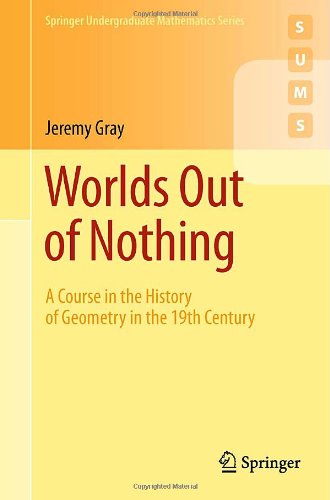
Worlds Out of Nothing: A Course in the History of Geometry in the 19th Century

Jeremy Gray

Springer | 2011 | 410 páginas | PDF  | 3 Mb

tiera.ru  (link direto)
carlossicoli.free.fr (link direto)
link


Based on the latest historical research, Worlds Out of Nothing is the first book to provide a course on the history of geometry in the 19th century. Topics covered in the first part of the book are projective geometry, especially the concept of duality, and non-Euclidean geometry. The book then moves on to the study of the singular points of algebraic curves (Plücker’s equations) and their role in resolving a paradox in the theory of duality; to Riemann’s work on differential geometry; and to Beltrami’s role in successfully establishing non-Euclidean geometry as a rigorous mathematical subject. The final part of the book considers how projective geometry rose to prominence, and looks at Poincaré’s ideas about non-Euclidean geometry and their physical and philosophical significance.
Three chapters are devoted to writing and assessing work in the history of mathematics, with examples of sample questions in the subject, advice on how to write essays, and comments on what instructors should be looking for

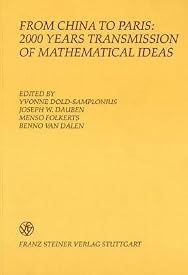
From China to Paris: 2000 Years Transmission of Mathematical Ideas


(Boethius. Texte und Abhandlungen zur Geschichte der Mathematik und der Naturwissenschaften)
Benno van Dalen, Joseph W. Dauben, Yvonne Dold-Samplonius, Menso Folkerts
Franz Steiner Verlag | 2002 | 470 páginas | PDF | 14,41 Mb

link (novo link)
Password: matav

Contents:
K. Vogel: A Surveying Problem Travels from China to Paris
J. Hoyrup: Seleucid Innovations in the Babylonian o Algebraico Tradition and their Kin Abroad
J. L. Berggren: Some Ancient and Medieval Approximations to Irrational Numbers and Their Transmission
J. Sesiano: A Reconstruction of Greek Multiplication Tables for Integers
A. Breard: Problems of Pursuit: Recreational Mathematics or Astronomy?
K. Chemla / A. Keller: The Sanskrit karanis and the Chinese mian
S. R. Sarma: Rule of Three and its Variations in India
L. Dun: A Homecoming Stranger: Transmission of the Method of Double False Position and the Story of Hiero's Crown
K. Plofker: Use and Transmission of Iterative Approximations in India and the Islamic World
J. P. Hogendijk: Anthyphairetic Ratio Theory in Medieval Islamic Mathematics
U. Rebstock: An Early Link of the Arabic Tradition of Practical Arithmetic: The Kitab al -Thadhkira bi-usul al-hisab wa 'l-fara'id wa-'awliha wa-tashihiha
A. Djebbar: La circulation des mathematiques entre l'Orient et l'Occident musulmans: Interrogations anciennes et elements nouveaux
C. Burnett: Indian Numerals in the Mediterranean Basin in the Twelfth Century, with Special Reference to the oEastern Formso
R. Franci: Jealous Husbands Crossing the River: A Problem from Alcuin to Tartaglia
T. Levy: De l'arabe a l'hebreu: la constitution de la litterature mathematique hebraique (XIIe-XVIe siecle)
B. van Dalen: Islamic and Chinese Astronomy under the Mongols: a Little-Known Case of Transmission
M. Bagheri: A New Treatise by al-Kashi on the Depression of the Visible Horizon
A. Volkov: On the Origins of the Toan phap dai thanh (Great Compendium of Mathematical Methods)
M. Folkerts: Regiomontanus' Role in the Transmission of Mathematical Problems
D. Pingree: Philippe de la Hire's Planetary Theories in Sanskrit. (Franz Steiner 2002)

segunda-feira, 6 de janeiro de 2014

The Mathematical Experience, Study Edition


Philip J. Davis, Reuben Hersh

 Birkhäuser; 1st Reprint of the 1995 Edition ed. 2012. Updated with Epilogues by the Authors edition |  2011 | 527 páginas | rar - pdf | 14,1 Mb

link
password : matav


Winner of the 1983 National Book Award!
"…a perfectly marvelous book about the Queen of Sciences, from which one will get a real feeling for what mathematicians do and who they are. The exposition is clear and full of wit and humor..." - The New Yorker (1983 National Book Award edition)
Mathematics has been a human activity for thousands of years. Yet only a few people from the vast population of users are professional mathematicians, who create, teach, foster, and apply it in a variety of situations. The authors of this book believe that it should be possible for these professional mathematicians to explain to non-professionals what they do, what they say they are doing, and why the world should support them at it. They also believe that mathematics should be taught to non-mathematics majors in such a way as to instill an appreciation of the power and beauty of mathematics. Many people from around the world have told the authors that they have done precisely that with the first edition and they have encouraged publication of this revised edition complete with exercises for helping students to demonstrate their understanding. This edition of the book should find a new generation of general readers and students who would like to know what mathematics is all about. It will prove invaluable as a course text for a general mathematics appreciation course, one in which the student can combine an appreciation for the esthetics with some satisfying and revealing applications.
The text is ideal for 1) a GE course for Liberal Arts students 2) a Capstone course for perspective teachers 3) a writing course for mathematics teachers. A wealth of customizable online course materials for the book can be obtained from Elena Anne Marchisotto (elena.marchisotto@csun.edu) upon request.

Problems in Solid Geometry


(Science for Everyone)
I. F. Sharygin

MIR | 1986 | pdf

scribd.com (link novo)

djvu - 1,4 Mb -  link direto
link

From the Preface:
This book contains 340 problems in solid geometry and is a natural continuation of Problems in Plane Geometry, Nauka, Moscow, 1982. It is therefore possible to confine myself here to those points where this book differs from the first. The problems in this collection are grouped into (1) computational problems and (2) problems on proof.
The simplest problems in Section 1 only have answers, others, have brief hints, and the most difficult, have detailed hints and worked solutions. There are two reservations. Firstly, in most cases only the general outline of the solution is given, a number of details being suggested for the reader to consider. Secondly, although the suggested solutions are valid, they are not patterns (models) to be used in examinations. Sections 2-4 contain various geometric facts and theorems, problems on maximum and minimum (some of the problems in this part could have been put in Section 1), and problems on loci. Some questions pertaining to the geometry of tetrahedron, spherical geometry, and so forth are also considered here.
As to the techniques for solving all these problems, I have to state that I prefer analytical computational methods to those associated with plane geometry. Some of the difficult problems in solid geometry will require a high level of concentration from the reader, and an ability to carry out some rather complicated work.


Índice:
Preface . 6
Section 1. Computational Problems. 7
Section 2. Problems on Proof . 37
Section 3. Problems on Extrema. Geometric Inequalities. 47
Section 4. 

Loci of Points. 54
An Arbitrary Tetrahedron 59. 

An Equi-faced Tetrahedron 61. 
An Orthocentric Tetrahedron 64. ´
An Arbitrary Polyhedron. The Sphere 65. 
An Outlet into Space 68.
Answers, Hints, Solutions . 6

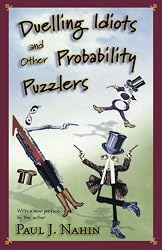
Duelling Idiots and Other Probability Puzzlers

Paul J. Nahin

Princeton University Press | 2000| 256 páginas | PDF | 9 Mb

link

Djvu | 1,8 Mb

link
link1
link2

Referência em: MathEduc

Written for undergraduates and mathematics enthusiasts, this book teaches the fundamentals of elementary probability theory using problems that are familiar to everyone. Light-hearted exercises include determining the odds of winning the World Series and how to obtain answers to an embarassing question using probability. MATLAB M-files are given to solve the problems presented.


Outros livros da série Paradoxes, Perplexities & Mathematical Conundrums
for the Serious Head Scratcher, publicados pela Princeton University Press, disponíveis no blog:


- Chases and Escapes: The Mathematics of Pursuit and Evasion (2007), de Paul J. Nahin
- Slicing Pizzas, Racing Turtles, and Further Adventures in Applied Mathematics
 (2012), de Robert B. Banks 
- Across the Board: The Mathematics of Chessboard Problems (2004),
de John J. Watkins

domingo, 5 de janeiro de 2014

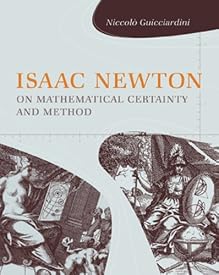
Isaac Newton on Mathematical Certainty and Method


(Transformations: Studies in the History of Science and Technology)
Niccola Guicciardini

The MIT Press | 2009 | 448 páginas |  pdf | 3,3 Mb

scribd.com (link novo)
link
link1

Descrição: Historians of mathematics have devoted considerable attention to Isaac Newton's work on algebra, series, fluxions, quadratures, and geometry. In Isaac Newton on Mathematical Certainty and Method, Niccolò Guicciardini examines a critical aspect of Newton's work that has not been tightly connected to Newton's actual practice: his philosophy of mathematics.

Newton aimed to inject certainty into natural philosophy by deploying mathematical reasoning (titling his main work The Mathematical Principles of Natural Philosophy most probably to highlight a stark contrast to Descartes's Principles of Philosophy). To that end he paid concerted attention to method, particularly in relation to the issue of certainty, participating in contemporary debates on the subject and elaborating his own answers. Guicciardini shows how Newton carefully positioned himself against two giants in the "common" and "new" analysis, Descartes and Leibniz. Although his work was in many ways disconnected from the traditions of Greek geometry, Newton portrayed himself as antiquity's legitimate heir, thereby distancing himself from the moderns.

Guicciardini reconstructs Newton's own method by extracting it from his concrete practice and not solely by examining his broader statements about such matters. He examines the full range of Newton's works, from his early treatises on series and fluxions to the late writings, which were produced in direct opposition to Leibniz. The complex interactions between Newton's understanding of method and his mathematical work then reveal themselves through Guicciardini's careful analysis of selected examples. Isaac Newton on Mathematical Certainty and Method uncovers what mathematics was for Newton, and what being a mathematician meant to him.

sábado, 4 de janeiro de 2014

Algebra and Trigonometry


Judith A. Beecher, Judith A. Penna, Marvin L. Bittinger

Addison-Wesley | 2007 | 3ª edição | 1014 páginas | pdf | 22 MB

f3.tiera.ru

lib.freescienceengineering.org

Beecher, Penna, and Bittinger’s Algebra and Trigonometry is known for enabling students to “see the math” through its focus on visualization and early introduction to functions. With the Fourth Edition, the authors continue to innovate by incorporating more ongoing review to help students develop their understanding and study effectively. Mid-chapter Review exercise sets have been added to give students practice in synthesizing the concepts, and new Study Summaries provide built-in tools to help them prepare for tests. The MyMathLab course (access kit required) has been expanded so that the online content is even more integrated with the text’s approach, with the addition of Vocabulary, Synthesis, and Mid-chapter Review exercises from the text as well as example-based videos created by the authors.