quarta-feira, 1 de janeiro de 2014

The Essential Guide to Secondary Mathematics: Successful and enjoyable teaching and learning


 Colin Foster

Routledge | 2012 | 212 páginas | rar-pdf | 2,47Mb

(password: matav)

  • Preparing yourself: thinking about mathematics and pedagogy, taking care of your health and dealing with stress
  • Different styles of learning and teaching mathematics
  • Ideas for lessons: what does it take to turn an idea into a lesson?
  • Tasks, timings and resources
  • Equality and dealing positively with difference
  • Mathematical starters, fillers and finishers: achieving variety
  • The mathematical classroom community: seating layouts, displays and practical considerations
  • Assessment: effective strategies for responding to learners‘ mathematics and writing reports.

Combining research-based theory with fresh, practical guidance for the classroom, The Essential Guide to Secondary Mathematics is a stimulating new resource for all student and practising teachers looking for new ideas and inspiration. With an emphasis on exciting your mathematical and pedagogical passions, it focuses on the dynamics of the classroom and the process of designing and using rich mathematical tasks.
Written by a highly experienced mathematics teacher who understands the realities of the secondary classroom, this book combines insights from the latest research into mathematical learning with useful strategies and ideas for engaging teaching. The text is punctuated by frequent tasks, some mathematical and others more reflective, which are designed to encourage independent thinking. Key topics covered include:
The Essential Guide to Secondary Mathematics will be a valuable resource both for beginning teachers interested in developing their understanding, and for experienced teachers looking to re-evaluate their practice. Aiming to develop all aspects of your mathematics teaching, this book will help you to devise, adapt and implement ideas for successful and enjoyable teaching and learning.

Contents
List of illustrations vii
List of tasks ix
Acknowledgments xiv
Introduction xv
1 The mathematics teacher 1
2 Developing as a mathematics teacher 13
PART 1
Preparing to teach mathematics 27
3 Preparing yourself 29
4 Learning and teaching mathematics 41
5 Ideas for lessons 53
6 Tasks, timings and resources 64
7 Equality and difference 80
8 Starters, fi llers and fi nishers 94
PART 2
Teaching mathematics 107
9 A mathematical classroom community 109
10 Listening and intervening 126
11 Groups and individuals 139
12 Extending and fi nishing 149
13 Independent thinking 160
14 Assessment 172
15 Constraints 186
References 199
Index 212

terça-feira, 31 de dezembro de 2013

Math Made Visual: Creating Images for Understanding Mathematics


(Classroom Resource Material)

Claudi Alsina, Roger B. Nelsen

The Mathematical Association of America | 2006 | 172 páginas | rar - PDF | 3,7 Mb

link (novo link)
password: matav

PDF | 11 Mb

depositfiles.com
rapidgator.net
gimnazija


Descrição: Is it possible to make mathematical drawings that help to understand mathematical idea, prooifs and arguments? The authors of this book are convinced that the answer is yes and the objective of this book is to show how some visualization techniques may be employed to produce pictures that have both mathematical and pedagogical interest. Mathematical drawings related to proofs have been produced since antiquity in China, Arabia, Greece and India but only in the last thirty years has there been a growing interest in so-called "proofs without words." Hundreds of these have been published in "Mathematics Magazine" and "The College Mathematics Journal," as well as in other journals, books and on the Internet. Often times, a person encountering a "proof without words" may have the feeling that the pictures involved are the result of a serendipitous discovery or the consequence of an exceptional ingenuity on the part of the picture’s creator. In this book the authors show that behind most of the pictures "proving" mathematical relations are some well-understood methods. As the reader shall see, a given mathematical idea or relation may have many different images that justify it, so that depending on the teaching level or the objectives for producing the pictures, one can choose the best alternative. The book is divided into three parts. Part I consists of twenty short chapters. Each one describes a method to visualize some mathematical idea (a proof, a concept, an operation,...) and several applications to concrete cases, explained in detail. At the end of each chapter there is a collection of challenges so the reader may practice the abilities acquired during the reading of the preceding sections. Part II presents some general pedagogical considerations concerning the development of visual thinking, practical approaches for making visualizations in the classroom and a discussion of the role that hands-on materials play in this process. Part III consists of hints or solutions to all challenges of Part I.

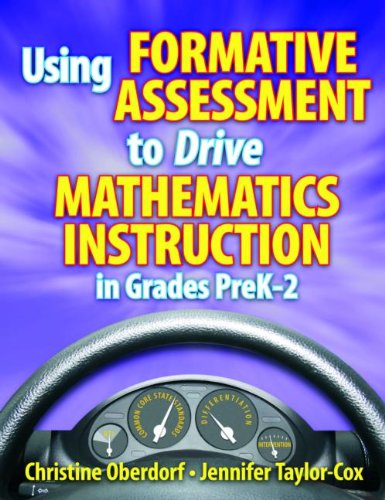
Using Formative Assessment to Drive Mathematics Instruction in Grades PreK-2


Jennifer Taylor-Cox,  Christine Oberdorf

Eye On Education | 2011 | 130 páginas | RAR - PDF | 1,75 Mb


link
(password - matav)

Provide targeted mathematics instruction for every child. These books combine formative assessment with practical activities to differentiate the elementary classroom. The formative assessments include student work samples at varying levels. The authors...Illustrate the distinction between a "traditional" assessment and an "enhanced" assessment. Describe specific differentiated activities so each student may consistently receive instruction geared to specific need. Provide teachers with "Questions to Assess" to determine what each child understands about the math concept. Show how to move students to higher-level mathematics thinking and to apply math concepts. Include extension activities to offer challenging work for children who have achieved skill mastery level. Each activity states a goal, the materials needed, a description of the activity, as well as specific questions to ask students. The assessments and activities are aligned with the Common Core State Standards for Mathematics and the expectations described by the National Council of Teachers of Mathematics. This resource will help teachers, principals, and curriculum directors identify students' levels of understanding about mathematics and provide concrete resources for remediation, instruction, and enrichment. These books are also an excellent resource for use during workshops and in-class observations. Provide targeted mathematics instruction for every child. These books combine formative assessment with practical activities to differentiate the elementary classroom. The formative assessments include student work samples at varying levels. The authors... Illustrate the distinction between a "traditional" assessment and an "enhanced" assessment. Describe specific differentiated activities so each student may consistently receive instruction geared to specific need. Provide teachers with "Questions to Assess" to determine what each child understands about the math concept. Show how to move students to higher-level mathematics thinking and to apply math concepts. Include extension activities to offer challenging work for children who have achieved skill mastery level. Each activity states a goal, the materials needed, a description of the activity, as well as specific questions to ask students. The assessments and activities are aligned with the Common Core State Standards for Mathematics and the expectations described by the National Council of Teachers of Mathematics. This resource will help teachers, principals, and curriculum directors identify students' levels of understanding about mathematics and provide concrete resources for remediation, instruction, and enrichment. These books are also an excellent resource for use during workshops and in-class observations.

terça-feira, 28 de maio de 2013

Reconceptualizing Early Mathematics Learning (Advances in Mathematics Education)


Lyn D. English, Joanne T. Mulligan
Springer | 2013 | 339 páginas | PDF | 6 Mb

minus.com
link

This book emanated primarily from concerns that the mathematical capabilities of young children continue to receive inadequate attention in both the research and instructional arenas. Research over many years has revealed that young children have sophisticated mathematical minds and a natural eagerness to engage in a range of mathematical activities.  As the chapters in this book attest, current research is showing that young children are developing complex mathematical knowledge and abstract reasoning a good deal earlier than previously thought.  A range of studies in prior to school and early school settings indicate that young learners do possess cognitive capacities which, with appropriately designed and implemented learning experiences, can enable forms of reasoning not typically seen in the early years.  Although there is a large and coherent body of research on individual content domains such as counting and arithmetic, there have been remarkably few studies that have attempted to describe characteristics of structural development in young students’ mathematics.  Collectively, the chapters highlight the importance of providing more exciting, relevant, and challenging 21st century mathematics learning for our young students.  The chapters provide a broad scope in their topics and approaches to advancing young children’s mathematical learning. They incorporate studies that highlight the importance of pattern and structure across the curriculum, studies that target particular content such as statistics, early algebra, and beginning number, and studies that consider how technology and other tools can facilitate early mathematical development. Reconceptualising the professional learning of teachers in promoting young children’s mathematics, including a consideration of the role of play, is also addressed.

Índice 

Contents
Perspectives on Reconceptualizing Early Mathematics Learning . . . . . 1
Lyn D. English and Joanne T. Mulligan
Early Mathematics Learning in Perspective: Eras and Forces of Change . 5
Kristie J. Newton and Patricia A. Alexander
Early Awareness of Mathematical Pattern and Structure. . . 29
Joanne T. Mulligan and Michael C. Mitchelmore
Reconceptualizing Early Mathematics Learning: The Fundamental Role of Pattern and Structure . 47
Joanne T. Mulligan, Michael C. Mitchelmore, Lyn D. English, and Nathan Crevensten
Reconceptualizing Statistical Learning in the Early Years . . . . . . . . . 67
Lyn D. English
Cognitive Guidelines for the Design and Evaluation of Early Mathematics Software: The Example of MathemAntics . . . . . . . . 83
Herbert P. Ginsburg, Azadeh Jamalian, and Samantha Creighan
Rethinking Early Mathematics: What Is Research-Based Curriculum for Young Children? . 121
Douglas H. Clements and Julie Sarama
Reflecting on Young Children’s Mathematics Learning . . . . . . . . . . 149
Bob Perry and Sue Dockett
Practices that Support Mathematics Learning in a Play-Based Classroom 163
Anita A. Wager
Communicating About Number: Fostering Young Children’s Mathematical Orientation in the World . . . 183
Bert van Oers
A Framework for Examining Technologies and Early Mathematics Learning . 205
Kristy Goodwin and Kate Highfield
The Role of Picture Books in Young Children’s Mathematics Learning . . 227
Marja Van den Heuvel-Panhuizen and Iliada Elia
Improving Numeracy Outcomes for Young Australian Indigenous Children .  . 253
Marina M. Papic
Enhancing Teacher Professional Development for Early Years Mathematics TeachersWorking in Disadvantaged Contexts . . . . . 283
Elizabeth Warren and Janine Quine
Mathematical Modeling at the Intersection of Elementary Mathematics,Art, and Engineering Education . . . 309
Heidi A. Diefes-Dux, Lindsay Whittenberg, and Roxanne McKee

segunda-feira, 27 de maio de 2013

Geometric Transformations IV, Circular Transformation


New Mathematical Library

I. M. Yaglom

Mathematical Association of America | 2009 | 294 páginas |  PDF | 4,51 Mb


The familiar plane geometry of secondary school - figures composed of lines and circles - takes on a new life when viewed as the study of properties that are preserved by special groups of transformations. No longer is there a single, universal geometry: different sets of transformations of the plane correspond to intriguing, disparate geometries. This book is the concluding Part IV of Geometric Transformations, but it can be studied independently of Parts I, II, and III. The present Part IV develops the geometry of transformations of the plane that map circles to circles (conformal or anallagmatic geometry). The notion of inversion, or reflection in a circle, is the key tool employed. Applications include ruler-and-compass constructions and the Poincaré model of hyperbolic geometry. The straightforward, direct presentation assumes only some background in elementary geometry and trigonometry.

sábado, 27 de outubro de 2012

Blaise Pascal: Mathematician, Physicist and Thinker About God


Donald Adamson

Palgrave Macmillan |1995 | 318 páginas | RAR - PDF | 14,96 Mb

link (password : matav)
uploading.com (password : matav)
20121027bp

This volume features a chronological survey exploring Pascal's (1623-62) achievement as a mathematician, physicist and religious thinker, and a chapter on his life. His work on conic sections, the probability calculus, number theory, cycloid curves and hydrostatics is considered in detail. Analyses of the "Provincial Letters" and the "Thoughts" bring out the distinctive features, thematic and technical, of each text. Pascal's lesser known works and the Wager argument are also studied.


Contents
List of Illustrations
List of Figures
Acknowledgments
1 Introduction
2 Foundations
3 Jansenism
4 A 'God-Inebriated Man'
5 The Provincial Letters
6 The Christian Life
7 Human Nature
8 The Wager
9 The Scriptures
10 Pascal, 'Devout Geometrician'
11 Conclusion
Notes and References
Select Bibliography
A List of Pascals Writings
Index

quinta-feira, 25 de outubro de 2012

Combinatorics of Permutations


Miklos Bona

 2.ª edição 

CRC | 2012  | 473 páginas | PDF  | 3 Mb


link

ryushare.com

A Unified Account of Permutations in Modern Combinatorics
A 2006 CHOICE Outstanding Academic Title, the first edition of this bestseller was lauded for its detailed yet engaging treatment of permutations. Providing more than enough material for a one-semester course, Combinatorics of Permutations, Second Edition continues to clearly show the usefulness of this subject for both students and researchers.
Expanded Chapters
Much of the book has been significantly revised and extended. This edition includes a new section on alternating permutations and new material on multivariate applications of the exponential formula. It also discusses several important results in pattern avoidance as well as the concept of asymptotically normal distributions.
New Chapter
An entirely new chapter focuses on three sorting algorithms from molecular biology. This emerging area of combinatorics is known for its easily stated and extremely difficult problems, which sometimes can be solved using deep techniques from seemingly remote branches of mathematics.
Additional Exercises and Problems
All chapters in the second edition have more exercises and problems. Exercises are marked according to level of difficulty and many of the problems encompass results from the last eight years.
A Unified Account of Permutations in Modern CombinatoricsA 2006 CHOICE Outstanding Academic Title, the first edition of this bestseller was lauded for its detailed yet engaging treatment of permutations. Providing more than enough material for a one-semester course, Combinatorics of Permutations, Second Edition continues to clearly show the usefulness of this subject for both students and researchers.Expanded ChaptersMuch of the book has been significantly revised and extended. This edition includes a new section on alternating permutations and new material on multivariate applications of the exponential formula. It also discusses several important results in pattern avoidance as well as the concept of asymptotically normal distributions.New ChapterAn entirely new chapter focuses on three sorting algorithms from molecular biology. This emerging area of combinatorics is known for its easily stated and extremely difficult problems, which sometimes can be solved using deep techniques from seemingly remote branches of mathematics. Additional Exercises and ProblemsAll chapters in the second edition have more exercises and problems. Exercises are marked according to level of difficulty and many of the problems encompass results from the last eight years.