segunda-feira, 27 de maio de 2013

Geometric Transformations IV, Circular Transformation


New Mathematical Library

I. M. Yaglom

Mathematical Association of America | 2009 | 294 páginas |  PDF | 4,51 Mb


The familiar plane geometry of secondary school - figures composed of lines and circles - takes on a new life when viewed as the study of properties that are preserved by special groups of transformations. No longer is there a single, universal geometry: different sets of transformations of the plane correspond to intriguing, disparate geometries. This book is the concluding Part IV of Geometric Transformations, but it can be studied independently of Parts I, II, and III. The present Part IV develops the geometry of transformations of the plane that map circles to circles (conformal or anallagmatic geometry). The notion of inversion, or reflection in a circle, is the key tool employed. Applications include ruler-and-compass constructions and the Poincaré model of hyperbolic geometry. The straightforward, direct presentation assumes only some background in elementary geometry and trigonometry.

sábado, 27 de outubro de 2012

Blaise Pascal: Mathematician, Physicist and Thinker About God


Donald Adamson

Palgrave Macmillan |1995 | 318 páginas | RAR - PDF | 14,96 Mb

link (password : matav)
uploading.com (password : matav)
20121027bp

This volume features a chronological survey exploring Pascal's (1623-62) achievement as a mathematician, physicist and religious thinker, and a chapter on his life. His work on conic sections, the probability calculus, number theory, cycloid curves and hydrostatics is considered in detail. Analyses of the "Provincial Letters" and the "Thoughts" bring out the distinctive features, thematic and technical, of each text. Pascal's lesser known works and the Wager argument are also studied.


Contents
List of Illustrations
List of Figures
Acknowledgments
1 Introduction
2 Foundations
3 Jansenism
4 A 'God-Inebriated Man'
5 The Provincial Letters
6 The Christian Life
7 Human Nature
8 The Wager
9 The Scriptures
10 Pascal, 'Devout Geometrician'
11 Conclusion
Notes and References
Select Bibliography
A List of Pascals Writings
Index

quinta-feira, 25 de outubro de 2012

Combinatorics of Permutations


Miklos Bona

 2.ª edição 

CRC | 2012  | 473 páginas | PDF  | 3 Mb


link

ryushare.com

A Unified Account of Permutations in Modern Combinatorics
A 2006 CHOICE Outstanding Academic Title, the first edition of this bestseller was lauded for its detailed yet engaging treatment of permutations. Providing more than enough material for a one-semester course, Combinatorics of Permutations, Second Edition continues to clearly show the usefulness of this subject for both students and researchers.
Expanded Chapters
Much of the book has been significantly revised and extended. This edition includes a new section on alternating permutations and new material on multivariate applications of the exponential formula. It also discusses several important results in pattern avoidance as well as the concept of asymptotically normal distributions.
New Chapter
An entirely new chapter focuses on three sorting algorithms from molecular biology. This emerging area of combinatorics is known for its easily stated and extremely difficult problems, which sometimes can be solved using deep techniques from seemingly remote branches of mathematics.
Additional Exercises and Problems
All chapters in the second edition have more exercises and problems. Exercises are marked according to level of difficulty and many of the problems encompass results from the last eight years.
A Unified Account of Permutations in Modern CombinatoricsA 2006 CHOICE Outstanding Academic Title, the first edition of this bestseller was lauded for its detailed yet engaging treatment of permutations. Providing more than enough material for a one-semester course, Combinatorics of Permutations, Second Edition continues to clearly show the usefulness of this subject for both students and researchers.Expanded ChaptersMuch of the book has been significantly revised and extended. This edition includes a new section on alternating permutations and new material on multivariate applications of the exponential formula. It also discusses several important results in pattern avoidance as well as the concept of asymptotically normal distributions.New ChapterAn entirely new chapter focuses on three sorting algorithms from molecular biology. This emerging area of combinatorics is known for its easily stated and extremely difficult problems, which sometimes can be solved using deep techniques from seemingly remote branches of mathematics. Additional Exercises and ProblemsAll chapters in the second edition have more exercises and problems. Exercises are marked according to level of difficulty and many of the problems encompass results from the last eight years.


Teachers Engaged in Research Inquiry into Mathematics Classrooms, Grades Pre K-2


Stephanie Z. Smith, Georgia State University
Marvin E. Smith, Georgia Southern University 


Information Age Publishing | 2006 | 257 páginas | RAR - PDF | 7,2 Mb


link (password : matav)


This volume was written primarily for teachers who have developed (or who are being encouraged to develop) an awareness of and commitment to teaching mathematics for understanding. The research findings presented in these chapters suggest instructional implications worthy of these teachers’ consideration. Often, the authors in this volume describe instructional practices or raise issues that have the potential to broaden views of teaching and learning mathematics. These chapters provide interesting problems and tasks used in the authors’ work that readers can use in their own classrooms.

CONTENTS
Introduction to the Series, Marilyn Cochran-Smith.
Introduction to the Pre-K–2 Volume, Stephanie Z. Smith and Marvin E. Smith.
Using Your Own Teaching as a Site for Research into Practice, Mary Kay Archer, Theresa J. Grant, and Kate Kline.
Mathematical Argument in a Second Grade Class: Generating and Justifying Generalized Statements about Odd and Even Numbers, Annie Keith.
Teacher as Researcher: Research as a Partnership,Karen Schweitzer. A Look at a Child’s Understanding of Mathematical Ideas through His Representations, Ana Vaisenstein.
Using Children’s Understandings of Linear Measurement to Inform Instruction, Linda Jaslow and Tanya Vik.
Classroom Research Informs Measure Up: A Different Look at Elementary Mathematics, Claire Okazaki, Fay Zenigami, and Barbara Dougherty.
You Changed My Mind about Triangles! Laurie Renfro.
Using Classroom Assessment to Support Growth of Number Sense in First Grade, Laurie Hands.
Uncovering Children’s Thinking about Pattern: Teacher-Researchers Improving Classroom Practice, Regina Wicks and Rita Janes.

Livros da mesma série, disponíveis no blog:


Teachers Engaged in Research: Inquiry in Mathematics Classrooms, Grades 3-5

sábado, 20 de outubro de 2012

Creativity, Giftedness, and Talent Development in Mathematics


Bharath Sriraman, The University of Montana 

The Montana Mathematics Enthusiast, Monograph 4 | 2008 | RAR - PDF | 2,59 Mb


link direto uploading.com (password : matav)
20121020cgtdm

Our innovative spirit and creativity lies beneath the comforts and security of today's technologically evolved society. Scientists, inventors, investors, artists and leaders play a vital role in the advancement and transmission of knowledge. Mathematics, in particular, plays a central role in numerous professions and has historically served as the gatekeeper to numerous other areas of study, particularly the hard sciences, engineering and business. Mathematics is also a major component in standardized tests in the U.S., and in university entrance exams in numerous parts of world. 
Creativity and imagination is often evident when young children begin to develop numeric and spatial concepts, and explore mathematical tasks that capture their interest. Creativity is also an essential ingredient in the work of professional mathematicians. Yet, the bulk of mathematical thinking encouraged in the institutionalized setting of schools is focused on rote learning, memorization, and the mastery of numerous skills to solve specific problems prescribed by the curricula or aimed at standardized testing. Given the lack of research based perspectives on talent development in mathematics education, this monograph is specifically focused on contributions towards the constructs of creativity and giftedness in mathematics. This monograph presents new perspectives for talent development in the mathematics classroom and gives insights into the psychology of creativity and giftedness. The book is aimed at classroom teachers, coordinators of gifted programs, math contest coaches, graduate students and researchers interested in creativity, giftedness, and talent development in mathematics.


CONTENTS
Table of Contents. 

Preface Bharath Sriraman 
1. The characteristics of mathematical creativity Bharath Sriraman
2. Mathematical giftedness, problem-solving and the ability to formulate generalizations. Bharath Sriraman 
3. Gifted ninth graders' notions of proof: Investigating parallels in approaches of mathematically gifted students and professional mathematicians Bharath Sriraman 
4. Are mathematical giftedness and mathematical creativity synonyms? A theoretical analysis of constructs. Bharath Sriraman 
5. Does mathematics gifted education need a working philosophy of creativity? Viktor Freiman & Bharath Sriraman 
6. Designing opportunities for all students to demonstrate mathematical prowess Sylvia Bulgar 
7. Problems to discover and to boost mathematical talent in early grades: A challenging situations approach Viktor Freiman 
8. Mathematical problem solving processes of Thai gifted students Supattra Pattivisan & Margaret L. Niess 
9. Knowledge as a manifestation of talent: Creating opportunities for the gifted. Alexander Karp 
10. An ode to Imre Lakatos: Bridging the ideal and actual mathematics classrooms Bharath Sriraman 
11. Mathematically gifted Korean elementary students' revisiting of Euler's polyhedron theorem Jaehoon Yim, Sanghun Song & Jiwon Kim 
12. Mathematically promising students from the space age to the information age Linda Sheffield 
13. Revisiting the needs of the gifted mathematics students: Are students surviving or thriving? Alan Zollman 
14. Playing with Powers Bharath Sriraman & Pawel Strzelecki


Functions, Data and Models: An Applied Approach to College Algebra


Sheldon P. Gordon, Florence S. Gordon


Mathematical Association of America | 2010 | 509 páginas | RAR - PDF | 3,10Mb


link  (password : matav)
uploading.com (password : matav)
20121020fdm


Functions, Data, and Models is a college-level algebra textbook that is written to provide the kind of mathematical knowledge and experience that students will need for courses in other fields such as biology, chemistry, business, finance, economics, and other areas that are heavily dependent on data either from laboratory experiments or from other studies. The book focuses on fundamental mathematical concepts and realistic problem-solving via mathematical modeling rather than the development of algebraic skills.
Functions, Data and Models presents college algebra in a way that differs from almost all college algebra books available today. The authors teach something new rather than covering the same ground as high school courses. By changing the content of the course, the authors are able to give students an introduction to data analysis and mathematical modeling that even students with limited algebraic skills can handle. The book contains rich exercises, many of which use real data. Also included are thought experiments or what if questions that are meant to stretch the student's mathematical thinking.
Contents: 1. Data Everywhere; 2. Functions Everywhere; ;3. Linear Functions; 4. More About Linear Functions; 5. Families of Nonlinear functions; 6. Polynomial Functions; 7. Extended Families of Functions; 8. Modeling Periodic Phenomena. Appendics: Absolute Values; Factorial Notation n!; Summation Notation; Statistical Calculations on TI Calulators; Statistical Calculations using Excel; Algebra of Linear Functions; Solving Equations Graphically; Zoom-and-Trace; Linear Regression on TI Calculators; Linear Regression in Excel; Solving Systems of Linear Equations Algebraically; Curve Fitting in Excel; Symmetry; Arithmetic of Complex Numbers; 2009 World Population Data.

quinta-feira, 18 de outubro de 2012

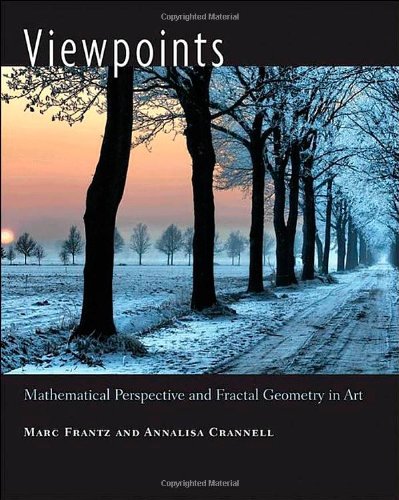
Viewpoints: Mathematical Perspective and Fractal Geometry in Art


Marc Frantz,  Annalisa Crannell


Princeton University Press | 2011 | 258 páginas | PDF  | 7,7 Mb


link uploaded.net
ryushare.com


An undergraduate textbook devoted exclusively to relationships between mathematics and art, Viewpoints is ideally suited for math-for-liberal-arts courses and mathematics courses for fine arts majors. The textbook contains a wide variety of classroom-tested activities and problems, a series of essays by contemporary artists written especially for the book, and a plethora of pedagogical and learning opportunities for instructors and students.Viewpoints focuses on two mathematical areas: perspective related to drawing man-made forms and fractal geometry related to drawing natural forms. Investigating facets of the three-dimensional world in order to understand mathematical concepts behind the art, the textbook explores art topics including comic, anamorphic, and classical art, as well as photography, while presenting such mathematical ideas as proportion, ratio, self-similarity, exponents, and logarithms. Straightforward problems and rewarding solutions empower students to make accurate, sophisticated drawings. Personal essays and short biographies by contemporary artists are interspersed between chapters and are accompanied by images of their work. These fine artists--who include mathematicians and scientists--examine how mathematics influences their art. Accessible to students of all levels, Viewpoints encourages experimentation and collaboration, and captures the essence of artistic and mathematical creation and discovery.Classroom-tested activities and problem solving Accessible problems that move beyond regular art school curriculum Multiple solutions of varying difficulty and applicability Appropriate for students of all mathematics and art levels Original and exclusive essays by contemporary artists Solutions manual (available only to teachers)