quarta-feira, 10 de outubro de 2012

La Matematica Como una de las Bellas Artes


Pablo Amster

Siglo XXI Argentina | 2006 | 130 páginas | PDF 

scribd.com
files.cuba-exactas.webnode.com.ar (link direto)
edukativos.com

Este libro es una caja de sorpresas, comenzando por la mas obvia: el autor intenta convencernos, y curiosamente lo logra, de que puede haber belleza en las matematicas. Una belleza tanto clasica como romantica, usualmente reservada a esos seres que pasan sus dias frente a un pizarron lleno de formulas extranas, pero a la que gracias a este pequeno gran libro podemos asomar las narices y deleitarnos en esta temeraria mezcla de ciencia y arte. El poeta portugues Fernando Pessoa (extensamente citado en el libro) afirmo que el binomio de Newton es tan hermoso como la Venus de Milo; lo que pasa es que muy poca gente se da cuenta. Gracias a Pablo Amster, este texto nos ayuda a darnos cuenta de tanta belleza despilfarrada por el mundo.


Prefacio 11
Capítulo 1. Una historia de amor 17
Fin y comienzo 19
¿Belleza matemática? 21
La Matemática no es el arte 33
Fernando Pessoa 34
La Matemática será tautológica 37
Capítulo 2. El poeta es un fingidor 45
La belleza clásica en los hechos matemáticos 49
La belleza romántica en los hechos matemáticos 53
La belleza en los métodos 74
Capítulo 3. Todos los matemáticos son mentirosos 85
Yo miento 85
No tan bien hecho 87
Representación e interpretación 90
El disparate no es de este mundo 95

El Zen en el arte de equivocarse con confianza 103
Un deseo que destroza el sistema 106
Una trama secreta 108
Capítulo 4. La mano de la princesa 111
Fondo y figura 111
El infinito 114
Una demostración fuera de serie 116
Bach explicado 118
Un texto que se explica a sí mismo 119
Epílogo
Último momento: la princesa se divorcia 121
Bibliografía comentada 123

Geometric Folding Algorithms: Linkages, Origami, Polyhedra

Erik D. Demaine, Joseph O'Rourke


Cambridge University Press | 2007 | 496 páginas | PDF | 11 Mb

link direto
legalreads.com
legalreads.com

Link sobre o livro: www.gfalop.org/

How can linkages, pieces of paper, and polyhedra be folded? The authors present hundreds of results and over 60 unsolved 'open problems' in this comprehensive look at the mathematics of folding, with an emphasis on algorithmic or computational aspects. Folding and unfolding problems have been implicit since Albrecht Dürer in the early 1500s, but have only recently been studied in the mathematical literature. Over the past decade, there has been a surge of interest in these problems, with applications ranging from robotics to protein folding. A proof shows that it is possible to design a series of jointed bars moving only in a flat plane that can sign a name or trace any other algebraic curve. One remarkable algorithm shows you can fold any straight-line drawing on paper so that the complete drawing can be cut out with one straight scissors cut. Aimed primarily at advanced undergraduate and graduate students in mathematics or computer science, this lavishly illustrated book will fascinate a broad audience, from high school students to researchers.

The Math Gene: How Mathematical Thinking Evolved And Why Numbers Are Like Gossip


Keith Devlin

Basic Books| 2001 | 352 Páginas| EPUB | 0,9 Mb

filepost.com
link

Why is math so hard? And why, despite this difficulty, are some people so good at it? If there’s some inborn capacity for mathematical thinking—which there must be, otherwise no one could do it —why can’t we all do it well? Keith Devlin has answers to all these difficult questions, and in giving them shows us how mathematical ability evolved, why it’s a part of language ability, and how we can make better use of this innate talent. He also offers a breathtakingly new theory of language development—that language evolved in two stages, and its main purpose was not communication—to show that the ability to think mathematically arose out of the same symbol-manipulating ability that was so crucial to the emergence of true language. Why, then, can’t we do math as well as we can speak? The answer, says Devlin, is that we can and do—we just don’t recognize when we’re using mathematical reasoning.

Outros livros do mesmo autor, disponíveis no blog:


Mathematics: The New Golden Age, Penguin (1988)
Life by the Numbers, John Wiley & Sons (1998)

The Language of Mathematics: Making the Invisible Visible, W.H. Freeman & Company (1998)

Sets, Functions, and Logic: An Introduction to Abstract Mathematics , CRC (2003)
The Numbers Behind NUMB3RS: Solving Crime with Mathematics, Plume (2007)
The Unfinished Game: Pascal, Fermat, and the Seventeenth-Century Letter that Made the World Modern, Basic Books (2008)
Mathematics Education for a New Era: Video Games as a Medium for Learning, A K Peters (2011)

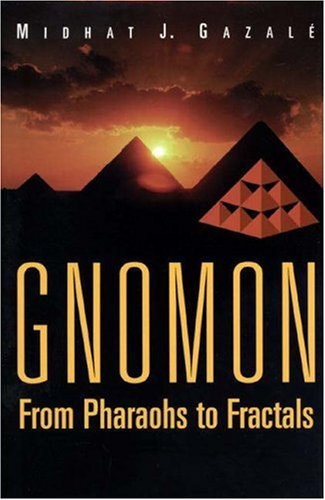
Gnomon: From Pharaohs to Fractals

Midhat Gazale 

Princeton University Press| 1999 | 288 páginas | djvu | 8,6 Mb

link
link1

 RAR - djvu | 8,66 Mb
uploading.com (password : matav)
20121010gpf


The beaver's tooth and the tiger's claw. Sunflowers and seashells. Fractals, Fibonacci sequences, and logarithmic spirals. These diverse forms of nature and mathematics are united by a common factor: all involve self-repeating shapes, or gnomons. Almost two thousand years ago, Hero of Alexandria defined the gnomon as that form which, when added to some form, results in a new form, similar to the original. In a spiral seashell, for example, we see that each new section of growth (the gnomon) resembles its predecessor and maintains the shell's overall shape. Inspired by Hero, Midhat Gazalé--a fellow native of Alexandria--explains the properties of gnomons, traces their long and colorful history in human thought, and explores the mathematical and geometrical marvels they make possible.
Gazalé is a man of wide-ranging interests and accomplishments. He is a mathematician and engineer who teaches at the University of Paris and whose business career lifted him to the Presidency of AT&T-France. He has a passion for numbers that is clear on every page, as he combines elegant mathematical explanations with compelling anecdotes and a rich variety of illustrations. He begins by explaining the basic properties of gnomons and tracing the term--which originally meant "that which allows one to know"--to ancient Egyptian and Greek timekeeping. Gazalé examines figurate numbers, which inspired the Greek notions of gnomon and number similarity. He introduces us to continued fractions and guides us through the intricacies of Fibonacci sequences, ladder networks, whorled figures, the famous "golden number," logarithmic spirals, and fractals. Along the way, he draws our attention to a host of intriguing and eccentric concepts, shapes, and numbers, from a complex geometric game invented by the nineteenth-century mathematician William Hamilton to a peculiar triangular shape that Gazalé terms the "winkle." Throughout, the book brims with original observations and research, from the presentation of a cousin of the "golden rectangle" that Gazalé calls the "silver pentagon" to the introduction of various new fractal figures and the coining of the term "gnomonicity" for the concept of self-similarity.
This is an erudite, engaging, and beautifully produced work that will appeal to anyone interested in the wonders of geometry and mathematics, as well as to enthusiasts of mathematical puzzles and recreations.

Contents
Gnomons 
Figurate and m-adic numbers
Continued fractions
Fibonacci sequences 
Ladders: from Fibonacci to wave propagation 
Whorled figures
The golden number
The silver number
Spirals
Positional number systems 
Fractals.


Teachers Engaged in Research Inquiry into Mathematics Classrooms, Grades 9-12


Laura R. Van Zoest, Western Michigan University 

Information Age Publishing | 2006 | 292 páginas | RAR - PDF | 1,8 Mb

link (password : matav)

This book provides examples of the ways in which 9-12 grade mathematics teachers from across North America are engaging in research. It offers a glimpse of the questions that capture the attention of teachers, the methodologies that they use to gather data, and the ways in which they make sense of what they find. The focus of these teachers' investigations into mathematics classrooms ranges from students' understanding of content to pedagogical changes to social issues. Underlying the chapters is the common goal of enabling students to develop a deep understanding of the mathematics they learn in their classrooms. By opening their analysis of their classroom practice to our inspection, these courageous teachers have invited us to think along with them and to learn more about our own teaching as a result. By sharing their work, they have given the mathematics education community an important opportunity. Everyone who reads this book-teachers, researchers, teacher-researchers, policy makers, administrators, and others interested in mathematics education-can learn from the findings and the light that they shed on issues important to mathematics education. This book, and the series of which it is a part, also provides the opportunity to step back and reflect on what can be learned about research from teachers who have engaged in the process. Areas of insight include: (a) the importance of collaboration and participation in communities that value research, (b) the potential of teacher research as a way to warrant teacher practice, (c) the power of video and other artifacts of teaching to support classroom inquiry, (d) connections between teaching and research, and (e) the publication process as professional development.

CONTENTS
Introduction to the Series, Marilyn Cochran-Smith. 
Introduction to the 9–12 Volume, Laura R. Van Zoest.
Probability Simulation: What a Teaching Experiment Revealed About Student Reasoning and Beliefs, Gwendolyn Zimmermann. 
Student Understanding of the Concept of Limit in a Technological Environment, William J. Harrington. Using Research to Analyze, Inform, and Assess Changes in Instruction, Heather J. Robinson. 
From Teachers’ Conversations to Students’ Mathematical Communications, Florence Glanfield, Ann Oviatt e Darlene Bazcuk. 
Lessons Teachers Can Learn About Students’ Mathematical Understanding Through Conversations With Them About Their Thinking: Implications for Practice, Craig Huhn, Kellie Huhn, e Peg Lamb. 
Navigating the Learning Curve: Learning to Teach Mathematics Through Lesson Study, John Carter, Robert Gammelgaard, e Michelle Pope. 
Learning From Elementary School Mathematics Research: Changes in the Beliefs and Practices of Secondary School Teachers, Scott Hendrickson e Sharon Christensen, com Vicki Lyons e Adrianne Olson. 
Giving Voice to Success in Mathematics Class, P. Janelle McFeetors.
Exploring Culture and Pedagogy in Mathematics Class Through Student Interviews, Jesse Solomon. 
Teaching Mathematics With Problems: What One Teacher Learned Through Research, Nicole Garcia e Patricio G. Herbst. 
Refreshing Mathematics Instruction Through Motion, Technology, and a Research Collaboration, Apolinário Barros e Dorina Sackman. 
Collaborating to Investigate and Improve Classroom Mathematics Discourse, Maureen Grant e Rebecca McGraw. 
Professional Development as a Catalyst for Classroom Change, Michael Verkaik e Beth Ritsema.

Livro relacionado, disponível no blog:


Teachers Engaged in Research: Inquiry in Mathematics Classrooms, Grades 3-5


terça-feira, 9 de outubro de 2012

Math Dictionary With Solutions: A Math Review

Chris Kornegay 

2.ª Edição 

Sage Publications |1999 | 577 páginas | RAR - PDF |17,03 Mb

uploading.com (password : matav)
20121009md

If you've ever taken a graduate statistics course and discovered that you've forgotten how to divide a fraction or turn a fraction into a percentage, then this handy guide to mathematics is for you. Each topic is provided with a definition, explanation, and examples of how to solve a particular problem using the topic's technique. With ample cross-referencing, this guide is the perfect reference for researchers working with numbers, who need a review of mathematical concepts.

Contemporary Perspectives on Mathematics in Early Childhood Education


Olivia Saracho, University of Maryland 

Bernard Spodek, University of Illinois 

Information Age Publishing | 2007 | 346 páginas | RAR - PDF | 2,32 Mb

Nenhum link disponível

This volume provides a comprehensive critical analysis of the research in mathematics education for young children. The researchers who conducted the critical analysis focused on the relationship between (1) mathematics learning in the early years and domain specific approaches to cognitive development, (2) the children’s social learning and their developing understanding of math, and (3) the children’s learning in a natural context and their understanding of mathematics concepts. The work of these scholars can help guide those researchers who are interested in pursuing studies in early childhood mathematics in a specific area of study. This volume will facilitate the research conducted by both novice and expert researchers. The volume has accomplished its major goals, which consists of critically analyzing important research in a specific area that would be most useful in advancing the field and provide recommendations for both researchers and educators.


CONTENTS
Introduction: Trends in Early Childhood Mathematics Research, Olivia N. Saracho e Bernard Spodek. History of Mathematics in Early Childhood Education, Olivia N. Saracho e Bernard Spodek. Rethinking the Starting Point for Mathematics Learning, Catherine Sophian. 
Knowing the Mathematics in Early Childhood Mathematics,Herbert P. Ginsburg e Barbrina Ertle. Mathematics in Early Childhood, Julie Sarama e Douglas H. Clements. 
Mathematics Learning and Teaching in the Early Years, Ann Anderson, Jim Anderson, e Carolyn Thauberge. 
Development of Children’s Mathematical Thinking in Early School Years, Jennifer M. Young-Loveridge. 
Development of Mathematical Reasoning among Young Children: How Do Children Understand Area and Length? William M. Bart, Masamichi Yuzawa, e Miki Yuzawa. 
The Impact of Method on Assessing Young Children’s Everyday Mathematical Experiences, Jonathan Tudge, LinLin Li, e Tiffany Kinney Stanley. 
An Examination of the Role of Statistical Investigation in Supporting the Development of Young Children’s Statistical Reasoning, Aisley Leavy. 
Research on Spatial Skills and Block Building in Girls and Boys: The Relationship to Later Mathematics Learning, Joanne Kersh, Beth M. Casey, e Jessica Mercer Young. 
Sociocultural Influences on Young Children’s Mathematical Knowledge, Prentice Starkey and Alice Klein. 
Parental Guidance of Numeracy Development in Early Childhood, Maureen Vandermaas-Peeler. 
Do Parents Count?: The Socialization of Children’s Numeracy, Joann P. Benigno e Shari Ellis. Research Perspectives in Early Childhood Mathematics, Olivia N. Saracho e Bernard Spodek. 
About the Contributors.