terça-feira, 19 de junho de 2012

Multiple Perspectives on Difficulties in Learning Literacy and Numeracy


Claire Wyatt-Smith, John Elkins e Stephanie Gunn

Springer | 2010 | : 422 Páginas | PDF | 2,89 Mb


  • Features coverage at the intersection of literacy education, numeracy education and learning disabilities, which traditionally have tended to be addressed separately by researchers and policy makers
  • Draws upon diverse theoretical perspectives in the common goal of improved learning especially for students who are struggling to achieve expected standards
  • Includes contributions by international experts
This book advances understandings of the difficulties in learning that students experience in the key areas of literacy and numeracy and the interventions that have been used to improve outcomes. By including authors drawn from several countries and with expertise in a variety of research traditions, the book addresses the sometimes complementary and sometimes contradictory results, and generates new approaches to understanding and serving students with difficulties in literacy and numeracy. A distinctive feature of the book is its focus at the intersection of literacy education, numeracy education and learning difficulties. Traditionally these have tended to be addressed separately by researchers and policy makers, leading to compartmentalised thinking and often demonstrates lack of awareness of developments in the other domains. In short, to date there has been limited exchange across these fields. Further, the published research and indeed policy attention indicates a relative imbalance given to literacy and numeracy education and learning difficulties relative to these more generally. The authors in this book respond to this by providing a more balanced coverage of these fields and extend the discussion into the contribution of information and communication technologies. This book brings together for the first time internationally recognised scholars from a diverse range of countries whose contributions provide an opening for new insights into difficulties in learning literacy and numeracy from a range of educational policy and practice contexts.

Índice

Contents Acknowledgements About the contributors List of figures List of tables Chapter 1 Theoretical frameworks and ways of seeing: Operating at the intersection—literacy, numeracy and learning difficulties Claire Wyatt-Smith & John Elkins, Griffith University, Australia Chapter 2 Learning difficulties, literacy and numeracy: Conversations across the fields Stephanie Gunn & Claire Wyatt-Smith, Griffith University, Australia Chapter 3 Researching the opportunities for learning for students with learning difficulties in classrooms: An ethnographic perspective Judith Green & Beth Yeager, University of California, Santa Barbara, United States, & Maria Lucia Castanheira, Federal University of Minas Gerais, Brazil Chapter 4 The new literacies of online reading comprehension: New opportunities and challenges for students with learning difficulties Jill Castek, University of California, Berkeley, Lisa Zawilinski, J. Greg McVerry, W. Ian O’Byrne & Donald J. Leu, University of Connecticut, United States Chapter 5 Literacy, technology and the Internet: What are the challenges and opportunities for learners with reading difficulties, and how do we support them in meeting those challenges and grasping those opportunities? Colin Harrison, University of Nottingham, United Kingdom Chapter 6 Essential provisions for quality learning support: Connecting literacy, numeracy and learning needs Peta Colbert, Griffith University, Australia Chapter 7 Reading the home and reading in school: Framing deficit constructions as learning difficulties in Singapore English classrooms Anneliese Kramer-Dahl & Dennis Kwek, National Institute of Education/Nanyang Technological University, Singapore Chapter 8 Parent, family and community support for addressing difficulties in literacy Janice Wearmouth, University of Bedfordshire, Bedford, United Kingdom & Mere Berryman, Poutama Pounamu Education Research and Development Centre, New Zealand Chapter 9 Enhancing reading comprehension through explicit comprehending strategy teaching John Munro, The University of Melbourne, Australia Chapter 10 The writing achievement, metacognitive knowledge of writing and motivation of middle-school students with learning difficulties Christina E. van Kraayenoord, Karen B. Moni, Anne Jobling & Robyn Miller, The University of Queensland, Australia; John Elkins, Griffith University, Australia & David Koppenhaver, Appalachian State University, Boone, North Carolina, United States Chapter 11 The role of self-monitoring in initial word recognition learning Robert M. Schwartz, Oakland University, Michigan & Patricia A. Gallant, University of Michigan-Flint, Michigan, United States Chapter 12 Effective instruction for older, low-progress readers: Meeting the needs of Indigenous students Kevin Wheldall & Robyn Beaman, Macquarie University, Australia Chapter 13 Actualising potential in the classroom: Moving from practising to be numerate towards engaging in the literate practice of mathematics Raymond Brown, Griffith University, Australia Chapter 14 Effective instruction in mathematics for students with learning difficulties Marjorie Montague, University of Miami, Florida, United States Chapter 15 Language, culture and learning mathematics: A Bourdieuian analysis of Indigenous learning Robyn Jorgensen (Zevenbergen), Griffith University, Australia and Nyangatjatjara Aboriginal Corporation, Yulara, Northern Territory, Australia Chapter 16 ‘She’s not in my head or in my body’: Developing identities of exclusion and inclusion in whole-class discussions Laura Black, University of Manchester, United Kingdom Chapter 17 Breaking down the silos: The search for an evidentiary base John Elkins & Claire Wyatt-Smith, Griffith University, Australia Index

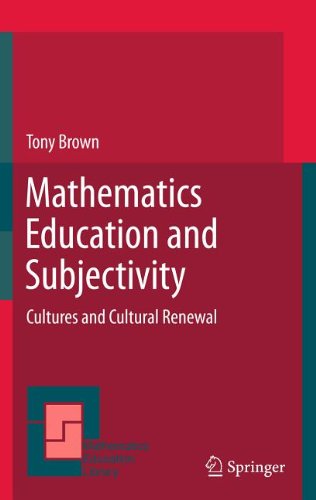
Mathematics Education and Subjectivity


Cultures and Cultural Renewal

Tony Brown

Springer | 2011| 174 páginas | PDF | 3,3 Mb


Considers how learners and teachers in different cultural settings construct mathematical knowledge as a result of their socially determined needs.
Introduces cutting edge theories of subjectivity
Shows how mathematics can provoke alternative ways of thinking towards enlivening our transformative capacities
This book rethinks mathematical teaching and learning with view to changing them to meet or resist emerging demands. Through considering how teachers, students and researchers make sense of their worlds, the book explores how some linguistic and socio-cultural locations link to prevalent conceptions of mathematics education. The locations include classroom mathematics, spatial awareness, media images of mathematics, curriculum development, teacher education and mathematics education research itself. The book introduces cutting edge theories of subjectivity that trouble more familiar psychological theories of “humans” apprehending mathematical “concepts”. Rather, it suggests that our senses of self and of mathematics result from self-reflections within the various localities in which we live. In foregrounding subjectivity the book shows how mathematics can provoke alternative ways of thinking towards enlivening our transformative capacities. Learning itself is depicted as participation in cultural renewal, where the very mathematics encountered is becoming something new. Addressing teachers, teacher educators and researchers, the book invites the reader to contemplate alternative trajectories of change into fresh ways of being.


Contents
About the author. - Acknowledgements. - 1 Introduction. – 2 The regulation of spatial perception.- 3 Cultural mediation of mathematics.- 4 Teacher conceptions of curriculum. 5 Subjectivity in mathematics education research.- 6 Lacanian subject of mathematical learning.- 7 The cultural renewal of mathematical learning.- 8 The political shaping of mathematical learning.- 9 Concluding remarks.- References.- Index.

Proof and Proving in Mathematics Education


The 19th ICMI Study

New ICMI Study Series, Vol. 15

Hanna, Gila; de Villiers, Michael (Eds.)

Springer | 2012 | 475 páginas | PDF | 7,23 Mb

uploading.com
link

  • First comprehensive book covering a wide range of aspects related to the teaching and learning of proof
  • Provides illustrative examples of proof practices and activities in different contexts and levels
  • Extensive survey of available research findings, and indicating directions for future research
One of the most significant tasks facing mathematics educators is to understand the role of mathematical reasoning and proving in mathematics teaching, so that its presence in instruction can be enhanced. This challenge has been given even greater importance by the assignment to proof of a more prominent place in the mathematics curriculum at all levels.
Along with this renewed emphasis, there has been an upsurge in research on the teaching and learning of proof at all grade levels, leading to a re-examination of the role of proof in the curriculum and of its relation to other forms of explanation, illustration and justification.
This book, resulting from the 19th ICMI Study, brings together a variety of viewpoints on issues such as:
  • The potential role of reasoning and proof in deepening mathematical understanding in the classroom as it does in mathematical practice. 
  • The developmental nature of mathematical reasoning and proof in teaching and learning from the earliest grades.
     
  • The development of suitable curriculum materials and teacher education programs to support the teaching of proof and proving.
The book considers proof and proving as complex but foundational in mathematics. Through the systematic examination of recent research this volume offers new ideas aimed at enhancing the place of proof and proving in our classrooms.

Table of contents
1. Aspects of proof in mathematics education: Gila Hanna and Michael de Villiers.- Part I: Proof and cognition.- 2. Cognitive development of proof: David Tall, Oleksiy Yevdokimov, Boris Koichu, Walter Whiteley, Margo Kondratieva, and Ying-Hao Cheng .- 3. Theorems as constructive visions: Giuseppe Longo.- Part II: Experimentation: Challenges and opportunities.- 4. Exploratory experimentation: Digitally-assisted discovery and proof: Jonathan M. Borwein.- 5. Experimental approaches to theoretical thinking: Artefacts and proofs.- Ferdinando Arzarello, Maria Giuseppina Bartolini Bussi, Allen Leung, Maria Alessandra Mariotti, and Ian Stevenson (With response by J. Borwein and J. Osborn).- Part III: Historical and educational perspectives of proof.- 6. Why proof?  A historian’s perspective: Judith V. Grabiner.- 7. Conceptions of proof – in research and in teaching: Richard Cabassut, AnnaMarie Conner, Filyet Asli Ersoz, Fulvia Furinghetti, Hans Niels Jahnke, and Francesca Morselli.- 8. Forms of proof and proving in the classroom: Tommy Dreyfus, Elena Nardi, and Roza Leikin.- 9. The need for proof and proving: mathematical and pedagogical perspectives: Orit Zaslavsky, Susan D. Nickerson, Andreas Stylianides, Ivy Kidron, and Greisy Winicki.- 10. Contemporary proofs for mathematics education: Frank Quinn.- Part IV: Proof in the school curriculum.- 11. Proof, Proving, and teacher-student interaction: Theories and contexts: Keith Jones and Patricio Herbst.- 12. From exploration to proof production: Feng-Jui Hsieh, Wang-Shian Horng, and Haw-Yaw Shy.- 13. Principles of task design for conjecturing and proving: Fou-Lai Lin, Kyeong-Hwa Lee, Kai-Lin Yang, Michal Tabach, and Gabriel Stylianides.- 14. Teachers’ professional learning of teaching proof and proving: Fou-Lai Lin, Kai-Lin Yang, Jane-Jane Lo, Pessia Tsamir, Dina Tirosh, and Gabriel Stylianides.- Part V: Argumentation and transition to tertiary level.- 15. Argumentation and proof in the mathematics classroom: Viviane Durand-Guerrier, Paolo Boero, Nadia Douek, Susanna Epp, and Denis Tanguay.- 16. Examining the role of logic in teaching proof: Viviane Durand-Guerrier, Paolo Boero, Nadia Douek, Susanna Epp, and Denis Tanguay.- 17. Transitions and proof and proving at tertiary level: Annie Selden.- Part VI: Lessons from the Eastern cultural traditions.- 18. Using documents from ancient China to teach mathematical proof: Karine Chemla .- 19. Proof in the Western and Eastern traditions: Implications for mathematics education: Man Keung Siu.- Acknowledgements.- Appendix 1: Discussion Document.- Appendix 2: Conference Proceedings: Table of contents.- Author Index.- Subject Index.

Actas do Encontro

Fou-Lai Lin, Feng-Jui Hsieh
Gila Hanna, Michael de Villiers

The Department of Mathematics, National Taiwan Normal University | 2009 | PDF

vol 1
140.122.140.1 (link direto)

vol 2
140.122.140.1 (link direto)

segunda-feira, 18 de junho de 2012

Mathematics as an Educational Task

Hans Freudenthal

Springer | 1972 | 692 páginas | PDF | djvu | 5 Mb

New Mathematics has been a slogan for a decade. Modern mathemtics, interpreted according to the letter, kills education; interpreted according to its spirit, it may give life. The author placesmathematics into its historical, developmental, and social context, and mathematics education into the context of general education, as it has developed and still continues to develop. At he summit of scientific production ot os gemera;;y acknowledged that mathematics is an activity rather than a well-established stock of knowledge. The author's teaching philosophy maintains that this applies to all levels of the learning process. These levels have been analyzed in numerous examples. This general theory is followed by an analysis of several crucial concepts and domains. In contrast to the modern tendency of overstressing the cardinal aspects, the number concepts is scrutinized from a wide spectrum of logical and developmental aspects. The author shows what the use of set theory are, while at the same time warning against its misuse. Geometry is no longer regarded as being summit of deductivity; its task is now seen as that of exploring the space we live in, and of offering a field of mathematical acitvity.

The Impact of Reform Instruction on Student Mathematics Achievement


An Example of a Summative Evaluation of a Standards-Based Curriculum 

(Studies in Mathematical Thinking and Learning Series)

Thomas Romberg,  Mary C. Shafer

Routledge | 2008 | 185 páginas | rar - PDF | 2 Mb

 link
password: matav

Summarizing data derived from a four-year combined longitudinal/ cross-sectional comparative study of the implementation of one standards-based middle school curriculum program, Mathematics in Context, this book demonstrates the challenges of conducting comparative longitudinal research in the reality of school life.
The study was designed to answer three questions:
  • What is the impact on student performance of the Mathematics in Context instructional approach, which differs from most conventional mathematics texts in both content and expected pedagogy?

  • How is this impact different from that of traditional instruction on student performance?

  • What variables associated with classroom instruction account for variation in student performance?
The researchers examined a range of variables that affected data collection. These variations highlight the need to study the effects of the culture in which student learning is situated when analyzing the impact of standards-based curricula on student achievement.
This book is directed to educational researchers interested in curriculum implementation, mathematics educators interested in the effects of using reform curriculum materials in classrooms, evaluators and research methodologists interested in structural modeling and scaling of instructional variables, and educational policy makers concerned about reform efforts.

Invitation to Number Theory

(New Mathematical Library)
Oystein Ore

Mathematical Assn of America | 1969 | 129 páginas | PDF | 3,16 Mb

scribd.com
estoyanov.net (link direto)

Djvu | 1,1 Mb 
link
linkl


Number theory has been instrumental in introducing many of the most distinguished mathematicians, past and present, to the charms and mysteries of mathematical research. The purpose of this simple little guide will have been achieved if it should lead some of its readers to appreciate why the properties of numbers can be so fascinating. It would be better still if it would induce you to try to find some number relations of your own; new curiosities devised by young people turn up every year. In any case, you will become familiar with some of the special mathematical concepts and methods used in number theory and will be prepared to embark upon the study of the more advanced books in its rich literature.

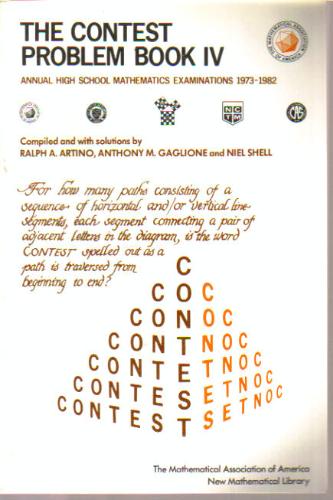
The Contest Problem Book IV


Annual High School Examinations, 1973-1982

Ralph A. Artino, Anthony M. Gaglione, Niel Shell

The Mathematical Association of America | 1982 | 198 páginas | PDF | 4,2 Mb


 djvu | 798 kb


This text contains the problems from the (American) Annual High School Mathematics Examinations (AHSME), from the years 1973 - 1982, their answers, and their solutions. The problems, which range from relatively straightforward calculations to fiendishly difficult problems that require considerable ingenuity to solve, draw upon algebra, geometry, trigonometry, number theory, combinatorics, probability, and logic. No calculus is assumed, but it can sometimes be employed to solve a problem. The problems, which are meant to be done without a calculator, increase in difficulty within each examination.

The 1973 examination consisted of 35 questions. It had four parts of 10, 10, 10, and 5 questions, worth 3, 4, 5, and 6 points each. A wrong answer resulted in a deduction of 1/4 of the point value of the question. From 1974 - 1982, the examinations consisted of 30 questions. From 1974 - 1977, each question was worth five points, with one point deducted for wrong answers. From 1978 - 1982, the score was obtained by adding 30 points to four times the number of correct responses and then subtracting the number of wrong answers. Thus, starting in 1978, it was no longer possible to obtain a negative score. From 1973 - 1977, students were given 80 minutes to complete the examination. From 1978 - 1982, they had 90 minutes to complete the examination. Thus, speed was essential.

After working through a test, you can check your answers against the key, determine if you wish to retry a problem, then read the solutions that are provided. Reading the solutions given in the text is instructive since they are clearly written and tend to be elegant. Moreover, in some cases, alternate solutions are given or the solutions include comments about relevant theorems or related problems. However, you will not find the solutions useful if you are not familiar with the theorems used in solving the problems.

Working through this book is a great way to develop your problem-solving skills. However, it is no longer as useful for preparing for the American Mathematics Competition (AMC), as the AHSME is now called. The format and contents of the examination have changed. For instance, questions about non-decimal bases would not be familiar to current students given changes in the curriculum. If you are interested in preparing for the current examination, you would benefit from working through The Contest Problem: Book VIII (MAA Problem Book Series) if you are preparing for the AMC 10 or The Contest Problem Book IX (Maa Problem Books) (Bk. 9) if you are preparing for the AMC 12. Top scorers on those examinations qualify for the American Invitational Mathematics Examination (AIME).