sexta-feira, 15 de junho de 2012

The Contest Problem Book III

Annual High School Contest 1966-1972

Charles T. Salkind, James M. Earl

The Mathematical Association of America | 1973 | 192 páginas | PDF | 4,41 Mb


The annual high school contests have been sponsored since 1950 by the Mathematical association of America and the Society of Actuaries, and more recently by Mu Alpha Theta (1965), the National Council of Teachers of Mathematics (1967) and the Casualty Actuarial Society (1971). Problems from the contests during the period 1950-1960 are published in Volume 5 of the New Mathematical Library, and those for 1961-1965 are published in Volume 17. The New Mathematical Library will continue to publish these contest problems from time-to-time; the present volume contains those from the period 1966-1972. The questions were compiled by Professor C.T. Salkind until his death, and since 1968 by Professor J.M. Earl, who died on November 25, 1972 after submitting problems for the 1973 contest. Professors Earl and Salkind also prepared the solutions for the contest problems. In preparing this and the earlier Contest Problem Books the editors of the NML have expanded these solutions and added alternative solutions.

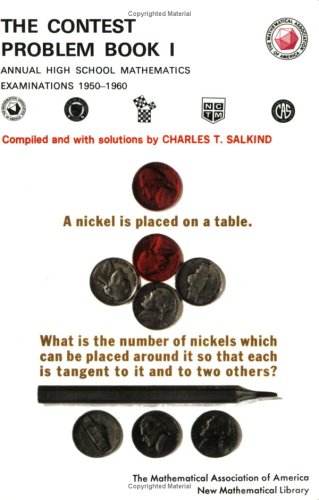
The Contest Problem Book I


Annual High School Mathematics Examinations 1950-1960

Charles T. Salkind

The Mathematical Association of America | 1975 | 160 páginas |  PDF | 4,2 Mb


djvu | 3,2 Mb


A great many students have participated annually in the Annual High School Mathematics Examination (AHSME) sponsored by the Mathematical Association of America (MAA) and four other national organizations in the mathematical sciences.* In 1960, 150,000 students participated from about 5,200 high schools. In 1980, 416,000 students participated from over 6,800 high schools.
Since 1950, when the first of these examinations was given., American high school students have tested their skills and ingenuity on such problem as:
The rails on a railroad are 30 feet long. As the train passes over the point where the rails are joined, there is an audible click. The speed of the train in miles per hour is approximately the number of clicks heard in how many seconds?
and many others, based on the high school curriculum in mathematics.

What Is Calculus About?

(New Mathematical Library)

Mathematical Association of America | 1962| 118 Páginas | PDF | 4,01 Mb

uploading.com
link

djvu - link

Whenever I teach calculus, my emphasis is always on the fact that the basic ideas of calculus can be understood by almost anyone. While I am not always successful in proving this to the students, Sawyer certainly would be. His explanations of the basics of a derivative are the clearest, most understandable that I have ever seen. There are many diagrams, and each one has a specific purpose and they are well integrated into the textual explanations.
This is not a book that you could use to teach a college calculus course. The mandatory epsilons and deltas that form the backbone of basic calculus are mentioned only as an incidental. Sawyer sets out to explain the foundation ideas of calculus in terms of everyday occurrences and for that reason it is better suited to someone who is curious about calculus. However, it could be used as a supplemental text in the foundations of science, as calculus is used in all areas of change, which describes almost all of nature.
While the notation of mathematics is concise, abstract and often appears esoteric, many of the ideas expressed in that notation are quite easy to follow. In this book, Sawyer explains what calculus is all about in terms that anyone who understands motion can follow. There needs to be more people like him writing books like this.

First Concepts of Topology

William G. Chinn, N. E. Steenrod

New Mathematical Library 

The Mathematical Association of America | 1966 | 160  páginas | PDF | 5,76 Mb

uploading.com
scribd.com

djvu - 1,6 Mb -
 link
link1

Our purpose in writing this book is to show how topology arose, develop a few of its elements, and present some of its simpler applications. Topology came to be recognized as a distinct area of mathematics about fifty years ago, and its major growth has taken place within the last thirty years. It is the most vigorous of the newer branches of mathematics and has been producing strong repercussions in most of the older branches. It got its start in response to the needs of analysis (the part of mathematics containing calculus and differential equations). However, topology is not a branch of analysis. Instead, it is a kind of geometry. It is not an advanced form of geometry such as projective or differential geometry, but rather a primitive, rudimentary form-one which underlies all geometries. A striking fact about topology is that its ideas have penetrated nearly all areas of mathematics. In most of these applications, topology supplies essential tools and concepts for proving certain basic propositions known as existence theorems.

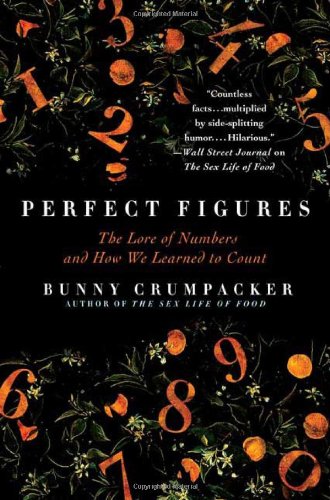
Perfect Figures: The Lore of Numbers and How We Learned to Count

Bunny Crumpacker

Thomas Dunne Books | 2007 | 288 páginas | epub | 295 kb

link
link1

Since the beginning of civilization, numbers have been more than just a way to keep count. Perfect Figures tells the stories of how each number came to be and what incredible associations and superstitions have been connected to them ever since. Along the way are some of the great oddities of numbers' past as:
-a time when finger-counting was a sign of intelligence (the Venerable Bede could count to a million on his hands)
-the medieval Algorists, who were burnt at the stake for their use of Arabic rather than Roman numerals
-the Bank of England, which stubbornly kept accounts on notched wooden sticks until 1826
Filled with Crumpacker's eloquent wit and broad intelligence, Perfect Figures brings the history of numbers to life just as Bill Bryson did for the English language in The Mother Tongue.

terça-feira, 12 de junho de 2012

Graphs and their Uses


Martin Gardner

The Mathematical Association of America | 1996 | 160 páginas | PDF | 4,04 Mb

scribd.com
uploading.com

Djvu -1,1 Mb
link direto
depositfiles.com
link

In 1963 Oystein Ore wrote this classic volume, which was published in the New Mathematical Library Series. This elegant book has provided students and teachers with an excellent introduction to the field of graph theory for close to thirty years. Robin Wilson's revision adds strength to the book by updating the terminology and notation, bringing them in line with contemporary usage. Wilson has added new material on interval graphs, the traveling salesman problem, bracing frameworks, shortest route problems, and coloring maps on surfaces. Most of the diagrams in the book have been redrawn.

Ingenuity in Mathematics


Ross Honsberger

The Mathematical Association of America | 1998 | 216 páginas | PDF | 5 Mb

link (pass: matav)

Djvu | 2,1 Mb

link direto
link
depositfiles.com


The nineteen essays here illustrate many different aspects of mathematical thinking. The author is very well-known for his best-selling books of problems; in this volume he seeks to share his appreciation of the elegant and ingenious approaches used in thinking about even elementary mathematics. Standard high school courses in algebra and geometry furnish a sufficient basis for understanding each essay. Topics include number theory, geometry, combinatorics, logic and probability, and the methods used often involve an interaction between these disciplines. Some of the essays are easy to read, others more challenging; some of the exercises are routine, others lead the reader deeper into the subject.